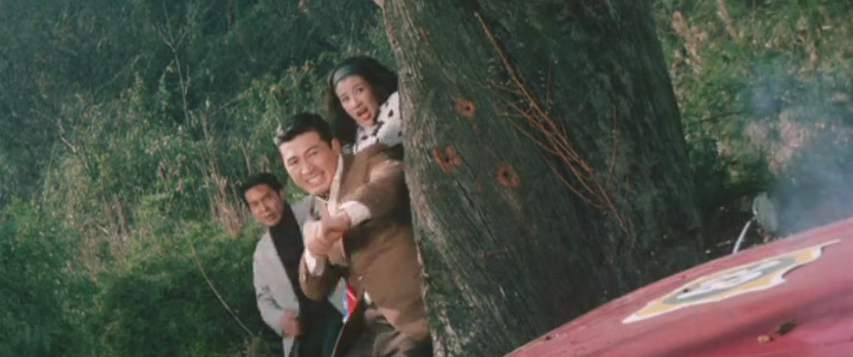
Golden Eyes (100発100中 黄金の眼, Jun Fukuda, 1968)

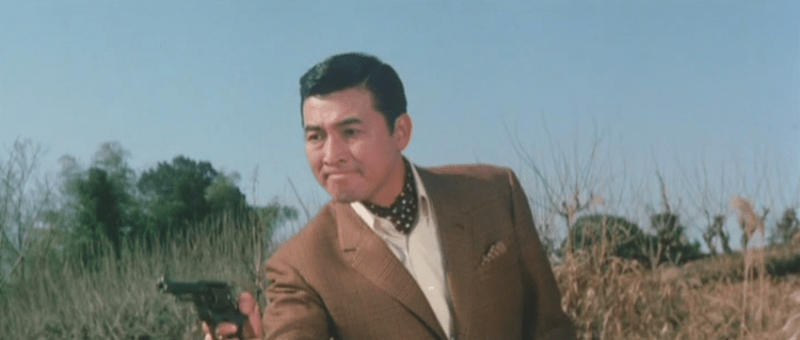
Three years after taking down illegal arms dealers, “Interpol” agent Andrew Hoshino (Akira Takarada) returns with another globetrotting adventure, this time concerning a missing coin worth a great deal to an amoral gold smuggler. Ironfinger had appeared in the midst of Bond-mania and boasted a script by none other than Kichachi Okamoto which was full of cartoonish fun and surreal humour as Andy made use of a series of spy gadgets to aid him in his cause. The similarly Bond-referencing sequel, Golden Eyes (100発100中 黄金の眼, Hyappatsu Hyakuchu: Ogon no Me) , attempts something much the same but perhaps without so much of Okamoto’s trademark sophisticated silliness. 

This time the action opens in Beirut where a chauffeur is being hunted by a man in a helicopter as he attempts to escape through the sand dunes. Skewered by a giant grappling hook, the driver’s body is apparently then deposited on the roof of a hotel, causing not a little embarrassment to gold smuggling kingpin Stonefeller (see what they did there?) who is already quite worried about attracting the attention of the local police. Meanwhile, Andy happens to be in Beirut on another “vacation”, having fun driving the owner of a shooting game in an arcade out of his mind before he runs into a little girl who tells him that she’s looking for an assassin to avenge the death of her father, the body deposited on the hotel roof. All she can afford to pay him is the silver dollar her dad gave her as a keepsake before he died, but it’s good enough for the kindhearted Andy who decides to get justice for the little girl no matter what. Just then, however, an attempt is made on his life by means of a bomb hidden in a bouquet given to him by pretty Japanese singer Mitsuko (Tomomi Sawa) who is in Beirut to find wealthy men to finance her love of rally car racing. 

The major antagonist is an ancient American “industrialist” with a dog called Sinbad who thinks that the gold must flow and that he’s doing a public service delivering it to Japan where its absence only highlights the “backwardness” of the Japanese state. Stonefeller is also blind but an ace sniper thanks to a directional microphone in place of a sight on his rifle. In any case, though Stonefeller is the kingpin, the true “villain” is Kurokawa (Yoshio Tsuchiya) who is responsible for the death of the little girl’s father, killed while thought to be in possession of the missing gold coin. The coin later makes villains of the two Beiruti gangsters working with Stonefeller who end up chasing after Kurokawa to try and retrieve it while Andy, mysterious “reporter” Ruby (Bibari Maeda), and earnest detective Tezuka (Makoto Sato) do their best to stop them. 

The international villainy may reflect a certain anxiety about Japan’s increasingly global role, rising economy prosperity, and relationship with the Americans, but it’s also a little guilty of exoticisation in its Middle Eastern setting with the majority of Beiruties played by Japanese actors in awkward brown face. An early, spectacular set piece sees Andy and Tezuka beset by Stonefeller’s goons swarming over the dunes dressed as mothers pushing prams which turn out to be fitted with machine guns while Andy sets up a complex stunt which sets off two abandoned weapons with a single pistol shot to take down the bad guys. 

Mitsuko, meanwhile, seems to be a symbol of out of control celebrity, an aspiring singer taking part in rally races sponsored by the Japan Economic Council dedicated to fuel efficiency. She is content to be discovered with a dead body because of all the free publicity it’s about to buy her, but more than holds her own when in a difficult situation with the amoral Kurokawa, perhaps a representative of unbridled capitalist greed. Almost blown up with flowers, encased in plaster like a giant mummy, and delivered poisoned gas by room service, Andy maintains an ambiguous cool while still making constant references to his dear French mama waiting for him at home in Paris. As expected, no one except for Tezuka has been quite honest about their intentions or identities, but it hardly seems to matter as they work together while pursuing their own angles to get their hands on the coin and stop the Stonefellers of the world messing around in their economy. 
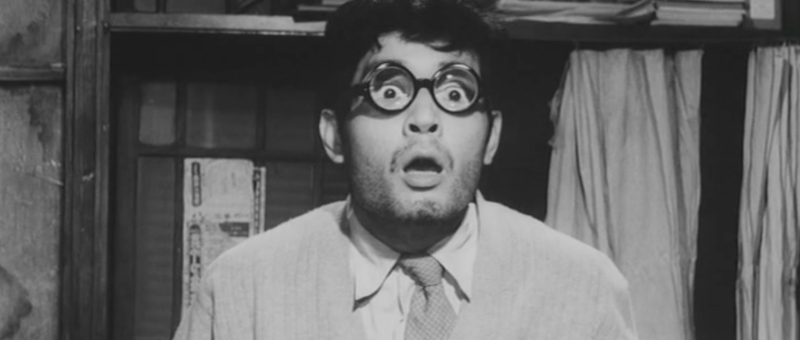

The Age of Assassins (殺人狂時代, Kihachi Okamoto, 1967)

“Hey, what’s going on around here?” a sidekick asks directly to camera at the conclusion of Kihachi Okamoto’s characteristically anarchic conspiracy-thriller-cum-spy-spoof The Age of Assassins (殺人狂時代, Satsujinkyo Jidai). Sparked by Bond mania, the late 1960s saw a marked trend in B-movie espionage parody though Okamoto’s take on the genre is darker than the norm even if embracing his trademark taste for absurdist humour leaving us wondering who our hero really is and which side, if any, he’s really on in the confusing geopolitical realities of 1967 Japan. 

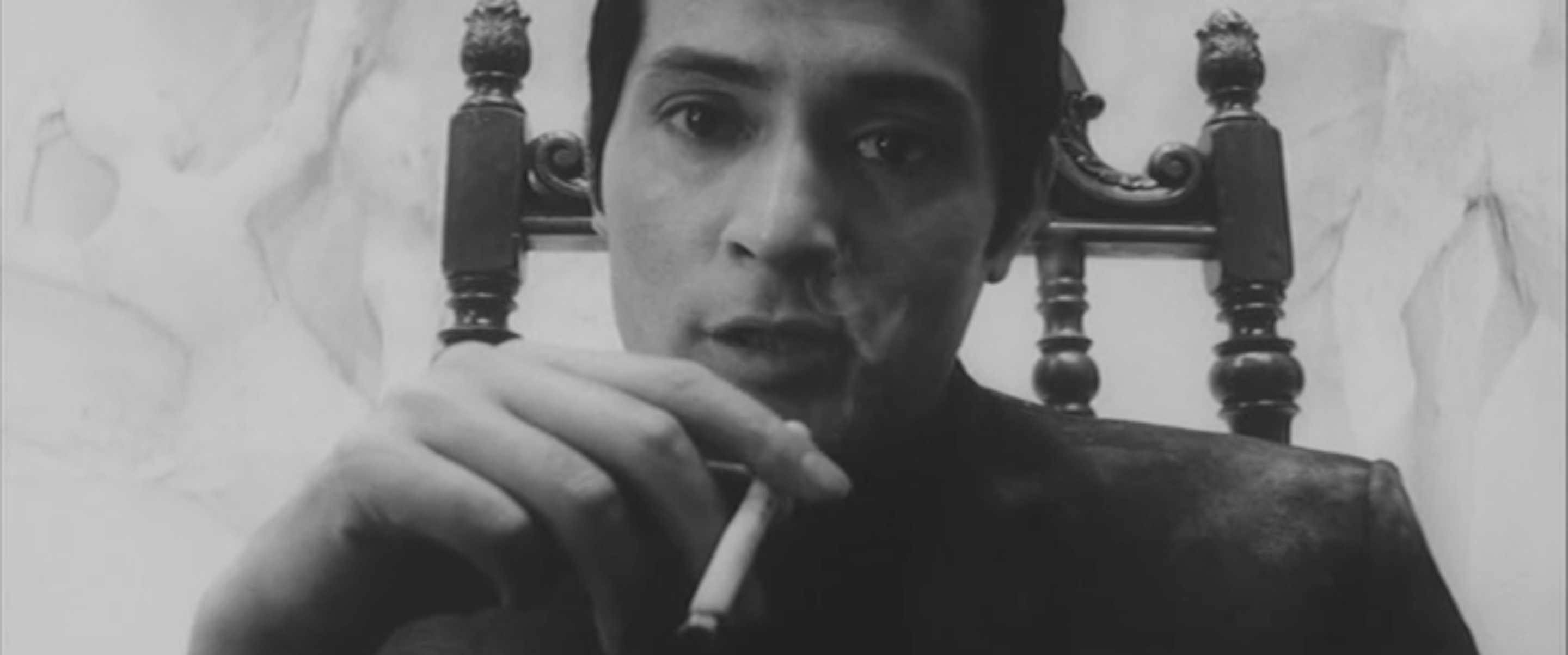
As we first meet him, the hero is bumbling professor of criminal psychology Shinji Kikyo (Tatsuya Nakadai) who has extreme myopia and a persistent case of athlete’s foot not to mention a prominent mother complex. Unbeknownst to him, he’s one of three targets picked not quite at random by Rudolf von Bruckmayer (Bruno Lucique), former Gestapo chief, who is interested in hiring some assassins trained by the megalomaniac psychiatrist Mizorogi (Hideyo Amamoto) who’s been turning his mentally distressed patients into hyper-efficient killing machines (sometimes literally) under the rationale that all great men throughout history have been in a certain sense “crazy”. Mizorogi is also in charge of a eugenicist project titled “The Greater Japan Population Control Council” which believes that Japan is already overpopulated but they have to ensure that “the lives of people who might become useful in the future must not be destroyed before they’re born.” Therefore, “the people who will be useless should be asked to bow out”, the assassin calmly explains shortly before Shinji is saved by the divine energy of his late mother as her bust falls from a shelf and knocks the killer out. 

The central conceit plays into a real anxiety about the post-war baby boom expressed in earlier films such as Yuzo Kawashima’s Burden of Love while attacking the capitalistic philosophy that regards some people as more useful than others. By the late 1960s, Nazis had begun to make frequent appearances in these kinds spy spoofs as comedy villains usually crazed to the point of being little real threat. Mizorogi too is eventually exposed as exalting the “mad” interested more in the art of chaos and the impulse to murder than in any greater political goal. Indeed, the central MacGuffin turns out to be less to do with a grand conspiracy to create some kind of super society than the very B-movie-esque missing diamond known as Cleopatra’s Tear.

Okamoto piles each of these subplots one on top of the other as if he were making it up as he goes along suddenly undercutting what we thought we knew with an unexpected reversal. Shedding his glasses and shaving his scraggly beard, Shinji shifts from myopic professor to suave super agent using profiling and psychology to stay one step ahead while encountering plots by spiritualist cults, overly cheerful self defence force officers in the middle of training exercises, and eccentric assassins. From a modern standpoint, it might seem uncomfortable that each of the killers is manifesting disability in order to seem non-threatening, a female operative concealing a deadly weapon behind an eyepatch, while her poetry-obsessed colleague stores his in a fake crutch, but then again they are each pawns of a game being played by the crazed Mizorogi. Aided by female reporter Keiko (Reiko Dan) and car thief sidekick Otomo Bill (Hideo Sunazuka), Shinji seems to bumble from one bizarre episode to another but may actually be far more in charge of the situation than we might have assumed. 

Among the most visually striking of Okamoto’s late ‘60s pictures and once again making great use of animation, Age of Assassins features high concept production design, Mizorogi’s asylum lair a maddening corridor of Omega-shaped passages with ornate cell bars on either side behind which we can see a room full of men often engaged in what seems to be a military exercise regime while the plaster effigies of human form seem to be bursting from the walls. As in all of Okamoto’s films the central message lies in the absurdity of violence suggesting in a sense that the dog-eat-dog ethos of contemporary capitalist consumerism is in itself a kind of internecine madness countered only by Shinji’s rather childish mentality crafting his various gadgets out of household objects while attacking this elitist individualism with nothing more sophisticated than a vegetable peeler. 


Original trailer (no subtitles)

Kill! (斬る, Kihachi Okamoto, 1968)

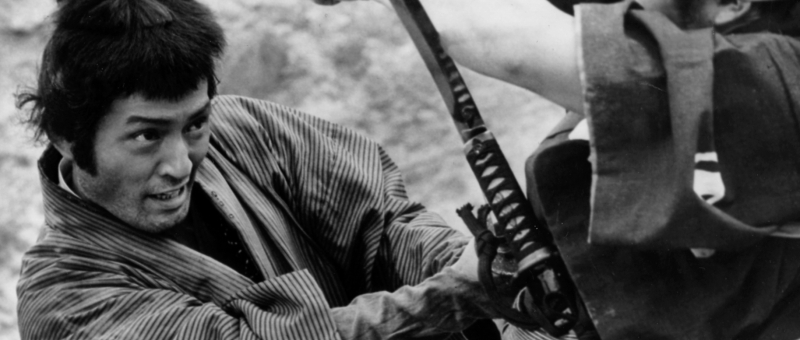
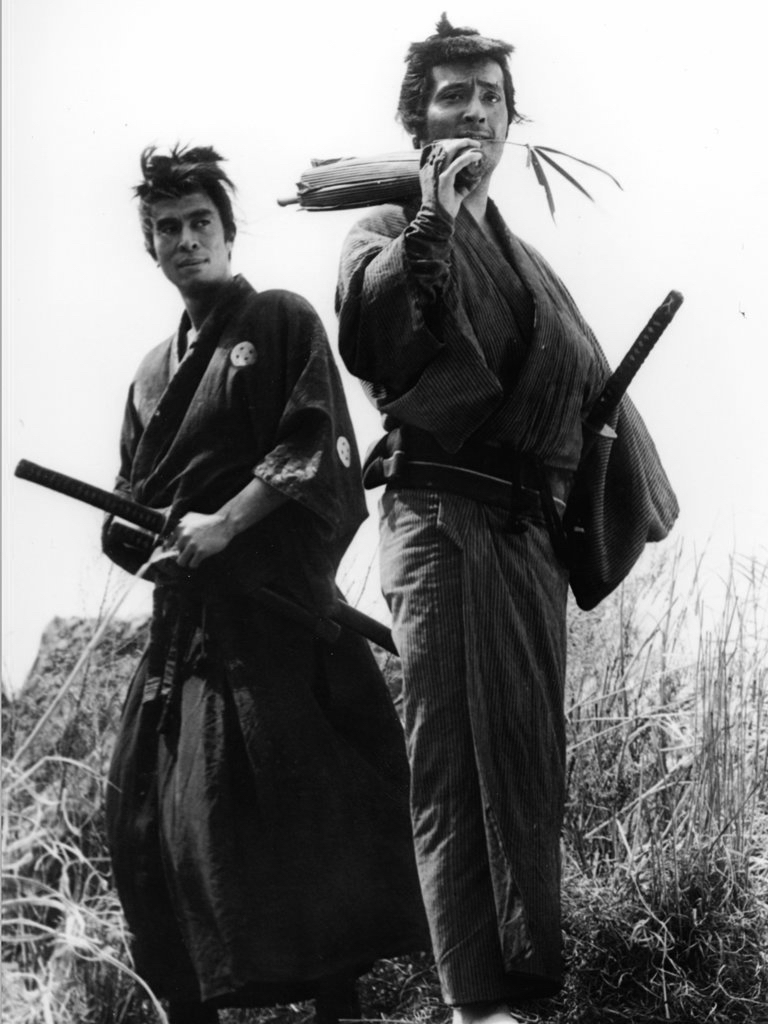
“Samurai aren’t as great as you might think” according to a jaded retainer in Kihachi Okamoto’s Kill! (斬る, Kiru) but it’s a message that the ambitious farmer at the film’s centre struggles to take in. Having been a victim of samurai violence he resolves to become a samurai while a former samurai turned yakuza drifter attempts to show him the hypocritical realities of the samurai life as they find themselves swept into local intrigue when a band of young revolutionaries arrive to cut down a corrupt and oppressive lord. 

Corrupt and oppressive is perhaps the defining image of the samurai in post-war cinema, but like the film’s title that cuts both ways. Farmer Tabata (Etsushi Takahashi) sold his lands to buy a sword after witnessing peasants cut down during an uprising but he’s decided the best way out of oppression is to become an oppressor and is dead set on achieving samurai glory through the time-honoured method of distinguishing himself in battle. That may prove a little difficult given that his new boss, Ayuzawa (Shigeru Koyama), immediately mocks him for swinging his sword as if it were a scythe. Then again as former samurai Genta (Tatsuya Nakadai) explains to him, if you don’t know what you’re doing you can always just stab people which at the end of the day does rather undermine the idea of samurai elegance in the art of killing. 

Genta keeps trying to tell Tabata that “samurai are no good” but Tabata still wants to be one anyway even after learning that Ayuzawa means to double cross them, hiring ronin to take out the young samurai whose sense of honour he manipulated to eliminate the admittedly corrupt (but aren’t they all?) lord for his own political gain while planning to send in his retainers to finish off the job to ensure there are no witnesses. Genta gave up his samurai status because he was “disgusted” by just this sort of duplicity along with the meaningless codes of loyalty that govern samurai society and caused him to betray a friend who was acting only in the interests of justice. Leader of the ronin Jurota (Shin Kishida) did something similar though in his case for love when his fiancée’s father was condemned on false charges and she and her mother exiled. He wants not land or status but only money in order to redeem the woman he loves from a geisha house and like Genta is under no illusions about the nature of samurai life having figured out most of what’s going on but hoping to emerge with the means to liberate both himself and his wife from samurai oppression. 

Even the elderly chamberlain later rescued by Genta tries to warn Tabata that the samurai life isn’t all it’s cracked up to be, hinting at the ways they are also oppressed by their own code while clearly gleeful to have had the opportunity of stepping into a teahouse for the first time responding to Genta’s request to stay put that if he could he’d like to stay put for the rest of his days. Both former samurai, neither Genta nor Jurota are minded to draw their swords knowing that whatever the outcome it would be unhappy while the young who thought it was their duty to change the world by removing one who brought shame on their names are faced with the realisation that they have been used and their resistance will count for nothing. Even their bond as brothers banding together to achieve a common goal is eventually disrupted by alcohol and petty jealousy.

Genta acts as a kind of chorus, touched by the naivety of the seven samurai holed up in a mountain lodge because they believed in justice, while knowing that the society itself is innately unjust and already beyond redemption. Tabata eventually comes to a similar conclusion having gained samurai status but found it quite literally uncomfortable deciding to shake off his newfound nobility and rejoin Genta as a cynical yet pure hearted wanderer because the only way to escape samurai oppression is to actively live outside it. The final irony is that it’s the elderly chamberlain who eventually sets him, and all they women trapped in indentured servitude at the geisha house, free using samurai gold to enable them to escape a system he himself cannot escape but does not exactly support while Genta enlists the help of local peasants to hold a festival of rebellion to cover the final assault. Marked by Okamoto’s characteristically absurd humour and cartoonish composition along with the eerily gothic emptiness of the deserted ghost town where not even yakuza can survive the film takes on a quasi-spiritual dimension in which Genta and the gang eventually walk out of hell if only into a purgatorial freedom. 


Kill! screens at Japan Society New York on Sept. 2 as part of the Monthly Classics series.

Original trailer (no subtitles)