Blue Period (ブルーピリオド, Kentaro Hagiwara, 2024)

An ennui-ridden teen finds the world opening up to him after he discovers the power of art yet fears he can’t live up to his new epiphany in Kentaro Hagiwara’s adaptation of the manga by Tsubasa Yamaguchi, Blue Period (ブルーピリオド). Less about art itself, the film presents its hero with the cowardice of conformity, challenging him above all to know himself and wield his selfhood like a weapon in a world that can at times be unforgiving.

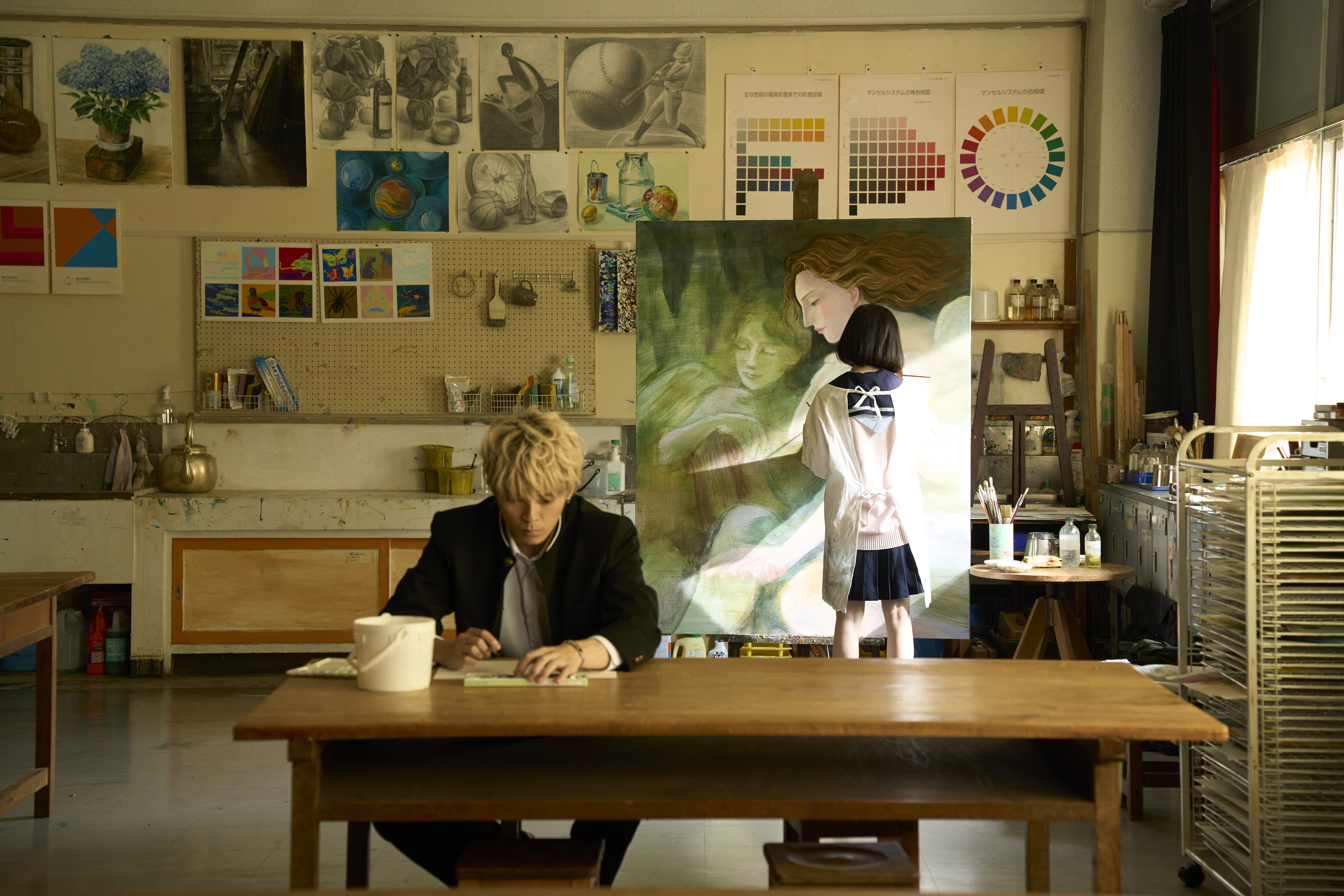
Even so, Yatora (Gordon Maeda) is a model student who gets good grades and is known for being well-mannered but secretly he’s filled with emptiness and has largely been just going through the motions. In his opening voice over, he relates that he does what he has to do, but declares himself unfulfilled and directionless. Unexpectedly captivated by a fellow student’s painting, he’s confronted by the power of art and the freedom it offers vowing to get into prestigious art school Tokyo University of the Arts.

The constraints he feels are partly economic in that his parents can’t afford a private university so he has to do his best to get into a public arts school while his mother seems dead against the idea of him going into the arts because it doesn’t put food on the table. Yatora parrots back similar lines describing art school as a pointless waste of time but is quickly taken to task by fellow student Yuka (Fumiya Takahashi) who challenges his tendency towards conformity and needles him into independent thoughts and action.

Yuka is also contrained by conservative social codes in that she dresses in a female uniform though many still call her by her male name, Ryuji. Though the pair have a rather spiky relationship, it’s Yuka’s attempts to challenge him that bounce Yatora towards discovering his true self which as it happens is done through embracing his least palatable elements. As Yuki correctly observes, his good boy persona and tendency towards hard work are just masks for his inner insecurity.

Yet as he’s also told, art isn’t just about talent but requires passion and tenacity which in its way makes it a perfect fit for Yatora’s hard-working nature as he buckles down to become a promising artist in the run up to his high school exams. As he later reflects, others may be more talented than him but they can’t make the things that he makes because the point is they come from himself. His early pieces are criticied for their superficiality, that he only sees what’s directly in front him rather than learning to see the world in other, more unique ways and engage with it on an individual level but through his artistic journey he discovers new ways of seeing along with his true self in all its complexity. 

His newfound desire to follow his heart places him at odds with prevailing social codes which favour the sensible though it also spurs others on to do the same, one of his best friends deciding to become a pastry chef rather than get a regular salaryman job hinting at a greater desire for personal fulfilment among the young. Often poetic in his imagery such the sparks that fly from Yatora’s nascent artwork or the comforting blue of the Shibuya twilight that becomes his safe space, Hagiwara sometimes paints Yatora’s quest like a shonen manga with a series of bosses to beat in Yatora’s various rivals and challenges most which teach him something about himself that spurs him on to continue chasing his artistic dreams while the exams themselves are also mental exercises of strategy and thinking outside the box to unlock a particular kind of self-expression. There is something quite refreshing, however, in the fact that Yatora’s only real rival is himself in his ongoing quest for skills and self-knowledge, earnestly applying himself to master his craft eager only for the places his artistry will take him both mentally and physically and no longer so dissatisfied with the world around him but filled with a new curiosity and the confidence in himself to continue exploring it.


Blue Period screened in New York as part of this year’s JAPAN CUTS.

Original trailer (English subtitles)

Follow the Light (光を追いかけて, Yoichi Narita, 2021) [Fantasia 2021]

“We all want to run, but still we’re holding on” insists the hero of Yoichi Narita’s rural coming-of-age tale, Follow the Light (光を追いかけて, Hikari wo Oikakete). Not perhaps as its title implies a religious treatise, Narita’s gentle drama nevertheless chases faith in the future while exploring the effects of rural depopulation, economic stagnation, and familial fragmentation on the lives of the young but eventually rediscovers a sense of security, not to mention wonder, in the natural world along with the importance of community in creating a feeling of emotional rootedness. 

Teenager Akira (Tsubasa Nakagawa) has just moved back to his dad’s hometown following the divorce of his parents, his mother presumably having left the family. As one might expect he is sullen and resentful, wishing a meteor storm would destroy his new home and drawing violent comic books to that effect. He ignores everyone at school and is uninterested in making friends, continuing to view himself as an outsider who is not destined to stay. This feeling is compounded by the fact that the school itself is about to close down due to the declining numbers of children in the local area as a result of rural depopulation. 

Akira’s interest is piqued, however, on witnessing a mysterious girl standing atop the roof of a farm house and surveying all below. Accidentally making friends with a bullied boy, Shota, Akira discovers the girl’s name is Maki (Itsuki Nagasawa) but is warned off her on the grounds that she is “crazy” and potentially violent. Akira ignores the warning, but is in any case guided towards the ostracised young woman by a mysterious light said to be caused by a UFO which leads him towards a crop circle in a rice paddy in the middle of which Maki is currently lying.

As Akira discovers, Maki has problems of her own in that her parents are in the middle of a debt crisis and about to lose the small petrol station they’ve been running as a family business. They are in fact just one of many casualties in the faltering local economy which is in a constant state of recession given that the young people all leave for the cities and there’s precious little money to be made in farming anymore. Akira’s father Ryota (Taro Suruga) went to Tokyo to be a musician, an ambition which obviously did not work out, and now he’s come back works for an organisation attempting to find solutions for the future of agriculture in an effort to bring prosperity back to the countryside. Akira’s teacher, Michiru (Rina Ikoma), by contrast who will soon be out of a job is disinterested in her work partly because she left to go to uni in Tokyo but was dragged back by parental pressure and remains intensely resentful trapped in a backwater provincial life quite clearly not of her choosing. 

It wasn’t of Akira’s choosing either and on top of dealing with the disruption of his parents’ separation he feels himself displaced as a city kid unused to the gentle rhythms of country life while struggling to understand the impenetrable local dialect. He originally does nothing on witnessing Shota’s bullying but later befriends him only for their friendship to be derailed by petty jealously in Shota’s resentment towards his growing interest in Maki. Maki, meanwhile, is also struggling with a sense of abandonment largely cared for by her down-to-earth farmer uncle in the wake of parental failure. Akira may originally feel the same way about his boomerang dad, returning home to live with grandma having failed in the city, but later perhaps comes to understand that return is not necessarily defeat while gradually warming to the joys of the country life with its wide-open vistas and kindhearted locals. 

Even so there’s a sense of desperation in these young lives as they watch their world dismantled in front of them as symbolised in the imminent closure of their school. Guided by lights they decide to look towards the future, positing a new sense of community open to anyone willing to be a part of it. As if echoing the sound of the Earth, Maki accepts her parental legacy in continuing to sing a traditional rural folksong once sung by her mother while Akira discovers a new sense of belonging in his father’s latent love for his old hometown. A hymn to a disappearing small-town Japan, Follow the Light is less lament than resurgent hope that something can be saved if only in change.


Follow the Light streamed as part of the 2021 Fantasia International Film Festival

Original trailer (English subtitles)

We Are Little Zombies (ウィーアーリトルゾンビーズ, Makoto Nagahisa, 2019)

Little Zombies poster“Reality’s too stupid to cry over” affirms the deadpan narrator of Makoto Nagahisa’s We Are Little Zombies (ウィーアーリトルゾンビーズ), so why does he feel so strange about feeling nothing much at all? Taking its cues from the French New Wave by way of ‘60s Japanese avant-garde, the first feature from the award winning And So We Put Goldfish in the Pool director is a riotous affair of retro video game nostalgia and deepening ennui, but it’s also a gentle meditation on finding the strength to keep moving forward despite all the pain, emptiness, and disappointment of being alive.

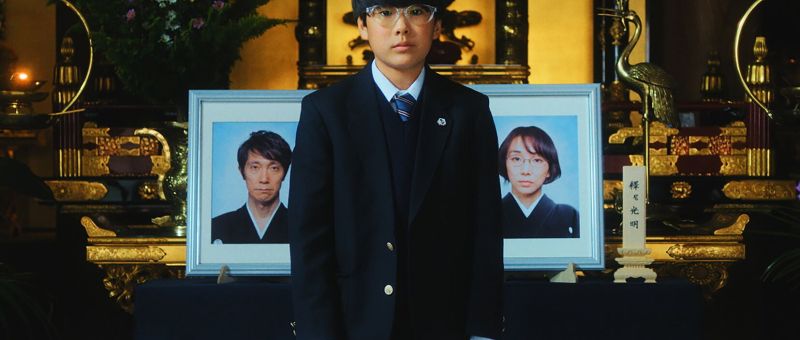
The “Little Zombies”, as we will later discover, are the latest tween viral pop sensation led by bespectacled 13-year-old Hikari (Keita Ninomiya). Recounting his own sorry tale of how his emotionally distant parents died in a freak bus accident, Hikari then teams up with three other similarly bereaved teens after meeting at the local crematorium where each of their parents is also making their final journey. Inspired by a retro RPG with the same title, the gang set off on an adventure to claim their independence by revisiting the sites of all their grief before making themselves intentionally homeless and forming an emo (no one says that anymore, apparently) grunge band to sing about their emotional numbness and general inability to feel.

Very much of the moment, but rooted in nostalgia for ages past, Little Zombies is another in a long line of Japanese movies asking serious questions about the traditional family. The reason Hikari can’t cry is, he says, because crying would be pointless. Babies cry for help, but no one is going to help him. Emotionally neglected by his parents who, when not working, were too wrapped up in their own drama to pay much attention to him, Hikari’s only connection to familial love is buried in the collection of video games they gave him in lieu of physical connection, his spectacles a kind of badge of that love earned through constant eyestrain.

The other kids, meanwhile, have similarly detached backgrounds – Takemura (Mondo Okumura) hated his useless and violent father but can’t forgive his parents for abandoning him in double suicide, Ishii (Satoshi) Mizuno) resented his careless dad but misses the stir-fries his mum cooked for him every day, and Ikuko (Sena Nakaijma) may have actually encouraged the murder of her parents by a creepy stalker while secretly pained over their rejection of her in embarrassment over her tendency to attract unwanted male attention even as child. The kids aren’t upset in the “normal” way because none of their relationships were “normal” and so their homes were never quite the points of comfort and safety one might have assumed them to be.

Orphaned and adrift, they fare little better. The adult world is as untrustworthy as ever and it’s not long before they begin to feel exploited by the powers intent on making them “stars”. Nevertheless, they continue with their deadpan routines as the “soulless” Little Zombies until their emotions, such as they are, begin inconveniently breaking through. “Despair is uncool”, but passion is impossible in a world where nothing really matters and all relationships are built on mutual transaction.

Mimicking Hikari’s retro video game, the Zombies pursue their quest towards the end level boss, passing through several stages and levelling up as they go, but face the continuing question of whether to continue with the game or not. Save and quit seems like a tempting option when there is no hope in sight, but giving in to despair would to be to let the world win. The only prize on offer is life going on “undramatically”, but in many ways that is the best reward one can hope for and who’s to say zombies don’t have feelings too? Dead but alive, the teens continue their adventure with heavy hearts but resolved in the knowledge that it’s probably OK to be numb to the world but also OK not to be. “Life is like a shit game”, but you keep playing anyway because sometimes it’s kind of fun. A visual tour de force and riot of ironic avant-garde post-modernism, We Are Little Zombies is a charmingly nostalgic throwback to the anything goes spirit of the bubble era and a strangely joyous celebration of finding small signs of hope amid the soulless chaos of modern life.


We Are Little Zombies was screened as part of the 2019 Nippon Connection Film Festival.

Original trailer (English subtitles)

Makoto Nagahisa’s short And So We Put Goldfish in the Pool

Music videos for We Are Little Zombies and Zombies But Alive