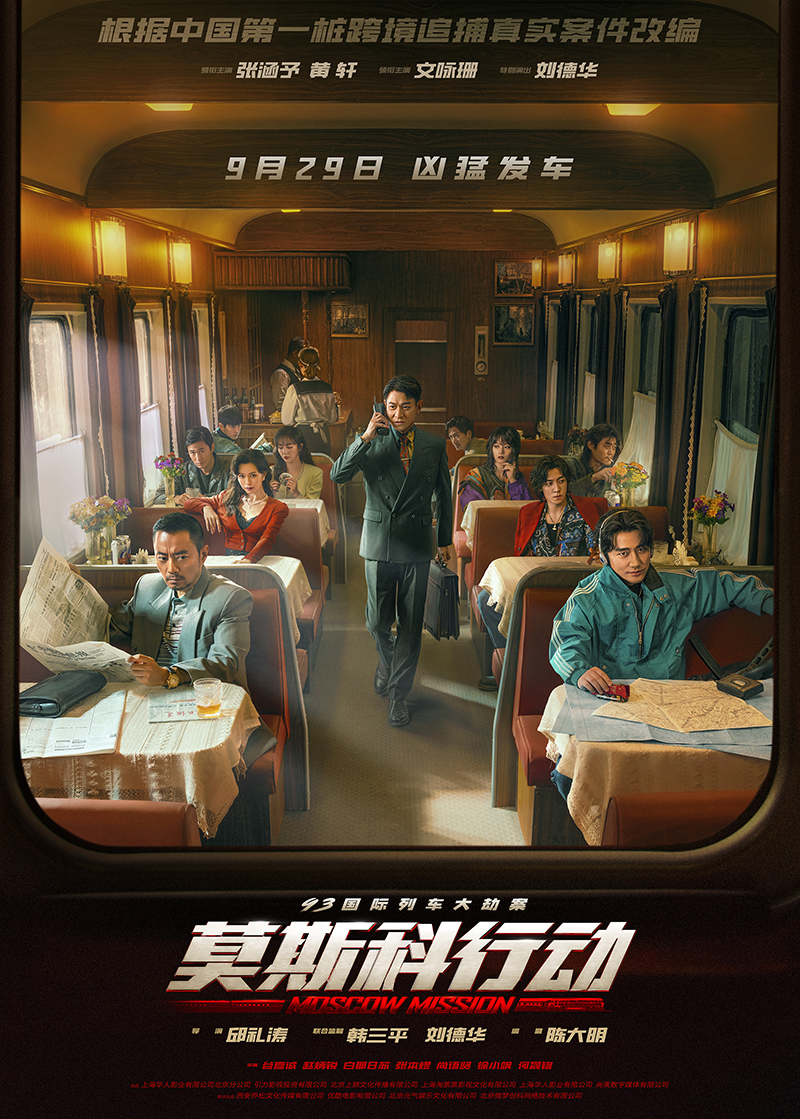
Moscow Mission (93国际列车大劫案:莫斯科行动, Herman Yau, 2023)

In the early 1990s, China and Russia were each struggling to accommodate new political and economic realities. This is at least one reason offered in explanation for the nexus of crime that overtook the long distance train connecting the two capitals in Herman Yau’s action drama Moscow Mission (93国际列车大劫案:莫斯科行动, guójì lièchē dà jié àn Mòsīkē xíngdòng). Inspired by a real life train heist in 1993, the film suggests that China was pulling ahead free of the labour protests which appear frequently in Moscow amid the collapsing Russian economy but equally insists that the bandits must be stopped because they not only endanger China’s international reputation but its trading relations with the former Soviet Union.

In truth there’s no real reason given for the mysterious D’s (Huang Xuan) heinous crime spree save a later allusion to a troubled childhood and the sudden death of his sensitive musician father when he was only 13 (which would put it shortly before the end of the Cultural Revolution). In any case, those around him have more complex motivations such as those of Zhenzhen (Janice Man Wing-San), a former sex worker employed by the gang to identify wealthy passengers and inform the rest of the crew by note, who needs the money for a sick relative. In any case, nearly everyone on this train is concealing vast amounts of hard cash, mostly in their underwear. Not content with the money, D also stops to rape a woman who had resisted but was found with a large amount of money stuffed in her bra. 

In short, there’s nothing noble about D’s gang or any implication they’re rebellious outlaws just thuggish crooks taking advantage of a geopolitical vulnerability. Local fixer Vasily (Andy Lau Tak-Wah), however, is otherwise depicted as a victim of circumstance cruelly separated from a then newborn daughter for whom he is continually searching. He made his money digging a tunnel from Shenzhen to Hong Kong and using it to smuggle luxury goods in much the same way many now use the train as is evident by the scenes at Russian station when passengers suddenly start leaning out windows flogging pairs of jeans. Vasily’s in on that trade too, as well attempting to broker a deal for a wealthy man to buy a former Soviet fighter jet, but seems unhappy with his life of petty crime selling fake passports to dodgy people and also has an ongoing non-romance with Zhenzhen who is trapped in an abusive relationship with D’s brother-in-arms Zhiwen (Jason Gu Jiacheng). 

Intense police captain Cui (Zhang Hanyu) is dispatched to catch the train robbers and avenge China’s international reputation by bringing order to the train but also stumbles on another crime in progress in the Russian capital. He has an opposite number in Sergey (Andrey Lazarev), a former KGB now FSB officer who hints at a new world order if also at a society very much in flux. In some ways the film suggests Cui’s inevitable victory is aided D’s hubristic overreach and the cooperation of the Russians rather than his own powers as a Chinese policeman, but also that China will clean up after itself taking down a Chinese gang while technically on foreign soil and making sure they return to China for justice. 

Yau opens strong with the high impact sequence of the original heist as the camera first pans along the inside of the train before finding Zhenzhen and then rest of the gang, while otherwise continuing to escalate the action with a climax at an abandoned rocket base and then a final shootout at the train depot where the carriages must quite literally change the gauge to shift from the old Soviet railways to the modern China. The gang members may implicitly be among those who’ve lost out in the face of new economic realities, though aside from D’s possibly duplicitous musing on the life he might have led if his father had not died leaves them little justification for the cruelty of their crimes. Meanwhile, Cui’s justice is not implacable, taking pity on both Zhenzhen and Vasily and promising to treat them fairly in acknowledgement of their cooperation as opposed to D who had problematic gang members bumped off by the possibly the worst hitman in Moscow and has been using Vasily’s daughter to manipulate him for last few years with no certainly that he actually knows where she is. Making a minor point about empty consumerism in the constant references to stolen watches, Yau goes big on spectacle but also homes in on the smaller stories of trauma and displacement that eventually provoke it.


International trailer (Simplified Chinese / English subtitles)

Flaming Cloud (三贵情史, Liu Siyi, 2023)

Regrets can turn into curses too, according to a melancholy middle-aged woman in Lin Siyi’s beautifully designed romantic fable, Flaming Cloud (三贵情史, Sānguì qíng shǐ) The English title refers to the deaths of gods and goddesses and a physical harbinger either of the joy of reunion or the sorrow of parting. Of course, in one way it’s all the same, every hello is also a goodbye and a curse can also be a blessing depending on how you look at it. 

As the narratorial voiceover explains, the heavens is where all of this starts as bored gods in a casino on a cloud place bets on the lives of mortals. A young woman approaches and places a wager on the existence of true love which is immediately countered by the bar’s musician. To carry out the wager, the gods decide to curse the then baby Sangui that anything he kisses will fall into a deep sleep until he kisses his one true love. 

A kind of reverse sleeping beauty, the film follows Sangui’s path through a fairytale world where he meets various others suffering in similar ways to himself but is otherwise regarded as an outcast because of unusual ability to put people to sleep. A young woman, Yuyu (Zhou Ye), who thinks he might be her prince, introduces him to a “witch” who promises to cure his curse if only he’ll treat her chronic insomnia in which he’s had not a drop of sleep in the last 12 years. What he discovers is that she is not a witch at all but the faded star, Yuexin (Yao Chen), who tells him that she cannot cure his curse for there is nothing really wrong with him and some might even see his ability as a gift, especially those like her who have trouble sleeping. 

Yuexin’s insomnia is born of past regret and the pain of lost love. She can’t sleep because she lacks the courage to face her past, while Sangui too is afraid unable to search for the girl he believes to be his one true love whom he met in childhood in case she has forgotten him or like everyone else regards him as a “freak”. Yuexin warns him that if he never gains the courage to look for Tingting (Zhou Yiran) he may regret it in time and that regret could become its own kind of curse. But in the fairytale society of White Stone he discovers only more prejudice and cruelty, stumbling on a hidden factory staffed by enslaved workers who describe themselves as being, like him, “freaks” unlikely to be missed by the world above. The villain is an exploitative factory owner whose business model is dependent on their forced labour though a mysterious ally has been helping them by smuggling medicine through the steampunk pipes that puncture their environment. They alone stand up to the factory owner, insisting that the workers are “no different” from themselves and defiantly resisting the authoritarian austerity of a wicked stepmother turned capitalist fat cat. 

But the film’s Chinese title reminds that this is a story of Sangui’s love and whether his curse can be lifted or not. Yuexin realises that the choice she made may have been mistaken, while the musician who bet against the existence of true love later admits he did so because he knows it’s real but the reality is painful for him or else he just wanted to see it proved and send a message to his own lost love that they would one day meet again. Even so, that doesn’t necessarily mean there will be a happy ending. The course of true love is always bittersweet and whichever way you look at it destined to end in a farewell though that doesn’t mean it isn’t worth following and not doing so out of fear is as Yuexin discovered only to suffer from the curse of regret. Featuring exquisite production design from the opening animation to the whimsical fairytale town gleefully melding eras from Yuexin’s flapper-esque costuming to the 1950s aesthetic of the factory owner’s wife and the steampunk quality of factory itself, Lin Siyi’s charming romantic fable is as much about middle-aged regret for the forgotten dream of love as it is about finding the courage to seek it out no matter the risk. 


Flaming Cloud screened as part of this year’s New York Asian Film Festival

Original trailer (English subtitles)

A Better Tomorrow 2018 (英雄本色2018, Ding Sheng, 2018)

better tomorrow 2018 posterIn the history of Hong Kong cinema, there are few films which could realistically claim the same worldwide influence as John Woo’s 1986 landmark A Better Tomorrow. Commissioned by Tsui Hark, the then jobbing director Woo was tasked with creating a vehicle for a veteran Shaw Brothers star. Casting Cantopop idol Leslie Cheung and TV sensation Chow Yun-fat, Woo mixed traditional melodrama with hyper masculine emotionality to give birth to what would become the “heroic bloodshed” genre which was to dominate the island’s cinematic output well into the ‘90s. A Better Tomorrow, as its title implies, is the perfect evocation of its era and among the first to express an oncoming anxiety for Hong Kong’s “return” to China then only a decade away. Slick and oozing with ‘80s, macho cool, Woo’s film captured the imaginations of young men everywhere who suddenly took to wearing sunglasses and trench coats while chewing on match sticks, dreaming dreams of heroism in a sometimes gloomy world.

Which is all to say, attempting to “remake” Woo’s masterpiece may well be a fool’s errand. It is however one which has been frequently attempted, not least by Wong Jing in 1994 and Song Hae-sung in Korea in 2010. Korean cinema has perhaps become the heir of heroic bloodshed with its inherent love of melodrama which often finds its way into the nation’s bloody gangster epics whose generally high level of homosocial bonding is perfectly primed for male honour drama. Ding Sheng, apparently a huge fan of the original Hong Kong hit, brings the tale north to the Mainland, relocating to Qingdao which serves as a trading post for the drug running route from Japan.

As in the original we have two biological brothers – Kai (Wang Kai), a “sailor” who has fallen into smuggling to support his family who are unaware of his criminal occupation, and Chao (Ma Tianyu) – a rookie policeman. Meanwhile, Kai also has a criminal “brother” in his younger partner Mark (Wang Talu), an orphaned hothead from Taiwan. Kai is a “noble” smuggler who refuses to traffic drugs but a Hong Kong triad boss is hellbent on fishing out his Japanese contacts and after a job goes wrong, Kai ends up getting shot and arrested by his own brother who is heartbroken to discover the truth. Spending three years in prison during which time Kai’s father is killed in a raid on their home by gangsters looking for info on the Japanese, Kai tries to go straight but finds himself pulled back into the underworld after coming into conflict with villainous gangster Cang (Yu Ailei) who has taken over the Japan route (and forced Kai’s old girlfriend into prostitution after getting her hooked on drugs).

Ding’s film, while replicating the plot of Woo’s original, attempts to bring it into the “modern” era in which the stylised, manly melodrama of the ‘80s action movie has long since been replaced by a finer desire for “uncool” realism. Ding does not seem to be making a particular point about modern China, other than in persistent economic inequality which has forced an “honest” man like Kai into a life of crime for the otherwise honourable reason of taking care of his family. Though this itself maybe a subtle reference to the post-90s world, the major anxiety seems to be more with cross cultural interactions and possible pollution of “good” Chinese men like Kai who have been led astray by the false promises of, for example, gangsters from Hong Kong, and the old enemies in Japan. Interestingly enough, the relationships themselves are formalised and superficial. In Japan Kai and Mark are entertained in a “super Japanese” bar of the kind which only tourists frequent, decked to the ceilings with cherry blossoms and staffed with “geisha” girls, while in China they take their guests to a bar which has Peking Opera going on in the background as entertainment.

Kai is fond of telling his sworn brother that everything in the world may change, but brotherhood remains the same. This turns turn out to be an ironic comment in that his natural brother, Chao, disowns him in shame and loathing after his release from prison. Nevertheless, Kai never gives up striving for Chao’s approval even whilst reuniting with Mark who has been crippled and reduced to cleaning boats at the harbour after trying to exact revenge for Kai’s betrayal. The trio’s manly honour code is thrown into stark relief by the amoral Cang who, claiming that “the world has changed” and loyalty no longer means anything, thinks nothing of shooting anyone and everyone who stands between himself and financial gain. If Ding has a comment to make, it’s that the traditional ideas of brotherhood, loyalty, justice and goodness are being eroded by the lure of foreign gold promised by corruption, exploitation, and an absence of morality.

Ding isn’t trying to match Woo’s grand sweep of tragic inevitability so much as aiming for straightforward crime drama but his occasional concessions to melodrama never quite gel with his otherwise gritty approach, nor do his unsubtle his homages to the original film which find Leslie Cheung’s iconic theme song becoming a frequent musical motif as well as prominently featuring at an ultra cool hipster bar located in a disused boat which plays his record on a turntable with a large picture of a grinning Chow Yun-fat behind it. A Better Tomorrow 2018 succeeds as a passible action drama, but one without the heart and soul that made Woo’s original so special. 


Screened at the 20th Udine Far East Film Festival.

Original trailer (English subtitles)