Er Woo Dong: The Entertainer (어우동, Lee Jang-ho, 1985)

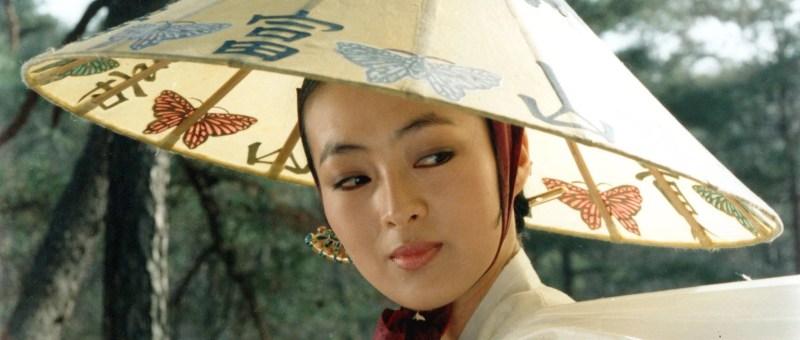
“The commoners get to have all the fun” a lady in waiting laments to her mistress in Lee Jang-ho’s historical drama set in the reign of good king Sejeong, Er Woo Dong: The Entertainer (어우동, Eo Udong). It is however the titular heroine Eoudong’s (Lee Bo-hee) determination to enjoy herself that becomes a threat to the social order, not only in her ability to subvert the Confucianist philosophies of the era by making men her playthings but doing so with those not of noble birth. 

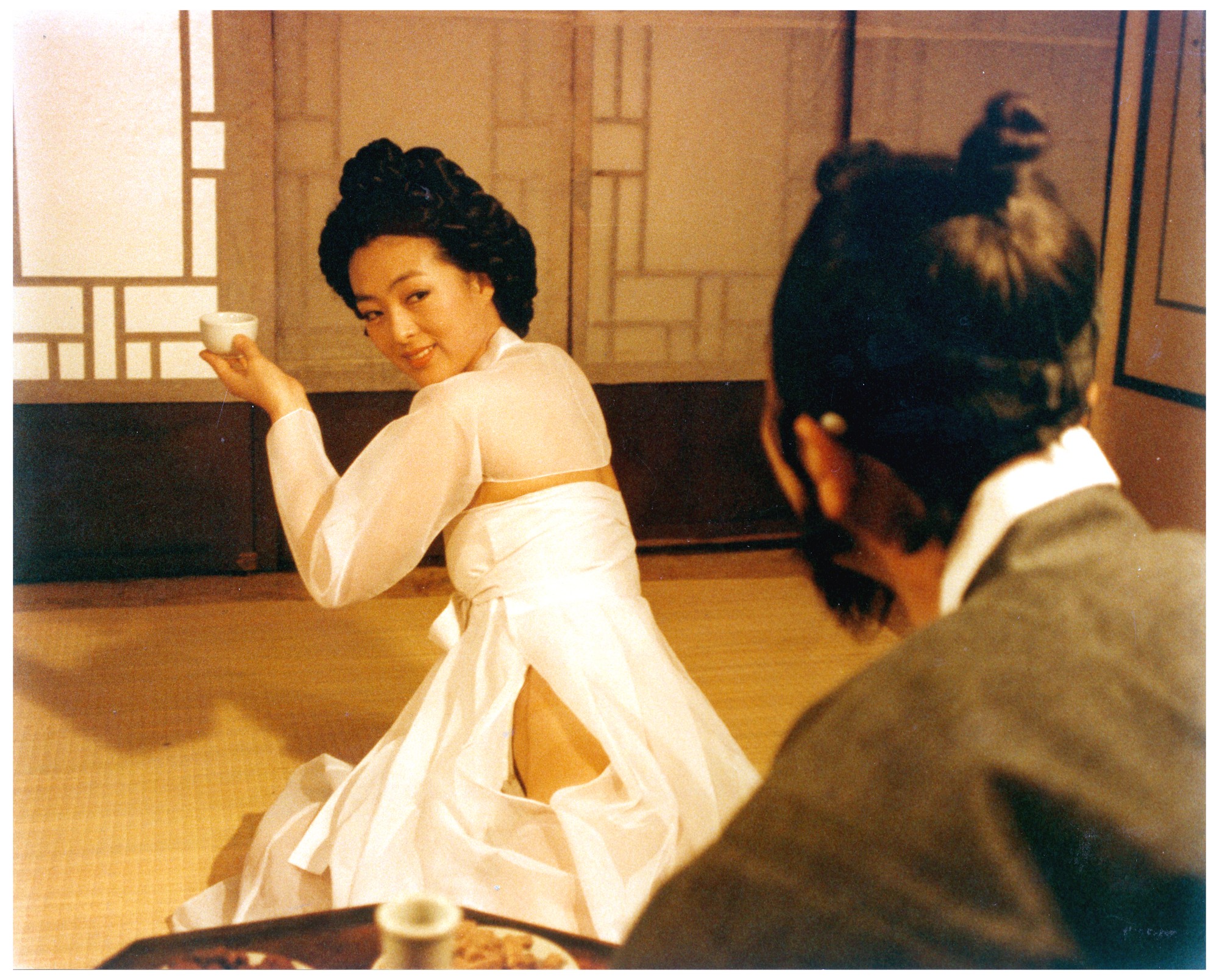
Legends seem to surround Euodong, a little more of her history revealed with each step in the investigation into the murder of a man she had slept with at a festival. The man had attempted to rape her, but Eoudong was soon able to gain the upper hand in the situation, realising that he is a servant boy who often visited her home. She sleeps with him willingly, dominating him by getting on top and making it about her pleasure and agency rather than his. Soon after she leaves, however, the boy is killed by an assassin apparently hired by her cruel and perverse husband, who is technically the king’s uncle, to tidy up after her. 

Set in 1479, the film is clear in its criticism of the feudal order while insisting that it is the nobles who are the most constrained because they must act by these arcane codes to which the commoners are not subject. The commoners revel at their festival, something more or less forbidden in the revered word of the court and most particularly for a woman like Euodong who craves freedom and excitement, longing to fly like a bird. People of often say of her that should have been born a commoner where her behaviour would not be regarded as so deeply problematic to the social order in its direct attack on notions of class and gender. Though she herself is niece to the prime minister, an assassin (Ahn Sung-ki) is later hired to neuter the threat she poses though there is a kind of care in the unusual request, instructing that death should come suddenly and without pain. Afterwards, the assassin should be sure to bury her in her beautiful place. 

The assassin, however also has a painful past in which in which he was quite literally castrated for a similar kind of transgression of class boundaries having become friends with a young noblewoman. While he lost his penis, his friend lost his tongue so that he would never speak of what happened rendering them both outcasts left with no option but to serve the system that had harmed them by becoming spies and assassins. Eoudong’s rebellion is towards this same system, a system in which women are regarded as worthless if they do not serve their proper function. Married at an early age, some recount that Eoudong was once cheerful but less so after her marriage. Her husband rarely visited her and in fact took a concubine but she was still blamed for the “failure” to conceive a child and threatened with the shame of being sent back to her birth family. In this era, a woman was forbidden from remarrying even in widowhood while it was relatively easy for a man to divorce his wife. Simply “talking back” was enough grounds to send a woman packing. 

The opening and closing text reminds us that the feudal era was “the hardest time for Korean women” if also perhaps inviting us to consider what our times are like too, insisting that Eoudong lives on in the hearts of oppressed women as one who fiercely resisted the constraints of her era. Lee roots the corruption firmly in the king, who is indeed the patriarch of a nation and presider over an oppressive social order founded on shame and misogyny as a means of maintaining male power. Coloured with the softcore excesses of ‘80s Korean cinema, Lee nevertheless signals the crushing austerity of noble life which slowly erodes the soul in robbing it of emotional fulfilment or individuality saving the artiest of his sex scenes for that between the liberated woman and an emasculated man each betrayed by the society in which they live and seeking the only escape that it presents itself to them. 
Lovers of Woomuk-Baemi (우묵배미의 사랑, Jang Sun-woo, 1990)

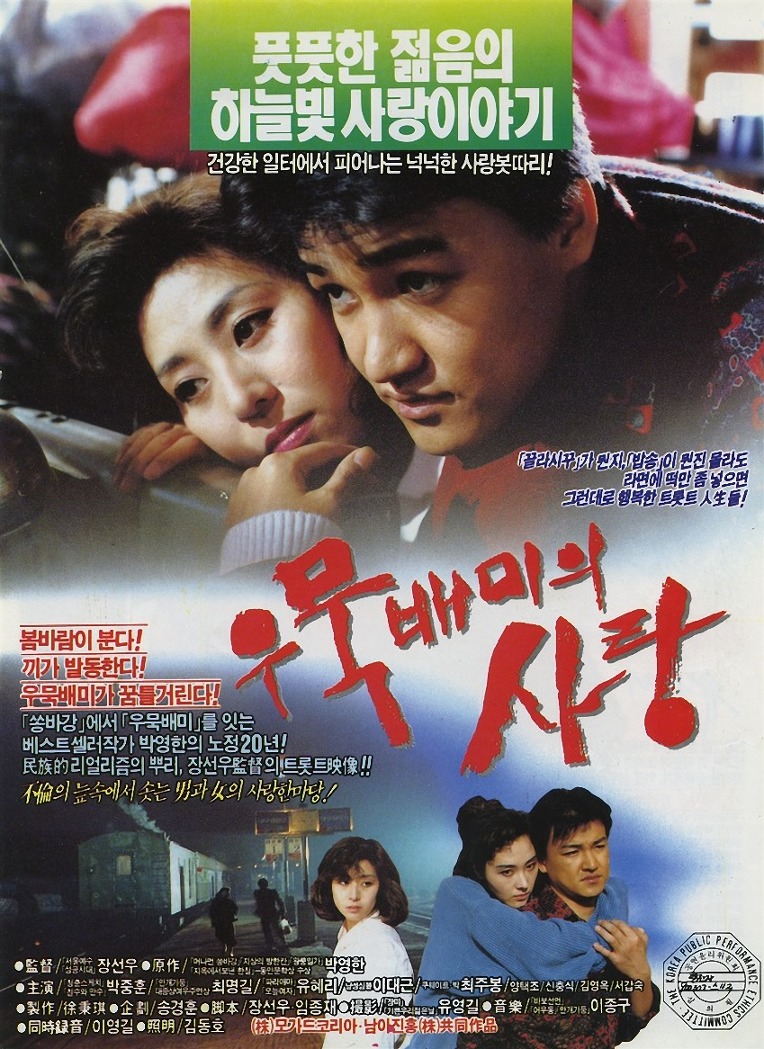
The Lovers of Woomook-baemi posterJang Sun-woo, a former political activist and underground filmmaker, is best remembered for formal experimentation and pointed social commentary, but his third feature The Lovers of Woomook-Baemi (우묵배미의 사랑, Umukbaemi Eui Sarang), stands out in his filmography in its fiercely naturalistic portrayal of working class life on the margins of a society in flux. Based on a novel by Park Yeong-han, The Lovers of Woomook-baemi, is a classic melodrama with infidelity at its core but it’s also a story of futility, the destructive effects of patriarchal social codes and toxic masculinity, and the frustrated promises of a new era for those excluded from its various benefits.

Jang begins his tale in the middle as Bae Il-do (Park Joong-hoon), a frustrated husband, returns home late to a troubled “wife” (Yoo Hye-ri) who promptly kicks him out again. Complaining furiously, Il-do dreams of another woman, Gong-ryae (Choi Myung-gil), with whom he had a brief affair, idly thinking that he might have been happy if he hadn’t got his current partner pregnant and got himself stuck with her for life even if they aren’t technically “married” in the legal sense.

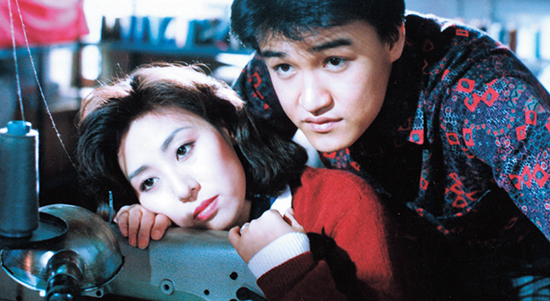
Moving backwards, we see Il-do, having failed in Seoul, returning to his home village with his common-law wife Sae-daek and infant child after an offer of work in a small seamstressing firm. The only man among a room full of mostly elderly women, Il-do is something of a novelty but is also taken by the woman on the machine next to him, Gong-ryae, who he later learns is also unhappily married and intensely lonely in her small-town existence. After some initial indecision, the pair embark on an affair, (still illegal at the time of the film’s release) but their prospects for future happiness seem slim given the restrictive quality of their lives.

The world that Jang depicts, for all its naturalistic flair, is intensely misogynistic. Il-do’s early recollections of Gong-ryae revolve around her bad marriage to an impotent man (Lee Dae-Geun) who mercilessly beats her. Indeed, we later see Gong-ryae turning up for work after suspicion has arisen about her relationship with Il-do with a black eye and bruises on her face while the other women giggle over the obviously awkward gossip. Domestic violence is, however, just a part of life in the village and the older women in particular view it as a sign of a healthy marriage. One woman even exclaims that she wishes she had a man to beat her, but thinks she’s unlikely to find anyone given her age and the fact that she already has numerous children.

Il-do, by contrast, proves somewhat popular among the ladies at the shop because of his relative lack of machismo. Like Gong-ryae, Il-do is also a victim of domestic violence. His wife beats, slaps, and attacks him verbally, later even dragging him home by the testicles along a very public walk of shame. He is not above violence or aggression, but as in much of Jang’s work, male violence is a sign of weakness rather than strength and each of Il-do’s violent episodes is more to do with defeat and repressed emotion than it is about strength or conquest. This also seems to be true for Gong-ryae’s husband whose violence and jealously is perhaps a reaction to his impotence, but when we later meet him we find a man much like Il-do. Chastened, Gong-ryae’s husband politely asks the man who bedded his wife if he knows where she is and if he sees her to please tell Gong-ryae that he’s sorry and wants her to come home.

As he does with Gong-ryae’s husband, Jang plays with our sympathies and allegiances, switching perspective to reveal to us that villains and victims are often one and the same. Sae-daek originally seems like our villain, a shrewish, henpecking “wife” who won’t let our hero go despite the evident toxicity of the pair’s non-marriage, but seen from her point of view we understand her plight. After running away from a violent home environment she winds up a bar hostess in the city where she builds up a spiky relationship with Il-do which goes south when he gets her pregnant. Despite this being the age of illegal adultery, it’s not so much a marriage certificate that binds a man and a woman together for good or ill but a child. As a neighbour puts it, a woman might leave her husband, but what sort of woman leaves a child? Sae-deok cannot care for her child alone and she cannot abandon it with Il-do and so she must keep him no matter how much personal suffering she must endure as the common law wife of a no good philandering ne’er do well.

Il-do likes to drift off into philosophical reveries in which he idly remarks on the futility of his existence, but in a very real sense he’s not wrong. He tried life in the city but it didn’t want him and he came home. Sae-deok, oddly enough, likes it in the village with its sense of community especially among the other put upon and oppressed women who attempt to support each other (whilst accidentally supporting the mechanisms which continue to oppress them), but there’s no pretending there’s anything more to life in Woomuk-Baemi than work and drink. Il-do knows this, as does Gong-ryae, and it’s their mutual sense of existential ennui which finally forces them together in an impossible attempt to rebel against the futility of their existence through transgressive sex and an attempt at emotional connection.

In the end, Il-do is dragged (by the short and curlies) back into the past, literally, as Sae-deok takes him back to his mother’s house to complain about the terrible way she’s been treated. Creating a scene outside, Sae-deok eventually manages to get through to her mother-in-law who had previously rejected her because of her lowly peasant background and history of sex work, enabling the two women to bond in their shared disappointment with Il-do who has now failed as a “man” on every possible level. Briefly reuniting with Gong-ryae in the greenhouse in which they used to meet, now reduced to ruins, Il-do declares that his love is like a mummy, wrapped so well it will endure for thousands of years without decay, but it’s already too late. Choices have been made, implicitly, which cannot be reversed. Jang leaves his protagonist where he started, frustrated and inert, suffering without hope in an oppressive environment which he knows, in his heart, he does not possess the courage to resist.


Available on region free blu-ray courtesy of the Korean Film Archive which also includes an audio commentary in English from film scholars Darcy Paquet and Marc Raymond, and Tony Rayns’ documentary The Jang Sun-woo Variations, as well as a 36 page bilingual booklet featuring essays by Rayns and film critic Lee Yeon-ho. Also available to stream via the Korean Film Archive’s YouTube Channel.