Aimitagai (アイミタガイ, Shogo Kusano, 2024)

When we say, “what goes around comes around”, we usually mean it in a bad way that someone is only getting what they deserve after behaving badly themselves. But the reverse is also true. The smallest acts of kindness people do without thinking can have quite profound effects on the world around them because, in the end, we are all connected. A bereaved father remarks that he thought novels that only had kind-hearted characters were unrealistic, but now he wants to believe that kind of world could exist after realising the impact his late daughter’s kindness had on those around her.

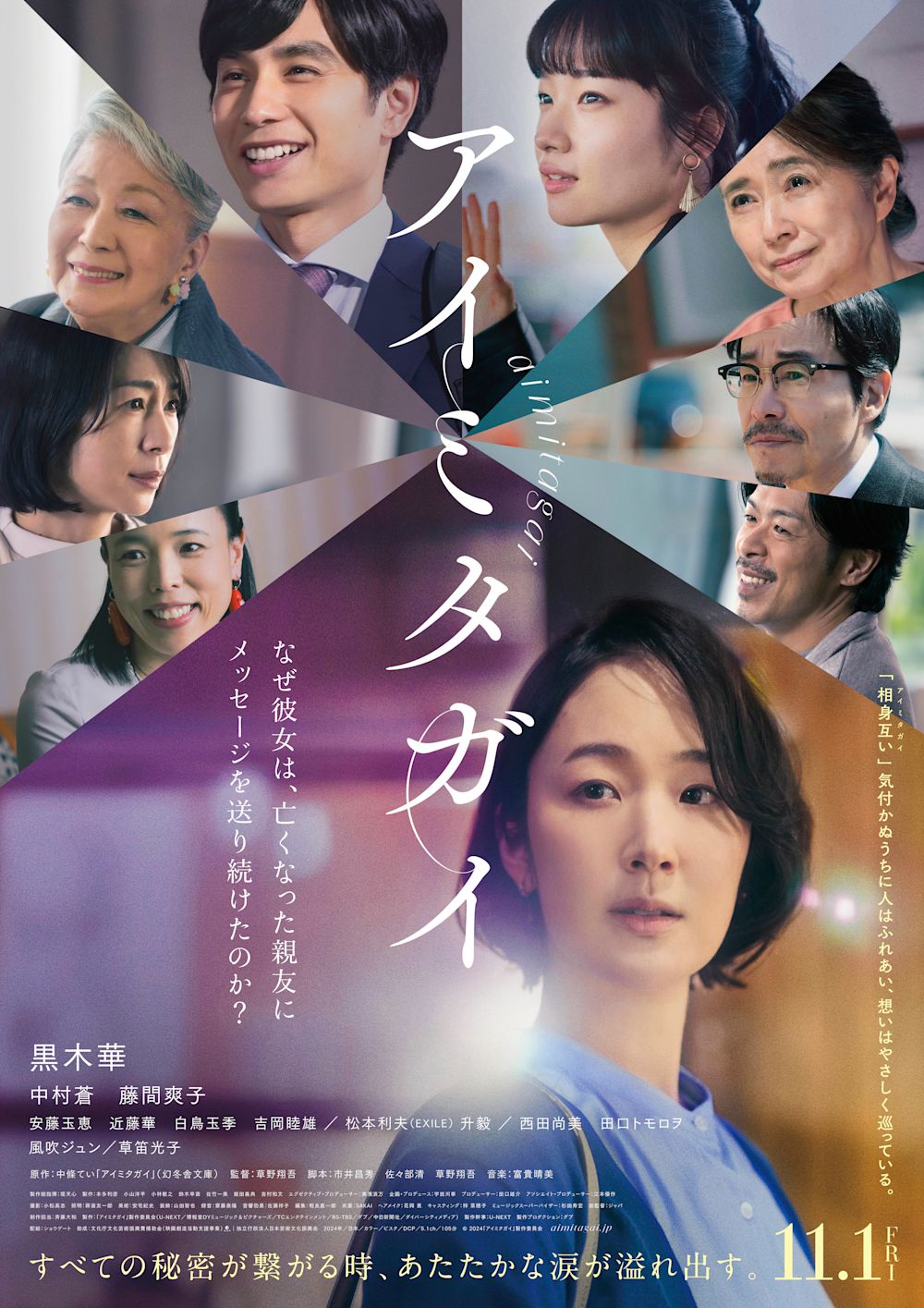
It was Kanami (Sawako Fujima) who saved Azusa (Haru Kuroki) in middle school when she was being bullied for coming from a single-parent family and the pair remained firm friends ever after until Kanami was suddenly killed in an accident while working overseas. Kanami’s loss leaves Azusa struggling to move forward with her life while mired in grief and uncertainty. Having lost her mother some years previously, she has never really dealt with the trauma of her parent’s acrimonious divorce and has a rather cynical view of marriage despite working as a wedding planner where her unmarried status sometimes causes her clients anxiety though it obviously has very little do with her ability to do her job. She’s always been clear with her long-time boyfriend Sumito (Aoi Nakamura) that marriage isn’t something she sees in her future, though he seems to want more commitment, while she repeatedly describes him as “unreliable” and is hesitant to take the next step with their relationship whether it involves getting married or not.

In that sense it’s really Azusa’s inability to surrender herself to the concept of what her grandmother (Jun Fubuki) calls “amai-tagai”, or mutual solidarity, which they experience first-hand while visiting her as another old lady nearby comes rushing in saying her house is on fire. It’s not so much reciprocity as a generalised idea of having each other’s backs, that people help each other as needed without keeping score in much the same way as Azusa was saved by Kanami and as she later realises by Komichi (Mitsuko Kusabue) whose piano-playing soothed her spirit though Komichi intended to play in secret, allowing her music to blend in with the six o’clock chimes as a daily act of atonement for having played the piano for boys who were going off to war many of whom never returned. It is then Azusa who saves Komichi in turn by telling her that she felt comforted by her music and that she does not believe that she has no right to play it simply because of the ways it was misused in the past. 

What Azusa fears is that by getting married she would essentially be cutting herself off from her paternal grandmother who, aside from her aunt (Tamae Ando) who is also Komichi’s housekeeper, is the only other family member she seems to have a meaningful connection with. Unable to let go Kanami, she keeps sending her messages little knowing that her mother is actually reading them and feeling both sorry and grateful that her daughter had such a good friend who like her is also struggling to continue on without her. She and Kanami’s father (Tomorowo Taguchi) find solace in the letters they receive from children at an orphanage where Kanami used to donate cakes and sweets after visiting there on a job. The photos she took are on display at their bathrooms, Azusa said because Kanami wanted them to be in a place where the children felt free to embrace their feelings privately without fear of embarrassment. 

The photographs, letters, and belated gifts are all examples of the ways in which what Kanami sent around is still going around and will continue to do so long after she herself is gone. Through realising the reality of “aimi-tagai”, Azusa learns that the world can also be a kind place, Sumito might be more “reliable” than she thought, and it might not be such a bad idea to trust people after all. Based on the novel by Tei Chujo, the film’s interwoven threads of serendipitous connections and the unexpected results of momentary acts of kindness prove oddly life-affirming if only in the ways in which each realise that Kanami is always with them even if physically absent.


Aimitagai screened as part of this year’s Toronto Japanese Film Festival.

Trailer (no subtitles)

What She Likes (彼女が好きなものは, Shogo Kusano, 2021)

“Distance keeps us safe” according to the hero of Shogo Kusano’s LGBTQ+ teen drama What She Likes (彼女が好きなものは, Kanojo no Sukina Mono wa) ironically commenting on the nature of “social distancing” in the age of corona along with his own sense of alienation. Though in comparison to other recent similarly themed features Kusano’s film may in some senses seem behind the times in its BL filter, it has its heart firmly in the right place as the hero and several of his friends attempt to find a place for themselves within the contemporary society which for various reasons they fear will not accept them. 

In high schooler Jun’s (Fuju Kamio) case, his sense of alienation is born of his internalised homophobia in which all he wants is to have a conventional heteronormative life within the confines of the traditional family with a wife, children, and grandchildren. Part of this may stem from a secondary source of marginalisation in that he comes from a single parent family which is itself still frowned upon by some as evidenced by the mild discomfort experienced by his new friend Sae (Anna Yamada) when he explains to her why he always eats cafeteria food rather than bringing a homemade bento. Sae’s source of internalised shame, meanwhile, is that she is a fujoshi or obsessive fan of boys love manga which revolve around romances between men but are aimed at an audience of young straight women rather than the LGBTQ+ community. 

Based on the novel by Naoto Asahara, what the film attempts to do is examine the gap between the BL fantasy and the reality of being gay in contemporary Japan. Sae is ashamed of her love of BL and ironically paranoid that Jun will expose her secret after running into him at a bookshop, explaining that she was shunned in middle school when her friends found out she enjoyed reading gay love stories which they viewed as “creepy”. Meanwhile, she has a complicated view of homosexuality off the page which is not always completely supportive. Both she and Jun continue to use a world that many would consider to be a homophobic slur to describe men who love men, Jun at times using the word against himself while simultaneously denying the identity. The first conclusion that he comes to is that Sae does not really like him but only the romanticised gay ideals from the fantasy world of BL which as is later pointed out are often set among a largely gay milieu or even in a world where everyone is gay. 

Sae refers to this space as the BL Planet, but Jun’s desire to go there is also a reflection of his internalised homophobia in that on the BL Planet he’d obviously be just like everyone else. He’s fond of repeating a sentence they learned in science class about a simplified world with zero friction which he later claims to reject unwilling to erase complication for superficial harmony but this is exactly what he’s doing in attempting to erase a part of himself in order to better conform to a heteronormative society. He beats himself up for not being able to have “normal” sex after half-heartedly agreeing to date Sae while engaging in physical intimacy with a much older man who is married with a child. Jun’s lover Makoto (Tsubasa Imai) later explains that his marriage is one of convenience born of the same kind of internalised homophobia experienced by Jun though he obviously loves his wife and child if in a different way while the inappropriateness of his relationship with a teenage boy is never raised by anyone.

Jun is taken to task by a brash classmate, Ono (Ryota Miura), for his irresponsibility in dating Sae knowing that he has no romantic interest in her hinting that perhaps not that much has changed in the last 10 or 15 years both men convincing themselves that heteronormative relationships are the only valid markers of success. Then again when Jun is accidentally outed his classmates are given a crash course in LGBTQ+ relations most of them expressing support and the conviction that society needs to become more accepting of diversity though it has to be said they were less than understanding before, particularly the boys who found Jun’s presence a challenge to their masculinity. 

Teenage boys they all are, but even infinitely sympathetic straight best friend Ryohei (Oshiro Maeda) engages in crude, misogynistic banter with their classmates forcing Jun to play along pretending to be a connoisseur of heterosexual pornography. Probably some or even most of the other boys are also lying in an act of performative masculinity but the pretence only adds to Jun’s internalised sense of otherness and belief that he is in some way broken continually asking not only why he was born like this but why anyone is. After receiving an alarming message from an online mentor, he is pushed towards a dark place in becoming convinced that the world has no place for him only to belatedly come to an acceptance of his identity as mediated through Sae’s concurrent epiphanies realising that without friction there is no progress and discovering liberation in authenticity. Despite a few mixed messages and a bizarre subplot about a hairdresser who is not himself gay but nevertheless obsessed with gay people to the extent that he thinks he can spot them in public places through codified signs and the look in their eyes, Kusano’s teen coming-of-age drama has its heart in the right place in its gentle plea for a more inclusive, joyfully diverse society. 


What She Likes screens at Genesis Cinema on 28th May as part of this year’s Queer East.

Original trailer (English subtitles)

Bittersweet (にがくてあまい, Shogo Kusano, 2016)

bittersweet poster“Vegetarian Men” became an unlikely buzzword in Japanese pop culture a few years ago. Coined by a confused older generation to describe a perceived decrease in “manliness” among young, urban males who had apparently lost interest in women and gained an interest in personal appearance as an indicator of social status, the term feeds into a series of social preoccupations from the declining birthrate and changing demographics to familial breakdown and economic stagnation. In an odd way, Bittersweet (にがくてあまい, Nigakute Amai) backs into this particular alley by adding an extra dimension in the story of a somewhat “manly” career woman and her non-romance with a gay vegetarian she meets by chance who eventually helps her to escape her arrested adolescence and progress towards a more conventional adulthood.

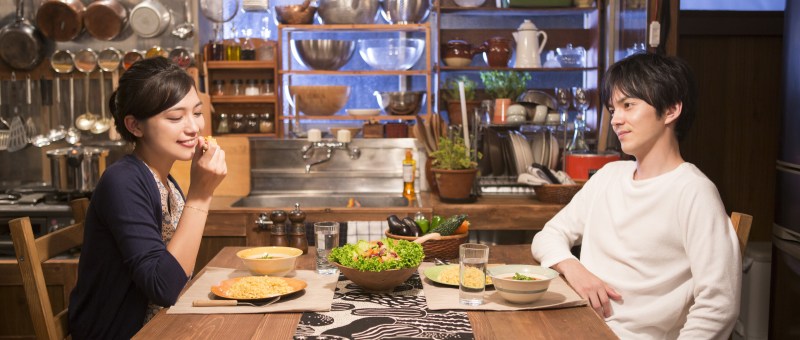
Maki (Haruna Kawaguchi), an advertising agency employee and workaholic career woman in her late ‘20s, has a philosophical objection to the existence of vegetables. Unable to cook and generally disinterested in food (or house work, clothes, makeup etc), Maki sucks on jelly packs at her desk so she can keep on typing, sometimes treating herself to a store bought bento. She’s told her “friends” at work that she’ll shortly be moving in with a boyfriend, but in reality she’s recently broken up with someone and is being evicted from her flat. Things are looking up when she’s put in charge of a commercial but the commercial turns out to be for goya bitter melon which is both a vegetable and not exactly an easy sell.

Fast forward to a bar where Maki is a regular. After getting blind drunk and going off on an anti-vegetable rant, Maki wakes up at home with Nagisa (Kento Hayashi) – a guy she quite liked the look of the previous night but went off when she noticed he was carrying a giant box of veggies, making her a nutritious breakfast which she then refuses to eat. Paranoid that Nagisa took advantage of her in the night, Maki goes through his bag and discovers that he’s a high school art teacher. Challenging him about what exactly happened, he is forced to tell her that she’s not his type. Nagisa is gay and brought the blackout drunk Maki back to her flat on the instructions of his friend, the gay bartender at Maki’s local. Maki, classy as ever, threatens to blackmail Nagisa by outing him at school unless he agrees to move in with her.

Thankfully, Bittersweet drops the romance angle relatively quickly as Maki begins to grow up and accepts that there’s no point chasing a man who will never be interested in her. Nagisa, originally adopting an almost maternal attitude towards the sullen Maki, later becomes something like a big brother figure, gently coaxing his friend towards self realisation through a series of well cooked meals and hard won life advice. Though there is a degree of stereotyping in his refined, elegant personality, cleanliness, and cooking ability, Nagisa’s sexuality is never much of an issue outside of the obvious fact that he is not “out” at work and that it may be impossible for him to be so. Despite Maki’s original consternation she gets over the shock of Nagisa’s confession fairly quickly and when he eventually meets her parents, they too react with relative positivity (Maki’s mum even slips a copy of a BL manga into her next care package).

Somewhat bizarrely the central drama revolves around Maki’s hatred of vegetables which stems back to a stubborn resentment of her parents’ unconventionality. In combatting her parents’ decision to abandon the world of corporate consumerism, Maki has become a “career woman”, eschewing the feminine arts in favour of the male drive. Where Bittersweet was perhaps progressive in its acceptance of Nagisa’s sexuality, it is less so with Maki’s seeming “maleness” – her drinking, meat eating, and workaholic ambition all painted as aspects of her life which are in need of correction. Though some of her habits are undoubtedly unhealthy – she could definitely benefit from better nutrition and scaling back on the binge drinking, Bittersweet is intent on “restoring” Maki to the cuteness befitting the heroine of a shojo manga rather than allowing her to become a confident modern woman who can have both a career and a love interest with little conflict between the two.

Through meeting Nagisa Maki is able to get over her vegetable hate and repair her strained relationship with her comparatively more down to earth parents while also realising she doesn’t necessarily want the life of empty consumerism symbolised by her relationship with her status obsessed former boyfriend. Meanwhile Nagisa has his own problems in dealing with a past trauma which his new found, quasi-familial relationship with Maki is the key to addressing. A pleasant surprise, Bittersweet is not the awkward romance the synopsis hints at, but a warm and gentle coming of age story in which vegetarian cookery, mutual respect, and a lot of patience, allow two youngsters to become unstuck and find in each other the strength they needed to finally move forward into a more promising future.


Original trailer (English subtitles)