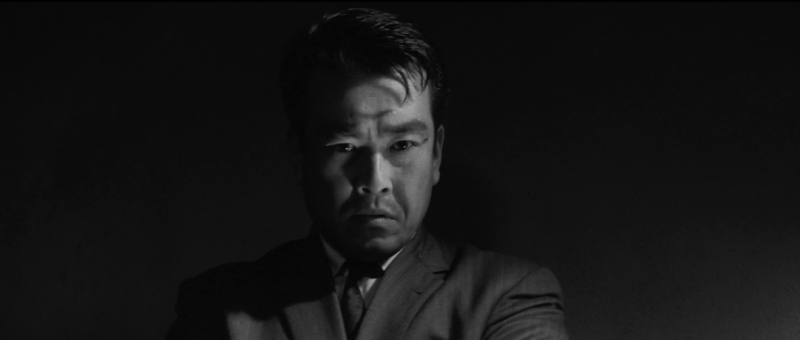
Scent of a Spell (魔性の香り, Toshiharu Ikeda, 1985)

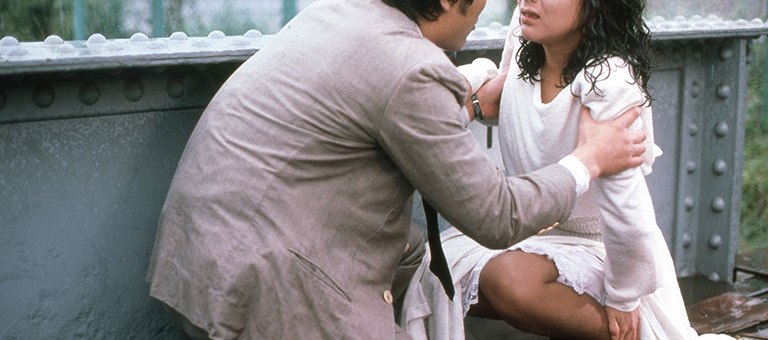
Esaka (Johnny Okura) feels like someone’s watching him. He has this sense of being observed by some otherworldly force along with a generalised feeling of uneasiness. But his paranoia seems to melt away after rescuing a young woman, Akiko (Mari Amachi), whose attempted suicide he witnesses during a rainstorm on his way home. He takes her in and one thing leads to another. For a time, they’re blissfully happy but then something starts to nag at him. Is Akiko really who she claims to be, or a demonic force of monstrous femininity?

It’s this malevolent quality to which the title of Toshiharu Ikeda’s noirish romance Scent of a Spell (魔性の香り, Masho no Kaori) alludes. Esaka is captivated by a hint of mystery and his own white knight syndrome, bewitched by Akiko but also perhaps growing tired of her and fearful of romantic commitment. He has after all been married before and his friend’s comments seems to suggest the cause of marital breakdown may either have been his womanising or his wife’s baseless jealousy. Akiko tells him that she’s on the run from an abusive husband prone to jealous rages and that though she has escaped from Osaka to Tokyo he always manages to track her down. Her sense of being pursued and Esaka’s of being watched seem to perfectly align while he seems to appreciate the fact that she needs him and he is quite literally sheltering her from danger.

Nevertheless, there are cracks in Akiko’s story beginning with the fact the bridge she threw herself off wasn’t the kind to pose a serious risk to life. The drop is only a few feet and though she resolutely refuses to be taken to a hospital because her husband might find her, she may be exaggerating the extent of her injuries. Meanwhile, she seems to have something of a jealous streak becoming irritated when Esaka talks to the proprietress of a local bar, thereafter apparently submitting herself to the attentions of his over-friendly colleague. Perhaps she had a reason to be annoyed given that she didn’t previously know any of these people and he inadvertently excluded her from the conversation, but it’s difficult for Esaka to know if she’s actually being unreasonable or he’s overreacting to a threat to his male pride and autonomy.

It’s this threat to his freedom that’s inflamed when he overhears another man talking to the lady behind the counter at a cafe he regularly goes to about his own girlfriend who is also named “Akiko” written with the character for “autumn”. Though there must be dozens of women with this not all that uncommon name combination in the city, it plants the seed of doubt in him that perhaps his Akiko and the other are the same and she’s two-timing him with this other guy while he’s at work. It also adds to his feeling that she has some kind of malevolent supernatural quality as if she were deliberately targeting lonely men for nefarious reasons. When the man from the cafe is found dead at home having been bludgeoned to death, he can’t help but feel that Akiko must have been involved and possibly intends to harm him too.

Of course, this may just be his fear that she will hurt him emotionally and his growing paranoia is a defence mechanism designed to protect himself against her abandonment or an infringement on his freedom. Or, alternatively, Akiko really is a dangerously crazed and jealous woman and letting her into his life will mean not a moment’s peace until it’s over. Even so, the pair of them discover intimacy in connection in their raw, desperate love making. Every time Esaka’s doubts rise to the surface, Akiko seduces him or he her and he momentarily forgets. In this, the film may have a latent misogyny as a final twist suggests that in the end all women are prone to fits of jealous rage not to mention cunning and trickery directed against each other as much as men who are also, to be fair, faithless liars and cheats. Akiko’s tragic backstory suggests something similar, that she is the inheritor of a legacy of compromised maternity and paternal betrayal. In any case, Esaka is not quite the hero he imagined himself to be either and in the end cannot save Akiko who may also in a way be choosing to sacrifice herself for love of him. Echoing the ending of In a Lonely Place, Ikeda casts their romance as fatalistic tragedy and bathes the noirish closing scenes in a heavenly golden light that suggests true love ends only in futility.


Scent of a Spell is released in the UK on blu-ray 17th February courtesy of Third Window Films.
Albino (アルビノ, Toru Kamei, 2016)

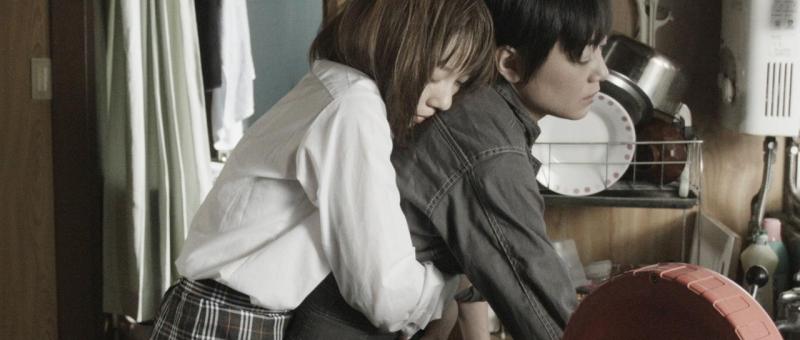
Two women struggle to free themselves from the abuses of a patriarchal and conservative society in Toru Kamei’s tragic lesbian romance, Albino (アルビノ). Though perhaps somewhat out of touch in its tacit implication that same sex love is inherently destructive, Kamei’s sensitive drama finds its marginalised heroines seeking mutual rescue but finding only temporary respite in the bubble of their love fraught as it is with danger and confusion as they each in their own way struggle to escape their respective prisons literal and self imposed. 

Butch plumber Yashima (Fujiko) has always felt somewhat ill at ease, that her inside doesn’t match her out, and the disconnect has made her reluctant to associate with others. On a job one day she encounters a strange young woman, Kyu (Satsuki Maue), wearing a high school uniform who can’t seem to stop gazing at her. Yashima fixes the problem with her sink which was clogged with paper tissue, but is surprised when Kyu calls back and says it happened again. On her return visit, while Kyu’s stepfather is out, Kyu asks Yashima to have a look at the bathroom where she gingerly seduces her, both women perhaps surprised by the depth of their desire. Problematic age gap aside, the two women embark on a passionate sexual affair but struggle to free themselves from the forces which constrain them outside of their intense physical connection. 

Hinting at a kind of gender dysphoria, Yashima lives as a man but feels pressured into conforming to conventional femininity. She’s the only woman at her job as a plumber, perhaps still stereotypically regarded as a male occupation, and simultaneously regarded as one of the boys made complicit in the misogynistic banter of her boss and colleague. Resented for her unwomanliness, she’s eventually assaulted by her skeevy vanmate who refuses to believe her when she says she has no interest in men. She implies that prior to her relationship with Kyu, she hadn’t considered other women but had perhaps thought of herself as male, and is immediately overwhelmed by her newfound desire. Meanwhile, she’s also dealing with familial trauma in her difficult relationship with her alcoholic mother who frequently turns up only to ask for money to spend on drink. 

Kyu, meanwhile, is more directly oppressed, trapped in an abusive environment with violent stepfather who repeatedly rapes her, his tissues the ones which eventually clog the sink after she tries to wash them away. She claims that the uniform is a fashion statement, though the implication seems to be that her stepfather does not allow her out of the house even to go to school if indeed she is still a student despite her claims to the contrary. That might also explain why she continues to clog the sink and call the plumber, potentially alerting Yashima’s boss not to mention the colleague who seems to have realised there’s something going on, rather than simply ring her directly even after she’s really only coming for sex. Kyu makes a habit of giving Yashima hard candies after each of their meetings, Yashima eventually realising that they spell out the word “help”, but she remains too traumatised to escape convinced that her stepfather would find her wherever they went. 

Somewhat awkwardly, the implication is that Yashima’s relationship with Kyu is the force which motivates her to accept her femininity, the younger woman transgressively kissing her after staining her lips with menstrual blood as if to ram the point home. Kyu meanwhile agrees that she too hates being a woman, though her resentment is perhaps more towards her constant victimisation, her utter powerlessness at the hands of the hands of the stepfather who abuses her and whom she cannot escape. Yashima too finds herself victimised as a woman, assaulted by her colleague who leaves by coldly telling her it was her own fault for refusing him, or perhaps simply for her “failure” to conform to conventional social norms, a crime for which he has punished her as means of correction. Yet they each struggle to free themselves, Kyu too traumatised to embrace her freedom despite her literal cry for help, while Yashima is continually punished for her atypical gender presentation. Only in sex do they find release. Shot with a detached realism which extends to the naturalistic though passionate, erotic love scenes Kamei’s melancholy drama offers little in the way of hope for either woman, subtly suggesting that their romance is a forlorn hope because there is no escape from the forces which oppress them in such a rigid and conformist society. 


Trailer (no subtitles)

The Desperate (どろ犬, Takaharu Saeki, 1964)

A bruiser cop railing against the system is pulled towards the dark side in Takaharu Saeki’s icy noir, The Desperate (どろ犬, Doro Inu). Adapted from a novel by Shoji Yuki, the film is one of only two Saeki directed in an otherwise lengthy career mainly spent in television and captures an eerie sense of existential dread as its detective hero sinks to even greater depths in a quest for self preservation while kicking back against the hypocrisies of the post-war society. 

As one officer puts it, Sugai (Minoru Oki) is one of many veteran officers who can’t adjust to new codes of justice in the democratic era. In the film’s opening sequence, he’s pulled aside and warned about using excessive force on a suspect only to counter that he knows the guy’s guilty so he doesn’t see what the problem is. Sugai had been particularly motivated about this case as the victim was an 18-year-old girl raped after accepting a lift from a stranger. She was so traumatised that she could hardly speak but did remember the registration plate of the car. She’d only been working because her father lost his factory job though he appears to have begun drinking and is abusive towards his daughter for her silence, later coming to the station to drop the charges after being paid off by the suspect’s lawyer. The legal definition of rape in this era is founded not on an idea of consent but whether violence was involved and the victim can be proved to have resisted physically. The guilty party, Tomita (Hideo Murota) claims that nothing illegal transpired in his car and then walks away with a smirk when his lawyer gets him off the hook. It’s all too much for Sugai to bear, resentful that the rich and powerful are now effectively above the law thanks to legislation he feels ties his hands as a police officer. 

It’s at this point he runs into petty yakuza Yamaguchi (Ko Nishimura) whom he’s been trying to turn as an informant, unwisely mouthing off about his dissatisfaction with contemporary law enforcement only for Yamaguchi to turn the tables and effectively blackmail him having discovered that Sugai has begun a relationship with the estranged wife of an imprisoned gangster. In an act of petty revenge and desperation, Sugai leaks info on “guilty” suspects who weren’t charged to Yamaguchi who exacts financial justice by extorting them for money while threatening to expose their immorality. 

Disappointed in him, the gangster’s wife, Chiyo (Chisako Hara), exclaims that Sugai’s no different from her husband and in truth he isn’t. Part of Sugai’s resentment lies in the fact his wife left him for another man while he was on a stakeout, frightened by his violence and insisting that she hated detectives. His old-fashioned police tactics include taking suspects to the dojo where beats the living daylights out of them. Later he tells another, more earnest officer, he reminds him of himself when he was younger implying that he has become corrupted by the times and the impossibility of justice, particularly for young women whom he feels an urge to protect, in a world ruled by money and status. He may feel some pangs of guilt for a rookie who is unfairly fingered as the mole on the grounds that he and Yamaguchi were originally from the same area and had a past acquaintance, but in the end is happy enough to scapegoat him for his wrongdoing while he continues trying to dig himself out a hole but falling still further into the abyss. 

Sugai is merely trying to save his own skin, but those around him are desperate too. His opposite number, Toku (Hisashi Igawa) is desperate to clear his name, while Chiyo is desperate for what she describes as a proper marriage to a proper man while seemingly kept captive in the apartment Sugai rents for her on his meagre police salary but does not live in himself. She wants to work and has an innocent desire to buy him some better shoes that he otherwise resents in its implied challenge to his masculinity that he evidently cannot afford all this additional expense coupled with the strain of keeping his problematic relationship with a gangster’s wife secret from his employers. In the end he claims that the problem was he couldn’t escape from being a detective, pushed into desperate acts of destruction as a man now exiled from his times unable to move on from post-war chaos into a newly democratic, consumerist Japan. Saeki ends his fatalistic vision with an image of a train reeling backwards, echoing the degree to which Sugai has lost control of his life and himself no longer a detective but only a man without a moral compass whose path can only lead in one direction.