The Boy and the Heron (君たちはどう生きるか, Hayao Miyazaki, 2023)

Sales of Genzaburo Yoshino’s 1937 novel How Do You Live? (君たちはどう生きるか, Kimitachi wa Do Ikiru ka? went through the roof when it was announced that the no longer retired Hayao Miyazaki would be directing a new film with the same title. Predictably, Miyazaki’s film turned out not to be an adaptation at all, or at least not a literal sense, but was intensely interested in the question not so much how do you live but how will you? Will you allow the past to make you bitter and live in a world of pain and resentment, or will you choose to live in a world of peace and beauty free of human malice?

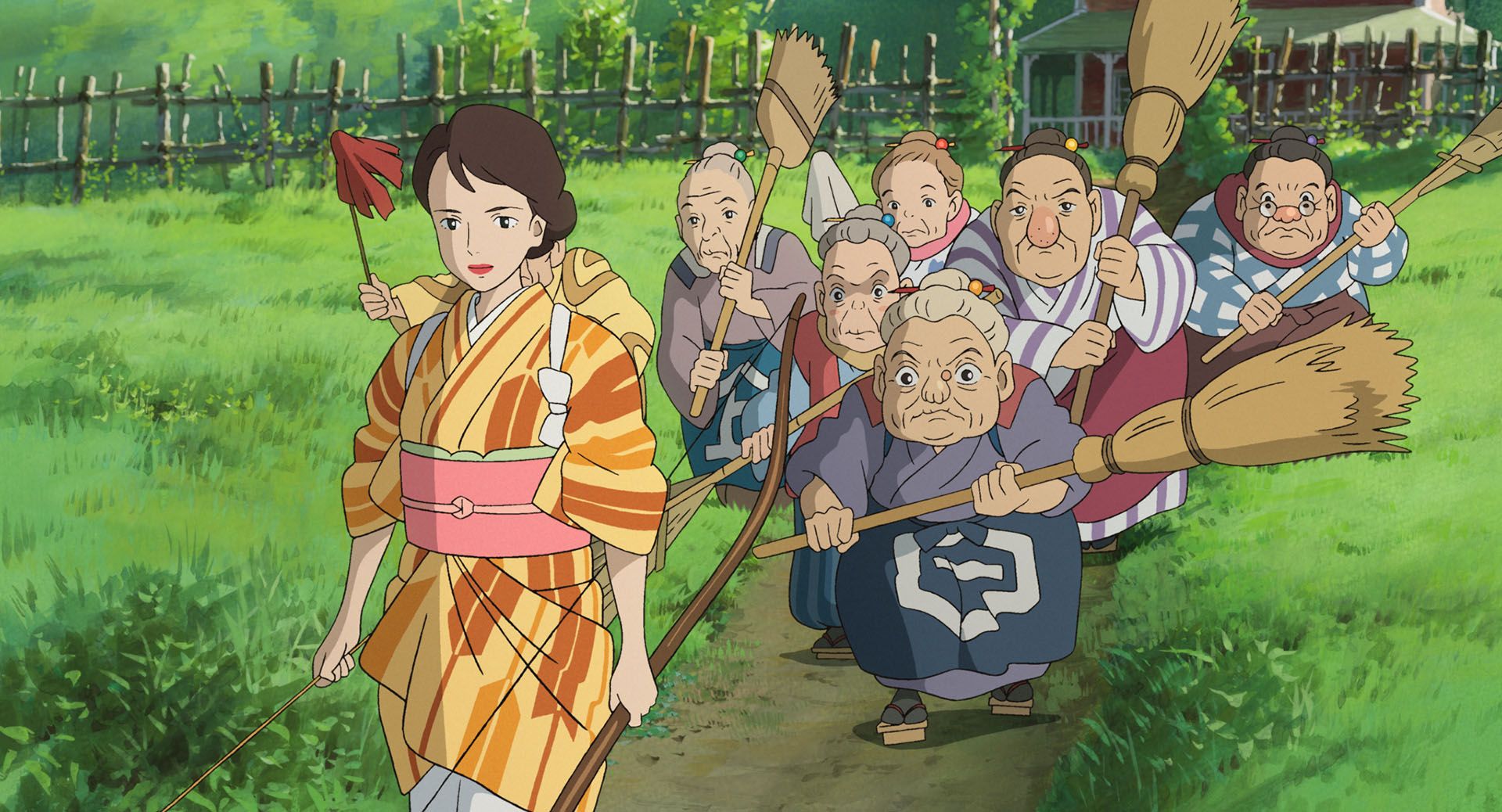
These are of course the questions faced by a post-war generation, the children of Miyazaki’s own era who came of age in a time of fear and suffering. Mahito (Soma Santoki), the hero, loses his mother in the firebombing of Tokyo. He runs through a world of shadows to save her from the flames but of course, he cannot. A year later everything has changed. His father has remarried, taking his mother’s younger sister Natsuko (Yoshino Kimura) as his new wife. Natsuko is now pregnant which suggests the relationship began some time ago though Mahito knew nothing of it and had no recollection of ever having met Natsuko before being sent to live in her giant mansion in the country more or less untouched by the war. 

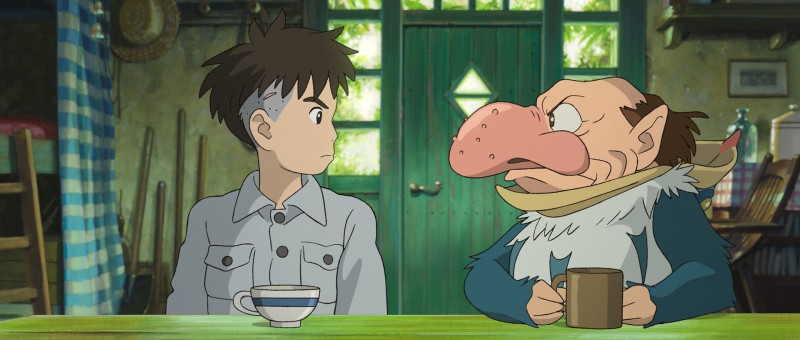
It’s here that Mahito’s own malice rises. He is polite, if sullen, but cannot warm to his new stepmother and resents his father’s relationship with her. Perpetually bothered by a grey heron (Masaki Suda) his first thought is to kill it, crafting a bow and arrow from bamboo and one of the heron’s own feathers. Shunned as the new boy at school he hits himself on the head with a rock while his father, Shoichi (Takuya Kimura), comically vows revenge and lets him stay home. As he points out, there’s not much “education” going on anyway with most of the students pulled away from their studies for “voluntary” labour in service of the war effort in this case agricultural. 

Shoichi has moved to the country to open a factory which it seems produces canopies for fighter planes which is all to say that he is profiting from the business of war, though transgressively referencing the failure in Saipan over breakfast with the mild implication that it might work out alright for him. There is after all a grim reason they’ll be in need of large numbers of aircraft parts in the near future. Mahito’s dark impulses are directly linked to those of militarism and the folly of war. When he finally enters the tower of madness apparently constructed by a great-uncle who went insane through reading too many books, he discovers that his enemies are an ever expanding clan of fascistic, man-eating parakeets led by a Mussolini-like despotic leader attempting to manipulate the Master of the tower. 

Inside the tower is a land out of time, a place for those already dead or in essence an eternal past. It’s here that Mahito is presented with a choice, how will he live? Will he choose malice and destruction, or will he choose to leave and build a new world of beauty and peace above? In many ways, the important point is that the choice is his as it is ours, that we are free to decide and that our choices create the world in which we live. Through his adventures in the tower, Mahito begins to come to terms with his situation and resolves to accept Natsuko as a mother and make friends of those he once considered enemies. When the tower itself crumbles, it takes with it the last vestiges of authoritarianism and tyranny.

Prompting his epiphany, Mahito discovers a copy of How Do You Live? in his room, a present from his late mother inscribed to the grown-up Mahito. He is surrounded by the world’s ugliness, forced into a surprisingly graphic fish gutting session that leaves him wiping away blood, recalling his profusely bleeding head injury and the scar it will forever mark him with. Pelicans imprisoned in the other world meanwhile tell him that they have no choice but to behave as they do for the Master of the Tower neglected to put enough fish in the rivers intending them to destroy rather nurture new life while their young too learn all the wrong lessons. Yet there is beauty and strangeness here too, along with kindness and humanity. Boundlessly inventive, Miyazaki couples surrealist visions of murderous birds and the hellish scenes of a city on fire with Mahito the only figure visible in his pale blue school uniform darting through the soot and the shadows. A vivid symphony of life, the film may in its way be about grief and the pain of moving on but finally discovers a kind of serenity in an accommodation with the present and the eternally unfinished question of how you yourself will live. 


The Boy and the Heron screened as part of this year’s BFI London Film Festival.
My Neighbor Totoro (となりのトトロ, Hayao Miyazaki, 1988)

© 1988 Studio Ghibli

“Trees and people used to be good friends” explains a father to his little girls newly arrived in the idyllic countryside of post-war Japan seeking respite from the destructive modernity that has made their mother ill. Released alongside the harrowing wartime drama Grave of the Fireflies, My Neighbor Totoro (となりのトトロ, Tonari no Totoro) is a charming tale of childhood adventure if not quite without its shades of darkness in which two sisters embrace the wonder of the natural world while trying to come to terms with mortality and the uncertainties of adulthood. 

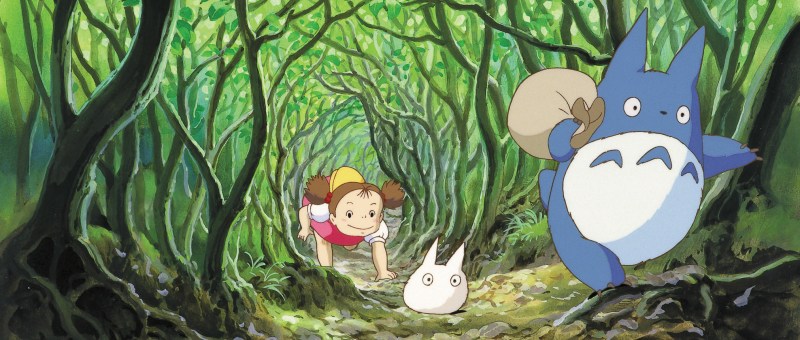
Satsuki (Noriko Hidaka) and her younger sister Mei (Chika Sakamoto) have moved into a large, ramshackle house in a rural village on the outskirts of Tokyo for the benefit of their mother’s health while she remains in hospital a few miles away. Living with their cheerful father (Shigesato Itoi), a professor in the city, the girls rejoice in exploring their new environment learning of the dust bunnies that inhabited their home before they moved in. An old lady from the village (Tanie Kitabayashi) who’s come to help keep house until the girls’ mother returns home explains that she could see the “soot spreaders” too when she was a child but presumably not anymore. The idea that the soot speakers will soon move on appears to make the sisters sad, and everyone including the parents is quite excited about the idea of living in a “haunted house” even if it’s one that rattles a little in the wind. It’s younger sister Mei who later follows the trail of acorns that mysteriously appear in their home and encounters a series of strange forest creatures she names “Totoro” that eventually introduce the girls to a parallel world of magic and fantasy. 

Their father probably doesn’t believe them, but indulges the girls’ stories and adventures while encouraging them to embrace a sense of wonder in their environment along with something deeper and older than contemporary modernity. “You probably met the king of this forest” he explains to Mei, pausing to offer a word of thanks to the ancient tree he says first drew him to the house that will be their new family home. Whether Totoro is “real” or simply a childish fantasy he helps the sisters escape their anxiety over their mother’s absence, not least by introducing them to new life in the seeds the girls plant in their garden and patiently wait to grow. The oldest, Satsuki, is perhaps a little more aware, worried that her father might not have told her everything about her mother’s condition and processing the idea that there is a possibility she won’t come home to them. She wants to protect her sister from the same fears but perhaps can’t, eventually losing her patience with her and instantly regretful when Mei goes off in a huff and gets lost.

There is darkness in the village too, a floating sandal in a nearby lake giving rise to fears that a child may have fallen in and drowned, but there’s also the gentle strength of the community in the kindly old lady and her shy grandson Kanta (Toshiyuki Amagasa) along with all the other villagers who come out in force to look for Mei fearing she may have tried to visit her mother at the hospital on her own. The old lady prays furiously while muttering Buddhist sutras and it’s probably not a coincidence that Mei sits by a row of Jizo statues after realising that she’s lost not knowing what to do. The girls are always careful to offer thanks at the Jizo shrine just as their father thanked the tree though it’s Totoro and the Catbus that eventually bring them back together echoing a sense that in a just world kindness will always be repaid. 

The countryside is in many ways closer to that just world, largely free of the evils of modernity such as the pollution of industry that has corrupted the cities. Technology is often unreliable, dad’s train is late, telegrams bring bad news, and telephone calls result in anxious waits, but life in the village is peaceful and happy and the people help each other when times are hard. It may be an idealised vision of rural living, but there’s no denying its appeal. Evoking a sense of nostalgia in its beautifully painted backgrounds, Miyazaki’s gentle drama is like much of his work an advocation for the importance of nature as a source of healing but equally for wonder in the fantastical adventures of two little girls finding strength and possibility in the heart of the forest.


My Neighbor Totoro screens on 35mm at Japan Society New York on Nov.4 as part of the Monthly Anime series. Japan Society will also be hosting a talk with puppet artist Basil Twist on Nov. 10 delving behind the scenes of the Royal Shakespeare Company’s currently running stage adaptation.

Trailer (English subtitles)

Images: © 1988 Studio Ghibli

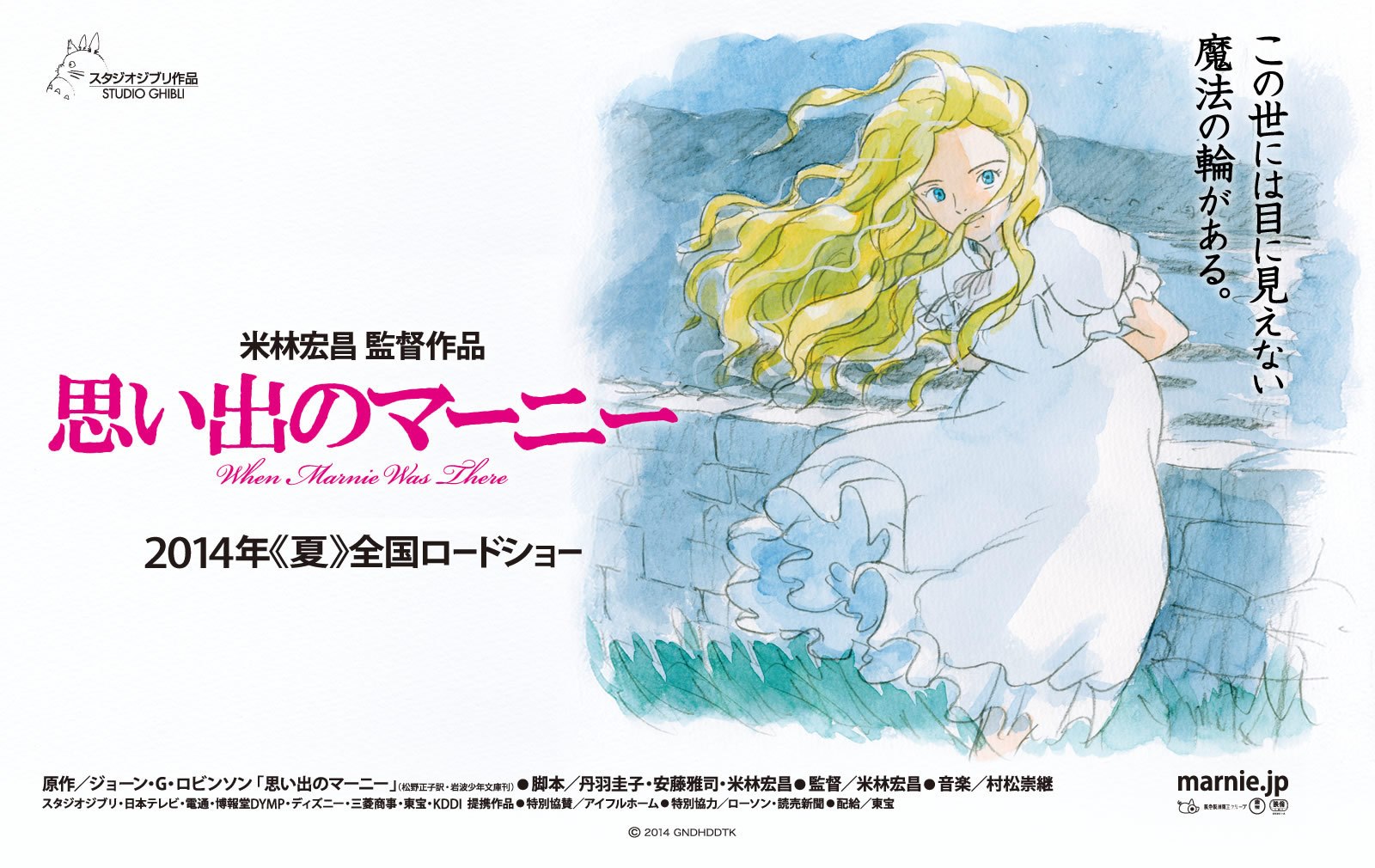
When Marnie Was There 思い出のマーニー (Hiromasa Yonebayashi 2014)

When-Marnie-Was-There-GhibliPerhaps the final effort from Studio Ghibli, When Marnie was There is directed by Hiromasa Yonebayashi whom some had seen as a potential successor to the company though it seems he too has now left Ghibli’s employ! Like Yonebayashi’s previous film The Secret World of Arriety, Marnie is also based on a vintage British children’s book – this time by Joan G. Robinson, though When Marnie Was There hasn’t enjoyed the same level on ongoing popularity as The Borrowers (maybe because it hasn’t received the same kind of televisual treatment as Mary Norton’s novels). Nevertheless, Marnie has been successfully shifted to modern day Japan whilst still managing to feel quite like ’60s England.

Anna is a solitary 12 year old orphaned girl living with her adoptive parents in Sapporo. A constant worry to her fretting mother, Anna suffers from severe asthma and has received complaints at school regarding her aloofness and seeming inability to make friends. Part blaming herself and her often absent husband, Anna’s mother decides to send her to the country for a while over the summer, hoping both that the clean air will be good for her lungs and a change of scene might help bring her out of herself. After arriving at a small seaside town to stay with some relatives of her mother’s, Anna hears tell of a mysterious grain silo which the local children think is haunted and also becomes strangely drawn to an apparently empty Western style mansion. Anna starts to dream about the house and eventually ends up meeting a mysterious and cheerful blonde girl there dressed in a distinctly old fashioned style. Though opposites in many ways the two have more than you might expect in common and quickly become firm friends. However, why can’t Marnie go very far from the mansion and why doesn’t anyone else seem to know about her? Only through solving the mystery of Marnie can Anna unlock the secrets that have been causing her pain in her own life.

Perhaps oddly, there are a lot of similarly themed children’s books from this period – enough to form a small genre all of their own though there are certainly much more well known examples than When Marnie was There. They are in fact so well known that to name any one of them might accidentally spoil the story but any British adult over 30 who grew up reading this kind of material or watching the numerous television adaptations has probably already figured out where this is going. Having said that, the film at least deviates from the norm in that the country relatives are actually nice if content to let Anna figure herself out while she’s there rather than the stern guardians you often see which necessitate the children getting out of the house to go on their adventures. Likewise, generally the stories focus on the accidental friendships developed by (oftentimes originally mismatched) children as they investigate whatever mystery has arisen – though Marnie has this, it leaves it as a nice, subtle detail that actually pays off in the end. Thankfully, though the resulting story is sad, there’s nothing really malevolent lurking and the resolution is such that it allows the central characters to close the loop on a traumatic event with their memories returned to them so they can move on with their lives.

By and large, the animation is just as impressive as any other Ghibli movie (though perhaps unremarkable by their very high standards). The pacing is, at times, strange – particularly the last segment in which the revelation is played as one long narrated tale, but Yonebayashi has been able to imbue this little seaside village with plenty of character full of tiny details and a fully realised life of its own. Though it’s a little more obviously sentimental than many of Ghibli’s other works and eschews some their more usual concerns, When Marnie was There stays true to the emphasis on the importance of friendship, loyalty and decency that has long been a mainstay in Ghibli movies. Unlike The Wind Rises or Princess Kaguya, this one is firmly aimed at girls of around the protagonist’s age and may have a little less to offer to those outside of it but its tale of adolescent connection still rings true.

Some might claim it’s second tier Ghibli, and they might be right, but even second tier Ghibli is still a ways ahead of most other animation. An old fashioned children’s mystery melodrama with friendship at its heart, When Marnie was There doesn’t exactly break any new ground but it does offer an intriguing tale told with characteristic warmth and intelligence by the promising young director Yonebayashi.

The Tale of the Princess Kaguya (かぐや姫の物語, Isao Takahata, 2013)

no3_kaguya_nikonikoboard_outSo, Studio Ghibli is no more. For the moment anyway – both of the old masters have hung up their paint brushes for good, intent on indulging other pursuits, or so they say. Neither has yet found a suitable apprentice to succeed them and so all Ghibli’s revels are now ended, the staff is broken, the book is burned and it’s time we all went home. We’ve not quite set them free yet though, 2014 saw both the founders release their “final masterpiece” in a pattern that was intended to mimic their early success – the double header of the gently melancholic yet uplifting My Neighbour Totoro and the utterly devastating Grave of the Fireflies. Miyazaki’s The Wind Rises read like a deeply moving final poem – a artist’s apology for his failings as man. Takahata’s, in a pattern reminiscent of his career overall, feels in some ways harsher. He pushes deeper both artistically but also emotionally, less cynical but also perhaps less forgiving. Based on the classic Japanese folktale by the same title, often translated into English as The Tale of the Bamboo Cutter, The Tale of the Princess Kaguya is another late career masterwork from Takahata that cuts right to the quick of what it means to be human.

Bamboo cutter Okina makes his everyday journey up the mountain to cut bamboo, but this time finds a single stalk shining strangely. When he cuts into it, a tiny yet elegant lady is sleeping inside. Quickly realising she must be a princess sent from heaven, he carries her home to his wife in whose hands she suddenly morphs into a screaming human child. The couple embrace their miraculous gift heartily and raise the girl as if she were their own. “L’il Bamboo” as the other village kids call her, grows at an alarming rate, but enjoys an idyllic country childhood full of long hot summers, juicy, ripe melons pinched from a neighbour’s garden and fantastic adventures. However, another shining bamboo stalk has yet more presents for Okina in the form of gold and expensive kimonos. Believing his little princess is intended for the life of a noble woman, not that of the lowly daughter of a bamboo cutter, he buys a big house in the city filled with teachers and servants. However, one person’s idea of “best” can be quite different from another’s, and no matter how much you love someone, there are lines that cannot be crossed.

Li’l Bamboo is an elemental creature, meant for frolicking with frogs and dancing under cherry blossoms but Princess Kaguya, the name given to her by a nobleman as she comes of age, is forced into the constrained life of a court lady. Imprisoned inside her castle, separated from her childhood friends and confined to a life of sedately studying “the feminine arts” Kaguya’s once wild love of life seems to dissipate under the weight of adulthood. Even on a rare (and secret) journey outside to once again view the transient cherry blossoms, she decides to return almost immediately after encountering a mother and her children who rapidly kneel, apologise for their presence and leave. Feeling the ever present barrier between herself and “ordinary” people because of her fine clothes and appearance, Kaguya retreats despondently. However, as relative “new money” to the noble set, she doesn’t fit in there either.

The life that Okina envisages for his “princess” maybe one that society regards as better, but that isn’t to say it’s the best for everyone. Okina’s tragedy is that he never stops to consider his adopted daughter’s own feelings. The responsibility he takes is too great and he never sees that he’s stifling the gift nature has given him. Kaguya goes along with most of this because he’s her father and she doesn’t want to displease him, but she’s constantly setting free caged animals because she herself feels so imprisoned. Okina’s desire to ensure his daughter’s future happiness has only made her miserable and in the end will cost them both dearly. As common now as it’s ever been, this classic miscommunication between parent and child is made all the more tragic because it has love at its core.

Unfolding like an illustrated scroll, Princess Kaguya is full of beautiful and imaginative artistry. With its beguiling watercolour-like aesthetic, the film often breaks into breathtaking, impressionistic spectacle that can allow a girl to dissolve into the landscape or summon dragons from the clouds and waves. It’s a style that’s perfectly suited to the classic nature of the story which is only aided by the traditional, folk-tale narration and whimsical score from Joe Hisaishi (working with Takahata here for the first time despite his long association with Studio Ghibli as a whole).

A fitting end to a long and sometimes difficult career, Princess Kaguya is, in the end, a tale of sad yet inevitable partings. Still, though Kaguya was often unhappy on Earth, ultimately she doesn’t want to leave nor to forget her experiences be they of joy or sorrow. Perhaps better appreciated from a perspective of age, Princess Kaguya is a sorrowful tale in many ways, full of misunderstandings and missed opportunities yet there is great beauty in it too. All things must pass, and we must bid goodbye to Studio Ghibli (for now, at least) though painful as it may be, we ought to be grateful for having had something to grieve.