
Ya Boy Kongming! The Movie (パリピ孔明 THE MOVIE, Shuhei Shibue, 2025) [Fantasia 2025]

Why in this world does war never cease? Reincarnated in modern-day Shibuya, third-century military strategist Zhuge Liang, known by his courtesy name Kongming, finds himself fighting a different battle in becoming the manager of an aspiring singer whose music he feels could unite the world in peace. Adapted from the manga by Yuto Yotsuba and illustrated by Ryo Ogawa, Ya Boy Kongming! (パリピ孔明 THE MOVIE, Paripi Koumei the Movie) is both a surreal advocation for the power of music and satirical take on the cutthroat entertainment industry.

Having decided to become Eiko’s (Moka Kamishiraishi) strategist, Kongming (Osamu Mukai) has already advanced her career with an appearance at a major festival. He’s also turned himself into a mini celebrity appearing on TV to offer his strategic opinions and starring in a number of adverts. Now he wants Eiko to enter a joint competition between the three leading music labels which ironically echoes his own Three Kingdoms era and requires him to make use of his classic strategies. But he’s also facing his greatest challenge yet in the form of Shin, a street singer whose music calls out to him in a similar way to Eiko’s yet not, he fears, in a good way. He’s plagued by strange visions of his past life and his old lord Liu Bei before being told that his dreams are of something called the “Yumi door” that leads to the afterlife and that he will want to step through it the next time he hears Eiko’s music. 

As some point out to him, perhaps he just shouldn’t listen, then, but to Kongming that would be the same as death and if it helps realise his dream of bringing about universal peace through Eiko’s music then he’ll gladly give up this strange second life he’s been given. Of course, this produces a conflict in Eiko who, on realising that Kongming is actually serious, isn’t sure if she should just not sing ever again to avoid accidentally killing him even though he tells her that her music has the power to save people. Meanwhile, she loses confidence in herself, thinking that he’s gone off her and is about to jump ship to Shin who is currently being managed by a descendent of Kongming’s old enemy Sima Yi, Sima Jun. 

Jun’s mission is then one both of familial revenge and a quest to make his sister a star. But whereas Kongming’s strategies are clever, Jun’s are underhanded and it’s clear he’s gone to the dark side in trying to advance Shin’s career. At the end of the day, Shin might not want to “cheat” either, but even so the teased battle of wits comes to pass as the two men attempt to outflank each other and win the coveted championship which is Kongming’s way of ensuring Eiko will be able to continue after he’s gone. Though her songs are all becoming independent and able to go on alone after someone important is no longer around, Eiko still values Kongming’s support and friendship and obviously doesn’t want him to go anywhere.

Yet what Jun ends up rediscovering is the joy of music and that it really can change people’s lives, a realisation that all the label bosses came to some time ago. Despite the cutthroat nature of their business, they do it because they believe in music too, whether it’s a girl with a guitar in the street or a Chinese boy band making a surprise appearance during their world tour. Jun and Kongming want the same thing, and Shin and Eiko aren’t really rivals but allies fighting for universal peace through music. Boasting excellent production values, the film lends a sense of melancholy nostalgia to the Three Kingdoms era and Kongming’s vaguely homoerotic relationship with the famed Liu Bei whose voice he once thought could unite the world in peace before he lost his life on the Wuzhang Plains and woke up in Shibuya clubland on Halloween thousands of years later. Endlessly surreal, there’s a childlike quality to the warring strategies of Kongming and Jun as they attempt to outflank each other with elaborate schemes, but also a genuine sense of warmth and joy in the love of music, which just might, after all, bring peace throughout the land.


Ya Boy Kongming! The Movie screened as part of this year’s Fantasia International Film Festival.

Original trailer (no subtitles)

The Colors Within (きみの色, Naoko Yamada, 2024)

“If I could see my own colour, what kind of colour would it be?” the heroine of Naoko Yamada’s The Colors Within (きみの色, Kimi no Iro) asks herself. Yet there’s a curious pun in the film’s Japanese title in that the word “kimi” simply means “you” but it’s also the name of another girl by whom Totsuko (Sayu Suzukawa) is captivated though she doesn’t quite have the ability to articulate her feelings beyond the fact she feels “all sparkly inside”. 

In any case, Totsuko has the ability to see people as colours but largely keeps it to herself in fear that people will think she’s “weird”. Totsuko does indeed appear to be slightly otherworldly, though no one really seems to reject her for her ethereality save perhaps one classmate who describes her as that girl who sits in the chapel on her own all the time. What she’s mostly doing in there is reciting the serenity prayer to find “peace of mind,” and talking to the cool nun at her Catholic boarding school, Sister Hiyoko (Yui Aragaki), who tries probe gently into whatever it is that’s bothering Totsuko but equally avoiding pressuring her reveal anything before she’s ready. Then again, Totsuko may not quite know what it is that’s making her feel uneasy even if she remains upbeat and cheerful with a childlike sense of fun and innocence.

This quality of joyfulness is directly contrasted with the intense melancholy of Kimi (Akari Takaishi) with whom Totsuko becomes fascinated after catching sight of her “beautiful” and “clear” colours. When Kimi disappears from the school it’s rumoured she talked back to a teacher or that they found out she had a boyfriend, but it seems a Catholic education just isn’t a good fit for Kimi so she decided to drop out. Like Totsuko, Kimi has a secret but hers is that she can’t bring herself to tell her grandmother, who attended the same school and is over the moon about her going there, that it isn’t working out for her. What with it being a Catholic school, there’s also the implication that Kimi and also Totsuko may be struggling to define themselves within a repressive environment and reconcile their differences in the intense fear of not only being rejected by their community but damned to hell. 

After Totsuko checks every bookshop in town because someone said they saw Kimi working in one, she accidentally starts a band with her and a boy who just happened to wander in, Rui (Taisei Kido). Rui also has a secret which is his love of music which he fears conflicts with his responsibility of taking over the family medical practice. He isn’t exactly sure he wants this future that’s been forced on him and prevents him from following his dreams. In fact, none of the teens really wants the kind of life their parents wanted for them but they aren’t yet certain of the kinds of lives they do want or really who they are which is why Totsuko is still unable to see her own colour despite clearly discerning everyone else’s.

Through making music together, they discover new ways of expressing themselves and with it growing self-acceptance that allows them to be honest with themselves and others about who they are and what they want. Music in itself becomes an act of holy communion with the universe, a pure communication of one soul to another much like Totsuko’s synaesthetic ability to see people as colours. Even Sister Hiyoko insists that any song that is about goodness, beauty, truth or indeed suffering is itself a hymn and in the end Totsuko’s song is about all those things. Her joy, Kimi’s sadness, and Rui’s confusion coming together in a harmonised symphony as a consequence of “sharing secrets and feelings of love”. This sense of delicacy extends to the animation itself which has a watery, ethereal quality. Produced by Science Saru, this is the first of Yamada’s films not based on existing material and is underpinned by a tremendous empathy for its anxious adolescents as well as their uncertain adults along with a true sense of wonder for a world of colour and light hidden from most but visible to the ever cheerful Totsuko content to dance through life for the pure joy of it even if as she says she wasn’t very good.


The Colors Within screened as part of this year’s BFI London Film Festival and is released in UK cinemas on 31st January courtesy of All the Anime.

Trailer (Japanese with English subtitles)

Images: © 2024 “THE COLORS WITHIN” FILM PARTNERS

Mayhem Girls (メイヘムガールズ, Shinichi Fujita, 2022)

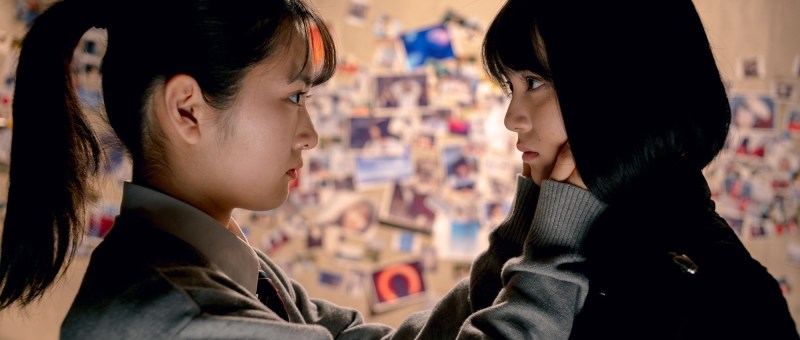
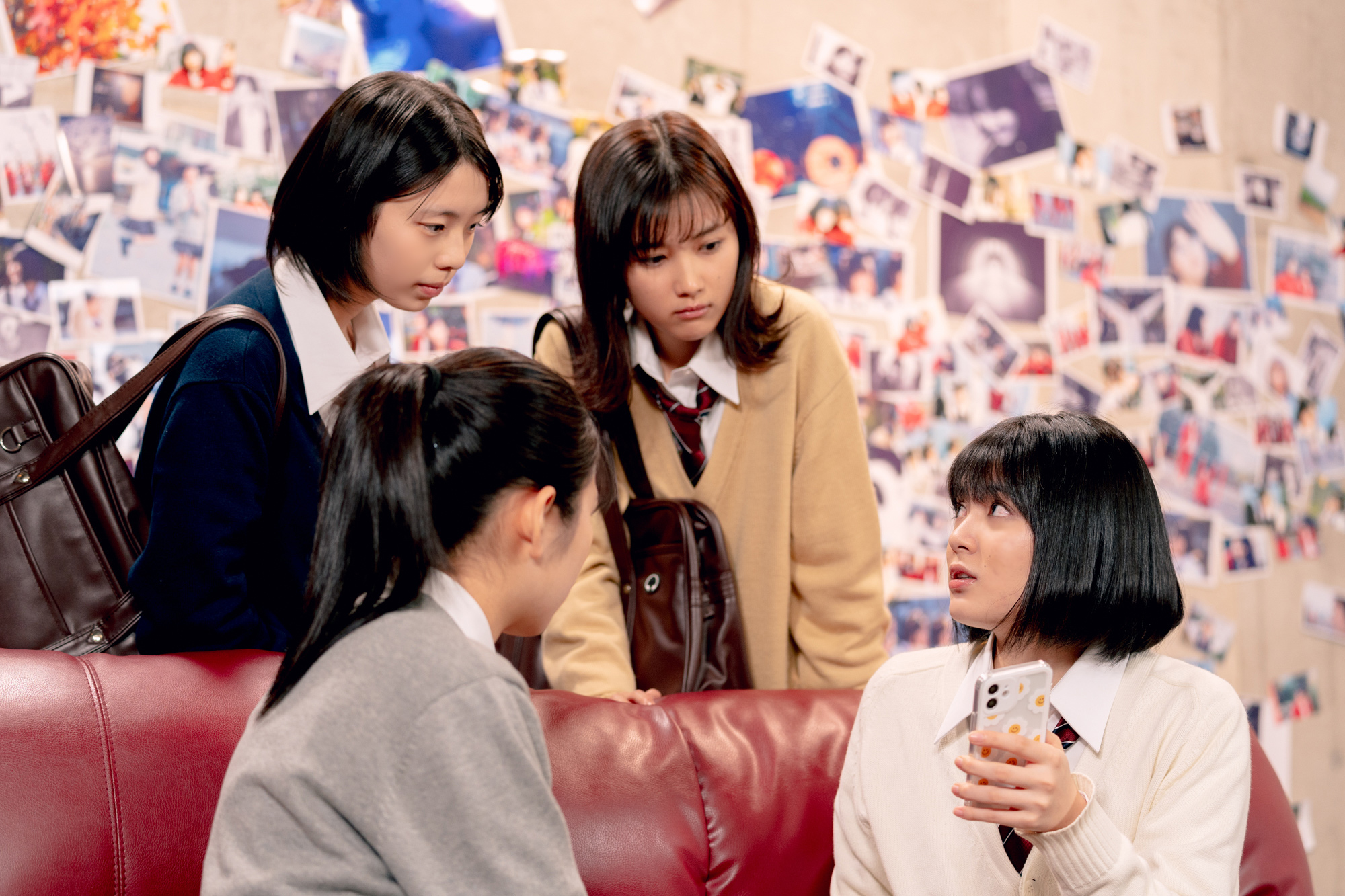
Four teenage girls unexpectedly find themselves with superpowers during the Covid-19 pandemic, but largely struggle with just the same problems as everyone else in Shinichi Fujita’s sci-fi-inflected high school dramedy Mayhem Girls (メイヘムガールズ). Despite the implications of the title, mayhem is not exactly the girls’ vibe though they each in their own way challenge the oppressive social norms of those around them later depressed by the realisation that they’ll soon have to go back to being “normal” and lose this brief respite they’ve been given from the rigours of high school life. 

The girls are already close to boiling point with the pressures of the pandemic as the teachers (ironically) yell at them to use hand sanitiser and social distance. The final straw seems to be the announcement that the Cultural Festival will be going online. That might be one reason why popular girl Mizuho (Mizuki Yoshida) suddenly snaps when her teacher catches her reading Twitter on her phone rather than studying. Miss Sawaguchi (Maako Miwa) is young and somewhat timid, unable to exert her authority over the class which is largely uninterested in her attempt to read out articles from English-language magazines. What’s the point, Mizuho wonders, in learning English if you can’t go abroad anyway? Sawaguchi takes this opportunity to reprimand Mizuho as a means of asserting her control but it backfires as something strange happens when she confiscates the phone. Sawaguchi’s hand stops mid-air allowing Mizuho to simply reclaim it while she runs out of the room as if in pain. 

This is only the first inkling that Mizuho has gained unexpected powers of telekinesis though she struggles to understand what happened, certain that she didn’t touch Miss Sawaguchi and confused that she seems to be talking about “violence” and displaying bruises on her wrists. In any case, the event loses her her phone which is akin to a kind of social death for a teenage girl. Her powers have, however, brought her to the attention of Tamaki (Amane Kamiya) who is a telepath, or more accurately given her an excuse to make contact for as it turns out Tamaki has long been carrying a torch for the oblivious Mizuho who is hung up on the student who was her tutor in middle school, Yusuke (Taisei Kido). Soon they are joined by two more girls, Akane (Manami Igashira) who can teleport, and Kei (Hina Kikuchi) who can read the minds of machines, in a kind of after school superpower club. 

Though they eventually become good friends, the relationship between the girls is strained by their differing views on their powers and by Mizuho’s concurrent obsession with Yusuke who is now a part-time delivery rider struggling to find a full time job in the middle of the pandemic. Using Kei’s powers to track him down she waits outside his house for him to come back and inserts herself into his life. Though he seems as if he’s about to remind her that her behaviour is inappropriate, Yusuke eventually goes all in on Mizuho after learning of her powers and asks her to use them to rob a bank so he can forget about his employment woes. 

There are many things you shouldn’t do for a boy and robbing a bank is very high on the list, though perhaps merely a more extreme version of a lesson typically learned in adolescence. In any case, this is far as Mizuho is pushed to the dark side. Other than that, none of the girls really consider using their powers for evil ends with even Tamaki admitting that she has thought about poking around in Mizuho’s head but feels it would be wrong to do so. It’s Tamaki who draws the short straw in being largely unable to articulate herself even by using her powers before eventually trying to communicate in images only to be robbed of the power to do so at the very last second when she’s reduced to being “normal” once again. 

“Normality” does seem to resume for them, each of the girls heading back to their own individual cliques having seemingly learned little from their experiences save Tamaki who is left with a lingering sadness. Perhaps what they’ve been through is a kind of mayhem, a period of chaos provoked by the pressures of the pandemic along with oppressive teachers and the regular teenage issues of unrequited love and romantic disappointment but they’ve returned to “normal” all too quickly leaving precious little time to meditate on the results of their flirtation with superpowers and psychic abilities in a world in which normality itself is both somewhat illusionary and infinitely oppressive.


Mayhem Girls screened as part of this year’s New York Asian Film Festival.

Original trailer (no subtitles)