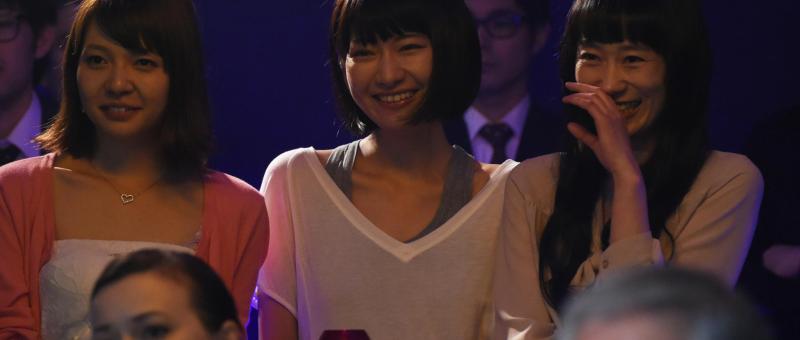
The Legend & Butterfly (レジェンド&バタフライ, Keishi Otomo, 2023)

“What was everything for?” an ageing Nobunaga (Takuya Kimura) asks his attendant Ranmaru (Somegoro Ichikawa) towards the conclusion of Keishi Otomo’s historical epic, The Legend & Butterfly (レジェンド&バタフライ, Legend & Butterfly) produced in celebration of Toei’s 70th anniversary. Oda Nobunaga is such a prominent historical figure that his story has been told countless times to the extent that his legend eclipses the reality, but rarely has been he depicted so sympathetically as in Otomo’s history retold as romantic melodrama in which he and his wife, Lady No (Haruka Ayase), are mere puppets of the times in which they live dreaming only of a place beyond the waves where they might be free of name or family. 

Tellingly, Otomo opens in the spring of 1549 in which the dynastic marriage was arranged to broker peace between unstable neighbouring nations Owari and Mino. Nobunaga’s father’s health is failing and he fears in the chaos of his death Mino may attack, while No’s father fears that her brother will soon revolt against him plunging the fiefdom into disarray and therefore vulnerable to an attack by Owari. At this point, Nobunaga is known as “the biggest idiot in Owari,” a foppish dandy who cares only about appearances. As he prepares to meet No, his courtiers apply his makeup and do his hair while dressing him in a rather outlandish outfit No immediately insults as “foolish”. He treats her with chauvinistic disdain, barely speaking save to order her to pour the drinks and give him a massage only for her to point out that she’s been travelling all day and a “thoughtful” considerate husband would be giving her a massage instead. “I detest women who do not know their place,” he snaps. “I detest men who are ignorant,” she counters. The wedding night ends in humiliating failure as No demonstrates her martial arts skills and Nobunaga is forced to call his guards to rescue him. 

Little is known of Lady No in historical record, but here she is bold and defiant, as her father had said too free with her opinions for a woman of the feudal era. She claims to have been married twice before and assassinated both husbands on her father’s orders, implying that she is essentially sleeper agent more than hostage and will kill Nobunaga without a moment’s thought as soon as the word is given. Yet she also begins to guide her husband towards his destiny, mocking him as a fool but giving him useful strategic advice that wins him glory on the battlefield along with the political advancement that led him to become the first great unifier of Japan. For all that they “hate” each other, they are well matched and have a similar sensibility that allows them first to become allies and then friends before frustrated lovers.

But their love is enabled only when they escape the feudal world, shaking off their retainers to go on a “normal” date in Kyoto where they dance to Western musicians and taste foreign candy only to end up accidentally massacring some peasants when No’s martial arts training kicks in trying to stop a man beating his son. Even so, they are forever linked by their time in Kyoto in the romantic talisman’s of a carved wooden frog and a European lute even if the blood-spattered jizo and buddhist statue watching their eventual connection imply there will be a reckoning for all the blood that is spent. Jumping on a few years, the film does not elaborate on what caused Nobunaga to become a man without a heart and lose the love of his most trusted ally but positions his transformation into the “Demon King” as the kernel of his undoing just as his dream of unifying Japan and bringing about an age of peace (if one ruled by fear) is about to become a reality. 

In any case, the one thing that everybody knows about Nobunaga is how he died though then again his remains were never recovered giving rise to a happier ending in which he and Lady No were finally able to escape the feudal world to chase a freer future beyond the sea which is perhaps what they do in the film’s poetic final sequence in which they might in a sense share a dream connected by frog and lute. It might not be very historically accurate, but that is perhaps the point in hinting at the lives they might have led if the world had been different. Otomo films with a painterly eye that lends an air of poignant gravitas to a tale of romantic tragedy in which love is both salvation and destruction amid the flames of a collapsing temple. 


The Legend & Butterfly screened as part of this year’s JAPAN CUTS.

Original trailer (English subtitles)
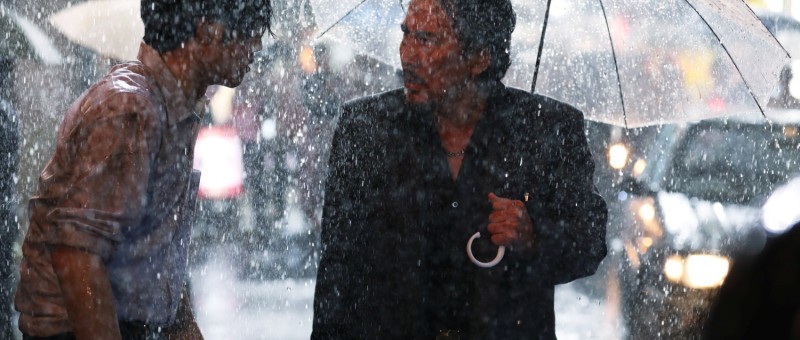
The Blood of Wolves (孤狼の血, Kazuya Shiraishi, 2018)

korou_honpos_0220_fin.aiJapanese cinema, like American cinema, is one of the few in which the hero cop is a recognisable trope. Though they may be bumbling, inefficient, obsessed with bureaucracy, or perhaps just lazy, police in Japanese cinema are rarely corrupt or actively engaged in criminality. Even within the realms of the “jitsuroku” gangster movie, the police maintain a fringe presence, permitting the existence of the underground crime world in order to contain it. “Jitsuroku” is, in a fashion, where we find ourselves with Kazuya Shiraishi’s throwback underworld police story, The Blood of Wolves (孤狼の血, Koro no Chi). Set in 1988, the end of the Showa Era which had seen the rebirth of post-war Japan and the ascendency of yakuza thuggery, The Blood of Wolves is based on a novel by Yuko Yuzuki rather than a “true account” of life on the frontlines of gangsterdom, but otherwise draws inspiration from the Battles Without Honour series in updating the story of nihilistic yakuza violence to the bubble era.

In 1988, a young accountant “goes missing” sending his sister to ask the police for help in locating him. The case gets passed to sleazy detective Ogami (Koji Yakusho) and his new rookie partner, Hioka (Tori Matsuzaka). Ogami leers disturbingly at the dame who just walked into his office before dismissing the newbie and extracting a sexual favour from the distressed relative of the missing man. Unfortunately, the accountant turns up dead and the bank he worked for turns out to be a yakuza front caught up in a burgeoning gang war between the Odani with whom Ogami has long standing connections and the gang from the next town over who are looking to increase their territory.

Ogami, a chain smoking, hard drinking, womanising detective of the old school, has one foot in the yakuza world and the other on the side of law enforcement. Hioka, a recent graduate from the local but also elite Hiroshima University (something of a rarity in his current occupation), is not quite sure what to make of his new boss and his decidedly “unorthodox” methods, becoming increasingly concerned about the way the police force operates in a town defined by organised crime. Deciding that Ogami has gone too far, he eventually makes the decision to go to IA with a list of complaints but there’s still so much he doesn’t know about Hiroshima and it is possible he may have picked the wrong side.

What he discovers is that the police force is so intrinsically rotten as to have become little more than a yakuza gang itself, only one with the legal right to carry guns and a more impressive uniform. Ogami, for all his faults, apparently has his heart in the right place. His “friendships” with gangsters are more means to an end than they are spiritual corruption, gaining leverage that will help him keep a lid on gang war – after all, no one wants a return to the turbulent days of the 1970s when the streets ran red with the blood of unlucky foot soldiers and that of the civilians who got in their way. Meanwhile Hioka, starting out as the straight-laced rookie, is himself “corrupted” by the corruption he uncovers, developing a complex mix of disgust and admiration for Ogami’s practiced methods of manipulation which, apparently, place public safety above all else.

Ogami, as he tells the conflicted Hioka, knows he walks a tightrope every day, neatly straddling the line between cop and yakuza, and the only way to stay alive is to keep on walking knowing one slip may lead to his doom. He may say cops can do whatever they like in pursuit of “justice” (and he does), but Ogami has his lines that cannot be crossed, unlike others in his organisation who care only for themselves and have long since given up any pretence of working for the public good.

Shiraishi channels classic Fukasaku from the noticeably retro Toei logo at the film’s opening to the voice over narration, garish red on screen text, and frequent use of freeze frames familiar from the Battles Without Honour series and associated “jitsuroku” gangster fare that followed in its wake. Moving the action up to 1988, the gangster world is once again in flux as it tries to corporatise itself to get in on the profits of bubble era prosperity which largely has no need for the thuggish gangster antics of the chaotic post-war years in which the yakuza could paint itself as a defender of the poor and oppressed no matter how ridiculous it might have been in reality. Ogami is a dying breed, a relic of the Showa era meeting its natural end, but perhaps you need to be a wolf to catch a wolf and guardian spirits can come in unexpected forms.


Screened at the 20th Udine Far East Film Festival.

Original trailer (English subtitles)

Dawn of the Felines (牝猫たち, Kazuya Shiraishi, 2017)

dawn of the felines poster largerTowards the end of the 60s and faced with the same problems as any other studio of the day – namely declining receipts as cinema audiences embraced television, Nikkatsu decided to spice up their already racy youth orientated output with a steady stream of sex and violence. The Roman Porno line took a loftier approach to the “pink film” – mainstream softcore pornography played in dedicated cinemas and created to a specific formula, by putting the resources of a bigger studio behind it with greater production values and acting talent. 40 years on Roman Porno is back. Kazuya Shiraishi’s Dawn of the Felines (牝猫たち, Mesunekotachi) takes inspiration from Night of the Felines by the Roman Porno master Noboru Tanaka but where Tanaka’s film is a raucous comedy following the humorous adventures of its three working girl protagonists, Shiraishi’s is a much less joyous affair as he casts his three lonely heroines adrift in Tokyo’s red light district.

Masako (Juri Ihata), Rie (Michie), and Yui (Satsuki Maue) are best friends, though they don’t even know each other’s real names. They each work for a shady escort agency in Tokyo’s red light district where they’re ordered and dispatched by their two-bit hustler of a manager Nonaka (Takuma Otoo) and driven around by the assistant who it turns out has been secretly filming them and posting the videos on YouTube as a kind of exposé on the sex trade.

Each of the women “has their tale to tell” as one puts it but none of them are particularly unhappy in their work, prostitution is simply their way of life and to that extent completely normalised. It does, however, interfere with their ability to form relationships, not just practically but emotionally. For unclear reasons possibly connected to debt collection Masako is technically homeless despite the large amounts of money she can earn, sleeping in cheap motels or all night manga cafes and carting all of her worldly possessions around with her in a tiny carry on size suitcase on wheels. One of her regulars, a millionaire shut in (Tomohiro Kaku), offers to let her stay with him but their relationship is strange and strained – somewhere between business and pleasure with the lines permanently unclear.

Rei, by contrast, is saddled with an elderly client who usually just wants to talk but eventually takes things in an extreme direction. Her path into prostitution is in a sense more positive even if it stems from a kind of vengeance in that the feeling of being needed and providing a valuable service gives her life meaning.

Yui looks for meaning through romance but rarely finds it thanks to the various potential mates she meets through her work. Yui’s young son Kenta has worrying bruises on his face, arms and torso, rarely speaks, and is frequently abandoned by his mother who pays a shady guy to look after him while she spends her time looking for love.

Working for a lenient agency the girls are more or less free agents rather than abused street walkers trapped by debt-bondage and could quit any time they wanted. Yui and Masako may be looking for an escape from this dead-end world – Yui at least is conscious of her age and the declining bookings, but neither names that as something that they are actively pursuing. Rei, by contrast, has made her escape already but has travelled in the opposite direction – from stifling bourgeois life to Belle du Jour liberation, but her eventual destination may be a much darker one than she’d anticipated.

This darkness hovers round the edges as the threat of violence is only ever indirectly expressed or fetishised as in a sequence led by Yui’s possible new partner and the bondage club he works at as one half of a warmup manzai act. Only towards the end does its reality finally surface, making plain how vulnerable and unprotected the women remain whilst on the job. Far from the liberated laughter of Night of the Felines, Shiraishi’s film traps its women with their own despairs as they wallow in an inescapable well of loneliness, satisfying the needs of others but unable to satisfy their own. Bleak but subtly ironic, Dawn of the Felines finds no joy in the sun rising, only the relief of the end of a working day as its three stray cats wander the streets looking for their place to belong.


Dawn of the Felines was screened at the 17th Nippon Connection Japanese Film Festival.

Original trailer (English subtitles)