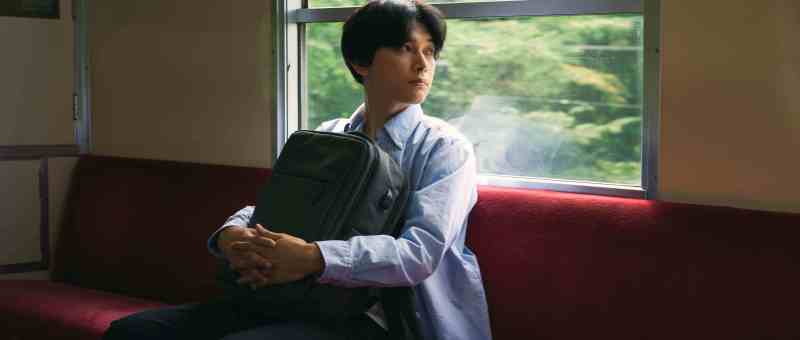
Living in Two Worlds (ぼくが生きてる、ふたつの世界, Mipo O, 2024)

Mipo O had been quietly building a reputation as one of Japan’s most promising young indie directors with such lauded films as The Light Shines Only There but has been on an extended hiatus since 2015’s Being Good. Living in Two Worlds (ぼくが生きてる、ふたつの世界, Boku ga Ikiteru, Futatsu no Sekai) marks her return to filmmaking after taking a break to raise a family and, adapted from from an autobiographical book by Daisuke Igarashi, not only explores the realities faced by the deaf community but the complicated relationship between a son and his mother.

Indeed, at times the issue is less that both of Daisuke’s (Ryo Yoshizawa) parents are deaf as it is that he does not listen. When he becomes a teenager, his mother Akiko (Akiko Oshidari) spends a huge amount of money on a high tech hearing aid because she wants to hear his voice, though most of what he says to her is hurtful and unpleasant. His older self is probably regretful, ashamed of the way he treated his mother in particular but also in regards to his rejection of his family because he felt embarrassed by their difference in what is a fiercely conformist culture. He doesn’t give his mother a letter about parents’ day because he doesn’t want her to come and also thinks it would be pointless because she wouldn’t be able to hear anything anyway. Later he tries to get his grandmother to come with him to a parent teacher meeting about his plans for high school and beyond, telling his mother she’d only be in the way. In fact, the meeting is quite awkward because the teacher talks directly to him without trying to include Akiko while Daisuke makes infrequent signs under the table as if embarrassed to have the teacher see them.

As a young child, Daisuke had interpreted for his mother using sign language publicly despite the awkward attitude towards it at home. His grandmother writes things down on paper instead, telling him that it’s too difficult for her to learn. That doesn’t make sense to his young brain as after all he’s picked it up since birth. But this early tension perhaps contributes to his increasingly conflicted feelings. When he brings a friend home, he asks him why his mother speaks in such a funny way but of course it’s normal to Daisuke and this perhaps innocent question begins to cement for him that his family isn’t “normal” and he isn’t like the other children. Resentment towards his mother only grows to the point he begins to blame all of his problems on her including his failure to get into the better high school though she has done nothing but support and encourage him. As she points out, she never had any choice about her schooling and received little education because her parents thought she’d recover her hearing and refused to send her to a specialist school until she was 14 meaning she was just sat there all day twiddling her thumbs while unable to make friends with hearing children who mostly ignored her.

The parents were also against the idea of her marrying her husband Yosuke (Akito Imai) because he was also deaf, nor did they support their decision to have a child believing two deaf parents would not be able to raise one safely or effectively. Such attitudes lay bare the lingering stigma towards disability which remains even within the family unit. Unable to separate himself from being the child of working class deaf parents, the teenage Daisuke abruptly moves to Tokyo with a vague idea of becoming an actor signalling his internal search for an independent identity. The film hints that his liminal status existing between the worlds of the hearing and the deaf has left him with subpar communication skills as seen in his repeated faux pas at job interviews until he finally tells the truth and is offered a job on the spot. There’s an intimacy involved in his interactions with his parents which often can’t be understood by others, but also a less pleasant undercurrent in the way these interplay with speech and his own decisions of when to switch between dialogue and sign. 

Having gone to Tokyo to escape being the child of deaf parents, he discovers that being “ordinary” doesn’t really suit him either and only begins to accept his identity after meeting a deaf woman at a pachinko parlour who invites him to her class for learning sign language in a more a formal way while another of her pupils gently explains to him that though he means well he sometimes does them a disservice by taking over as a hearing person when he should let them do the things they can do for themselves. The absence of musical score and variation in the sound mix emphasise Daisuke’s transition between worlds and his own attempts to locate himself within them eventually discovering the equilibrium that allows him to realise he was the one who couldn’t hear along though his mother had always been talking to him. Touching but resisting sentimentality, O’s poignant drama never shies away from the failings of its protagonist but equally from those of the society within which he lives that can itself be unwelcoming of difference.


Living in Two Worlds screened as part of this year’s BFI London Film Festival

International trailer (English subtitles)

(Ab)normal Desire (正欲, Yoshiyuki Kishi, 2023)

There’s a pun embedded in the Japanese title of Yoshiyuki Kishi’s heartfelt drama (Ab)normal Desire in that first character in the word for “sexual desire” (seiyoku, 性欲) has been replaced by one that can be read the same but has the meaning of “correct”, or “proper”. But “normal” is also relative construct that implies conformance with the majority even if that may not actually be the case. As one of the protagonists later remarks “everyone is pervy” though they themselves feel such a degree of shame and otherness that it’s largely prevented them from living any kind of life at all.

In that sense it may be hard to understand why a fetish for water would invite such severe self-loathing in that it causes no harm to others if admittedly resulting in ridicule if exposed. Then again, society can be a fierce watchdog. Department store shop assistant Natsuki (Yui Aragaki) is taken to task by her pregnant colleague who refuses to take her seriously when she says she’s not really interested in getting a boyfriend before giving her a lecture about her biological clock. Though Natsuki appears uninterested in her vacant prattling, the woman later becomes upset and harshly tells her that she was only trying to be “nice” because she felt “sorry” for her and that making people be nice to you in this way is actually a form of harassment which, whichever way you look at it, is some particularly twisted logic.

Her alienation seems to stem from the fact that she feels “abnormal” and that her fetish for water is a part of herself she must be careful to hide. Her parents watch a news report on Tokyo Rainbow Pride and marvel at the idea that there are now choices other than marriage and children but even among the young there remains confusion and shame amid an inability to reconcile the seemingly opposing concepts of “normality” and “diversity” as they struggle to define themselves. A plan to have a male dancer who usually dances in a masculine style dance in a more feminine way backfires when he points out that asking someone to dance in a way they don’t want to doesn’t really do much to advance “diversity”.

But diversity isn’t considered an ideal by all and parents of young children find themselves confused and conflicted when their kids begin to reject conventionality at an early age by asking to withdraw themselves from school and instead focus on other kinds of education that align with their interests. Challenged by his wife about why he never listens to their son’s concerns, prosecutor Hiroki (Goro Inagaki) replies that he should “just be normal” and later describes people who are “unable to live normal lives” as bugs in the system which must eradicated. A symbol of lingering authoritarianism, Hiroki is an intensely conservative man obsessed with properness who thinks it’s his job to decide which crimes everyone is guilty of rather than make any attempt to understand the world around him outside of binary terms like right and wrong or normal and abnormal. When his assistant passes him information on fetishes as a potential explanation for the case of a man who repeatedly steals taps, he simply rolls his eyes and dismisses it.

Yet he perhaps has his own fears and internalised shame as evidenced by his outrage on discovering that another man has been coming to the house to help his wife with tech setup for their son’s new outlet in livestreaming and not only that, he was able to blow up the balloons that Hiroki himself failed to inflate. It’s his rigid authoritarianism that eventually alienates his wife and son who come to see him only as an oppressive bully unable to accept anything that differs from his own definition of “normal”. Finally, he’s the one who is isolated, imprisoned by his own repression and lack of understanding or unwillingness to accept those around him.

Even so, despite its positive messages that no one should feel themselves alone or that society has no place for them the film muddies the waters by introducing fetishes that are necessarily problematic in that they cause harm to others who do not or cannot consent and could not and should not be accepted by mainstream society though oddly those that have them seem to feel less shame only fearing being caught because acting on their desires is against both moral and judicial laws. In any case, in discovering togetherness, that they are not alone, those who feel their desires to be “abnormal” can begin to ease their loneliness and find a place for themselves in an often judgemental world.


(Ab)normal Desire screened as part of this year’s Toronto Japanese Film Festival.

Original trailer (English subtitles)

Wilderness (あゝ、荒野, Yoshiyuki Kishi, 2017)

wilderness posterWhen Shuji Terayama published his only novel in 1966, Japan was riding high – the 1964 Olympics had put the nation back on the global map and post-war desperation was beginning shift towards economic prosperity. In adapting Terayama’s jazz-inspired avant-garde prose experiment for the screen, Yoshiyuki Kishi updates the action to 2021 and a slightly futuristic Tokyo once again feeling a mild sense of post-Olympic malaise. Terayama, like the twin heroes of Wilderness (あゝ、荒野, Ah, Koya), got his “education” on the streets of Shinjuku, claiming that more could be learned from boxing and horse races than any course of study. Both damaged young men, these lonely souls begin to find a place for themselves within the ring but discover only emptiness in place of the freedom they so desperately long for.

Shinji (Masaki Suda), abandoned to an orphanage by his mother after his father committed suicide, has just been released from juvie after being involved in a street fight which left one of his best friends paralysed. Discovering that his old gang won’t take him back he’s at a loss for what to do. Meanwhile, shy barber Kenji (Yang Ik-june) who stammers so badly that he barely speaks at all, is battling the possessive stranglehold his drunken, violent ex-military father weilds over him. Raised in Korea until his mother died and his father brought him back to Japan, Kenji has always struggled to feel a part of the world he inhabits. The two meet by chance when Shinji decides to confront the man who attacked his gang, Yuji (Yuki Yamada) – now an up and coming prize fighter. Shinji is badly injured by the professional boxer while Kenji comes to his rescue, bringing them to the attention of rival boxing manager Horiguchi (Yusuke Santamaria) who manages to recruit them both for his fledgling studio.

The Tokyo of 2021 is, perhaps like its 1966 counterpart, one of intense confusion and anxiety. Plagued by mysterious terrorist attacks, the nation is also facing an extension of very real social problems exacerbated by a tail off from the temporary Olympic economic bump. As the economy continues to decline with unemployment on the rise, crime and suicides increase while social attitudes harden. In an ageing society, love hotels are being turned into care homes and wedding halls into funeral parlours. The elder care industry is in crisis, necessitating a controversial law which promises certain benefits to those who commit to dedicating themselves either to the caring professions or to the self defence forces.

Yet nothing much of this matters to a man like Shinji who ignores the crowds fleeing in terror from the latest attack in favour of “free” ramen left behind by the man who recently vacated the seat next to him out of a prudent desire to make a speedy escape. Shinji takes up boxing as way of getting public revenge on Yuji but also finds that suits him, not just as an outlet for his youthful frustrations but in the discipline and rigour of the training hall as well as the camaraderie among the small team at the gym. Kenji, by contrast, is kind hearted and so shy he can barely look his opponent in the eye. He comes to boxing as a way of finally learning to stand up for himself against his bullying father, but eventually discovers that it might be a way for him achieve what he has always dreamed of – connection.

Asked why he thinks it is we’re born at all if all we do if suffer and long for death, Kenji replies that must be “to connect” though he has no answer when asked if he ever has. For Kenji boxing is a spiritual as well as physical “contact sport” through which he hopes to finally build the kind of bridges to others that Shinji perhaps builds in a more usual way. Shinji tells himself that the only way to win is to hate, that in boxing the man who hates the hardest becomes the champion but all Kenji wants from the violence of the ring is love and acceptance. Shinji’s friend, Ryuki (Katsuya Kobayashi), has forgiven the man who crippled him and moved on with his life while Shinji is consumed by rage, warped beyond recognition in his need to prove himself superior to the forces which have already defeated him – his father’s suicide, his mother’s abandonment, and his friend’s betrayal.

While Shinji blusters, shows off, and throws it all away, Kenji patiently hones his craft hoping to meet him again in the boxing ring and “connect” in the way they never could before. There’s something essentially sad in Kenji’s deep sense of loneliness, the sketches in his notebook and strange relationship with an equally sad-eyed gangster/promoter (Satoru Kawaguchi) suggesting a hankering for something more than brotherhood. Nevertheless what each of the men responds to is the positive familial environment they have never previously known, anchored by the paternalism of coach Horiguchi and cemented by unconditional brotherly love.

Caught at cross purposes, the two young men battle each other looking for the same thing – a sense of freedom and of being connected to the world, but emerge with little more than scars and broken hearts, finding release only in a final transcendent moment of poetic tragedy. Kishi’s vision of the immediate future is bleak in the extreme, a nihilistic society in which hope has become a poison and death its only antidote. A tragedy of those who want to live but don’t know how, Wilderness is a minor miracle which proves infinitely affecting even in the depths of its despair.


Screened at Nippon Connection 2018.

Original trailer (no subtitles)

Interview with director Yoshiyuki Kishi conducted at the Busan International Film Festival (Japanese with English subtitles)