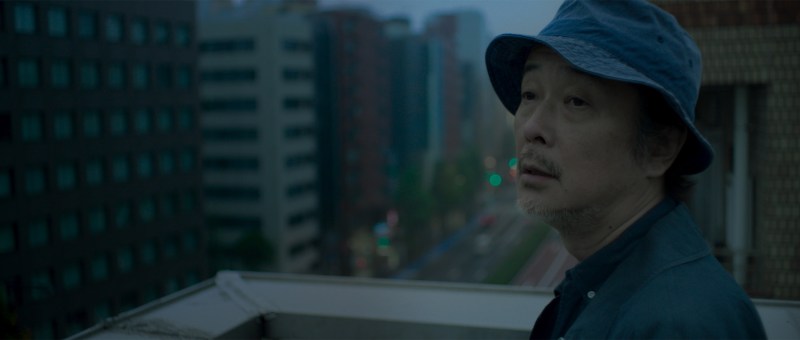

Cottontail (コットンテール, Patrick Dickinson, 2023)

A recently bereaved widower travelling to Lake Windermere to scatter his wife’s ashes begins to reclaim an image of family in Patrick Dickinson’s melancholy character study, Cottontail (コットンテール). Having travelled to the Lake District in her childhood to visit her father who was working in the UK at the time, Akiko (Tae Kimura) recalled fondly a sense of familial connection symbolised by a photo she believes to have been taken on the lake’s shores and continued to wear a Peter Rabbit necklace right to her dying day.

In a poignant note to her husband Kenzaburo Lily Franky) written before her dementia worsened and left with a Buddhist priest until the time of her death, Akiko expresses regret that they were never able to go there again as a family while she was alive but would like him to scatter her ashes on Lake Windermere in the company of their Son, Toshi (Ryo Nishikido), who now has a wife and daughter of his own.

As we can see from the opening scenes, Kenzaburo is a man living at odds with the world around him. Emotionally distant, he finds it difficult to relate to his son and often quite literally shuts him out leaving Toshi hurt and resentful. To begin with, Kenzaburo insists he will go to Lake Windermere on his own and only later agrees to allow Toshi and his family to accompany him, making all the travel arrangements. Once there, however, he becomes impatient and after a minor argument over the itinerary takes off alone only to get on the wrong train and end up on the opposite side of the country as he’s kindly informed by a raucous hen party on their way to York. Forced to rely on the kindness of strangers, he’s taken in by a farmer (Ciarán Hinds) and his daughter (Aoife Hinds) who have suffered a bereavement themselves and attempt to help him process his loss while encouraging him to reconcile with his son. Presenting a kind of mirror he may bounce off while mediating these complex emotions in a second language allows Kenzaburo the opportunity to confront himself and his grief along with his feelings of inadequacy as a husband and father.

We can sense his own regret in a flashback to a meeting in a cafe shortly after Akiko was diagnosed with dementia in which she looks to Kenzaburo for reassurance but he remains in denial. She tells him that she’s afraid and can’t bear the idea of losing her family or becoming a burden to them but he simply tells her that it won’t come to that as if he were closing himself off to the reality but also from her in leaving Akiko alone to deal with her fear and loneliness in refusal to confront anything that is emotionally difficult or unpleasant. Yet Kenzaburo refuses to relinquish her memory, stubbornly carrying her ashes in a tea tin and at times holding it up as if he were showing her around and attempting to share this trip with her in a more literal way.

What threatens to devolve into a more conventional road trip drama in which Kenzaburo is helped on his way by a series of improbably kind and sagacious strangers develops into something deeper as he trudges his way through the English countryside which as it turns out is not all that aesthetically different from that of Japan and largely free of the often claustrophobic hedgerows that literally separate us from the surrounding scenery. The landscape further recalls scenes from Kenzaburo’s life as he begins to reflect on his time with Akiko and confront the reality of her loss along with his new life without her.

In effect, he’s journeying towards a recreation of Akiko’s photograph and its capture of a brief moment of familial unity in a gradual process of reconciling with Toshi and his own position as a father. Quiet and unassuming, Dickinson’s film is less a slow voyage through grief and learning to let go as it is one of gaining courage to open a door that had long been closed, Kenzaburo no longer the melancholy octopus hiding deep in the ocean but a bobbing rabbit eager to experience more of the world around him before it’s too late.


Cottontail opens in UK cinemas 14th February courtesy of Day for Night.

UK trailer (English subtitles)
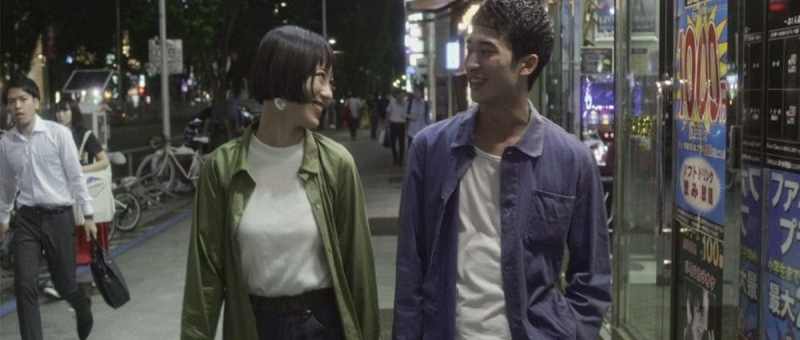
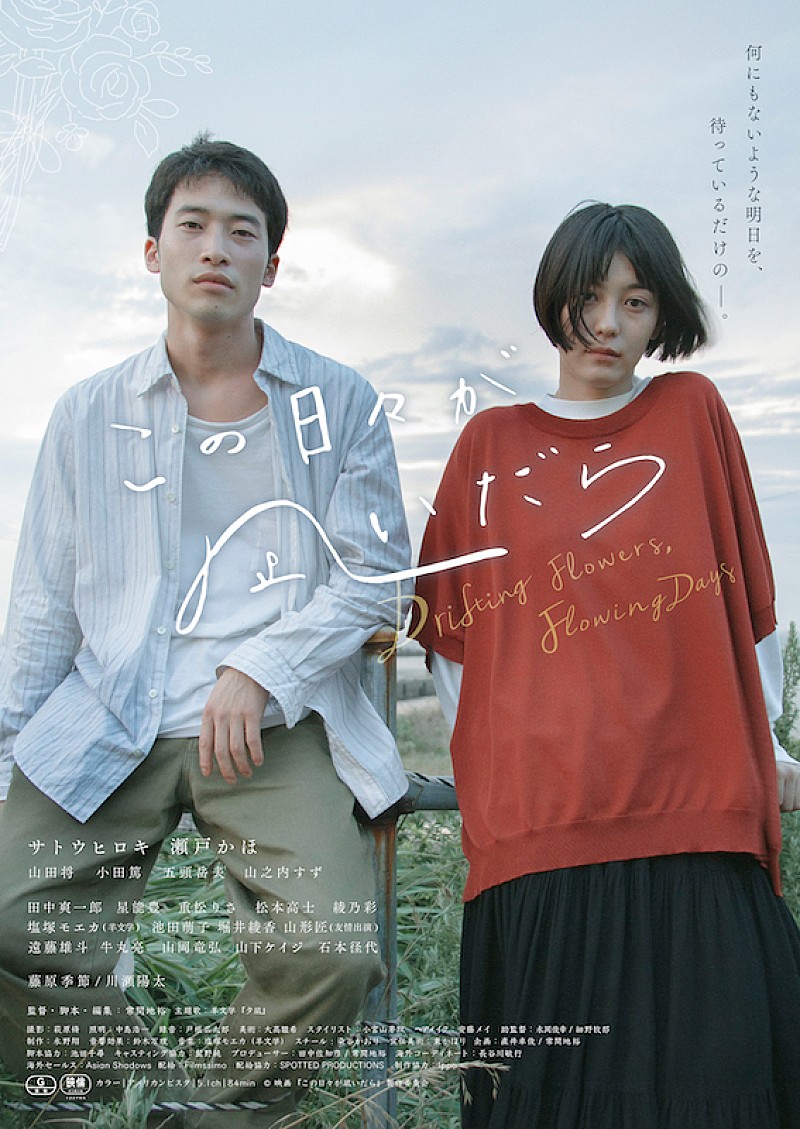
Drifting Flowers, Flowing Days (この日々が凪いだら, Yutaka Tsunemachi, 2023)

Life goes on as usual, until it doesn’t. The couple at the centre of Yutaka Tsunemachi’s debut feature Drifting Flowers, Flowing Days (この日々が凪いだら, Kono Hibi Ga Naidara), are about to hit the crisis of youth in which they begin to think seriously about their futures and fear that their lives can no longer continue simply as they were but also struggle to find direction while torn between what society views as a successful life and their own desires.

The crunch point comes when Hiroto (Hiroki Sato), a construction worker, and Futaba (Kaho Seto), who works in a florist’s, learn that their rundown apartment block is going to be demolished and they have six months to find somewhere else to live. While Futaba idly looks at wedding rings, she isn’t really sure how Hiroto views their relationship or if he’s even assuming they’ll finding somewhere new together. The financial strain of an unexpected move also has her wondering if she should give up her job in the florist’s, which she enjoys due to her love of flowers, and start looking for a regular company job but an attempt to talk about it with Hiroto only results in petulance born of male pride as he takes it as her complaining he doesn’t earn enough with his job as a casual labourer. 

Another source of friction is that Hiroto seems reluctant to meet Futaba’s family while refusing to introduce her to his hinting at longstanding childhood trauma stemming from a legacy of domestic abuse and a father who lost himself in drink. Even so, he’s drawn to an older man at work, Haruo, who soldiers on despite his decreasing physical capability. When he is unceremoniously fired, the Haruo takes his own life having lost his both his means of supporting himself and his sense of purpose. Haruo might remind him of father though Hiroto feels somewhat guilty that he didn’t do very much to help while he was alive and resentful towards his heartless boss and colleagues who did nothing more than make fun of him. 

This idea of people being disposable tools of corporate entities is further born out by the experiences of his hometown friend, Daigo (Masashi Yamada), who is feeling burned out by his dream job in the city largely thanks to a bullying boss and overbearing work culture. A friend who experienced something similar tells him she just quit her job and feels much better so if he doesn’t feel appreciated he should leave, but it’s not really that simple. Not only does he need a steady income to survive but there’s a degree of shame and trepidation in not following the conventional path, the same shame and trepidation that has Futaba worrying she’s being irresponsible in following her dream of opening a florist’s of her own rather than using her degree to get a better paid job and start saving for the next phase of adulthood while still uncertain if Hiroto is going to want to get married and settle down. 

Experiencing another crisis that forces him to confront his childhood trauma, Hiroto sighs that his future is shrouded in darkness and he wishes that it was all set out for him an ironic inversion of the crisis experienced by others his age that they resent being railroaded into a life of conventional success that in fact does not make them happy. In any case, he emerges with a little more clarity about the kind of future he might want no longer so frightened of commitment or suspicious of familial bonds. What the youngsters experience is a perhaps premature end to their youth symbolised by the literal tearing down of their world in the soon to be demolished apartment block that forces them out of their inertia and onto a path towards a more settled adulthood. But equally that doesn’t necessarily mean that they have to abandon their dreams or live up to an ideal of conventional success if it’s not what they want but can begin to find other futures for themselves outside of the mainstream that are valid and satisfying. Tsunemachi follows them with a hazy detachment but captures something of the anxieties of contemporary youth still struggling to find accommodation with demands of living in a judgmental and uncertain society. 


Drifting Flowers, Flowing Days screened as part of the 18th Season of Asian Pop-Up Cinema.

Original trailer (English subtitles)

Tea Friends (茶飲友達, Bunji Sotoyama, 2023)

Japan’s rapidly ageing society has provoked an epidemic of loneliness but also perhaps new business opportunities in Bunji Sotoyama’s empathetic social drama Tea Friends (茶飲友達, Chanomi Tomodachi). The phrase may sound innocuous enough, but given some potentially outdated cultural connotations the men who spot the advert cunningly placed in a newspaper to catch the eyes of older readers may have reason to assume that it’s more than just tea and chat on offer. Though as it turns out, it’s not just the old who are lonely as a younger generation in turn often in conflict with their parents also attempt to seek security and comfort in found family.

That said, there’s something a little cult-like about the way that Mana (Rei Okamoto), a former sex worker, talks about her organisation which aims to cure late life loneliness through what others might describe as an elderly sex ring. Employing a collection of older women, she accompanies them to meet new clients where they silently slide viagra over the table. The gentleman caller subscribes to a plan to purchase “tea” and anything that happens inside the hotel room they subsequently go to is just “free love” rather than “prostitution”. Mana sees herself as running a “community safety net” and helping elderly people who might otherwise have become isolated and depressed keep active as part of one big happy family along with the other members of staff who have, like her, become estranged from their parents and relatives. 

For Yoshiki, one of the men who escorts the ladies around, it’s that he views his father as a failure for leaving a well-paid corporate job to open a bakery which subsequently went bankrupt and has led to him living in his car. He thinks that in the end it’s better not to try at all than be left with the humiliation of things not working out. But then for Mana herself it’s more a sense of parental rejection. After a difficult childhood, her now terminally ill mother continues to reject her on the grounds of her history of sex work while she continues to crave the unconditional love of a family. Like a mother hen, she nestles those around her into the Tea Friends organisation which operates out of her own home and strives to create a place where everyone can feel they belong. 

Which is all to say she’s the loneliest one of all, but as someone else later cautions her you can’t cure your own loneliness with the loneliness of others. What she sees as a social enterprise others may see as a deliberate attempt to take advantage of vulnerable people who have admittedly been let down by an indifferent society and are in need of the money even more so than comfort or validation. At the other end of the spectrum, a young woman working at Tea Friends discovers that she is pregnant but her boyfriend immediately rejects her, insisting that he refuses to take responsibility and revealing that he is already married. Chika wants to have her baby, but everyone seems to be telling her that she shouldn’t. The doctors seem to look down on her after realising she isn’t married and the father most likely not in the picture, while an attempt to inquire about benefits at the town hall leads only to judgement as the clerk pithily tells her that they’re there for when you need them but she shouldn’t “depend” on them too much virtually calling her a scrounger and implying she’s been irresponsible in becoming a single mother. 

As another of the older women admits, being used was better than being ignored and at least being part of Tea Friends gave her a sense of purpose and acceptance if only for a time. In any case, Mana’s attempt to find unconditional love from her new “family” largely flounders as even those she’d come to believe herself close to desert her when the threat of legal proceedings enters the picture leaving her to face the music alone while she continues to protect them insisting that they’ve done nothing wrong even if it it was technically against the law. An old man’s devastation on picking up the phone and getting no answer suggests that Mana might have had a point when she said it was a social service seeing as no one else seems keen to tackle the problem of late life loneliness even if she did go about it in a problematic way. As Mana often says, righteousness does not equal happiness and it is often outdated social brainwashing that keeps people unhappy and not least herself as she struggles to find the unconditional love lacking in her life that would enable her to cure her own loneliness even in the prime of her youth.


Tea Friends screened as part of this year’s Camera Japan.

Original trailer (English subtitles)

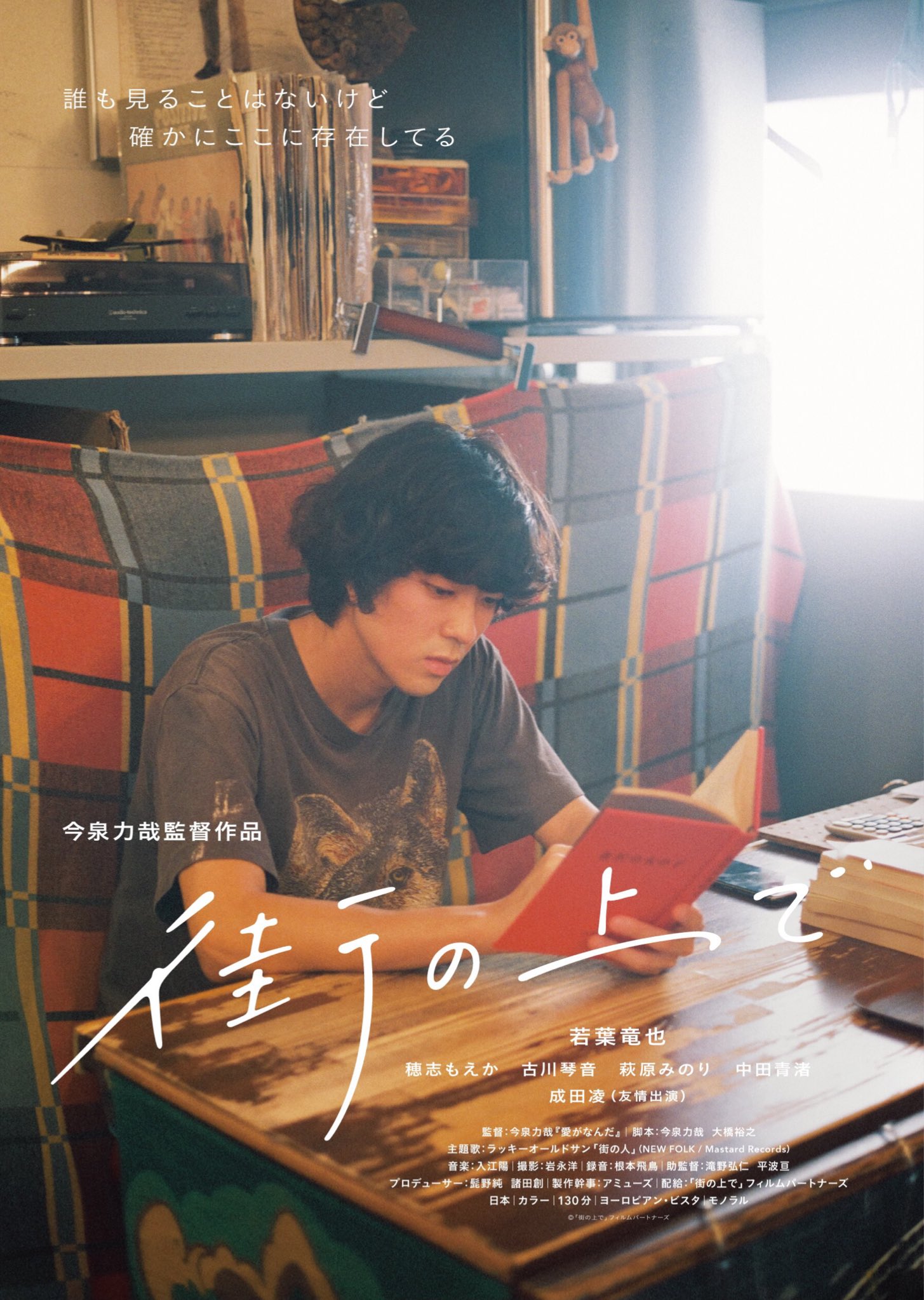
Over the Town (街の上で, Rikiya Imaizumi, 2019)

Frustrated youngsters chase an unrealisable dream of idealised romance in Rikiya Imaizumi’s ode to Shimokitazawa, Over the Town (街の上で, Machi no Uede). For the moment at least known as the bohemian, avant-garde artists quarter of the contemporary capital beloved for its slightly retro quality replete as it is with narrow lanes and period buildings, Shimokitazawa is also a place of constant change but as the hero later points out even if “parts change and disappear that doesn’t mean they never existed”. Nevertheless, he seems to be marked by a particular anxiety, as do many of his age struggling to make meaningful connections in an ever shifting world. 

Ao’s (Ryuya Wakaba) world begins to crumble when he’s unexpectedly dumped by his beloved girlfriend, Yuki (Moeka Hoshi), on her birthday. Unceremoniously telling him that she’s met someone else, Yuki rationalises that breaking up is the only option but Ao tries to resist only for her to tell him that he can go on deluding himself that he still has a girlfriend but from now on she’ll be hanging out with someone new. From then on, Ao seems to be surrounded by frustrated couples and worryingly outdated ideas of romantic politics such as those of the students who drop into the vintage clothing shop where he works. Ao assumes they’re a couple, but a row slowly brews as the girl, Asako, declares herself bored with helping the guy, Shigeru, try on clothes that turn out to be for the purpose of impressing a different girl altogether despite knowing that Asako fancies him. Eventually Shigeru makes a highly inappropriate suggestion, almost akin to a bet, that if the woman he has a crush on rejects him he’ll deign to dating her even though Asako is “a distant second” in his heart. The shocking thing is that Asako agrees, a slightly mournful look in her eyes as she finally reaffirms that she really hopes it works out with the other girl. 

Throughout the exchange during which Ao looks on as an awkward bystander, it becomes increasingly difficult to see what’s so great about Shigeru. Meanwhile, not even Ao comes off particularly well, struggling to deal with his breakup and refusing to accept Yuki has moved on. So hung up on her is he that she eventually ends up contacting the barman at his favourite haunt to ask him to have a word, explaining that it’s inappropriate to go on texting your ex even if she doesn’t reply. Meanwhile, he finds himself at the centre of romantic missed connection, captivated by a sad woman at a concert who gives him a menthol cigarette he keeps in his ashtray as a kind of talisman for the rest of the picture. Infinitely awkward, he talks himself out a potential date with the cute girl at his favourite used bookstore (Kotone Furukawa) by asking an inappropriate question, later doing something similar to a woman (Seina Nakata) with whom he makes a more platonic connection as they each reflect that for some strange reason it’s much easier to open up to someone you have no romantic interest in. 

Perhaps that’s why a melancholy policeman keeps stopping random people in the street to ask their advice on his peculiar romantic dilemma in having inconveniently fallen in love with his “niece” (by marriage and the same age as he is, so maybe it’s “OK”, he’d like to think). Shimokitazawa, which Ao rarely leaves, is indeed a small world, the various strands of his romantic entanglements strangely connected from a young woman’s unrequited longing for her sumo wrestler childhood sweetheart to a TV actor’s (Ryo Narita) troubled love life and a young film director’s (Minori Hagiwara) attempt to deflect her own sense of romantic disaffection. Just as Yuki used another man as an excuse to break up with Ao, Ao finds himself recruited as a fake boyfriend to help a young woman shake off a controlling ex whose refusal to accept the relationship is over in the absence of another man skews even darker than his own signalling perhaps like that first vintage shop exchange the dangerously outdated sexual politics which continue to underpin modern dating. Perhaps boring love is the real kind of fun, comfortable and balanced marked by true connection and mutual vulnerability rather than a giddy anxiety. A stubborn holdout where everything’s secondhand in a continual circulatory process of exchange and return, Shimokitazawa is the kind of place where love finds you even if it takes a while to wander on its way. A charming ode to this timeless yet ever-changing district, Imaizumi’s quirky dramedy keeps the neurosis of young love on the horizon but suggests that romance, like a well baked cake, keeps much better than you’d think when cooled.


Over the Town screened as part of the 2021 Osaka Asian Film Festival.

Original trailer (no subtitles)

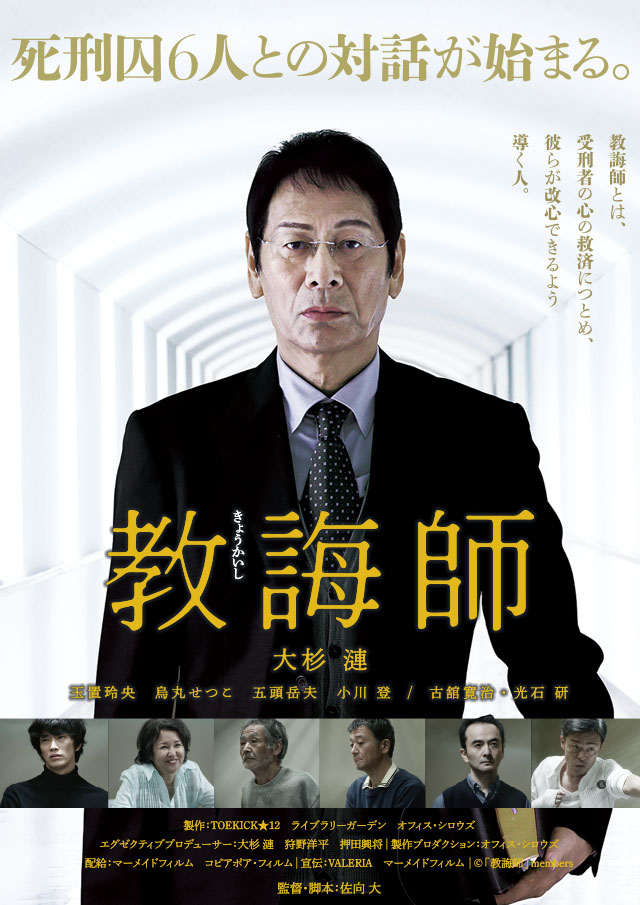
The Chaplain (教誨師, Dai Sako, 2018)

The Chaplian posterJapan is one of the few developed nations which still maintains the death penalty, though in practice infrequently. The sentence of death is handed down almost exclusively to mass or serial murderers, child killers, or those whose crimes are judged to be of extraordinary barbarity. Unlike other nations, Japan houses those on death row not in prisons but in detention centres, denying them the rights that are afforded to regular prisoners such as visitation, exercise, and entertainment. Execution must be carried out within five days of the judgement being handed down. The prisoner themselves is informed on the morning of their death and given a choice of last meal, but their family members, legal team, and the general public are only informed once it has taken place preventing any last minute attempts for a stay.

In what would be his final screen role (and his first as a producer), Ren Osugi stars as a prison chaplain, Saeki, attempting to guide a series of Death Row prisoners towards spiritual peace as they prepare to accept their judgement. Though none of the prisoners he visits protests their innocence, some are more repentant than others and not all of them have fully internalised the fact they will never leave the facility even when no further legal attempts to commute their sentences seem to be underway. Some might say there is an element of exploitation in sending a chaplain in at all seeing as this is literally a captive audience. The crimes which lead to being on Death Row are necessarily extreme, many prisoners either have no remaining family members or have been abandoned by them out of shame, leaving them intensely lonely and devoid of human contact (not even televisions or radios are permitted). They are therefore much more interested in conversation than they are in The Bible or accepting Jesus into their hearts.

Then again, Saeki’s first visit is to a man who says nothing at all, allowing him to fill the silence with some of his own backstory which hints at a personal trauma possibly informing his desire to save the souls of these unfortunate people. Another prisoner, by contrast, is all too eager to convert but, as Saeki soon realises, is almost entirely illiterate and therefore struggling to hear the word of God through being unable to read. Saeki does his best to help them, gently listening to their fears and worries but encounters a familiar series of social problems which made their fates inevitable stemming from entrenched poverty and social inequality.

Only six months into the job, he wonders if he’s really getting through and if his efforts are worthwhile. His most challenging prisoner is a young man convicted of a mass killing of those with learning difficulties (inspired by a real life case), whom he deemed to be a drain on national resources. A hyper-rational sociopath, Takamiya (Leo Tamaoki) baits Saeki with unassailable, coldhearted logic which asks why, if he’s happy enough to kill and eat “stupid” animals like cows and pigs, but not “clever” ones like dolphins, his application of the same logic to the human world can be wrong? If all creatures have an equal right to life, then killing for food is as wrong as any other kind of killing and the death penalty nothing more than state sanctioned murder. There is no rational answer for Takamiya’s philosophy and aside from his abhorrent, unfeeling rationality he may have a point when it comes to social hypocrisy. All Saeki can do is ask him to stand with the people that he killed, and acknowledge that God or no God, Saeki too will be with him until the very end.

If Takamiya begins to question the terrifying rationalism which led him to his truly barbaric act, he does so probably not because of Saeki’s ministrations but because of his proximity to death. Meanwhile, another prisoner, Suzuki (Kanji Furutachi), convicted of a stalker murder, seems to have picked up entirely the wrong message in coming to blame just about everyone else for his crime and absolving himself of responsibility. He might have found peace, but it is not the kind of peace he was supposed to find. Noguchi (Setsuko Karasuma), meanwhile, the only female prisoner, continues to talk about the future as if she really thinks she’s getting out. Only Shoichi (Takeo Gozu), an elderly man, seems to truly accept Saeki’s teachings though it is perhaps enough to make him feel as if he really is making a difference.

Sako opts for subtlety in pointing out the inherent hypocritical immorality of the death penalty and particularly in the context of the Japanese legal system which relies heavily on confessions often extracted under duress. Battling his own sense of guilt, Saeki tries to save himself by saving the souls of others but finds his work an uphill battle in a society which prefers not to speak of unpleasant matters and thereby renders itself absolute and unaccountable in the rigidity of its justice.


The Chaplain (教誨師, Kyoukaishi) was screened as part of Japan Cuts 2019.

Original trailer (English subtitles)

The Shonen Merikensack (少年メリケンサック, Kankuro Kudo, 2009)

The Shonen Merikensack posterWhen you spent your youth screaming phrases like “no future” and “fumigate the human race”, how are you supposed to go about being 50-something? A&R girl Kanna is about to find out in Kankuro Kudo’s generation gap comedy The Shonen Merikensack (少年メリケンサック) as she accidentally finds herself needing to sign a gang of ageing never were rockers. A nostalgia trip in more ways than one, Kudo is on a journey to find the true spirit of punk in a still conservative world.
25 year old Kanna (Aoi Miyazaki) is an unsuccessful scout at a major Japanese label which mainly deals with commercial bands and folk guitar outfits. As she’s about to quit any way, Kanna makes a last minute pitch for a punk band she’s found on YouTube, fully expecting to be shown the door for the last time. However, what she didn’t know is that her boss, Tokita (Yusuke Santamaria), is a former punk rocker still dreaming of his glory days of youthful rebellion. With her leaving do mere hours away, Kanna’s contract is extended so that she can bring in these new internet stars whose retro punk style looks set to capture the charts.

Unfortunately, the reason Tokita was so impressed with the band’s authentically ‘80s style is because the video was shot in 1983. The Brass Knuckle Boys hit their heyday 25 years ago and are now middle aged men who’ve done different kinds of inconsequential things with their lives since their musical careers ended. Kanna needs to get the band back together, but she may end up wishing she’d never bothered.

Mixing documentary-style talking heads footage with the contemporary narrative, Kudo points towards an examination of tempestuous youth and rueful middle age as he slips back and fore between the early days of the Brass Knuckle Boys and their attempts to patch up old differences and make an improbable comeback. Kanna, only 25, can’t quite understand all of this shared history but becomes responsible for trying to help them all put it behind them. Her job is complicated by the fact that estranged brothers Akio (Koichi Sato) and Haruo (Yuichi Kimura) made their on stage fighting a part of the act until a stupid accident left the band’s vocalist, Jimmy (Tomorowo Taguchi), in wheelchair.

The spirit of punk burns within them, even if their contemporaries are apt to point and laugh. The Brass Knuckle Boys, when it comes down to it, were successful bandwagon jumpers on the punk gravy train. Craving fame, the guys started out marketing themselves as a very early kind of boy band complete with silly outfits and cute personal branding full of jumpsuits, rainbows, and coordinated dance routines. Yet if the punk movement attracted them merely as the next cool thing, it also caught on to some of their youthful anger and teenage resentment. In the end unrestrained passion destroyed what they had as the ongoing war between the brothers escalated from petty sibling bickering to something less kind.

Twenty-five years later the wounds have not yet healed. Akio is a lousy drunk with a bad attitude, Haruo is an angry cow farmer, drummer Young has a range of health problems, and Jimmy’s barely present. Tokita has become a corporate suit, a symbol of everything he once fought against and his former bandmate is his biggest selling artist – eccentric, glam, and very high concept.

The men are looking back (even those of them who aren’t even really that old), whereas Kanna can only look forwards. Before the Brass Knuckle Boys, she was about to be kicked out of her A&R job and planned to go home with her tail between her legs to help her confused father with his very unsuccessful conveyor belt sushi restaurant. Apparently in a solid relationship with a coffee shop guitarist who keeps urging her to put in a good word for him at the record label with his sappy demo tapes, Kanna’s life is the definition of middle of the road. Neither she not her boyfriend could be any less “punk” if they tried but if they truly want to follow their dreams they will have to find it somewhere within themselves.

At over two hours The Shonen Merikensack is pushing the limit for a comedy and does not quite manage to maintain momentum even as its ending is, appropriately enough, an unexpected anticlimax. Kudo’s generally absurd sense of humour occasionally takes a backseat to a more juvenile kind which is much less satisfying than the madcap action of his previous films but still provides enough off beat laughs to compensate for an otherwise inconsequential narrative.


Original trailer (English subtitles)

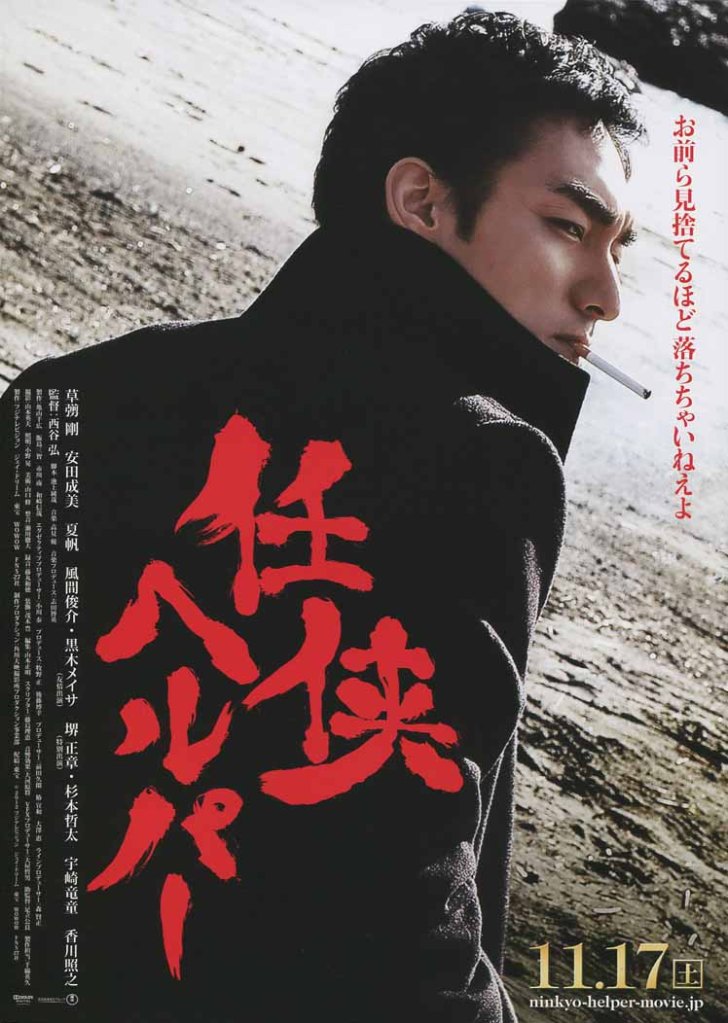
Beautiful World (任侠ヘルパー, Hiroshi Nishitani, 2012)

ninkyo helperIn old yakuza lore, the “ninkyo” way, the outlaw stands as guardian to the people. Defend the weak, crush the strong. Of course, these are just words and in truth most yakuza’s aims are focussed in quite a different direction and no longer extend to protecting the peasantry from bandits or overbearing feudal lords (quite the reverse, in fact). However, some idealistic young men nevertheless end up joining the yakuza ranks in the mistaken belief that they’re somehow going to be able to help people, however wrongheaded and naive that might be.

The hero of Hiroshi Nishitani’s Beautiful World (任侠ヘルパー, Ninkyo Helper) is just one of these world weary idealists turned cynics. We find him working a low rent convenience store job where he fills the shop with the kind of intensity that only a disappointed former yakuza can generate. Hikoichi (Tsuyoshi Kusanagi) was trying to make a go of things in the regular world, but when a sad little old man comes in with armed robbery on his to do list, Hikoichi shows his yakuza stripes by easily beating him down in front of his stunned colleague.

This might have earned him some brownie points at work, but overcome by pity for this pathetic old man reduced to robbing corner shops for petty change, he gives him the cash and tells him to run. The police soon turn up and arrest them both – during the robbery Hikochi’s colourful tattoos were caught on security camera and no one wants a yakuza working here, even if he did volunteer to pay back the tiny sum of money the old guy got from his own wages.

Meeting up in prison, Hikoichi and the armed robber eventually become friends and after his release, Hikoichi ends up in the old guy’s home town where he joins his former clan as an enforcer. Extremely bitter by this point, Hikoichi has decided to play the modern yakuza game to the max so when he finds out his assignment is running a dodgy “care” home which gets its residents by extorting old people through outrageous loans which send them bankrupt, he only briefly pauses.

The idea of a yakuza running a care home is a strange one. The Uminoneko residential care facility is far from what one would want from a old people’s home – there are no doctors, or even carers, the entire home is run by one nurse, herself an elderly woman who got her nurse’s certification and eldercare qualifications back in 1943!

With a rapidly ageing population, eldercare is a big topic in Japan as the birth rate has progressively fallen while lifespans have increased leaving many older people without family to look after them. With the nature of the family unit also changing, it’s become much harder to care for elderly relatives at home especially if they need around the clock attention. There are simply not enough facilities available to cope with the increasing needs of the older generation leaving families struggling to cope and social services overwhelmed. It’s not surprising that the yakuza have picked up on this as a growth area.

When Hikoichi arrives at the Uminoneko facility, which is just really a prefab shed with some futons in it, he finds a hellish place filled with unstimulated old people left on their beds to die. The place is filthy, and about the only attention the guests receive is the occasional offering of food to keep them alive so that the clan can keep claiming their pensions and welfare payments. Though Hikoichi goes along with this to begin with, it’s not long before his idealism rears its ugly head and he hits on the idea of reforming Uminoneko by turning it into a kind of old person’s commune in which the residents themselves will help out with the running of the place. What was a sad and gloomy prison of exploitation suddenly transforms as the older generation rediscover a place that they can belong, working together to build their own community. However, this of course means less money for the clan and more trouble for Hikoichi.

The clan aren’t his only problems as the town also has a progressive mayor who made a commitment to wipe out organised crime and turn the area into a tourist hotspot with a special focus on caring for the older generation. Teruo (Teruyuki Kagawa) has is own stuff going on which again causes a problem for Hikioichi as he also has a long standing crush on the older yakuza’s daughter, now a single mother with two young children and a mother of her own with senile dementia who needs expensive medical care. Yoko (Narumi Yasuda) has a grudge against yakuza after enduring decades of stigma and eventual abandonment by her father but is willing to deal with them if it will enable her to help her mother. Predictably she begins to develop a better understanding of her father as she bonds with Hikochi and warms to his noble tough guy ways.

Directed by Hiroshi Nishitani and inspired by a TV show (though functioning as a standalone movie), Beautiful World is a finely plotted drama which explores both the roles of the ageing population and eldercare explosion in Japan, and the conflicting role of the yakuza who seek to exploit those who are arguably the weakest in society. Hikoichi makes for a very Takakura-like, brooding presence as his innate idealism and desire to help those around him conflict with his experiences as a yakuza which teach him to distrust everyone and expect betrayal and exploitation at every turn. Resolving in an unconventional and unexpected way, this otherwise mainstream, if  beautifully photographed, drama develops into one of the more interesting character driven pieces of recent times.


Unsubbed trailer:

https://www.youtube.com/watch?v=Xyqd3v_-2oQ