Throne of Blood (蜘蛛巣城, Akira Kurosawa, 1957)

In many ways, the underlying theme in Akira Kurosawa’s films of the 1950s is that we are incapable of knowing ourselves and are, as a forest spirit remarks in Throne of Blood (蜘蛛巣城, Kumonosu-jo), afraid to look into our own hearts and admit our darkest desires. In adapting Shakespeare’s Macbeth, Kurosawa is less interested in the pull of ambition than the insecurity that drives it along with the inability to transcend himself that precipitates the hero’s decline. 

Indeed, after Washizu (Toshiro Mifune) and his best friend Miki (Minoru Chiaki) ride into the misty forest domain of the witch-like seer who ominously turns her spinning while offering a moral lesson that neither of them heed, they sit on the ground and laugh about what they’ve heard. Yet as Washizu partly admits the old woman revealed something of himself to him in that she echoed a dream of which he was unwilling to speak. Miki asks what warrior would not want to be placed in charge of a castle, but for Washizu it’s almost a primal need to prove himself in surpassing other men. Miki, by contrast, is not so nakedly ambitious but he doesn’t really need to be because he has a son. Washizu has no heir, his line will end with him and so he has only this life to make something of his name. 

Having no heir also undermines his sense of masculinity, just as it undermines the femininity of his wife, Lady Asaji (Isuzu Yamada), who as a woman now likely too old to bear a child may fear for her position. Kurosawa styles Yamada’s face as a perfect noh mask while she delivers her lines with the intonation of noh theatre all of which lends her a fairly eerie presence which only deepens as she descends into the darkness and back out again hovering like a ghost. She is in a sense perhaps already dead if not otherwise possessed by some malignant spirit as she urges her husband on in their dark deeds like a demon on his shoulder even going so far as to present him with the spear he will use to murder his lord, the ultimate act of samurai transgression. 

Yet as Lady Asaji points out, the present lord killed the lord before him for the right to sit on the dais. When the lord comes to stay with them on a pretext of hunting while preparing to launch an attack on a potential rival, the couple are moved into a room previously inhabited by a retainer who’d tried to mount a rebellion but was defeated. He took his own life and the room is still stained with his blood which covers both walls and floor. Washizu ought to realise that this is his fate too, but deep down he wants the prophecy to be true, which it is if more in the letter than the spirit. Would he have done it if he had not met the forest spirit, or would he only idly have thought of it but never followed through? It’s not something that can be known, but his eventual failure is born more of his inability to accept this side of himself than it is the price of ambition in itself. “If you’re going to choose ambition choose it honestly with cruelty” the forest spirit later advises, and Washizu might have been more successful if had he done so earlier. 

Then again, the world he lives in is as Lady Asaji describes it a wicked one in which betrayal is an all but inevitable certainty. Washizu insists that Miki is his friend, and that making Miki’s son his heir satisfies the prophecy while binding him to him so that he cannot rebel even if he were minded to. But Lady Asaji assumes that Miki is ambitious too, suggesting that he may strike first or report his treachery in the hope of personal advancement. For the prophecy to come true, someone has to betray the lord though it need not have been either of them but there can be no trust or friendship in this world of fierce hierarchy and internecine violence. 

Both men should perhaps have realised that when they were trapped riding around the eerie lair of the forest spirit with its mists and cobwebs not to mention heaps of piled skeletons still in their armour all victims of ambition and the spirit’s false promises if also echoing the legacy of wartime folly. “Look upon the ruins of the castle of delusion” the noh chant that opens and closes the film intones, warning of illusionary riches and the price of deluding oneself along with the destruction wrought by those unable to break free of the spider’s web of human desire. 


Throne of Blood screens at the BFI Southbank, London on 21st February 2023 as part of the Kurosawa season.

Original trailer (no subtitles)
The Hidden Fortress (隠し砦の三悪人, Akira Kurosawa, 1958)

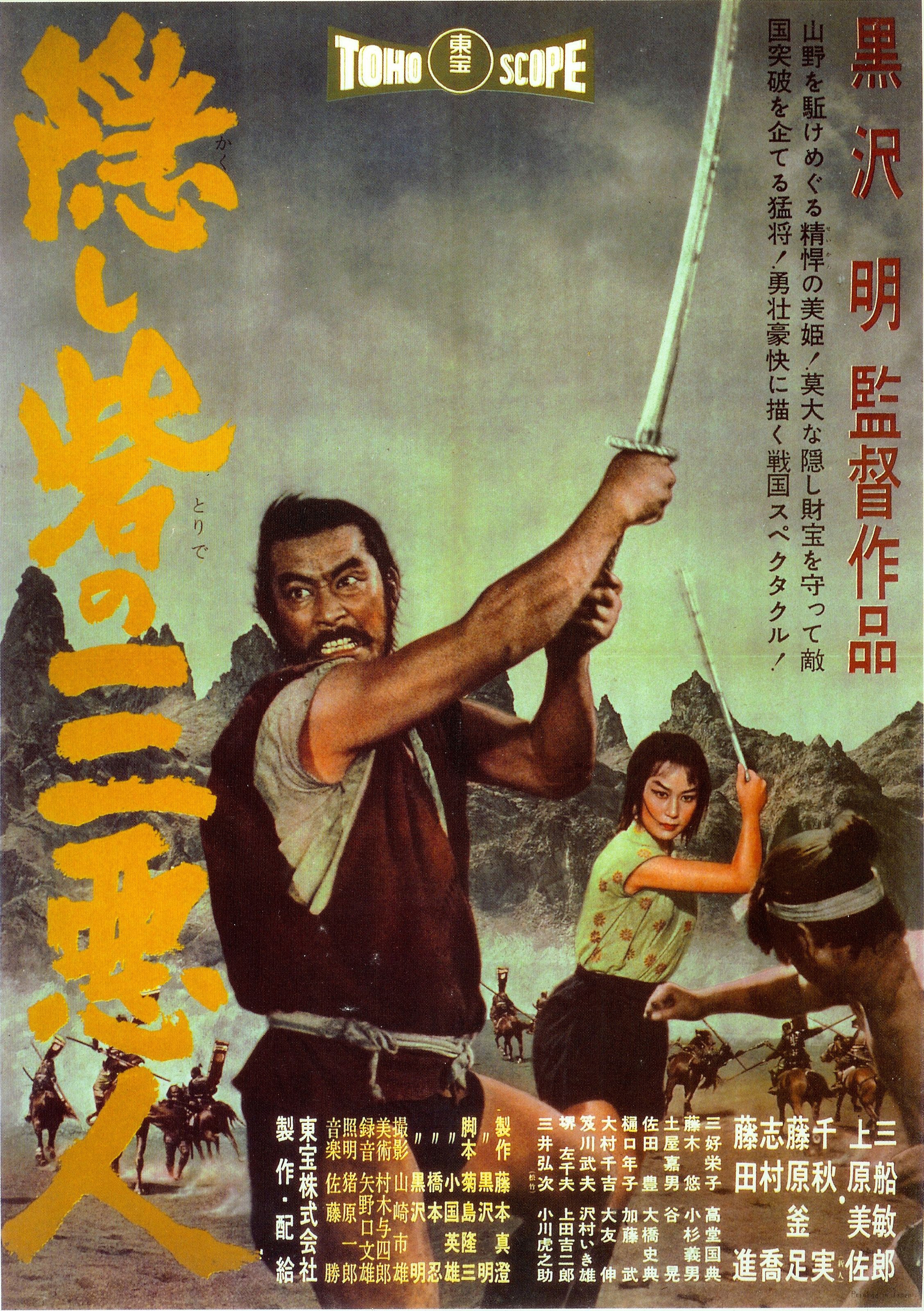
“Your kindness will harm you” a well-meaning retainer advises his charge, but in the end it is her kindness which saves her along with numerous others in Akira Kurosawa’s Sengoku-era epic, The Hidden Fortress (隠し砦の三悪人, Kakushi Toride no San Akunin). Largely told from the point of view of two bumbling peasants trying to get rich quick by exploiting the hierarchal fluidity of a time of war, the film nevertheless cuts against the grain of the democratic era in advocating not so much the destruction of the class-bound feudal order as benevolent authority. 

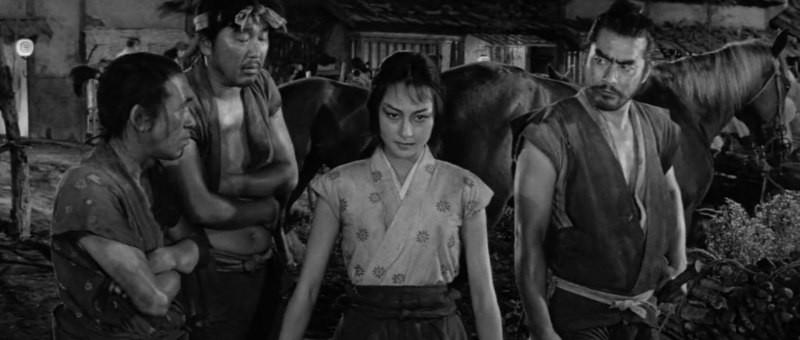
This can quite clearly be seen in the dynamic figure of displaced princess Yuki (Misa Uehara), the successor of her routed clan protected by a hidden fortress in the mountains which she must eventually leave. Her female servant laments that her father raised her as a boy which has given her a haughty and dominant manner at odds with the polite submissiveness usually expected of upperclass women. While often exerting her authority, she is otherwise uncomfortable with the uncritical servitude of her retainers, chief among them the talented general Makabe (Toshiro Mifune) who sacrificed the life of his own sister, allowing her to be executed in Yuki’s place buying them some time. “Kofuyu was 16. I am 16. What difference is there in our souls?” she asks, yet even if she believes their souls are equal she is not quite so egalitarian as to forget her position or the power and privilege that comes with it. 

Nevertheless, hers is an authority that is tempered by compassion and in the end chosen. Her salvation comes in speaking her mind to an enemy retainer, Tadokoro (Susumu Fujita), who has been savagely beaten by his own lord for losing a duel with Makabe who, to the mind of some, humiliated him with kindness in refusing to take his life leaving him to live in defeat. Yuki says she doesn’t know who is stupider, Tadokoro or his lord, for never would she punish a man in such a way simply for losing to an enemy. She tells him that there is another way, and that he need not serve a lord who does not serve him leading Tadokoro to defect and choose to follow her instead. 

She also inspires confidence in a young woman she insists on redeeming after discovering that she is a former member of the Akizuka clan sold into sexual slavery after being taken prisoner by the Yamane. Kurosawa presents the girl with a dilemma on realising that the mysterious woman who saved her is the fugitive princess, knowing that she could betray her and pocket the gold, but finds her resolving to serve Yuki all the more. In a moment of irony, we learn that the girl was bought for five silver coins, the same amount of money a wealthy traveller offers for Makabe’s horse, but displeases her master in refusing to speak or serve customers. For Yuki he offers gold, though withdraws on being told that she is mute. Knowing that she would be unable to disguise her speech or accent which would instantly give her away as a haughty princess, Makabe convinces her to stay silent though as she tells him he cannot make her heart mute too. 

Even the peasants, oblivious to her true identity, view Yuki as part of the spoils insisting that they should be entitled to a third of her too and at one point preparing to rape her only to be fought off by the rescued girl. “We can rely on their greed” Makabe had said, knowing that their material desires make them easy to manipulate and that their loyalties are otherwise fickle. Matashichi (Kamatari Fujiwara) and his friend Tahei (Minoru Chiaki) sold their houses in their village to buy armour in the hope of achieving social mobility through distinguishing themselves in war, but have largely been humiliated, robbed of their armour, mistaken for captured members of the enemy, and forced to dig the graves of others. They pledge eternal friendship but their bond is continually disrupted by the promise of monetary gain. They fall out over a moral quandary, one willing to plunder the body of a fallen soldier and the other not, while even on reuniting squabbling about how to divide the money first deciding it should be equal and immediately disagreeing as soon as they get their hands on it. At the film’s conclusion it rests on Yuki to play mother, telling them that they must be good and share the boon she’s given them equally without complaint each then too only quick to be generous insisting that the other can keep it. 

The implication is still, however, that Matashichi and Tahei should return to their village to live as peasants while Yuki assumes her place in a castle no longer hidden as its ruler. Order has returned and the old system remains in place, all that changes is that this is now a compassionate autocracy ruled by a benevolent lord who views her subjects lives as equal to her own yet not perhaps their status. Where it might prompt Tadokoro to conclude that he need serve no lord at all for there should be no leaders only equals, the film concludes that a leader should be just and if they are not they should not be followed. Then again, the disagreement between firm friends Matashichi and Tahei is ended when they each have enough and no longer find themselves fighting for a bigger slice of the pie content in the validation of their equality. As Makabe puts it, heavy is the head that wears the crown. Yuki’s suffering is in the responsibility of rebuilding her clan though she does so with compassion and empathy ruling with respect rather than fear or austerity. Kurosawa utilises the novel scope format to hint at the wide open vistas that extend ahead of the peasants as they make their way towards the castle in search of gold only to leave with something that while more valuable may also shine so brightly as to blind them to the inherent inequalities of the feudal order. 


The Hidden Fortress screens at the BFI Southbank, London on 20th & 27th January 2023 as part of the Kurosawa season.