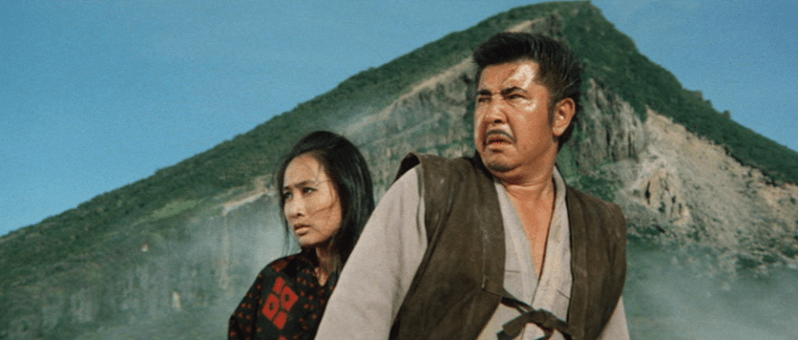
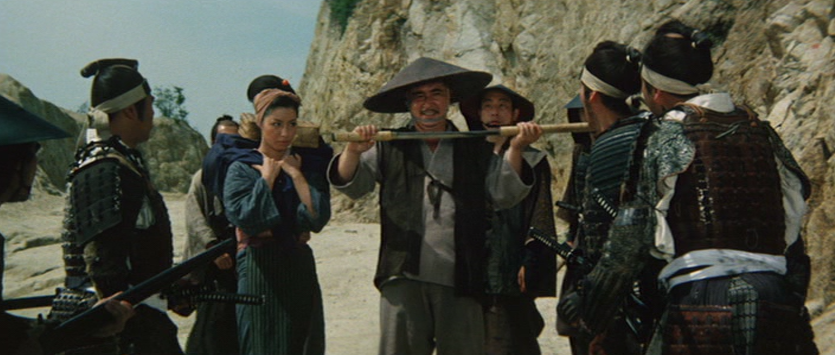
Killer’s Mission (賞金稼ぎ, Shigehiro Ozawa, 1969)

According to the title card at the beginning of Shigehiro Ozawa’s Killer’s Mission (賞金稼ぎ, Shokin Kasegi), none of the events it depicts have been recorded in history because the shogunate decided to erase them all in fear of the effect they may have on the nation’s geopolitical stability. Nevertheless, it gives some very concrete dates for its historical action, even if they may not make complete sense while foreshadowing the political turbulence of the following century. 

What it essentially attempts to do is tell a James Bond-style tale of political intrigue in a feudal Japan in which perpetual peace has begun to create its own problems. Here played in a cameo appearance from Koji Tsuruta, the Shogun Ieshige was weak in part because he was in poor health and had a speech impediment which led him to be rejected by his retainers. The problem here, however, is with Satsuma which has been on bad terms with the Tokugawa shogunate since the Battle of Sekigahara after which they took power. Satsuma will in fact be at the centre of the conspiracy to overthrow the government in the following century, but for the purposes of the film have fallen foul of a rumour that the plan to do an arms deal with some Dutch sailors who sailed South to Kyushu after being rebuffed in Edo. 

A civil war is feared and in the interests of maintaining peace, Ieshige sends his trusted spy Ichibei (Tomisaburo Wakayama) to protect Satsuma official Ijuin Ukiyo (Chiezo Kataoka) in the hope that he will be able to talk his young and naive lord out of doing the deal. Ostensibly a doctor by trade, Ichibei has a series of spy gadgets such as hidden blades and collapsible guns stored in a secret room at his surgery which he then carries in a black leather utility belt. He keeps the nature of his mission close to his chest, but often double bluffs by simply telling people he is a shogunate spy or otherwise adopting a disguise as he does in a moment of meta comedy impersonating the signature role of his brother Shintaro Katsu by posing as a Zatoichi-style blind masseur. 

As if to signal the cruelty of the feudal world, Ichibei comes across the corpses of suspected spies abandoned outside Satsuma territory while his enemies meditate on their ancient slight and consider taking the deal in the hope of avenging their defeat and overthrowing the Tokugawa. They are warned that creating unrest and sowing division may be exactly what foreign powers like the Dutch crave, but aren’t particularly bothered, preferring to take their chances with them rather than curry favour with the Shogun and possibly destabilising the entire society along with it. 

Of course, much of this is anachronistic with the Dutch sailors appearing in a distinctly 19th century fashion carrying weapons which are also too advanced for the era as are Ichibei’s folding pistols. Through his travels, he runs into a female Iga spy who too can do some nifty ninja tricks and has a gadget of her own in a comb which can shoot poison darts, though luckily it’s one of the poisons Ichibei has already developed an immunity to. Ichibei is fond of crying that you kill him he’ll simply come back to life, barrelling through the air with feats of improbable human agility and generally behaving like some kind of supernatural entity with a secondary talent for violent seduction. 

Though ironic and often darkly comic, there is an unavoidable poignancy in the inner conflict of Ijuin who knows his clan is about to do something very foolish but is torn between his duty to obey them and that to act in their best interests, eventually backed into a corner and left with no real way out of his predicament. As Ichibei points out, it’s difficult to keep the peace, especially when restless young samurai spot opportunities to cause chaos and the outside world knocks on the door of a closed community. Even so, Ozawa ends on a romantic image of a beach at sunset somehow undercutting the violence and tragedy with the restoration of an order that might itself be imperfect in its peacefulness.


Horrors of Malformed Men (江戸川乱歩全集 恐怖奇形人間, Teruo Ishii, 1969)

Horrors of Malformed Men poster

The line between madness and sanity is often a thin one, entirely dependent on a series of social perceptions themselves dictated by a vague concept of time and morality. Horrors of Malformed Men (江戸川乱歩全集 恐怖奇形人間, Edogawa Rampo Zenshu: Kyofu Kikei Ningen), loosely inspired by an Edogawa Rampo short story The Strange Tale of Panorama Island as well as a series of similarly themed tales from East and West, is set in 1925 – the end of “Taisho” which is to say immediately before the problematic “Showa” era marked by its own kind of madness and defeat if also by a gradual rebirth. Nevertheless, madness reigns in here though it’s madness of a very particular kind as those excluded from a fiercely conformist society seek to remake the world in their own image and take a horrifyingly poetic revenge on the rest of humanity for their failure to embrace difference.

The tale begins with amnesiac medical student Hirosuke (Teruo Yoshida) who finds himself inside a cage at a mental institution surrounded by screaming, half naked women one of whom attacks him with a knife. Luckily, the knife turns out to be a stage prop with a retractible blade presumably given to the unfortunate woman wielding it as a kind of calming device. Eventually rescued by the warden who attacks the mad with whips as if they were mere cattle, Hirosuke retreats to his cell to ponder on his current circumstances, if he is really “mad” or the only sane man in an insane world. Meanwhile, he is plagued by the memories of a long forgotten lullaby and the vision of a woman’s face suddenly contorting, transformed into a horrifying monstrosity.

Managing to escape, Hirosuke gets a lead on the lullaby that takes him to a coastal village where he discovers that a man who looks eerily like himself has recently passed away. Hoping to solve a series of mysteries, he fakes his own death and manages to convince the other villagers that he is the recently deceased Genzaburo somehow resurrected and risen from the grave. Where all this takes him is to a mysterious island where Genzaburo’s father Jogoro (Tatsumi Hijikata) – a hideously deformed man with webbed fingers, has been trying to create his own bizarre society.

Horrors of Malformed Men was technically “banned”, or perhaps it’s better to say suppressed in an act of self censorship by a nervous studio, but not so much for its gleefully surreal grotesquery as for the “malformed” in the Japanese title which is in fact an extraordinarily offensive word. In any case it adopts a typically difficult position towards those it calls “malformed” as warped both in body and mind. Our mad scientist, Jogoro is a man driven insane by his society’s consistent rejection of him. When the beautiful wife he has somehow managed to win displays only disgust towards his twisted body and finally betrays him by sleeping with her handsome, sensitive cousin, Jogoro’s mental stability is forever fractured leading to his dark desire to take revenge on the “perfect” world by creating his own “malformed” creatures mirroring his own spiritual decline.

Jogoro’s island is a place of “madness” where spiritual corruption leads only to a kind of devolution in which animalistic desires exist only to be sated. Here there is no love or community, only a cold and individual progress towards oblivion. Hirosuke enters a nightmare of a waking sort in which he must confront himself, his family legacy, and a potential conflict between his own desires and the rules of society. Yet he is also haunted by the image of an as yet unseen future of where such ugliness may lead. Jogoro’s otherworldliness and deformities, his singleminded to desire to remake the world with himself on top and others all below, speak of a madness yet to come and the terrible retribution which would be exacted for it.

As if to reinforce his own message, Hirosuke declares himself not of this kind – he chooses to remove himself from a world with which his personal desires are incompatible, maintaining their purity in refusing to live on indulging in a practice most would regard as so taboo as to constitute a kind of “madness” all on its own rather than honouring civilisation by living on in denial. Something tells him, this is where he’s been heading all along. Deeply strange, surreal, and perhaps questionable in its final moment of capitulation which lays the blame for the entire sad and sorry escapade at the feet of a scornful woman rather than the society which both forced her to marry a man she didn’t like and encouraged her to reject him on the grounds of his “ugliness”, Horrors of Malformed Men is not a story about madmen and weird islands but of the evil that men do and the pain it leaves behind.


Horrors of Malformed Men is available on blu-ray from Arrow Films. The set includes two audio commentaries – one featuring film critic Mark Schilling ported from a previous release, and the other a new commentary by film scholar Tom Mes, as well as interviews with Shinya Tsukamoto and Minoru Kawasaki on Ishii’s career, and footage of Ishii visiting the Udine Far East Film Festival. The first pressing also comes with a booklet featuring a wide ranging essay by Jasper Sharp plus shorter essays by Tom Mes on Ishii’s career and Grady Hendrix on Edogawa Rampo.

Original trailer (English subtitles)