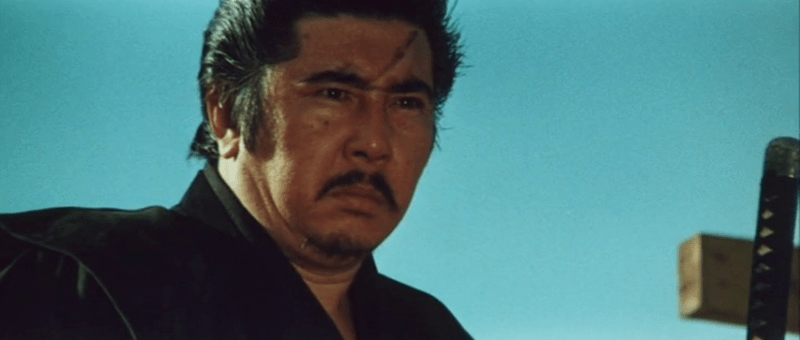
The Fort of Death (五人の賞金稼ぎ, Eiichi Kudo, 1969)

Shikoro Ichibei (Tomisaburo Wakayama) returns yet this time seemingly on the opposite side in the second in the Bounty Hunter series, The Fort of Death (五人の賞金稼ぎ, Gonin no Shokin Kasegi) this time directed by Eiichi Kudo. If the first film had been an Edo-era take on James Bond, the second is very much Spaghetti Western and feudal tragedy as Ichibei finds himself coming to, if not quite the rescue of the oppressed farmers, then at least moral support in taking stand against corrupt and self-interested lords.

This might be surprising in that in the first film Ichibei had been a shogunate spy and seemingly close friend of the man himself, yet this time around he’s working as a doctor while taking bounty hunter jobs to earn extra money to support the poor people who come to him for help. Like a true western hero, he has a small posse which includes the ninja lady, Kagero (Tomoko Mayama), from the first film only she’s being played by the actress who previously starred as his other love interest. In any case, he’s approached by a young man from a small village which is making a last-ditch appeal to the local lord to lower their tax burdens so they don’t all starve, though so far the lord’s response has been to add additional taxes and kill people for not paying them. 

On his arrival, Ichibei soon realises that the man who recommended him was actually the leader of the government forces during a previous peasant uprising at which Ichibei had also tried to help the farmers. In that case, Bessho (Shin Tokudaiji) had won, but it didn’t do him any good. His clan was dissolved and he became a wanderer, taken in by the village and now indebted to them, hoping Ichibei can help but fully aware of the brutality with which such challenges to the feudal order are put down. 

The lord later suggests it’s not really his fault. He has to curry favour with Edo to protect the domain, which is why he agreed to participate in a construction project that led him to confiscate all of his farmers’ rice and wheat. But then it’s also true that he is vain, and cruel. On realising the village has hired a man like Ichibei, some of the retainers suggest reopening negotiations but others complain that they must now crush the farmers or face ruin themselves while trying to ensure the strife in their domain does not come to the attention of the government in Edo. 

Part of their problem is that Ichibei simply has better technology in the form of gatling guns. Tying into the western themes, Ichibei is well versed in the use of firearms, while the samurai are mostly reliant on traditional weaponry such as arrows and swords. The lord later insists on using some canons, but is oblivious to the risk as the shogun has banned the use of gunpowder and using them may end up bringing him to his attention and thereby landing him in a lot of possible fatal trouble. 

In any case, it’s the villagers who suffer. Ichibei encounters a woman who has lost her mind, refusing to give up her baby who has died of malnutrition while her husband was executed for non payment of taxes. Meanwhile, some of the other ronin they hired attempt to rape a villager, and a young couple are prevented from marrying because the headman is worried that it would send the wrong message in a time so much strife. Then again, a woman basically attempts to rape Ichibei, descending on him while he’s still asleep which otherwise leads into a fairly comic sequence in which Ichibei must fight of a bunch of ninjas intent on stealing the gatling gun while dressed only his underwear.

Darkly comic it may be, but also surprisingly violent with a ninja at one point using a dead body as a Molotov cocktail not to mention the severed heads and limbs of the battle scenes. Ichibei is fully aware that the battle is a forlorn hope, but also that the villagers have no choice and perhaps this is better for them than simply accepting their fate and starving to death. Even so, he reserves his final words for the Edo inspector who arrives only when the battle is done to survey the scene, berating him that he ought to know what happened here from looking at the battlefield and deducing that this domain has not been run particularly well. It’s a tragedy of feudalism that provokes a tearful rage from the compassionate bounty hunter trying his best to heal the sickness in his society, though perhaps like the patient who visits him with a venereal complaint concluding the best solution is to cut it right off.

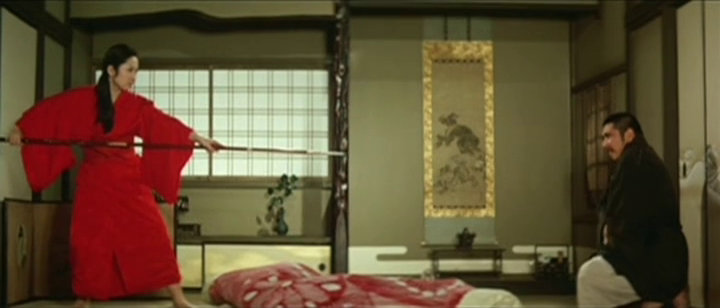
Wicked Priest 5: Breaking The Commandments (極悪坊主 飲む打つ買う, Buichi Saito, 1971)

The Wicked Priest returns for his final adventure and once again finds himself tackling the corruptions of the mid-Meiji society. Titled in English “Breaking the Commandments” (極悪坊主 飲む打つ買う, Gokuaku Bozu – Nomu Utsu Kau), the Japanese title refers to something Shinkai (Tomisaburo Wakayama) admits part way through, that his ironically non-buddhistic life revolves around drinking, gambling, and women all vices he seems unable to give up even as he continues to fight justice for the oppressed little guy amid the burgeoning capitalist society of the new Japan.

Indeed the film opens with him in a brothel where he’s exhausting one woman after another and demanding she be replaced with a fresh model while simultaneously covering for petty crook Hideji (Teruo Ishiyama) who is hiding his sex worker girlfriend in the cupboard to save her from a local gangster. In the first few instalment, Shinkai is a lecherous yet lovable rogue who in his own way respects women but in these last two instalments is certainly less kind, treating these sex workers more or less as disposable while later threatening to rape a lady gambler who tried to trick him. In any case, after realising that even Hideji who he went out of his way to help is trying to deceive him, Shinkai ends up getting involved with a local dispute over transportation licences and a nefarious land-sharking plan run by thuggish gangsters with the collusion of the police chief.

The land sharks want to take over the abandoned mansion where Hideji and his family of crooks are currently living in the company of a former samurai lord who seems to be suffering with some kind of delusion that it’s still the Sengoku era. The police chief isn’t up for the idea at first but the gangsters falsely imply that those living in this area of town are merely “jobless people and criminals” that they don’t need to worry about. But their plan depends on bringing on board Wajima who holds the license for running freight carts but Wajima is an honest man who isn’t interested in bribes and has no respect for those who exploit others. He refuses to participate in the project.

Shinkai too refuses to let the gangsters get away with mowing over Hideji and the others and is once again saved by Ryotatsu (Bunta Sugawara) who agrees to put off their final fight until Shinkai is finished cleaning up this dirty little town. He largely does this by donning an elaborate disguise and teaming up with lady gambler Gin to trick conspirator Kawashima into giving back Wajima’s (Takashi Shimura) license after setting him up so he’d lose it. Meanwhile he also tries to repair another broken father-son relationship between Wajima and his errant boy Ryutaro (Kyosuke Machida) whom he’d kicked out some years previously after he became a yakuza and got into trouble with the law. 

What seems clear is that the chaos of Meiji has allowed the greedy to profit over the changing orders of the hierarchical society, no longer bound by traditional notions of good conduct or basic humanity. The police chief first objects to the plan, stating that many people living in the area the gangsters have earmarked for their docks are honest and hardworking and shouldn’t be lumped in with “criminals”, but is soon won over by a bribe and is also supporting a mistress in a separate household. Yet even so, Shinkai turns this same weapon back on Kawashima (Fumio Watanabe) in pretending to be a general from Tokyo who will soon be his father-in-law, leveraging his social advancement to bring him back into line in appealing to his greed and ambition while hinting at a militarist future in reminding him that Wajima’s carts were essential during the Satsuma Rebellion and may be so again should the occasion call.

After seeing off a series of bounty hunters, one sent in via a honey trap that suggests the gangsters really know their enemy, Shinkai has no option but to clear out the corruption himself at the point of a sword culminating in another bloody showdown which is also in its own way a means of protecting Ryutaro from a pointless revenge. “If I die the devil in hell will be in for a big surprise!” Shinkai cooly remarks as he marches off to fight for justice, but then there’s another battle waiting for him in the postponed grudge match with Ryotatsu as the two men tussle atop a sand dune ironically trapped in a co-dependent cycle of vengeance and salvation while Shinkai’s wandering most likely will never end.


Lone Wolf and Cub: White Heaven in Hell (子連れ狼 地獄へ行くぞ!大五郎, Yoshiyuki Kuroda, 1974)

lone-wolf-and-cub-white-heaven-in-hell-japanese Ogami (Tomisaburo Wakayama) and his son Daigoro (Akihiro Tomikawa) have been following the Demon Way for five films, chasing the elusive Lord Retsudo (Minoru Oki) of the villainous Yagyu clan who was responsible for the murder of Ogami’s wife and his subsequent framing for treason. The Demon Way is never easy, and Ogami has committed himself to following it to its conclusion, but recent encounters have broadened a conflict in his heart as innocents and seekers of justice have died alongside guilty men and cowards. Lone Wolf and Cub: White Heaven in Hell (子連れ狼 地獄へ行くぞ!大五郎, Kozure Okami: Jigoku e Ikuzo! Daigoro) moves him closer to his target but also further deepens his descent into the underworld as he’s forced to confront the wake of his ongoing quest for vengeance.

Ogami and Daigoro have made it to Snow Country, meanwhile Lord Retsudo is receiving a dressing down from a superior over his total failure to eliminate the Lone Wolf or his Cub. It seems Ogami has already despatched all three of Retsudo’s sons, and so now Retsudo pledges his daughter, Kaori (Junko Hitomi), skilled in the use of daggers and every bit as fine a warrior as her defeated brothers, in the mission to end the Ogami threat.

Things do not go to plan and Retsudo is forced to approach his one remaining son. An illegitimate child born to a concubine, disavowed, and hidden away in the mountains, Hyoe (Isao Kimura) is not well disposed to his estranged father’s request to save the Yagyu clan to which he feels only rage and resentment. Sending his father away, Hyoe nevertheless decides to take on Ogami in the hope of embarrassing the Yagyu by taking him out first. Possibly having spent too much time alone, Hyoe’s plan involves a number of strange rituals beginning with resurrecting three of his men as emotionless (yet intelligent) zombies meant to terrify Ogami and his son into submission.

Throughout the series, we’ve seen Ogami’s world darken as the straightforward missions of eliminating corrupt lords eventually gave way to more morally dubious assignments with the tragic story of Oyuki and later the assassination of an entire family in order to preserve the legitimate arm of a historical clan. Along the way, Ogami has met “true samurai” and villainous cowards, but his encounters with honest men and women have only served to shake his heart as he guides his young son onwards bound for hell by way of death or violence.

The pair have never been afraid before, but Hyoe’s plan hinges on pushing Ogami’s mind into those dark places, preventing him from fighting back against his supernatural soldiers. Death has always surrounded them, but the price of Ogami’s vengeance is brought home to him when Hyoe’s forces unceremoniously wipe out the entire population of an inn where Ogami and Daigoro are staying whilst hovering in some nearby trees to remind them that this is all really their fault and the longer they keep on down this path, the more the innocent will suffer. The zombie trio threaten to destroy Ogami’s human emotions – joy, sorrow, pleasure, and anger, leaving him only with fear. Unbowed, Ogami faces Hyoe but the pair have more in common than they thought and so round one ends in a stalemate.

White Heaven in Hell, though not intended as a conclusion to the series, neatly brings things full circle as Ogami visits his wife’s grave, recalling his familial tragedy and reinforcing his bond with Daigoro. All of the films have, in some way, dealt with functional and dysfunctional family, each commenting on the unusual relationship between Ogami and his son. Finally meeting face to face, Retsudo takes Ogami to task for the loss of his children which Ogami throws right back at him – after all, all he did was defend himself against a threat Retsudo himself instigated. Ogami eventually tells him that he hopes Retsudo becomes so lonely that he goes completely mad. Retsudo’s pointless manoeuvring has cost him dearly in the loss of each of his legitimate children, eventually forcing the acknowledgement of his illegitimate son and daughter whose hatred of him also leads to their undoing. So great is Hyoe’s loathing of the Yagyu, that his last ditch attempt at revenge is in trying to convince his own sister, Azuma, to bear his child and create a new line to finish them off once and for all.

Kenji Misumi declined to return for this instalment, claiming the series had become too much like a Western which is a little ironic as White Heaven in Hell leaves the arid deserts behind for the frozen ice plains of the north. Yoshiyuki Kuroda, making his first and only contribution to the series, had a strong background in horror cinema which might explain the sudden appearance of the supernatural elements in what has been, up to now, a fairly grounded exercise even if somewhat outlandish. This is also the only script with which original creator Kazuo Koike was not not involved and bears the least relation to the then ongoing manga. Still, the action is undoubtedly innovative as the baby cart’s wheels are swapped for skis and Ogami faces off against an entire army of enemies on a snow covered hillside. Kuroda sticks more closely to Misumi’s aesthetic than Saito had done though steers away from the painterly cinematics in favour of showcasing the snow covered terrain, driving Ogami deeper into hell as his heart freezes over but denying him the vengeance that has become his life’s work. White Heaven in Hell is the last outing for Ogami yet refuses to close the circle, his quest may be a never ending one, plunging both himself and his son into an inescapable cycle of violence and regret as the Demon’s Way stretches on endlessly towards an uncertain destination.


Original trailer (subtitles in German for captions only)

https://www.youtube.com/watch?v=tfmwNpfQPG4

Lone Wolf and Cub: Baby Cart in the Land of Demons (子連れ狼 冥府魔道, Kenji Misumi, 1973)

baby-cart-land-demonsOgami (Tomisaburo Wakayama), former Shogun executioner now a fugitive in search of justice after being framed for treason by the villainous Yagyu clan who are also responsible for the death of his wife, is still on the Demon’s Way with his young son Daigoro (Akihiro Tomikawa). Five films into this six film cycle, the pair are edging closer to their goal as the evil Lord Retsudo continues to make shadowy appearances at the corners of their world. However, the Demon’s Way carries a heavy toll, littered with corpses of unlucky challengers, the road has, of late, begun to claim the lives of the virtuous along with the venal. Conflicted as he was in his execution of a contract to assassinate the tragic Oyuki in the previous instalment, Baby Cart in Peril, whose story was perhaps even sadder than his own, Ogami is about to descend further still as a commission to kill a living Buddha proves even more sordid than expected.

Baby Cart in the Land of Demons (子連れ狼 冥府魔道,  Kozure Okami: Meifumado) starts as it means to go on as Ogami finds yet another coded way of touting for business when he notices the strange demonic drawing on the face mask of a resting man and correctly reads it as a message for the Lone Wolf and Cub. The Kuroda clan have despatched five of their best men wearing just such masks in order to test his skills and find out if he’s worthy of their job. Each time he defeats one, he’ll receive 100 ryou (a fifth of his fee) and part of the reasons and explanations he requires in deciding whether to take the job.

This time the assignment is to do with a mislaid yet incriminating letter from the Kuroda lord, Naritaka (Shingo Yamashiro), who has unwisely been deceiving the Shogun as to the identity of his children. Very much in love with his mistress, Naritaka has been passing off their daughter, Hamachiyo (Sumida Kazuyo), as his son Matsumaru. Meanwhile the real Matsumaru, his legitimate heir through his legal wife, has been imprisoned in the compound and kept away from prying eyes. A particularly stupid and pointless ruse, yet the lord has created even more problems for himself by allowing a letter outlining all of this to fall into the hands of a treacherous priest, Jikei (Hideji Otaki), who turns out to be the head of a ninja spy network. Ogami’s job is to kill Jikei and get the letter back but it comes with some additional spice – Jikei plans to hand the letter to Lord Retsudo, Ogami’s arch nemesis.

Ogami’s world is a feudal one where allegiance to one’s lord trumps almost everything. The lords are, however, often dishonest, selfish, and cruel. The hypocrisy of the samurai world is a phenomenon well known to all, and most particularly to Ogami who has found himself at the mercy of the ambitious Yagyu clan. Whatever else he may have become, Ogami is a man of honour to whom the way of samurai maintains a deep spiritual importance. Jikei’s attempt to unsettle Ogami by asking him what he thinks he’s going to achieve on the Demon’s Way and if killing a living Buddha is a fitting use of his talents, further pushes Ogami into a spiritual crisis regarding his quest for vengeance and ongoing career as a sword for hire.

Naritaka has, indeed, broken his code in lying to the Shogun but also in rejecting his position and creating an alternative family of his choosing by favouring the female child of his mistress over his legitimate male heir. In addition to his contract to kill Jikei and retake the letter, Ogami also receives a request to assassinate the lord himself alongside his concubine and even their daughter. This illegitimate line cannot be allowed to continue, the illicit family born of personal choice must be cut off before it begins to corrupt the future of the Kuroda clan. Actively plotting the death of one’s lord is an unthinkable concept, yet a retainer also has a responsibility to guard the honour of their house and so the lord must go, even if the retainer is bound to follow him.

The decision to execute the entire family recalls the series’ origins in which Ogami was seen to act as a second in the “harakiri” of a toddler shortly before seeing his own family fall under the sword of a Yagyu plot. Daigoro is growing older at an unnatural rate but shows a little more willingness to engage in acts of altruistic heroism than his father, such as in an episode where he decides to refuse to identify a local pickpocket even if it means he himself will be flogged in her place. Ogami looks on in inaction, yet there is the faintest flicker of pride in his otherwise impassive face as his fearless son opts to undergo a harsh punishment rather than allow someone else to suffer even as she tries to save him in turn. Daigoro also has an awkward moment of connection with the similarly aged unlucky princess but remains apparently unmoved by her fate at the end of their mission. The legitimate prince may have been liberated and the official line restored, but there has been a heavy price for all concerned and the Kuroda clan is far from saved.

Baby Cart in the Land of Demons marks the return, albeit for the last time, of the series’ original director Kenji Misumi who gets rid of the heavily exploitation leaning approach brought by Buichi Saito in the previous film, Baby Cart in Peril. No voiceovers, no musical sequences, and an overall return to quiet contemplation mixed with impressively balletic fight sequences rather than the frenetic action and sudden trickery which defined Baby Cart in Peril send the series back to its spiritual roots after a brief foray into the contemporary jidaigeki. Baby Cart in the Land of Demons is also the first in the series which contains no female nudity though it does make room for another skilled female warrior and also repeats the motif of Ogami leaving a melancholy woman behind him as he sets off into the sunset, yet this time it’s a woman who has chosen her own path in keeping with her own code and earned Ogami’s respect, and perhaps sorrow, in the process. Ogami is drawing closer to Retsudo, though his path leads him through a land of demons each more villainous than the last and justice seems like an unrealistic ideal where only men like Ogami stand at the gates of man and beast.


Original trailer (subtitles in German for captions only)

https://www.youtube.com/watch?v=utQYU-Ur8_8