Cloud (Cloud クラウド, Kiyoshi Kurosawa, 2024)

“We wanted to make easy money,” a down-on-his luck reseller admits, “is life easy now?” Factory worker Ryosuke (Masaki Suda) rebels against capitalism by subverting it through buying low and selling high while repeatedly refusing promotions at his job in a textiles factory. Though it might seem that reselling is just a way to earn an income that seems almost passive but is actually fairly labour-intensive, it’s clear that Ryosuke is a young man dissatisfied with capitalistic realities and lacking direction in his life. 

Reselling has become a kind of game to him and like a gambler who plays to lose he’s hooked on the thrill of making a killing exploiting other people’s misery. He’s at once filled with pride and smugness over his apparent triumph over his society and consumed by self-loathing. His friend and fellow reseller Muraoka (Masataka Kubota) tells him that another acquaintance has been arrested for scalping concert tickets with both of them lamenting his foolishness in getting involved with something so risky. The implication is that their friend, Goto, must have been in real desperation to lower himself to such levels and they each fear they may someday end up in the same position. Muraoka laments that that kind of selling is a young man’s game and neither of them have the time or energy to spend all day queuing to buy stuff just to sell it on cheap. They are each, it seems, beginning to feel the increasing desperation of their age that they are running out of time and have little to show for their efforts nor any prospects for the future. 

But on the other hand, neither of them want to be locked into the grind or join the oppressive but secure world of the salaryman. In many ways, Ryosuke’s factory boss Takimoto (Yoshiyoshi Arakawa) represents the “correct” path of hard and honest work, though his own paternalistic conviction in meritocracy seems outdated in a man of his age whose formative years occurred during an era of economic stagnation. He talks to Ryosuke as if he’s a young man who wants to get on but lacks confidence, telling him that he has leadership potential and is wasted on the shop floor, but his language also has an edge of the uncanny as if he were trying to recruit Ryosuke into his own worker drone revolution. In any case, even if it might be true that Ryosuke lacks confidence and ambition, that isn’t the reason he refuses promotions, which seems to be another way of rebelling against capitalism. When he eventually quits, he suggests it’s because he’s sick of being told what to do and wants more autonomy over his life and finances.

He tells his girlfriend Akiko (Kotone Furukawa) that she should quit her job too, which she’s only too happy to do because, unlike him, she actively doesn’t want to work and only wants to spend money. When she said she was thinking of giving up her apartment, Ryosuke naturally asked her to officially move in but she refused because his place is too small and she has too much stuff. Akiko has already been corrupted by the same consumerist bug that’s driving Ryosuke’s reselling business, but neither of them can really afford this lifestyle in the city. Ryosuke’s bright idea is to move to the remote countryside where he’s able to rent a huge, though ominous-looking, property for a fraction of the price with the idea of also economically supporting Akiko who will revert to traditional gender roles as a housewife in charge of the domestic space and most especially the kitchen.

But freedom cannot be found simply by retreating from urbanity and the couple soon find themselves plagued by a pervasive sense of resentment. The locals are not particularly accepting of people from Tokyo and are also needled by their success which is something they feel they’ve been unfairly denied. When Ryosuke tries to report a smashed window, even the policeman hassles him and says he’s received a tip-off that Ryosuke is breaking trading standards regulations by selling counterfeit goods as the real thing. Reselling in itself is not illegal, if definitely dubious morally and incredibly cynical. Ryosuke doesn’t seem to like to think about that and tells his new assistant, Sano (Daiken Okudaira), that he tries to sell all the items as quickly as possible so he doesn’t have to worry too much about their authenticity. If they’re wanted they’ll sell, Ryosuke justifies but he might as well be talking about himself.

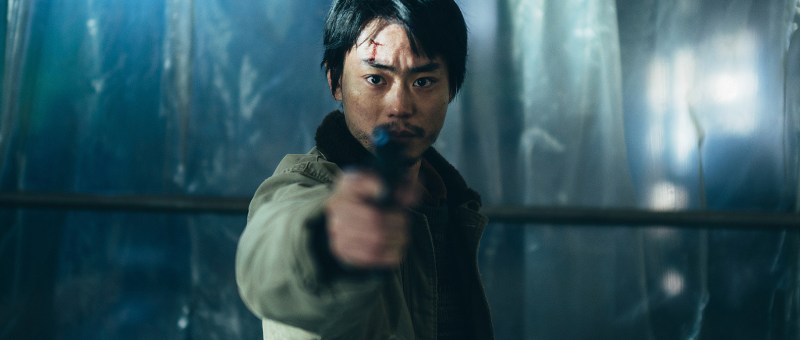
“Being real or fake doesn’t matter?” Sano asks him, just as Ryosuke’s online and offline personas start to blur. He’s unaware that there are people actively hunting him for selling them substandard goods and is later pursued by real life vigilantes acting like online trolls and planning to torture him to death during a livestream. Like many of Kurosawa’s heroes, Ryosuke is completely convinced that he’s the benchmark for normal and it’s everything around him that’s strange or unfair. As the internet once again invades the “real” world, or perhaps it’s more that Ryosuke’s living his online life offline, the increasing unreality of the situation makes us wonder if any of this is “really” happening or product of Ryosuke’s fractured identity as it finally collapses under the twin corruptions of capitalism and social media. “Please keep focusing only on making money,” his new guardian angel Sano tells him, “everything will be obtainable. Whatever you want. Even things that can end the world.” Flying through ironically heavenly clouds, Ryosuke reflects that the path to hell really is paved with gold and his Mephistophelian pact with hyper-capitalism may have damned him beyond all repair.  


Cloud is in cinemas from 25th April courtesy of Blue Finch Film Releasing 

UK trailer (English subtitles)

Onoda: 10,000 Nights in the Jungle (Onoda, 10 000 nuits dans la jungle, Arthur Harari, 2021)

For most people, the Pacific War ended in 1945. For Hiroo Onoda it may in a sense never have ended though he laid down his arms in 1974, 30 years after his initial dispatch, having spent the intervening three decades pursuing guerrilla warfare in the Philippine jungle the last two of them entirely alone. Arthur Harari’s three-hour existential epic, Onoda: 10,000 Nights in the Jungle (Onoda, 10 000 nuits dans la jungle), explores the psychological dimensions of his quasi-religious conviction in the righteousness of a mission which is in one sense no more than to survive along with his refusal to accept that the war is over and his personal struggle has been pointless. 

Immediately in opening the film in 1974 with a young man identified only as a “tourist” (Taiga Nakano) arriving on the island in search of Onoda (Kanji Tsuda), Harari draws a direct contrast between these two arrivals and subsequent departures. As he says, the Tourist is just that in town for a specific purpose after which he will leave and though you might be able to say the same of Onoda who came to the island of Lubang in late 1944 his reality was very different. On luring him out of the jungle by playing the patriotic war song he had sung with the other soldiers who unlike him accepted the surrender, the Tourist poignantly tells Onoda that he has travelled to over 50 countries whereas Onoda in a certain sense has never left Japan. “This island belongs to us” he’s fond of insisting seeing it as a piece of the Japanese empire which others are trying to take from him but he alone must defend. 

As we discover, the young Onoda (Yuya Endo) had wanted to become a pilot but washed out of the training program because of a fear of heights and was subsequently put forward for a kamikaze squadron. The irony of his life is that he is a man who refused to die for the emperor, his will to survive bringing him to the attention of Major Taniguchi (Issey Ogata) of the notorious Nakano spy school who sells his students a line that they are the good guys helping to liberate East Asia from Western imperialism. Trained in guerrilla warfare part of Onoda’s mission is to foster an uprising in the local population whom he assumes will also oppose American influence never realising that he is in fact a part of a destructive colonising force they will also seek to repel not least because of the way they have been treated by Japanese forces. 

Onoda’s first meeting with his captain on arriving on Lubang is interrupted by the arrival of the mayor of a nearby town who has come to complain that Japanese soldiers have been stealing food supplies from local farmers. This comes as a surprise to Onoda who is obviously not fully aware of the reality on the ground. His initial orders are largely ignored by the remaining NCOs who get up and leave during his briefing knowing that what he’s proposing is impossible. These men are already battle weary, many of them are sick, and they are running low on supplies. Onoda is 22 and fresh faced, arriving full of energy and patriotic zeal assuming these men are simply lazy or lack ideological commitment. He has no grounds to wield authority and no combat experience that would permit him to understand the circumstances in which he finds himself. In an especial irony, his first kill occurs after the war has (for everyone else) ended and he will himself go on to commit acts of atrocity against the local population which he justifies as acts of war. 

The military song which he is fond of singing celebrates there being no more bandits, yet banditry is essentially what he has been reduced to calling into question any idea of heroism which might be attributed to his refusal to accept the wartime defeat. In his Nakano spy school training, Onoda had been encouraged to ignore the accepted rules of war, that all is permissible in the pursuit of victory. He is also told that the prize for the “secret war” he is conducting will be a “secret glory” that goes unrecognised by others while he alone will possess true integrity in knowing that he never wavered in his mission. Yet there is something in him which weakens when he encounters the Tourist and is told that most of Japan believes him to be dead, rendering his struggle an irrelevance. 

He begins to admit the concept of surrender but only if given new orders from Taniguchi whose contradictory teachings have informed the course of his life, yet Taniguchi like many of his generation in the Japan of 1974 does not want to face his wartime past. The bookshop he now runs sells no military books and he claims not to remember Onoda or Lubang refusing his responsibility for his role in the conflict now filled with shame and regret. Yet it’s also possible that Onoda misunderstood the nature of the mission he’d been assigned, that in saving him from the kamikaze squadron because he did not want to die, Taniguchi gave him only one order – to survive. “You do not have the right to die” he reminds the recruits while giving them the ultra-individualist mantra that they must be their own officers which is in essence the paradoxical instruction to obey no orders but their own meaning that Onoda was always free to accept defeat. 

The psychological consequences of doing so, however, may have been too great. Coming of age in a militarised society, he already feels himself emasculated and embarrassed by his failure to become a pilot essentially because he is afraid to die. An awkward meeting with his father (played by film director Nobuhiro Suwa) resembles that of a Spartan woman sending her son to war with the instruction to return with his shield or on it. To return in defeat is psychologically impossible and suicide forbidden and so the only choice is inertia. In this Onoda may be hiding in the jungle unable to face a post-war future, descending into delusional conspiracy when presented with evidence that the war is over choosing to see the attempts of others to discourage him from his mission as proof of its importance, as if he and the remaining soldier sticking with him are key players in geopolitical manoeuvring worthy of such an elaborate plot. To believe the world is wrong is easier than to accept that he’s wasted his life in service of a mistaken ideal while failing to prove himself a man by the standards of a heavily militarised society. 

He’s tempted out of his delusion only by the Tourist who confronts him with the face of a new Japan entirely unknown to him, a Japan of economic prosperity, of the Shinkansen, of democracy. Being taken off the island means he must finally leave his dreams and delusions behind to enter a new post-war reality. Harari frames the island of Lubang as a psychological realm, the topography of Onoda’s delusion, but is also mindful of the islanders living outside it whom Onoda terrorises under the justification of war no better than a bandit in his quest for survival. In Harari’s oneiric landscapes, Onoda’s vistas are forever haunted by the spectres of his latent regret in the reflections of the boy he once was who came to Lubang to prove himself a man only to leave it a ghost. 


Onoda: 10,000 Nights in the Jungle opens in UK cinemas April 15 courtesy of Third Window Films. It will also be released on blu-ray May 16 in a set which also features an interview with actor Kanji Tsuda plus an interview with director Arthur Harari, DOP Tom Harari and assistant director Benjamin Papin.

Original trailer (English subtitles)

Mr. Long (ミスター・ロン, SABU, 2017)

Mr. LongTaiwan and Japan have a complicated history, but in SABU’s latest slice of cross-cultural interplay each place becomes a kind of refuge from the other. Working largely in Mandarin and with Taiwanese star Chang Chen, SABU returns to a familiar story – the lonely hitman tempted by a normal family life filled with peace and simplicity only to have his dreams taken from him by the spectre of his past. Only this time it isn’t just his past but that of others too. Despite the melancholy air, Mr. Long (ミスター・ロン) is a testament to the power of simple human kindness but also a condemnation of underworld cruelty and its vicelike grip on all who enter its grasp.
Mr. Long (Chen Chang) is the best hitman in the Taiwanese underground. A part-time cook, he’s known for his knife skills and fearless action, entering a room full of gangsters and instantly eviscerating them before they can even reach for their weapons. Sent to Japan to take out a prominent yakuza, Mr. Long finds his usual methods ineffective owing to the fact his target is wearing a stab vest. Captured, beaten and driven out into the middle of nowhere, Mr. Long is beginning to think this is the end of his story when the gangsters are attacked by another knife wielding assailant repeatedly asking them to free his girl. Mr. Long escapes in the ensuing chaos but has no money or way back home.

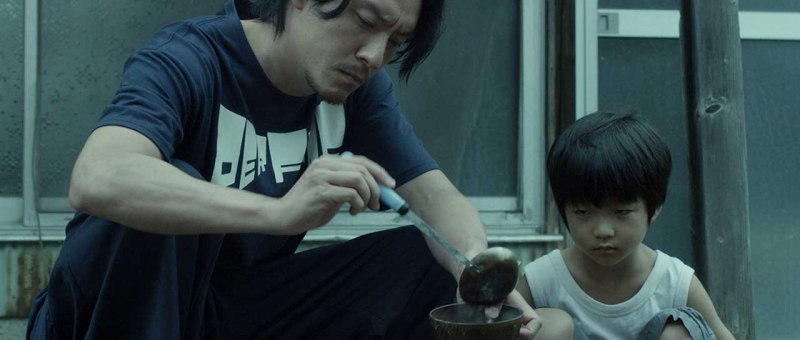
Marooned and bleeding in a rundown area, Mr. Long is saved by quiet little boy who brings him first medical supplies and then some probably stolen vegetables. Mr. Long manages to find an abandoned house which still has running water and cooking facilities and shares his improbably tasty soup with the little boy whose name is Jun. Surprisingly, Jun can speak fluent Mandarin because his mother, Lily, is also from Taiwan. Soon enough, other people in the area start to hear about the mysterious stranger and his wondrous cooking. Before he knows what’s happening, the tiny town has adopted him and built a stall on a cart where he can sell Taiwanese beef noodles.

SABU embraces his absurd sense of humour as Mr. Long’s capture becomes a cartoonish slapstick affair which ultimately sees him running off into the night with a sack on his head before regaining his quintessential cool. Mr. Long is the archetypal movie hitman – the major reason why he doesn’t say much is firstly that he doesn’t know any Japanese but  his conversations with the boy are pretty one sided and he doesn’t seem to be the chattiest even in Taiwan. Confused as to why all of this is happening Mr. Long asks Jun for guidance only for him to point out that it’s his own fault for acting so cool and never saying anything.

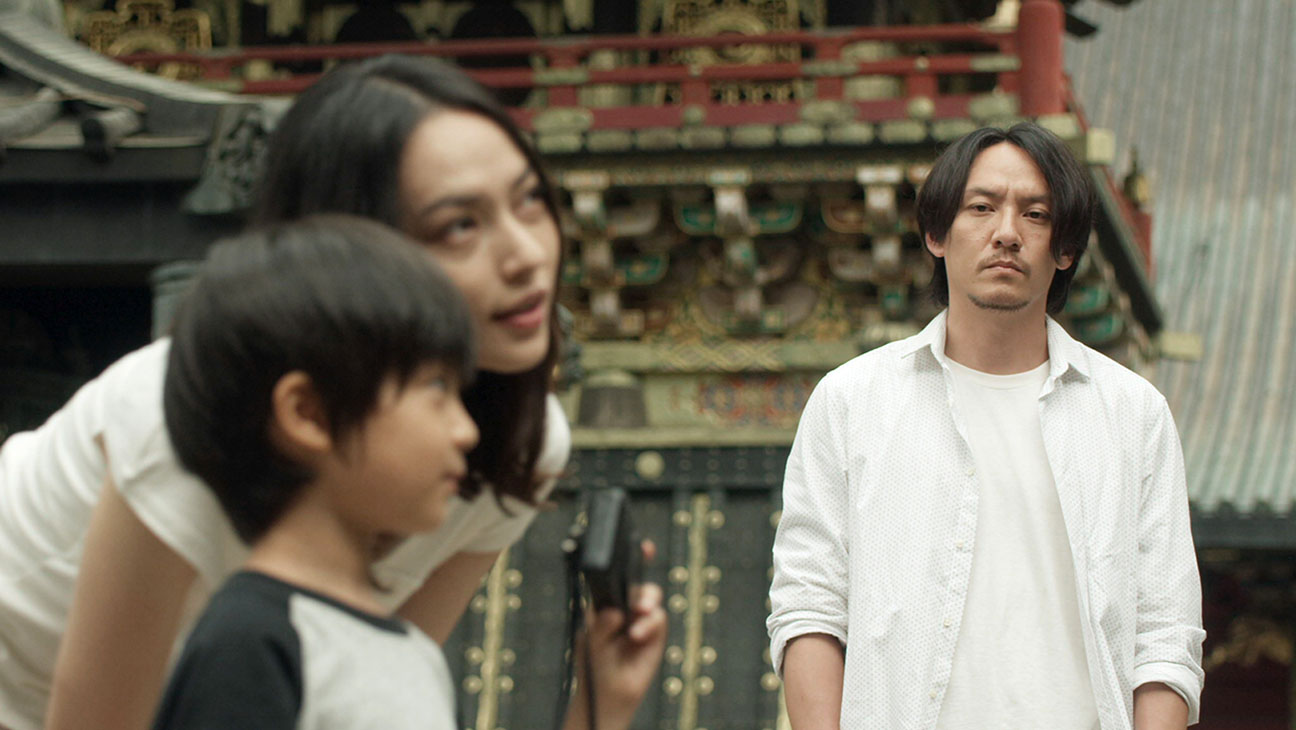
Yet for all the comedy there’s an underlying sadness as Mr. Long comes to care for this strangely friendly village which has more or less adopted him, providing him with food, clothing, and even an occupation in his brand new beef noodle stand. Even though he’s been in contact with his bosses and is supposed to get a boat to Taiwan in just a few days, Mr. Long doesn’t quite want to go home and let all of these nice people down. Especially as he’s begun to bond with the boy and grow closer to his mother.

Both Mr. Long and Lily are people who’ve had their lives ruined by proximity to the underworld – his by being trapped into a profession of killing with no possibility of escape, and hers by losing the love of her life to men who claimed to own her. Lily’s story is a sad one which eventually sees her fall into prostitution as a means of caring for her son only to be exploited by a duplicitous customer who gets her hooked on heroine as a means of control. Mr. Long frees her from this particular demon and the three begin to look as if they could make a go of things together only for the past to suddenly reappear and ruin everything.

Unexpectedly dark, Mr. Long veers between whimsical comedy and heartbreaking tragedy as its hero begins to long for another life which he knows he will be denied. Filled with SABU’s typically absurd world view mixed with balletic yet horrifying violence as the lonely hitman becomes the dragon spelt out in his name, Mr. Long is a familiar gangland tale in which a man cannot escape his past or his nature and risks rejection from those who’ve come to love him when they discover who he really is, but even if there can be no escape for some there is hope of redemption in human kindness and genuine connection.


Mr. Long was screened at the 17th Nippon Connection Japanese Film Festival.

Original trailer (no subtitles)

Happiness (ハピネス, SABU, 2016)

happiness still“Memories are what warm you up from the inside. But they’re also what tear you apart” runs the often quoted aphorism from Haruki Murakami. SABU seems to see things the same way and indulges an equally surreal side of himself in the sci-fi tinged Happiness (ハピネス). Memory, as the film would have it, both sustains and ruins – there are terrible things which cannot be forgotten, no matter how hard one tries, while the happiest moments of one’s life get lost among the myriad everyday occurrences. Happiness is the one thing everyone craves even if they don’t quite know what it is, little knowing that they had it once if only for a few seconds, but if the desire to attain “happiness” is itself a reason for living could simply obtaining it by technological means do more harm than good?

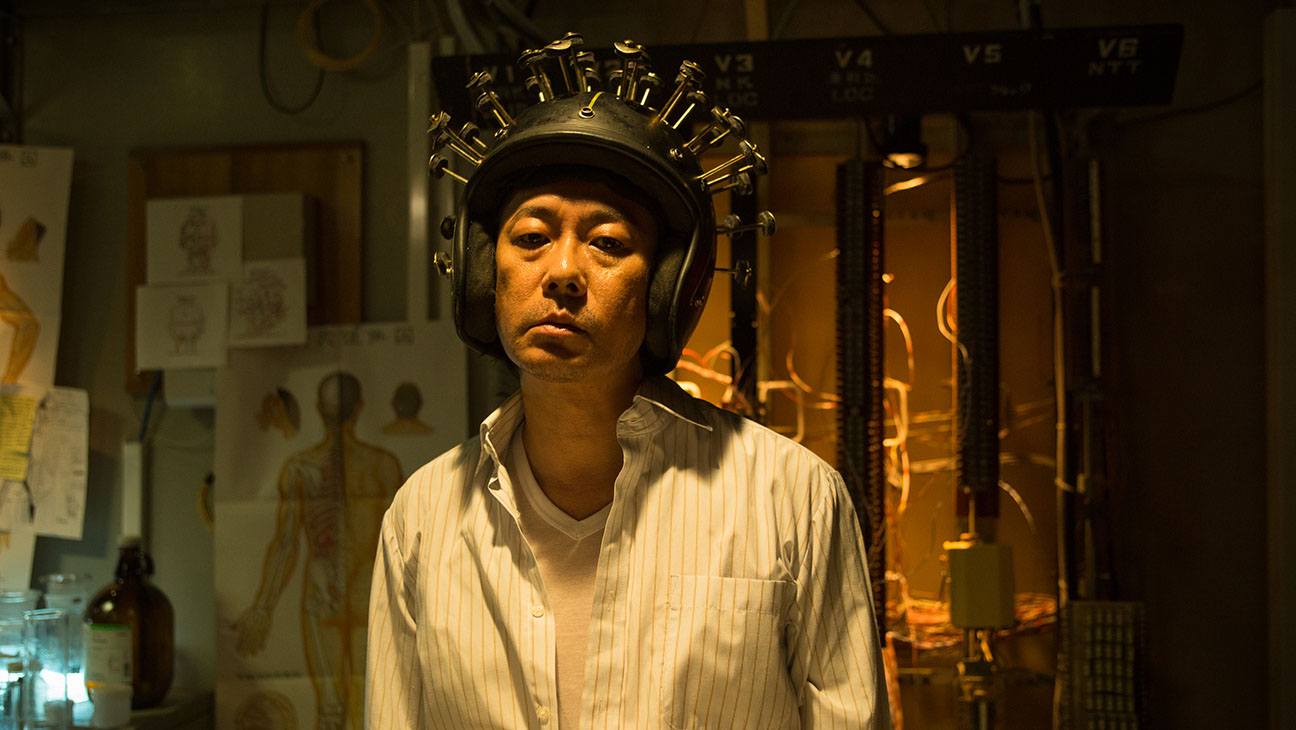
A man gets off a country bus carrying a large, mysterious looking box. He stops into the only visible building which happens to a be a “convenience” store housing a wizened old woman who tells the man to just take the bottle of water he is trying to buy because once she gets rid of everything in the shop she can finally die and escape her misery. The man leaves the money anyway and exits the shop, only to make a swift return, take a large helmet studded with old-fashioned round typewriter keys out of his box and place it on the old woman’s head. After the man makes a few adjustments the old woman is thrown into reverie, remembering a time when she was just a small child and her mother greeted her when she arrived home all by herself. Overwhelmed with feeling her mother’s love, the old woman comes back to life and rediscovers a zest for living which she’d long since given up.

So begins the strange odyssey of Kanzaki (Masatoshi Nagase) who finds himself in one of Japan’s most depressed towns where everyone hangs around listlessly, sitting in waiting rooms waiting for nothing in particular, passing the time until it runs out. Suggesting one of the women in the strange waiting area might like to try on the helmet, Kanzaki gets himself arrested but after the police try it out too he comes to the attention of the mayor who invites him to stay hoping the “happiness machine” can help revitalise the dying community and stop some of the young people blowing out of town looking for somewhere less soul-destroying to call home. Kanzaki’s request to access the town census, however, hints at an ulterior motive and it’s as well to note that a happiness machine could also be a sadness machine if you run it in reverse.

SABU’s long and varied career has taken him from men who can’t stop running to those who can’t start, but the men and women of Happiness are impeded by forces more emotional than physical manifesting themselves through bodily inertia. Like many towns in modern Japan, the small village Kanzaki finds himself in is facing a depopulation crisis as the old far outweigh the young and the idea of the future almost belongs to the past. Those who don the happiness helmet regain access to a long-buried memory which reminds them what it feels like to live again. Almost reborn they start to believe that true happiness is possible, that they were once loved, and that their lives truly do have meaning. Yet they can experience all of this joy only because of the intense collective depression they’d hitherto been labouring under. Happiness is only possible because of sorrow, and so the two must work in concert to create a kind of melancholy equilibrium.

Melancholy is a quality which seems to define Kanzaki, inventor of a machine he says can make people happy. As it turns out, his motives were not exactly all about peace and love but a means to an end, his own sorrows run deep and his solution to easing them is a darker one than simply becoming lost in his happy memories. Turning his own machine against itself, he forces a man to relive what he claims is the worst night of his life – one which he could not forget, and one which plagues him every night before he tries to go to sleep. Showing him happy memories too only seems to deepen the pain, though the explanation they eventually offer for his subsequent actions makes him a victim too, betrayed by those who should have protected him and eventually taking his revenge on innocents whose only crime was to be a happy family in front of a man from an unforgiving one.

Painting his world in an almost comforting green tint which can’t help but recall the dull but calming colours of a hospital, SABU channels Roy Andersson by way of David Lynch in his deadpan detachment which becomes humorous precisely because of its overt lack of comic intent. The clues are planted early from a flash of Kanzaki’s wedding ring but refusal to answer question about his family to his hangdog expression and general air of someone who carries a heavy burden, but SABU neatly changes gear surreptitiously to explore what the true explanation is for Kanzaki’s strange machine and improbable arrival in such a small, uninteresting town. Memory is a cruel burden, offering both joy and sorrow, but there can be no happiness without suffering and no life without a willingness to embrace them both the same.


Happiness was screened at the 17th Nippon Connection Film Festival.

Busan trailer (no subtitles)