Dear Stranger (ディア・ストレンジャー, Tetsuya Mariko, 2025)

The Japanese film industry is generally regarded as fairly insular and focused solely on the domestic market with half an eye on other Asian territories where its stars are already popular. It has, however, made some attempts to enter Hollywood particularly in the 1970s with films such as Kinji Fukasaku’s Virus which for various reasons was largely unsuccessful in either market and suffered artistically from its attempts to bend itself to an international audience. 

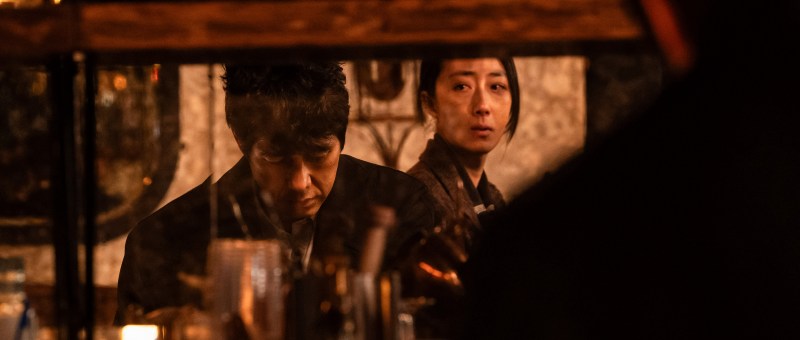
Tetsuya Mariko’s Dear Stranger (ディア・ストレンジャー) is the first in Toei’s contemporary attempt to court an audience outside of Japan as part of its Toei New Wave 2033 initiative, but it seems to be suffering from some of the same problems. The biggest is that 90% of the film is in English but the delivery is often stilted and inauthentic from both the international and native-speaking cast. That may in one way be ironic, as one of the major themes is the impossibility of communication. Emotional clarity is only really revealed during the puppetry sequences when no dialogue is involved. Set in New York, the film shifts between Mandarin, Japanese, Spanish, English and sign language, but simultaneously suggests the problem is less an external language barrier than an internal one that prevents people from saying what they really mean or encourages them to keep the truth of themselves hidden.

It’s living in this liminal third space that disrupts the marriage between Taiwanese-American Jane / Yi-zhen (Gwei Lun-mei) and her Japanese husband Kenji (Hidetoshi Nishijima) as she points out that they speak to each other in a language is not their own. At moments of high tension, they argue in Mandarin and Japanese, though as we largely discover there are more issues in play, beginning with the fact that their marriage may at least partially have begun as one of convenience. Kenji is not the biological father of their young son Kai. Jane finds herself asking who they are as a couple without him and if she ever really loved Kenji at all. Kenji suggests he married her because he loved her and accepted the child as his own for the same reason, but throughout the film is in an incredibly angry and hostile mood. He appears at times sexist, criticising Jane for not keeping the house tidy while he is “under a lot of pressure” at work and resents “the chaos” of their life. Jane’s mother doesn’t approve of her working either and calls her a bad mother for doing so even while expecting her to mind their convenience while she tries to find a carer to look after her father who is living with advanced dementia and can’t be left alone.

Part of that is likely that they need someone who speaks Mandarin, hinting at the sense of isolation and orphanhood that comes with migration in lacking extended familial support that in this case does not seem to be met by community. Jane too feels isolated and trapped by her role as a mother. She expresses herself only through her puppetry, which is also something denied her by Kenji and her mother. Kenji, meanwhile, feels undervalued at the university where his supervisor seems dismissive of him and his work which he regards as unoriginal. He may have decided to marry Jane in part in search of family having lost of his own in Japan with his mother never having been found after the Kobe earthquake when when he was a teenager, but simultaneously struggles to integrate himself within their family. His loss of Kai who disappears while he was supposed to be taking care of him is then symbolic in reflecting his own frustrated paternity and fear that the biological father will return to take all this away from him.

In many ways, it’s Kenji’s own psyche that’s in ruins informing his academic practice which focuses on abandoned and disused buildings and the effect they have on the surrounding environment. He’s asking himself how to create a new world from the ashes of the old, but doesn’t appear to have done so successfully in his own life and is increasingly unsure if he wants to. Perhaps because of its awkwardness, the film takes on an increasingly surreal quality as Kenji is heckled by irrationally angry guests at his book presentation and basically accused of facilitating urban crime in his praise of disused spaces and then descends into some kind of fugue state chasing the larger-than-life puppet version of Kai from Jane’s play which is also an embodiment of her own frustrated yearning for freedom. 

“In the wreckage we find truth,” Kenji answers one of the questioners at his presentation and it may in a sense be true for him but in another perhaps not. It becomes unclear what exactly he experiences as “real” and what not, what a product of his own mythologising and what actually happened, while Jane slips quietly into the background and her sudden acceptance of Kenji whom she previously regarded as “unreliable” and appeared to resent, seems somewhat hollow given that he continues to treat her coldly and is extremely hostile with all around him from the police, who are actually trying to help find his son, to the well-meaning kindergarten teachers, and his employers. In the end, it’s really Kenji who is stranger to himself much more than a stranger in a strange land trying to forge a new identity in a place of psychological ruin.


Dear Stranger was screened as part of this year’s Busan International Film Festival

Trailer (English subtitles)

Miyamoto (宮本から君へ, Tetsuya Mariko, 2019)

Three years after Destruction Babies, Tetsuya Mariko returns with another ultra-violent though strangely humorous masculinity drama as a mild-mannered salaryman embarks on a quest to win the heart of his one true love by proving himself a man even if aware that his efforts are entirely meaningless while he strikes out where it counts. Inspired by Hideki Arai’s manga, Mariko previously adapted Miyamoto (宮本から君へ, Miyamoto kara Kimi e) as a late night TV drama with the majority of the cast reprising their roles for the big screen feature.

As the film opens, the titular Miyamoto (Sosuke Ikematsu) is walking bruised and bloodied through a children’s park, staring at his unrecognisable face in the hazy mirror of a public bathroom. A regular salaryman, he’s later taken to task by his boss (Kanji Furutachi). After all, how does he expect people to do business with him when he’s lost all his front teeth and has his arm in a sling? His boss reminds him he’s about to be married and will soon be a father so perhaps a little more forward-thinking responsibility is in order. It seems that Miyamoto got into some kind of fight and improbably enough he won, the other guy apparently in hospital not to recover for months though thankfully he does not want to press charges. Nevertheless, Miyamoto seems strangely cheerful, happy in himself as he takes his bride to be, Yasuko (Yu Aoi), home to meet his parents who don’t disapprove but are extremely put out by his continued secrecy especially as Yasuko is already pregnant though something tells us there’s much more to this than your average shotgun wedding.  

Skipping back between the present day of the happily settled couple and the various stages of their courtship we begin to see a pattern developing as the hapless young salaryman falls for the pretty office lady only to discover she was technically using him to break up with an obsessive ex struggling to accept that their relationship is over. Challenged by bohemian playboy Yuji (Arata Iura), Miyamoto instinctively barks out that Yasuko is a special woman and he will protect her at all costs though the jury’s out on how exactly he plans to do that. In any case, Yuji exits and even if unconvinced, Yasuko is taken in by the idea of finding a protector. But Miyamoto is less than true to his word. When it really counts, he lets her down, passed out drunk as she’s assaulted by a friend from his rugby team (Wataru Ichinose). What ensues is partly, in his mind, a means of making amends to her by getting his revenge and a quest to reclaim his self-respect by asserting his masculinity in besting his girlfriend’s rapist in a fight. “It was me he insulted” Miyamoto somewhat problematically insists, rage shovelling rice into his mouth directly from the cooker while Yasuko can barely contain her resentment and exasperation with his continued failure to follow through while painting himself as the victim in her rape. 

Consumed by toxic masculinity, Miyamoto does indeed frame everything through the prism of his fracturing manhood, never jealous or abusive but comparing himself unfavourably to the other men in Yasuko’s life and convincing himself the way to beat them all is by proving himself the most manly through the medium of pugilism. Meanwhile, he emotionally neglects the woman he claims to love and promised to protect, temporarily distancing himself from her while he embarks on his quest, leaving her entirely alone to deal with her trauma. Yasuko makes it clear that she doesn’t care about his pointless and idiotic need to validate himself through male violence, but he does it anyway and then expects her to be impressed (which she isn’t, really). In any case he freely admits he did it all for himself, literally shredding his rival’s manhood in order to retake his own in addition to gaining an extremely ironic form of revenge.  

Absurd and ridiculous as it is, Miyamoto’s quest does at least allow him to gain the self-confidence which will eventually allow him to patch things up with Yasuko, ironically by affirming that he no longer sees the need to look for approval and will protect her and their new family forevermore. A dark satire of fragile masculinity filled with cartoonish yet surprisingly graphic violence, Mariko’s third feature nevertheless retreats from the pure nihilism of Destruction Babies towards a more positive if perhaps equally uncomfortable resolution as the no longer quite so insecure Miyamoto prepares to enter a new phase of his life as a paternal figure and protector of a family.


Miyamoto streams in the US via the Smart Cinema app until Sept.12 as part of this year’s New York Asian Film Festival.

Original trailer (no subtitles)

Destruction Babies (ディストラクション・ベイビーズ, Tetsuya Mariko, 2016)

destruction-babiesPost-golden age, Japanese cinema has arguably had a preoccupation with the angry young man. From the ever present tension of the seishun eiga to the frustrations of ‘70s art films and the punk nihilism of the 1980s which only seemed to deepen after the bubble burst, the young men of Japanese cinema have most often gone to war with themselves in violent intensity, prepared to burn the world which they feel holds no place for them. Tetsuya Mariko’s Destruction Babies (ディストラクション・ベイビーズ) is a fine addition to this tradition but also an urgent one. Stepping somehow beyond nihilism, Mariko’s vision of his country’s future is a bleak one in which young, fatherless men inherit the traditions of their ancestors all the while desperately trying to destroy them. Devoid of hope, of purpose, and of human connection the youth of the day get their kicks vicariously, so busy sharing their experiences online that reality has become an obsolete concept and the physical sensation of violence the only remaining truth.

The rundown port towns of Shikoku are an apt place to stage this battle. Panning over the depressingly quiet harbour, urgent, thrumming electric guitars bring tension to the air as the younger of two brothers, Shota (Nijiro Murakami), catches sight of his only remaining family member, older brother Taira (Yuya Yagira). Currently in the middle of getting a beating from local thugs, Taira signals his intention to leave town, which he does after his boss breaks up the fight and tells him to get lost.

By the time Shota has crossed the river, his brother is already lost to him. A vengeful, crazed demon with strange, burning eyes, Taira has taken the same path as many an angry young man and headed into town spoiling for a fight. Driven by rage, Taira fights back but only to be fought with – he craves pain, is energised by it, and rises again with every fall stronger but a little less human.

As he says, he has his rules (as mysterious as they may be), but Taira’s violent exploits eventually find a disciple in previously cowardly high school boy Yuya (Masaki Suda) who discovers the potential violence has to create power from fear in witnessing Taira’s one man war of stubbornness with the local yakuza. Yuya, a coward at heart, is without code, fears pain, and seeks only domination to ease his lack of self confidence. Taira, random as his violence is, attacks only other males capable of giving him what he needs but Yuya makes a point of attacking those least likely to offer resistance. Proclaiming that he always wanted to hit a woman, Yuya drop kicks schoolgirls and sends middle aged housewives and their shopping flying.

The sole female voice, Nana (Nana Komatsu) – a kleptomaniac yakuza moll who finds her validation though shoplifting unneeded items selected for the pleasure of stealing them, originally finds the ongoing violence exciting as she watches the viral videos but feels very differently when confronted with its real, physical presence and each of the implied threats to her person it presents. Tough and wily, Nana is a survivor. Where Taira staked his life on violence and Yuya on the threat of it, Nana survives through cunning. The victory is hers, as hollow as it may turn out to be.

Mariko’s chilling vision paints the ongoing crime spree as a natural result of a series of long standing cultural norms in which contradictory notions of masculinity compete with a conformist, constraining society. The entire founding principle of the small town in which the film takes place is that men come of age through violence, though the older man who has (or claims to have) provided the bulk of parental input for these parentless brothers describes Taira as if he were the very demon such festivals are often created to expel. Men of 18 years carry the portable shrines, he repeatedly says, but 18 year old Taira is a “troublemaker” and “troublemakers” must leave the town altogether.

If Taira sought connection through violence, Shota continues to seek it through human emotions – searching for his brother, hanging out with his friends, and drawing closer to his brother’s boss who offers him differing degrees of fatherly input. In contrast to his peers, Shota seems to disapprove of the way his cocksure (false) friend Kenji (Takumi Kitamura) treats women though it is also true that Kenji is actively frustrating his attempts to find his brother whilst dangling a clue right before his eyes. Nevertheless, the harshness of this unforgiving world seems determined to turn Shota into the same rage filled creature of despair as his older brother as injustice piles on injustice with no hope of respite.

Destruction Babies is apt name for the current society – born of chaos, trapped in perpetual childhood, and thriving on violence. Taira and Shota were always outsiders in a world which organises itself entirely around the family unit but the force which drives their world is not love but pain, this world is one underpinned by the physical at the expense of the spiritual. Metaphorically or literally, the lives of the young men of today will entail repeated blows to the face while those of the young women will require ingenious sideward motions to avoid them. Oblique, ambiguous, and soaked in blood, Destruction Babies is a rebel yell for a forlorn hope, as raw as it is disturbing.


Screened as part of the Japan Foundation Touring Film Programme 2017 and set for UK release from Third Window Films later in the year.

Original trailer (English subtitles)