Nemurubaka: Hypnic Jerks (ネムルバカ, Yugo Sakamoto, 2025)

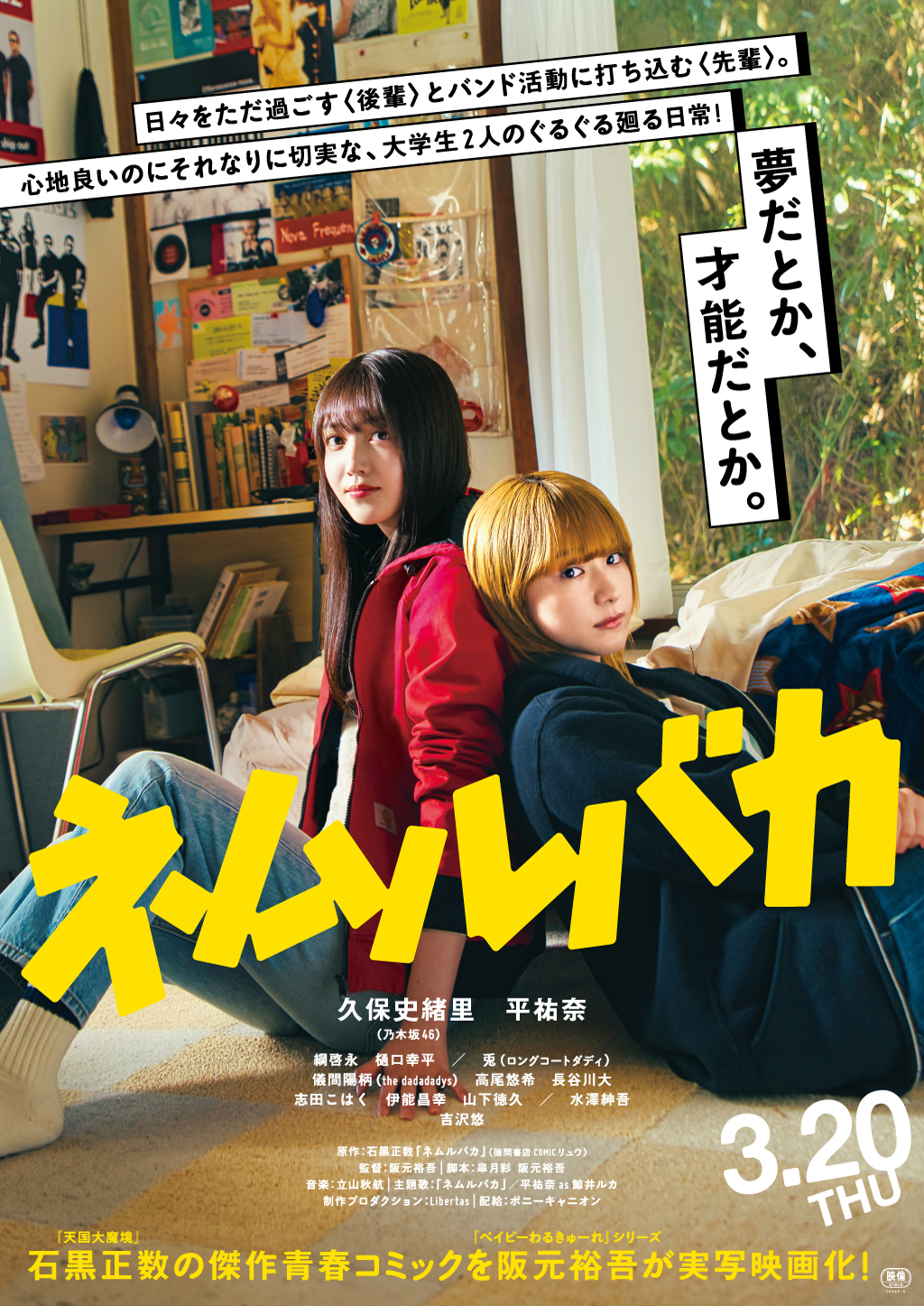
Is it better to have a goal and know what you want, or is it easier to be just kind of muddling along? The heroines of Yugo Sakamoto’s oddly titled slacker comedy Nemurabaka: Hypnic Jerks (ネムルバカ) are coming at this from opposite sides. Ruka (Yuna Taira) is a rock band and her dream is to make it as a musician, though she isn’t really sure she has what it takes, while Yumi (Shiori Kubo), though in some ways the more sensible of the pair, has no idea what she’s doing with her life.

The fact that Yumi addresses Ruka only as “sempai” bears out the ways in which she feels slightly inferior to her, and, in fact, to everyone. As she says to Ruka, it’s like everyone else has a foot on the ladder, but she can’t even see where the ladder is let alone climb it. Ruka offers to split her pay for polishing up some ornaments for a friend who works as a maid at a posh person’s house as long as she does half of it, adding that now at least Yumi’s on the bottom rung while simultaneously trying to make her an equal. While Yumi idolises Ruka, Ruka seems to be jealous of Yumi’s carefree nature and relative lack of impetus. 

Then again, the way she seems to quickly shut down anyone making romantic overtures towards Yumi along with her habit of gazing at her while she’s asleep may suggest another kind of desire. The gazing turns out to have a practical dimension, at least, that somewhat dissolves the disparity as it’s Yumi who has facilitated Ruka’s art and, to an extent, all her songs appear to be about her. This may be what she means when she tells Yumi that she’s very important to her to try and quell her feelings of low self-worth and inferiority. Nevertheless, this notion of being somehow lesser is only reinforced by the intrusion of a guy, Taguchi (Keito Tsuna), who pretends to have romantic interest in Yumi but is in reality after Ruka who exploits him for free food and the use of his car. 

Exposed, Taguchi calls Yumi “low-tier” and “a simpleton”, but inexplicably still expects Ruka to date him despite having just confessed to using her friend and then insulting her as part of a botched apology. Part of the problem is that Taguchi is a spoiled rich kid who doesn’t understand how the world works. He has a useless GPS device installed in his car featuring a maid-style character who deliberately gives rubbish directions because men like him generally prefer women to be stupid and cute even though he’s set his sights on Ruka who is moody and rebellious. While the girls are humming and hawing over a new rice cooker and going hungry at the end of the day, he’s obsessing over getting a new outfit for his GPS mascot. His comparatively more sensible friend who sort of mirrors Yumi indulges in superhero fantasy and is jealous of Ruka because of her certainty about her path in life even if Ruka is anything but certain in her ability to follow it.

It’s that sense of uncertainty that, in a way, convinces her to accept an offer of a record contract despite the fact they only want her and not her bandmates while she’ll also have to move out of the flat she shares with Yumi to go to Tokyo. She admits that she’d like to live this aimless life with her for longer, but is frightened of becoming stuck and never able to progress to anything else. But the price of that is she ends up making soulless idol pop for the commercialised music industry despite having been signed for a punk anthem about youthful despair. Yumi may be the “sleeping idiot” of the title in a more literal sense, but perhaps Ruka isn’t really fully awake either but allowing others to lead her towards what she should want but perhaps really doesn’t. In any case, unlike similarly themed films, this one doesn’t really lean into the idea that an aimless life is fine itself but encourages Yumi and the others to try and find a sense of purpose as she becomes a “sempai” herself, if also maintaining the courage to walk away from a compromised vision of success that isn’t at all what they wanted.


Nemurubaka: Hypnic Jerks screens as part of this year’s Japan Foundation Touring Film Programme.

Images: © Masakazu Ishiguro, Tokuma Shoten_Nemurubaka Film Production Committee

Ring Wandering (リング・ワンダリング, Masakazu Kaneko, 2021)

“Don’t forget me” pleads a mysterious young woman guiding the hero of Masakazu Kaneko’s Ring Wandering (リング・ワンダリング) towards the buried legacy he is unwittingly seeking. In this metaphorical drama, the aspiring manga artist hero is on a quest to discover the true appearance of the long extinct Japanese wolf, but is confronted by a more immediate source of unresolved history while working on a construction site for the upcoming Tokyo Olympic Games. 

The manga Sosuke (Show Kasamatsu) is working on is about a wolf and a hunter, Ginzo (Hatsunori Hasegawa), whose daughter Kozue was killed by one of his own traps. Though praising the general concept, his workplace friend points out that his manga lacks human feeling but Sosuke claims it’s unnecessary in a story that’s about a duel to the death between man and nature while matter of factly admitting that Kozue is merely a plot device designed to demonstrate Ginzo’s manly solitude. Yet Soskue complains that he can’t make progress because the Japanese wolf is extinct and he can’t figure out how to draw it. 

His quest is in one sense for the soul of Japan taking the wolf as a symbol of a prehistoric age of innocence though as it turns out he knows precious little about more recent history. The workers at the construction site have heard rumours about a stoppage at another build and joke amongst themselves that if they should find any kind of cultural artefact they’ll just ignore it rather than risk the project being shut down or any one losing their job. The site itself symbolises a tendency to simply build over the buried past erasing traces of anything unpleasant or inconvenient. When Sosuke comes across an animal’s skull buried in a pit he has recently dug, he is convinced it’s that of a Japanese wolf only later realising it is more likely to be that of a dog killed in the fire bombing of Tokyo during the war along with thousands of others on whose bodies the modern city is said to lie. 

Then again, impassive in expression Sosuke is particularly clueless when it comes to recent history. While searching for more wolf cues he comes across a young woman (Junko Abe) looking for her missing dog but completely fails to spot her unusual dress aside from assuming the old-fashioned sandals she is wearing are for the fireworks show set to take place that day incongruously in the winter. Similarly in accompanying her to her home he is confused by all her references to things like the metal contribution and her brother having been sent to the country. He wonders if she might be a ghost, and she wonders the same of him, but still doesn’t seem to grasp that he’s slipped into another era fraught with danger and anxiety only realising the truth on exiting the dream and doing some present day research. 

The fallacy of violence works its way into his manga in the fact that Ginzo’s traps eventually lead to the death of his daughter while he becomes on fixated on besting the wild wolf as a point of male pride though others in the village are mindful to let it live. A pedlar meanwhile explains that the wolf has been forced down towards the village because of the declining economic situation as more people hunt in the mountains for food and fur depriving him of his dinner. He tells Ginzo that the country has been “brainwashed in militarism” and the gunpowder that killed Kozue and will one day be repurposed to create joy and awe is now his most wanted commodity. In the end Ginzo too is saved by a kind of visitation, a ghost from the past offering a hand of both salvation and forgiveness along with an admonishment forcing him to take responsibility for his role in his daughter’s death.

In forging a familial relationship with a lost generation Sosuke comes to a new understanding of more recent history and in a sense discovers the connection he was seeking with his culture, weaving the anxieties of 1940s into an otherwise pre-modern fable about the battle between man and nature in which wolf becomes not aggressor but casualty in a great national folly. Like Kaneko’s previous film Albino’s Trees deeply spiritual in its forest imagery and oneiric atmosphere, Ring Wandering finds its hero transported into the past while unwittingly discovering what it is he’s looking for without ever realising that it has always been right beneath his feet. 


Ring Wandering streamed as part of this year’s Nippon Connection.

Original trailer (English subtitles)

Images: ©RWProductionCommittee

The Big Bee (天空の蜂, Yukihiko Tsutsumi, 2015)

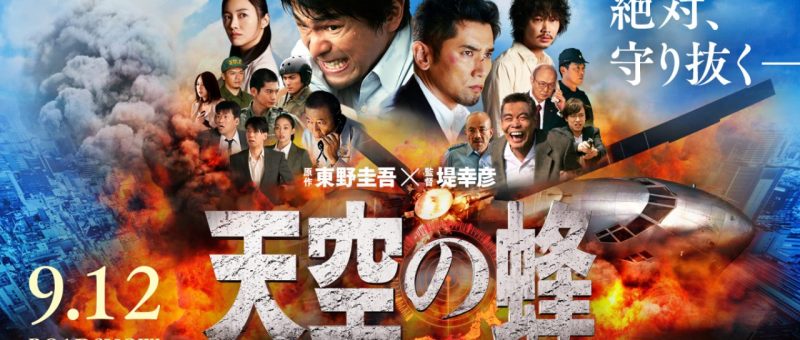
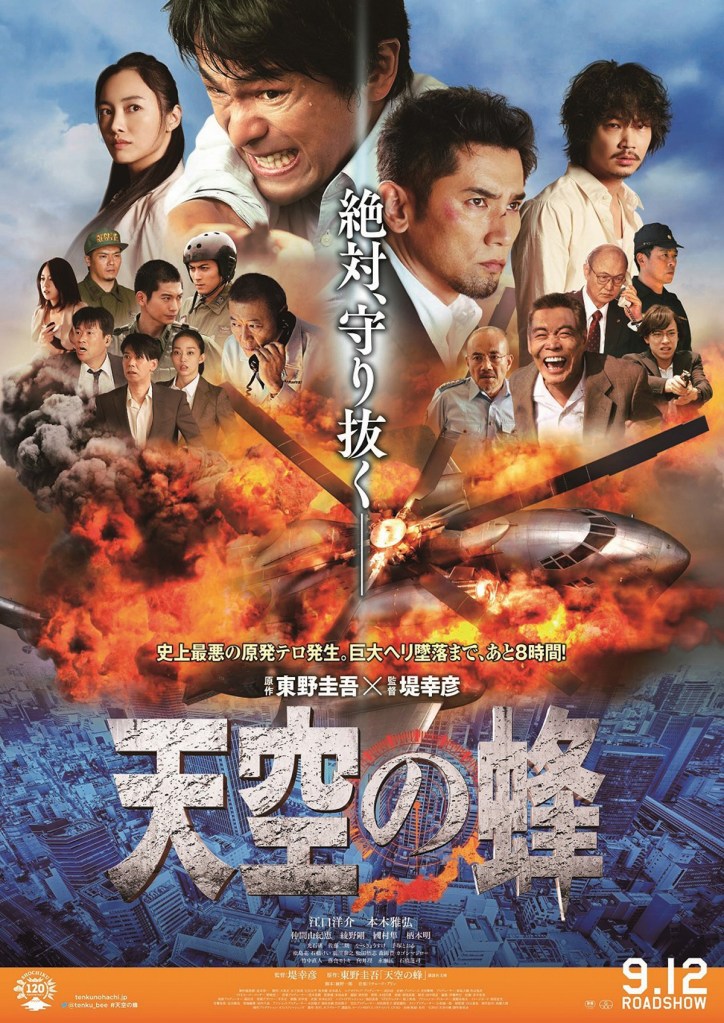
Blockbuster cinema wades into the anti-nuclear debate in a characteristically ambivalent take from prolific author Keigo Higashino adapted from his 1995 novel. Brought to the screen by blockbuster master Yukihiko Tsutsumi, The Big Bee (天空の蜂, Tenku no Hachi) is less wedded to its anti-nuclear message than it might at first seem, eventually sliding into a more comfortable tale of failed fathers redeemed with a potentially ambiguous coda that perhaps undercuts much of what has gone before . 

The main action takes place on 8th August, 1995 which falls between the 50th anniversaries of the atomic bomb attacks on Hiroshima and Nagasaki and is also a few months after the devastating earthquake in Kobe. Engineer Yuhara (Yosuke Eguchi) is about to unveil the “Big Bee”, Japan’s largest ever helicopter built with state of the art technology. He’s brought along his wife and son, but it’s clear there is discord in the family and neither of them are very impressed that the security guard didn’t even seem to know who he was so perhaps he’s not such a big shot after all. While his wife Atsuko (Kei Ishibashi) takes their son Takahiko (Shota Taguchi) and another boy to get a drink from the vending machine, Yuhara talks things over with a colleague and reveals that his workaholic lifestyle has destroyed his family life. He’s about to be divorced and doesn’t seem particularly cut up about it. Asked what’s going to happen to Takahiko, Yuhara cooly explains that it’s best he stays with his mum because he isn’t capable of being a good father to him. Unfortunately, Takahiko overhears him say that he’s essentially planning to abandon him and runs off to explore on his own, eventually sneaking aboard the helicopter which is then hijacked by a mysterious villain via remote control who flies it over a nuclear power plant and gives the Japanese government the eight hours before the fuel runs out to agree to shut down all the nuclear power plants in Japan. 

Yuhara’s failure as a father is immediately brought home to him when his son manages to throw the other boy, who climbed in with him but got injured, to safety, but doesn’t trust his dad enough to jump himself after hearing him say he was going to abandon him to his mother. Yuhara, meanwhile, was able to jump and grab the ramp of the helicopter but not to climb up and reach his son. He has to accept that his failure as a father and in consequence as a man is complete and total. His quest to save Takahiko is also a quest to redeem himself in the eyes of his society and avoid being branded as a man who sacrificed his family for a career and was finally unable to protect them.

Yet, at the present time, he’s also trying to save a nation while in the place of a father. To his mind, he built the Big Bee as a rescue craft, but its usage is most obviously military. He and his former colleague Mishima (Masahiro Motoki) see themselves as neutral engineers interested in technology but not particularly in its application. The government is reluctant to shut the plants down not only because cutting the power is extremely inconvenient and damaging to the economy, but because they do not wish to reopen the nuclear debate and risk the general populace realising that nuclear power is not entirely “safe”. Of course, this has extreme resonance in light of the Fukushima disaster, the government wilfully putting lives at risk in order to safeguard its own ends in refusing to issue an evacuation order for a potential disaster area covering all of the nation’s major cities right across the centre of the Japanese mainland.

This cavalier approach to human life extends to those working in the plants. We’re quickly introduced to a middle-aged woman whose son died of leukaemia she believes caused by lax safety procedures while the prime suspect is a friend of his (Go Ayano) who may also be suffering from a terminal illness caused by exposure to radiation after working as a cleaner at the power station. He vows revenge on a society which has rendered him “disposable”, thrown away like used tissue and left to fend for himself only because he was born into socio-economic circumstances which left him with no other choice than to take a “dangerous” job for employers that failed to protect him in much the same way Yuhara has failed to protect his son. 

The farmers in the town where the plant has become the major source of employment complain that no one wanted it but everyone needed the money. One leans into the mild message that perhaps we take our electric lives for granted, plugging in our toothbrushes without really thinking of the costs incurred in how we generate our power. Hotels dim their lights and switch off elevators while guests complain of the heat in the absence of aircon, but didn’t we manage OK before the power grid? Perhaps so, but our lives have changed. It might be as well to think again if those changes are really as good for us as we think they are, but you can’t turn back the clock. 

Not even the villain really wants the clock turning back, just better accountability and proper governance that puts the lives of citizens ahead of economic gain. Then again, a lot of this is personal, an act of self harm rebranded as revenge taken in atonement for the failures of a father. In this respect Yuhara may redeem himself, but there’s a note of discomfort in the jump to 2011 and the Fukushima disaster which doesn’t so much shout “I told you so” as over rely on the heroic efforts of the Self Defence Force as they battle a disaster which the powers that be from the government to the power company have failed to prevent. Yuhara wonders if the country is worth dying for and is comforted only in a trick he taught his son to calm his anxiety in the wake of the Kobe earthquake, tapping out “I am here” in morse code as an affirmation of survival which might also serve to say the work goes on even while “fathers” continue to fail in their responsibilities. 


Hong Kong release trailer (English subtitles)