Yamabuki (やまぶき, Juichiro Yamasaki, 2022)

The lives of a series of dejected souls in a moribund quarry town intersect in unexpected ways in a poetical drama from Juichiro Yamasaki, Yamabuki (やまぶき). The film takes it name from a colourful mountain flower which as someone later comments grows in the shade where no one can see, much like the sullen teenage girl whose mother named her after it because as she says “sunflowers face the sun but you don’t have to”. A tale of finding a place to root oneself in a rocky landscape the film has an understandably melancholy atmosphere but nevertheless eventually finds hope in perseverance or as one of the heroes finally sighs, “ask and ye shall receive”.

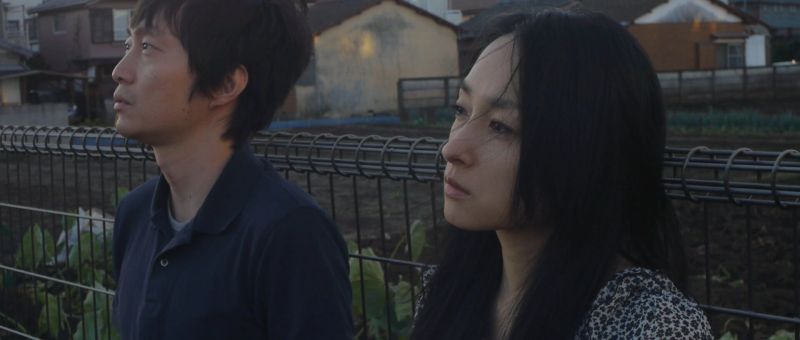
“This is my family” former Korean equestrian Chang-su (Kang Yoon-soo) beams on visiting a local ranch where his girlfriend’s daughter Uzuki is learning to ride. Chang-su explains that he was forced to give up horse riding after his father’s business went bust, implying at least that he’s from a formerly wealthy family in Korea with whom he seems to have few emotional ties. We see him send money abroad which seems to be intended to pay off loan sharks, presumably his father’s debts unwisely incurred by his failing business and perhaps the reason why Chang-su has come to Japan to work a manual job in a quarry. Most of the other workers are also economic migrants, many of them from the same area and conversing with each other in their own shared language though Chang-su seems to be the only Korean. After receiving the news that he’s to be made a regular employee rather than a casual worker, he starts to think that his life is back on track allowing him to once again ride a horse. 

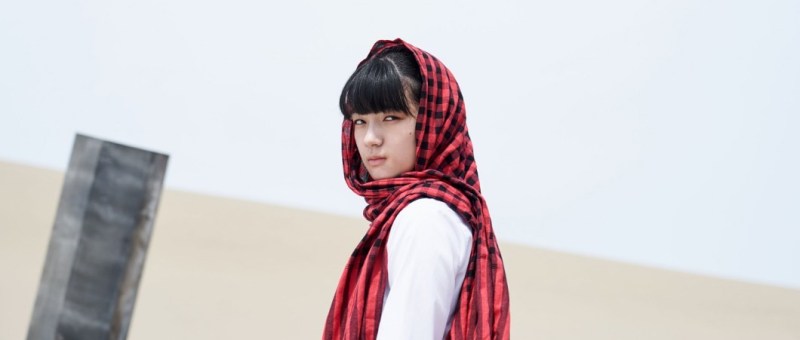
But his hopes are suddenly dashed when his car is hit by falling rocks dislodged by police detective Hayakawa (Yota Kawase) trying to uproot a yamabuki flower to take home with him while his teenage daughter, Yamabuki (Kirara Iori), rolls her eyes and storms off. Reeling from the death of her war reporter mother in a Middle Eastern combat zone, Yamabuki is at odds with her father and searching for her own identity. She has begun hanging out with a group of protestors who stand silently at the roadside with prominent signage though their protests seem to take on many forms with no particular focus. One moment it’s the consumption tax and the next American presence in Okinawa or racism in contemporary Japan. This last one is met with a counter protest by a man shouting at them to go back where they came from, echoing the kind of othering and displacement felt by Chang-su who is let go from the quarry after the accident.

Just as Chang-su tries to anchor himself with his new family, Hayakawa tries to remake his in the absence of his wife while carrying on a kind of relationship with a Chinese sex worker equally displaced by the modern society and looking for a place to belong. As she points out, her mother came to Japan because at that time it looked like the future, but like the quarry town it now seems like the past. Her mother returned to the economic powerhouse of Shenzhen and has apparently become wealthy, though her half-Japanese daughter struggles to find a place for herself. As Chang-su reveals, “yamabuki” was also the name given to gold coins offered as bribes in the feudal era, lamenting the money-oriented nature of the contemporary society just as Yamabuki herself concludes that she wants her life to mean something and to feel present in every second of her existence. Her father had objected to the protests, but eventually tells her that she should be preparing for her independence and learning to be accountable to herself for her actions. She must have the courage of her convictions, as he lays out in a scene shot in the manner of a political rally and echoing Soviet realist cinema, so she can’t regret it later even if she one day changes her mind.  

They are all, in their ways, like the yamabuki rooting themselves in rocky ground and growing in the shade each discovering something new that allows them to continue despite the continual disappointment of their lives. Shot in a grainy 4:3 16mm, the film emphasises the aura of impossibility that enshrouds the town as if it were somehow trapped in the past, but equally lends it a kind of elegiac quality peppered with the colourful yellow of the yamabuki flowers which suggest that it is possible to blossom even under the constant gloom of a continually uncertain existence.


Yamabuki screens at New York’s IFC Center on Feb. 10 & 11 as part of ACA Cinema Project’s New Films From Japan. Director Juichiro Yamasaki will be present at each screening for a Q&A.

Original trailer (English subtitles)
Breath of Rokkasho (息衝く, Bunyo Kimura, 2017)

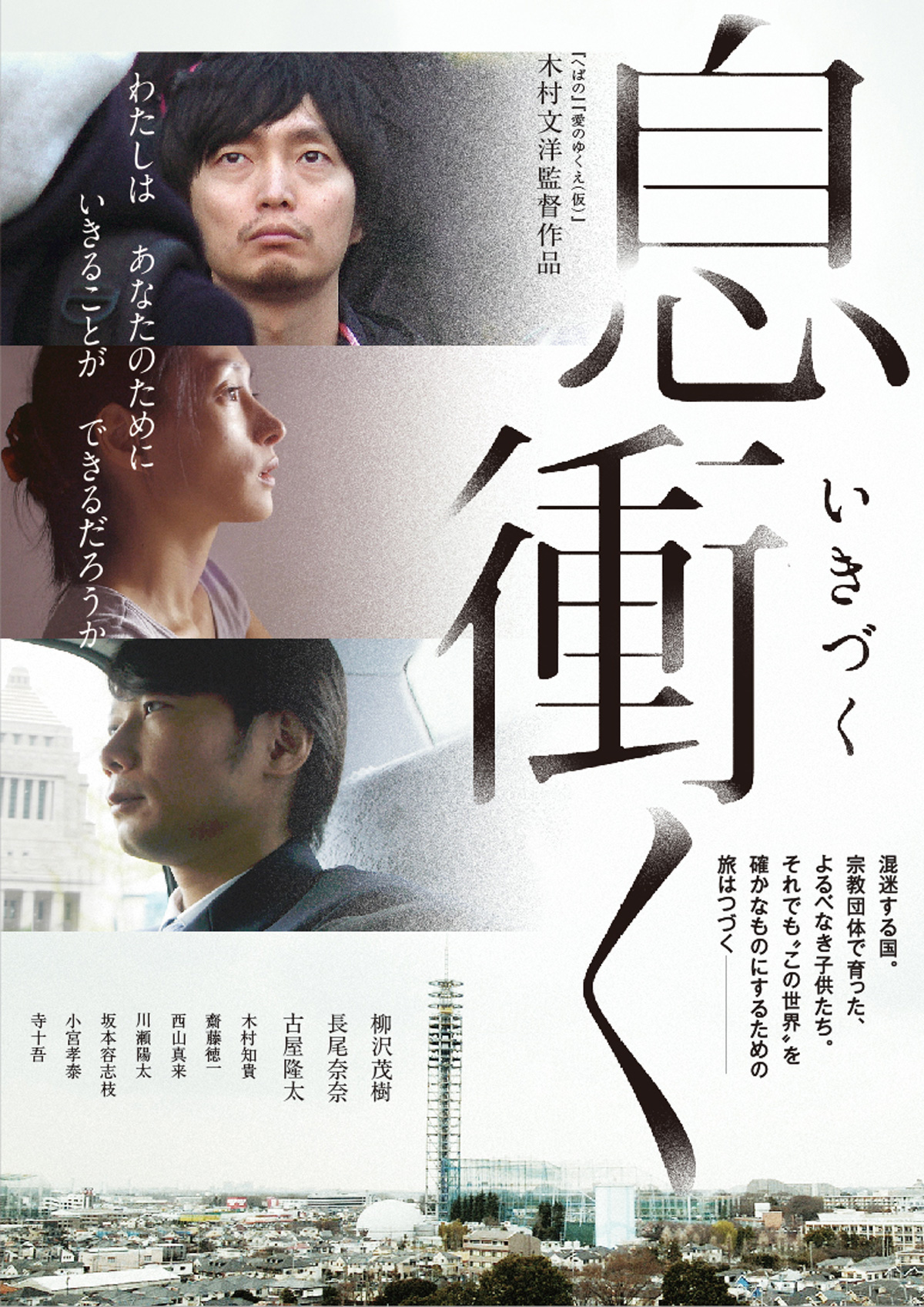
Breath of Rokkasho posterIndividual desire versus responsibility to the collective is something of a major theme in Japanese cinema. The fallible ideologue at the centre of Breath of Rokkasho (息衝く, Ikizuku) believes individualism is the key to world happiness, implying that a collection of fulfilled individuals would amount to a fulfilled society, but then again his logic is perhaps hard to follow when he cares so little for other people’s freedom. Taking place in the post-Fukushima world, Rokkasho wants to extend this idea through examining the complexity of the anti-nuclear movement and the political forces which advocate for it while ordinary people largely sit back in silent disapproval. The ideal society, if there even is such a thing, will probably not be built by those in power but by those who manage shake off the problematic legacy of the past in order to embrace their “individual” wills but with the collective good in mind.

Norio (Shigeki Yanagisawa), Yasuyuki (Ryuta Furuya), and Yoshi (Nana Nagao) were raised in a politicised Buddhist cult, The Seed Association, which has a strong interest in ecological affairs and therefore the anti-nuclear movement. Each lacking fatherly input, the three youngsters fell under the spell of the cult’s most prominent member, Mr. M (Satoru Jitsunashi). Mr. M however abruptly upped and left them, abandoned without hope or answers. 20 years later, Norio is a civil servant also working for the Seed Association on political campaigns while Yasuyuki has become the new golden boy whom many tout as the natural successor to Mr. M. Yoshi left the sect at a much younger age and is now a single mother in the middle of what seems to be a fairly messy divorce.

Looking up at the Tanashi Tower (also known as Sky Tower West Tokyo) – a “state of the art” radio tower completed in 1989 midway through a period of unprecedented economic prosperity and named after the town which used to stand here the name of which literally means “no rice”, the three kids ask Mr. M if it’s possible to see the Nighthawk Star from down below. He tells them he doesn’t know, but they can look for it together. Mr. M did not help them, he disappeared and left them with only more questions and an even shakier relationship with their familial pasts. Each badly let down by parental figures who either abandoned their families to join the cult out of nuclear fear, committed suicide, or were simply distant and neglectful, neither Norio, Yasuyuki, or Yoshi has been able to step into the adult world with any degree of confidence or faith in its teachings.

Only by confronting their difficult pasts can the trio begin to unblock their individual paths. A visit to the long absent Mr. M who has apparently embraced full individualism as a hermit farmer who dresses in a comical baby chick’s costume complete with squeaky claw-shaped slippers, begins to show them that their faith in his teachings may have been misplaced. Mr. M claims that the human race is not yet strong enough to live only by thinking of its own happiness, something that he feels would bring the greatest happiness to all mankind. Refusing to recognise the “selfishness” of his philosophy, Mr. M has withdrawn from society and made himself the centre of a happy nation of one.

Parental betrayal becomes a major theme, eventually extending to the paternity of the state in its repeated failures to protect and care for its children. The English title of the film references the Rokkasho nuclear reprocessing facility which has become an ongoing scandal in its 20-year series of construction delays with 23 postponements issued since its original 1997 projected date for completion. Norio, the melancholy civil servant, hails from the town himself – in fact his mother took him away from it precisely because she feared a nuclear disaster. Yet The Seed Association, or anyone else for that matter, has not been able to solve the nuclear issue even in the post-Fukushima era. Engaged in the business of “politics” the sect’s intentions have become blurred as they contemplate their survival in an ever shrinking society, subject to the same political games of manipulation and backbiting as any other party. Gradually disillusioned with the cult’s hypocrisy and didacticism, Norio considers forging his own path – something which sets him at odds with Yasuyuki whose faith is also shaken only he’s invested far too much to allow himself to acknowledge it.

The Japanese title, by contrast, simply means to gasp for air. Trapped fast in society filled with corrupt, conflicting values each of the three struggles to find a foothold for themselves as they flounder wildly without guidance or aim. Yet in being forced to confront themselves and their pasts there is a movement towards progress, or at least a strong desire to find it. They, like their nation, have been betrayed and struggled to deal with their betrayal, but have managed to find their own essential truth even so and along with it the ability breathe deeply even when the air is thickening.


Screened at Nippon Connection 2018.

Original trailer (no subtitles)