Last Mile (ラストマイル, Ayuko Tsukahara, 2024)

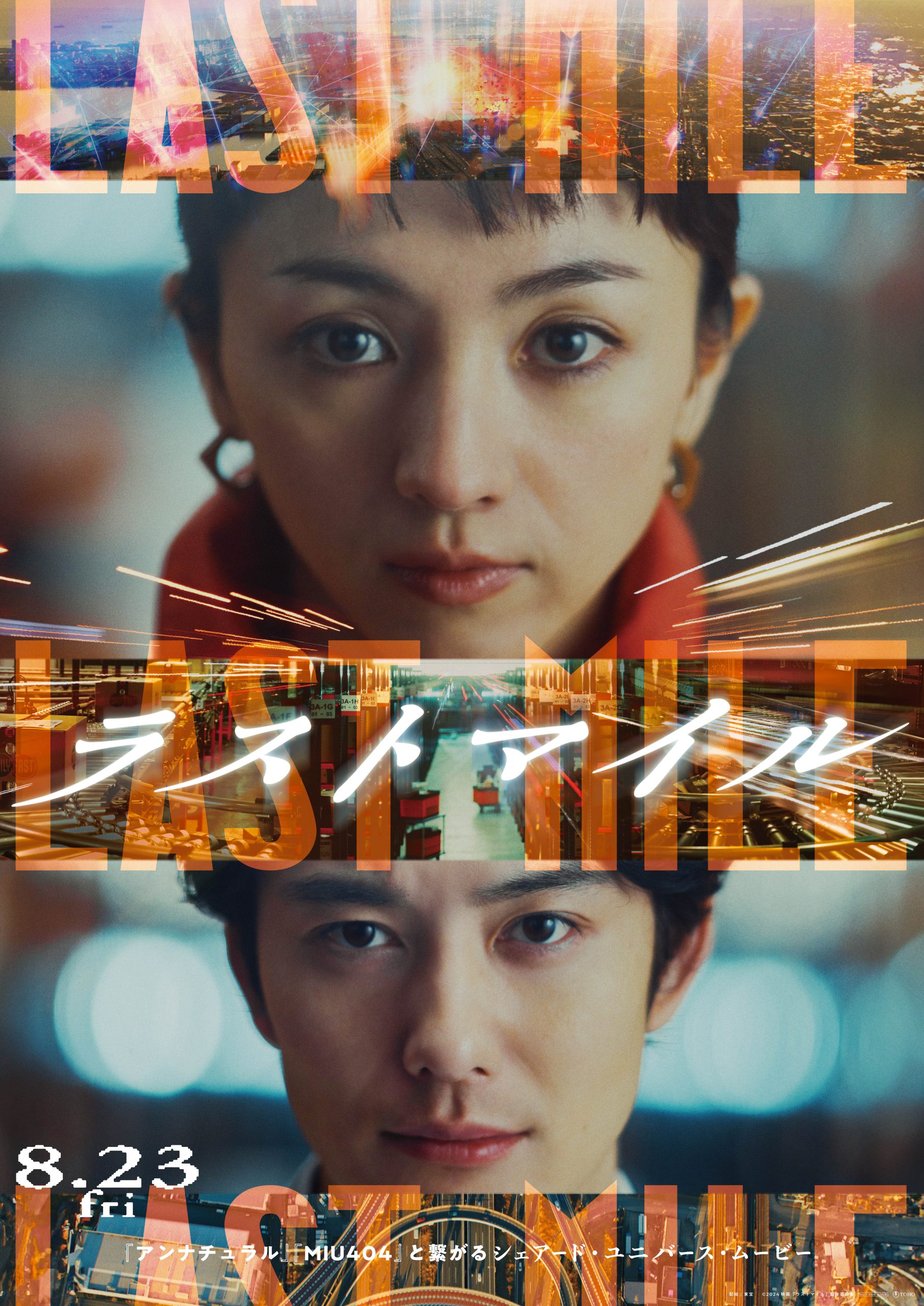
“Customer-centric”, what does that actually mean? The Amazon-like US-based conglomerate at the centre of Ayako Tsukahara’s Last Mile (ラストマイル) prides itself on its customer-centric philosophy, but at the end of the day, what that really means is that they give us what we tell them we want through our purchasing patterns and browsing history. That would be that we want everything as cheap and fast as it’s possible to be and don’t really think about the wider implications or what a world of infinite convenience might be doing to the society around us.

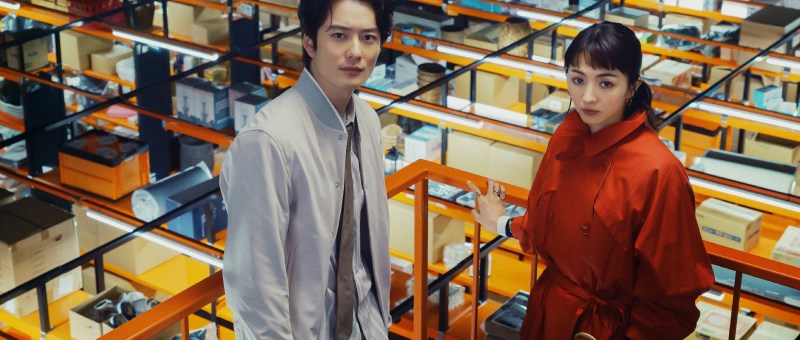
At least from the perspective of corporate lackey Elena (Hikari Mitsushima), recently returned from the US, the reason Daily Fast pressures its delivery staff to lower costs isn’t to maximise their profits, it’s so they can go on providing lower prices to customers which to her is all part of their customer-centric approach. This doesn’t really gel with her off-the-cuff remark about the warehouse not having a safety net to protect the workers from accidental falls or, she ominously adds, prevent people from jumping. That she brought it up at all might signal that she knows something’s not quite with the way this company treats its employees, though as it turns out she may have something else on her mind. In any case, when she arrives on her very first day the entrance to the complex is little better than a cattle market with a man on loud speaker barking instructions about were to go to the 800 members of staff some of whom have only been brought in to bulk up for the upcoming Black Friday sale. 

Which is all to say, it wouldn’t be all that surprising if the fact that some of their parcels have been exploding on delivery were a concerted attack against their ultra-capitalist philosophy, though actively delivering bombs to people who didn’t order them is not very “customer-centric” in any case. Obviously, Elena isn’t keen on this either but is also convinced that it can’t really be their fault because they have strict and dehumanising security measures in place preventing the workers from bringing in anything inessential. Even after she works out that the bomber has actually warned them that there are 12 bombs out there, she wilfully withholds the evidence from law enforcement to avoid damaging their share prices while trying to minimise business interruption rather than do anything sensible like stop delivering people parcels until they’ve figured out what’s going on with the bombs, though the real mystery is why the police don’t really seem to have the power to do that and, in fact, end up working with the warehouse to check each parcel individually to keep the conveyor belts going.

From the aerial view, the city itself resembles the warehouse with the roads taking the place of the belts as delivery vans shuttle along them. Seventy-something delivery driver subcontractor Sano (Shohei Hino) once had a friend who used to say that they were the ones who kept the country running. Yacchan became the number one driver largely because he took 10 minutes to eat his lunch and worked every hour god sent for dwindling pay with the implication that his gruelling schedule contributed to his early death. Sano’s son Wataru (Shôhei Uno) has just started working with him on the van after being laid off from an electronics job. They made quality washing machines that were designed to be efficient and to last, but of course they couldn’t compete with cheaper brands so they went bust.

Elena berates herself for being “too Japanese” for the American company which is to say that she takes pride in her work. That’s not to say that everything about the American business culture is bad as she encourages her assistant, Ko (Hikari Mitsushima), to call her Elena and to feel free to speak his mind rather than equivocate to avoid causing offence. But despite their “customer-centric” approach, it’s clear that the company puts profits above all else and treats its workers, who are not actually employees, poorly, without concern for their wellbeing. Yagi (Sadao Abe), the boss of logistics first Sheep Express which is the prime courier for Daily Fast, laments that he’d love to hire more drivers to help them through this crisis but he can’t because they’re always squeezing his budget and no one will work for their terrible rates except for those who, like Sheep Express itself, have no other options and will have put up with it because they’re dependent on Daily Fast. And because they’re dependent on Daily Fast, it means we all have to keep buying stuff we don’t really want or need just keep the belts going because we’re terrified about what will happen if they stop.

There is a direct comparison between Wataru’s well-made washing machines and the cheap and fast consumerist model that’s gradually taken over that suggests things like craftsmanship and integrity have gone out the window in a world where no one really bothers to go the last mile anymore, though it’s his steadfast engineering that eventually saves the day while even Elena comes to rethink her career trajectory and advises the drivers to strike and end this culture of exploitation because it turns out Daily Fast needs them more than they need Daily Fast. But maybe we don’t really need Daily Fast either, and we’re as much to blame for letting them give us what we think we want without really considering what that actually means. Perhaps a “customer-centric” society’s not all it’s cracked up to be, especially when workers and consumers are often the same people stuck on conveyor belts knowing there’s only one way to stop them.


Last Mile screens 19th June as part of this year’s Toronto Japanese Film Festival.

Trailer (no subtitles)

Stay Mum (かくしごと, Kosai Sekine, 2024)

Late into Kosai Sekine’s maternal mystery Stay Mum (かくしごと. Kakushigoto), a doctor describes the behaviour of an old man living with dementia as a “convenient delusion” and later remarks forgetting is a kind of salvation that liberates him from what was apparently a very stressful life of repression and properness. Yet to the heroine there’s something very unfair about someone who has hurt her so deeply being allowed to just forget all about it while she has to go on carrying the legacy of his unkindness along with her own grief and pain.

Ironically enough, she finds herself caught in the middle as a mother and a daughter after taking in a little boy her friend accidentally ran over who appears to have extensive scars and bruising that suggest he has been mistreated by his birth family for some time. The boy also claims to have lost his memory, leading Chisako (Anne Watanabe) to fill in the blanks for him. She gives him a name, Takumi, and tells him that he is her son intending to raise the boy covertly while temporarily staying in her rural hometown to care for her estranged father after he was found wandering around in a state of undress.

Even Takumi realises the irony of Chisako’s father Ko (Eiji Okada) falling further into a state of forgetting just as he is learning to “remember” thanks to the memories Chisako imparts to him in their fictional shared history. The film’s English title is a kind pun playing the fact that everyone involved must “stay mum” in order to maintain this delusion of family life while also hinting Chisako’s desire to reclaim her maternity having lost a child of her own. The Japanese title more literally translates as “that which is hidden” while the novel that it’s based on is titled the more direct “lie” though of course it leaves ambiguous to which lie it is referring. But as the doctor had said, it becomes a “convenient delusion” for everyone which grants them a kind of peace and serenity that allows them to reclaim exactly what they wanted out of life but perhaps could not get in any other way.

But of course, it can’t last and at the same time also delays a final confrontation with the reality that would truly allow them to move forward. Someone later accuses Chisako of brainwashing Takumi, essentially kidnapping him while forcing him to play the role of her son as if she were simply mentally disturbed and desperate to overcome her grief rather than genuinely concerned and morally outraged by the idea of allowing a boy who shows clear signs of abuse to return to a home in which he will continue to be mistreated. But at the same time, she struggles to relate to her father and behaves towards him in ways which to Takumi may seem abusive, shouting at and at one point slapping him after a particularly unkind remark. Her inability to control herself further compounds her sense of failure as both mother and daughter, still carrying an internalised sense of inadequacy because of her father’s toxic parenting while in the midst of forgetting he is perhaps still able to perceive the mistakes he made that cost him a functioning relationship with his daughter.

Ko spends his days crafting statues of the goddess of mercy as if begging for atonement all while unable to recall the face he wished to give her. The irony is that as the doctor said, forgetting allows him to drop his guard and to remember the costs of the way he lived his life. As Chisako counters there are also things which shouldn’t be forgotten no matter how painful they may be to remember, along with those which cannot really be forgiven, though the act of wilful forgetfulness does perhaps provide a salve for the wounds of the past. Though at times overly contrived and strikingly predictable, Sekine’s empathetic contemplation of the emotional truths behind the bonds of parents and their children ends in a violent confrontation with corrupted parenthood but equally in a gesture of mutual salvation which ironically depends entirely on the willingness to speak the truth both emotional and literal. 


Stay Mum screened as part of this year’s Toronto Japanese Film Festival

Original trailer (no subtitles)

Masked Ward (仮面病棟, Hisashi Kimura, 2020)

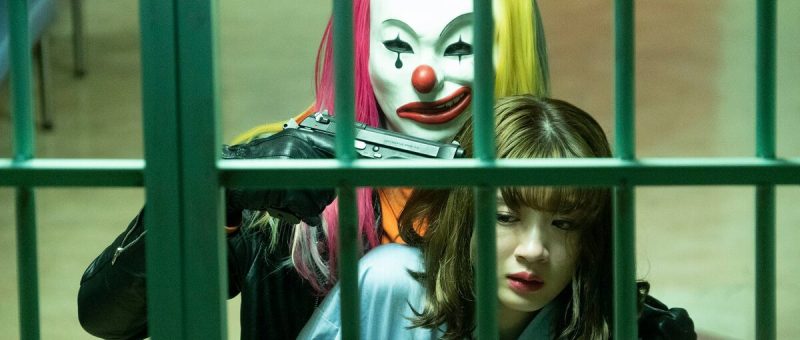
“This hospital is…abnormal” according to locum doctor Hayami (Kentaro Sakaguchi) as he begins to discover dark goings on while trapped in a former psychiatric home after being taken hostage by a man in a clown mask. Based on the medical mystery novel by Mikito Chinen, Masked Ward (仮面病棟, Kamen Byoto) is partly a meditation on guilt and grief and partly an attack on backroom eugenics in an often judgemental and potentially corrupt society, if wrapped up in a wilfully silly B-movie crime thriller. 

Still on a temporary sabbatical following a bereavement, Dr. Hayami is recruited by an old friend, Kosakai (Ryohei Ohtani), to cover a night shift at a long term care hospital mostly catering to patients living with dementia. It has to be said the hospital itself has an instantly creepy aura, the police who later arrive describing it as looking like a prison which is apt because no one ever thought to remove the bars from the interior intended to keep “dangerous” patients from escaping. Even so, Hayami is repeatedly assured that nothing ever happens here and most likely he won’t need to come out of his room. Unfortunately that proves to be bad advice because not long after he settles in, a man in a clown mask turns up with a young woman he apparently himself shot but now wants patched up thereafter taking everyone present hostage while hiding out from police who have instituted a manhunt after he robbed a convenience store at gunpoint. 

You’d have to admit it looks a bit suspicious that all of this happened the very night that Hayami is in charge, especially as it’s suggested he may bear a grudge towards head doctor Tadokoro (Masanobu Takashima) as he was the one who refused to admit Hayami’s late girlfriend Yoko (Izumi Fujimoto) who was killed in a car accident in which Hayami was driving. Then again, as Hayami says, what would be the point in that? Suffering frequent flashbacks he subconsciously links the young woman, Hitomi (Mei Nagano), with Yoko determined in a sense to save her instead while trying to figure out what exactly is going on in this very weird medical institution and what the clown is trying to achieve with his random siege. 

The creepiness of the hospital is already well established with its former psychiatric institution vibes, something only enhanced on the discovery of an apparently disused operating theatre which is no grimy basement filled with rusty equipment but appears to have been refurbished recently and is sparklingly clean. It doesn’t really take a genius to figure out what’s been going on in there or why evil head doctor Tadokoro doesn’t want to call the police, but it does call into question not just his own ethics but those of the wider medical profession as he advances a series of eugenicist justifications for his decisions insisting that some lives are not worth saving while those of the elite who “can’t bear to wait” obviously are. Many of those in their beds have no names, taking those only of the area in which they were found supposedly with no identification, and are receiving only basic care otherwise forgotten by an indifferent society while hypocritical politicians offer platitudes about equality, superficially insisting that every citizen should have the right to live, to be protected, and to have a future.  

Even so Kimura can’t quite decide how seriously he wants to treat the darkness at the film’s centre, embracing the outlandishness of the material through a series of B-movie cliches from eerie handheld photography in the creepiness of the of the empty hospital corridors to literal lightning effects and foreshadowing so heavy it almost feels ironic. Yet the tone is at the same time earnest and slightly naive, the police apparently minded to cover the whole thing up due to pressure from above while Hayami is otherwise free to blow the whistle by getting the media involved with a press conference beamed directly onto a big inner-city screen in the middle of a presidential campaign speech all of which seems faintly unlikely given how far they were prepared to go keep the conspiracy secret while one wonders if he’d really be able to get so much attention so quickly even having recovered the secret documents proving his claims are true. In any case, his speech is only really intended for an audience of one as he says pretty much the same thing as the duplicitous politician only he really means it while urging those who’ve been irreparably harmed to give up their hate and try to move on sharing feelings and hopes rather than anger and resentment which is a nice message but perhaps also not especially helpful in holding those who’ve misused their power to account. 


Masked Ward streams until 27th February in several territories as part of Japanese Film Festival Online 2022.

Original trailer (English sutbtitles)

Air Doll (空気人形, Hirokazu Koreeda, 2009)

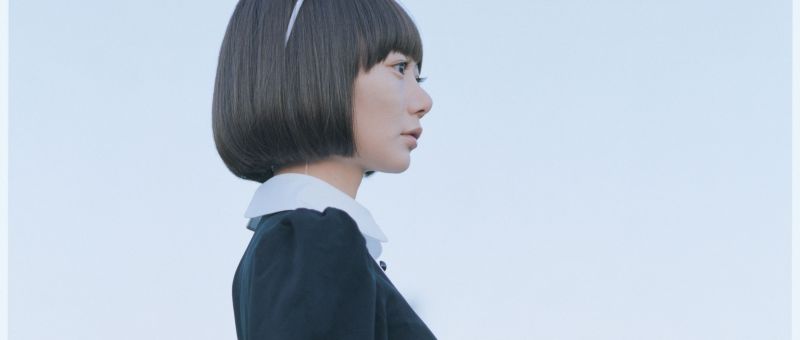
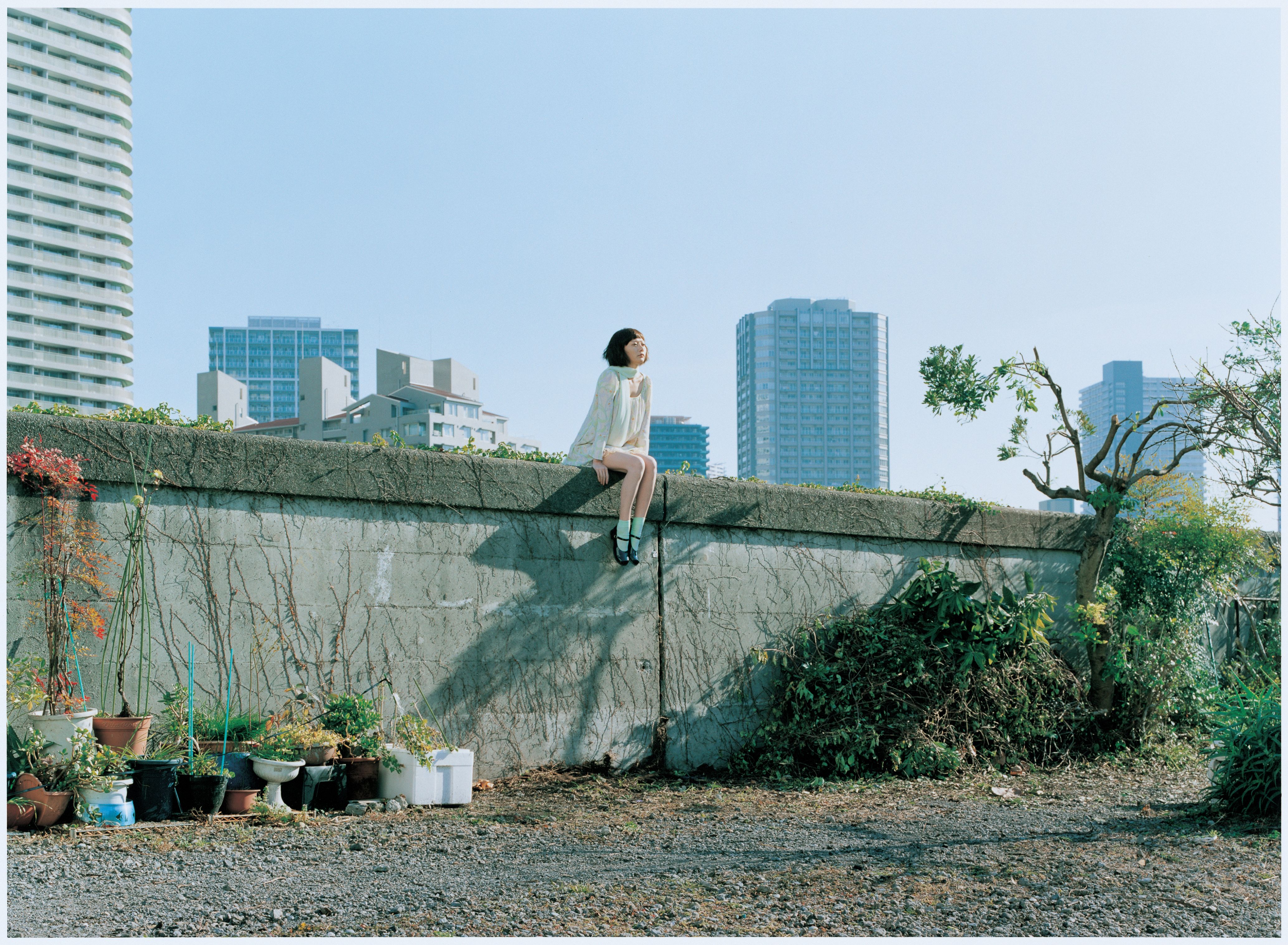
“Was everything you saw in this world sad? Was there something, anything, what was beautiful?” the heroine of Hirokazu Koreeda’s exploration of urban loneliness Air Doll (空気人形, Kuki Ningyo) is asked by her creator though he can offer her few answers for the strange mystery of her life. Like a child, she takes beauty where she finds it yet much of what she sees is indeed sad as she reflects on the disconnected lives around her, the emptiness and futility of life in the contemporary society where everything is just a substitute for something else which cannot be obtained. 

As for herself, she is quite literally empty inside, an inflatable sex doll owned by middle-aged family restaurant waiter Hideo (Itsuji Itao) who has given her the name of his ex, Nozomi (Bae Doona), which ironically means hope, wish, or desire though not generally of the sexual kind. Yet one day she suddenly wakes up and begins to explore the world rejoicing in its new sensations feeling the rain on her hands and the wind that sounds the chimes as she watches her neighbours go about their daily routine. Dressed in the French maid’s outfit picked out for her by Hideo she gets a job at a local video store and begins living a more independent life while learning how to operate in human society. She feels herself out of place but is repeatedly told that there are others like her, mistaking her literal emptiness for their spiritual despair. 

Yet that sense of emptiness and futility is evident from Nozomi’s first forays into the human world in that the first act of mundanity she witnesses is the bin men sorting rubbish for disposal. “Unfortunately they’re non-burnable” Nozomi’s creator explains when she visits him in search of answers revealing he throws out the broken dolls that are returned to him once a year, “after all, once we die we’re burnable garbage. It’s not such a big difference” he adds, though as it turns out it is quite a big difference to Nozomi in ramming home to her that she can never become human and will always be something else, an inorganic “substitute” for something perceived as the “real”. 

“Your only flaw is that your body’s so cold” Hideo ironically laments as he warms her up in the bath, something she is told repeatedly to remind her that though she has discovered a heart it does not beat and she is not “alive”. Yet an old man (Masaya Takahashi) seeking a different kind of comfort later remarks that those with cold hands often have warm hearts as he reflects on his own life as a “substitute” teacher while she looks over the pictures of the many dogs he’s had through the course of his life as substitutes for the traditional family that have only left him feeling lonelier through their inevitable absences. There is perhaps in this a slightly conservative and uncomfortable implication that the loneliness we see in everybody that we meet is partly caused by the decline of the traditional family itself partly a consequence of the shifting gender roles of the later 20th century society. When they first meet, Nozomi has been rejected by a group of local mothers for inappropriately cooing over a baby in a pushchair the old man comforting her with a tale of the mayfly which is itself empty inside existing only to give birth and then die its own life defined by futility. Nozomi can never truly be human, but more than that she can never truly be a woman because she cannot reproduce as signalled in her final exchange with a little girl in her neighbourhood who swaps her beaten up and broken doll, a substitute for her absent mother now symbolic daughter to Nozomi, in exchange for her ring, a symbol of adulthood. 

In this way Nozomi becomes herself a symbol of something that is broken, an active barrier to societal happiness in providing a way for men like Hideo to escape the responsibility of the traditional family by satisfying his sexual desire through a fantasy of intimacy with an inanimate substitute. When Nozomi throws her pump away, Hideo buys a new model and when she confronts him he asks her to go back to being a passive doll because he finds all the human stuff “annoying” and only wants a woman who can be a selfless embodiment of his desires, will never talk back, challenge him, or hurt his feelings. Meanwhile, when her boss at the store (Ryo Iwamatsu) who seems have experienced a recent familial breakdown of his own blackmails her into having sex with him in the bathroom he is conversely annoyed by her passivity while tearfully calling out his wife’s name. Even her innocent love for coworker Junichi (Arata Iura) has its darkness, not only does she suspect she’s merely a substitute for his ex, his fetishisation of her revolves around his ability to take control over life by letting out her air and then permitting her to live by blowing his own back into her. 

“I am an air doll. A substitute for sexual desire” is how she introduces herself, preoccupied with her literal emptiness yet along with a heart discovering a sense of self as she interacts with others, beginning to wear her own clothes rather than those purchased for her by Hideo. At a moment of crisis she is surrounded by all the treasures she’s collected which ironically include a number of ornaments intended for a doll’s house including a tiny simulacrum of a cake which reappears in her imaginary birthday party suggesting that the only true happiness is to be found in wishful fantasy while the “real” will only ever disappoint. Nevertheless, she uses her last breath to bring happiness to all she can, uniting the old man with a lonely old woman (Sumiko Fuji) who confesses to random crimes just to have someone to talk to. Shot with unusual fluidity by Mark Lee Ping-Bing, Koreeda captures a society in flux in which the easy convenience of disposable consumerism has begun to replace human relationships and left us all empty inside. 


Air Doll in in US cinemas and on VOD Feb. 4 courtesy of Dekanalog

Trailer (English subtitles)

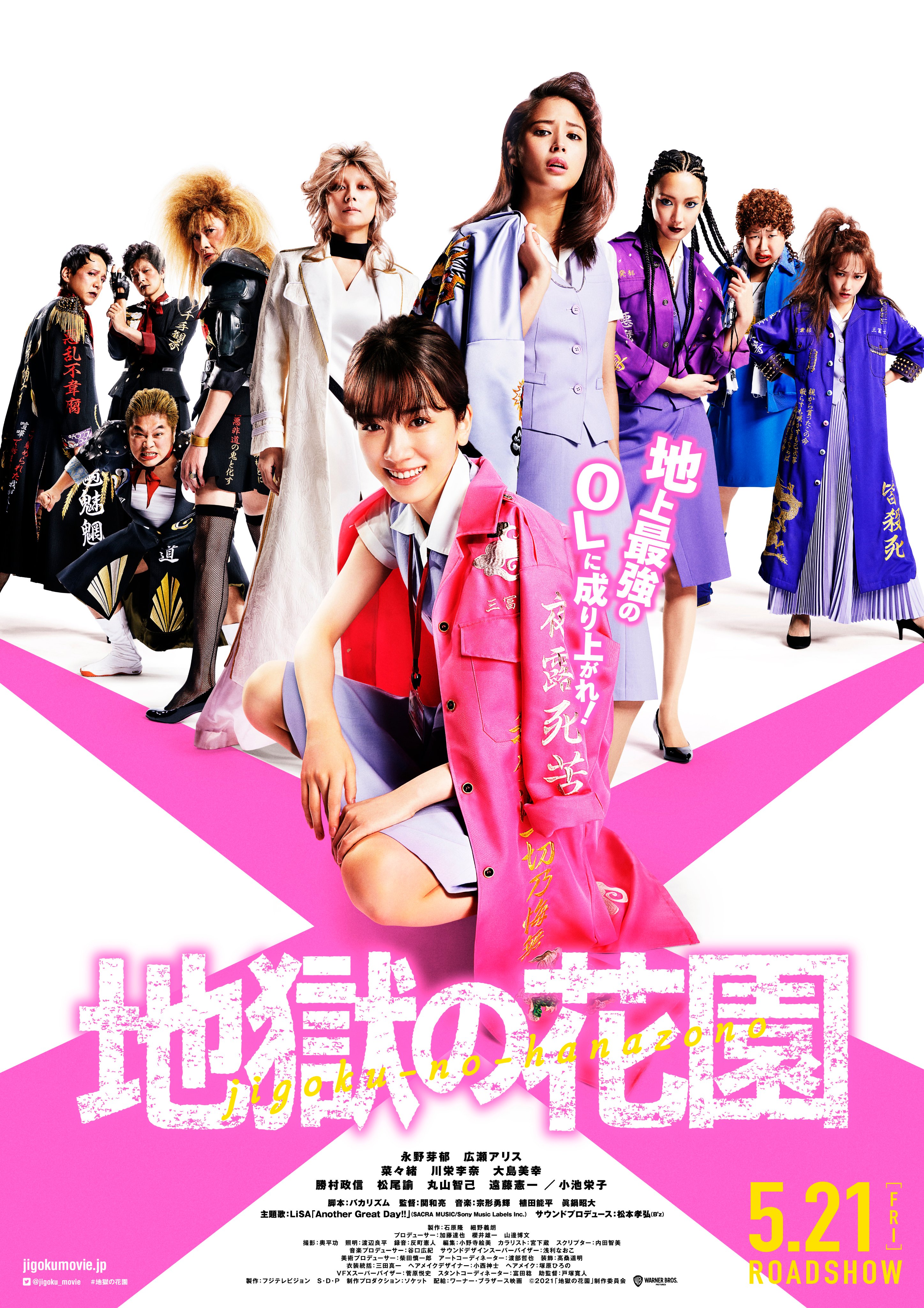
Jigoku-no-Hanazono: Office Royale (地獄の花園, Kazuaki Seki, 2021) [Fantasia 2021]

The OL, or “office lady” occupies a peculiar place in Japanese pop culture if not the society itself. The evolution of the typing pool, the OL exists to one side of office life, treated as domestic staff in the corporate environment and in many ways expected to be invisible. As such, an OL performs stereotypically feminine tasks in the office such as keeping the place clean and their male bosses looked after in addition to handling often dull and pointless admin work. It goes without saying that in general being an OL is a young woman’s job with the expectation that most will either find a way to transition onto a more viable career track or simply leave the world of work behind to marry and become a regular housewife. 

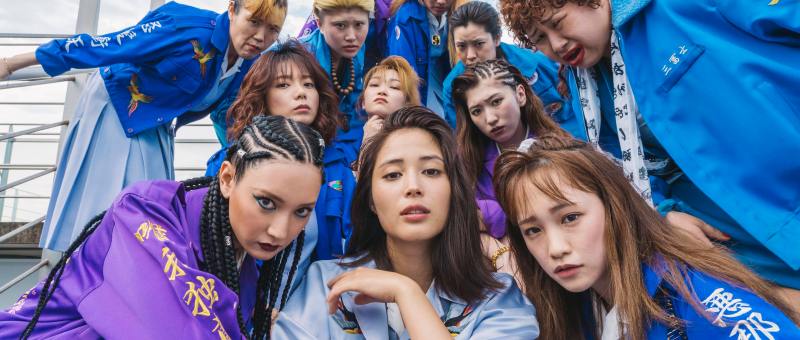
It’s this image of the OL as the embodiment of bland geniality that is at the centre of Kazuaki Seki’s zany comedy Jigoku-no-Hanazono: Office Royale (地獄の花園, Jigoku no Hanazono), a repurposing of “yankee” high school delinquent manga for the world of the office lady scripted by comedian Bakarhythm. A devotee of yankee manga, 26-year-old OL Naoko (Mei Nagano) explains that even office ladies have their warring factions outlining the tripartite fault lines at play in even her small company where the head OLs from Sales, R&D, and Manufacturing constantly vie for hegemony through physical dominance. She however merely observes from the sidelines defiantly living her “ordinary” office lady life. That is until new hire Ran Hojo (Alice Hirose) arrives to upset the precarious workplace power balance. 

Naoko first catches sight of Ran after she challenges some of the OLs from her company as they harass a timid male employee in the street though they don’t become best friends until after Ran spots a salaryman trying to upskirt her at a bus stop and decides to teach him a lesson. Despite being a yankee, it seems that Ran is also trying to live a normal OL life, bonding with Naoko over their shared love of a TV drama, but is not exactly good at the job and regards fighting as her one and only skill. Perhaps speaking to an inner insecurity born of being a woman in a conformist and patriarchal society, each of the women struggle to see themselves as protagonists in their own lives rather than mere supporting players unwittingly both playing the role of the ditzy best friend to the competent hero. 

In one of her many meta quips commenting on the action and how it would play out if she were a character in a yankee manga, Naoko laments her status as the “comic book hero’s boring friend” which is extremely ironic seeing as she is certainly the heroine of this movie given that it’s her voiceover we’re hearing and her POV we generally adopt. Yet Seki sometimes undercuts her by shifting to a rival voiceover offered by Ran herself doubtful of her proper place in the narrative and eventually descending into an existential crisis after an unexpected setback shatters her sense of self. 

Nevertheless, even if as the de facto leader of her company’s OLs Ran advocates for equality insisting there are no bosses and no underlings only women standing together, Office Royale generally embraces rather than attacks societal sexism particularly in its somewhat unexpected conclusion which ends in ironic romance rather than female solidarity. Even so, it’s interesting that the OLs lose interest in delinquency once the hierarchy of fists has been fairly decided, acknowledging the superior skills of a better fighter and thereafter living peacefully rather than continuing the internecine determination to sit at the top of the pyramid which is the hallmark of the high school yankee manga. 

While the final arc strays into some potentially problematic territory with the uncomfortable humour of four male actors playing the top fighters of a rival gang of OLs from another company, Office Royale offers a series of surprisingly well choreographed fight scenes even if eventually descending into manga-esque cartoonish violence while much of the humour stems from Naoko’s adorably nerdy voiceover musing on what would happen next if this were a yankee manga. In the end, however, it’s less a tale of office lady infighting than of a pair of young women coming to a better understanding of themselves even if they do so through the potentially destructive medium of pugilism. 


Jigoku-no-Hanazono: Office Royale streamed as part of this year’s Fantasia International Film Festival

Original trailer (English subtitles)

Audition (オーディション, Takashi Miike, 1999)

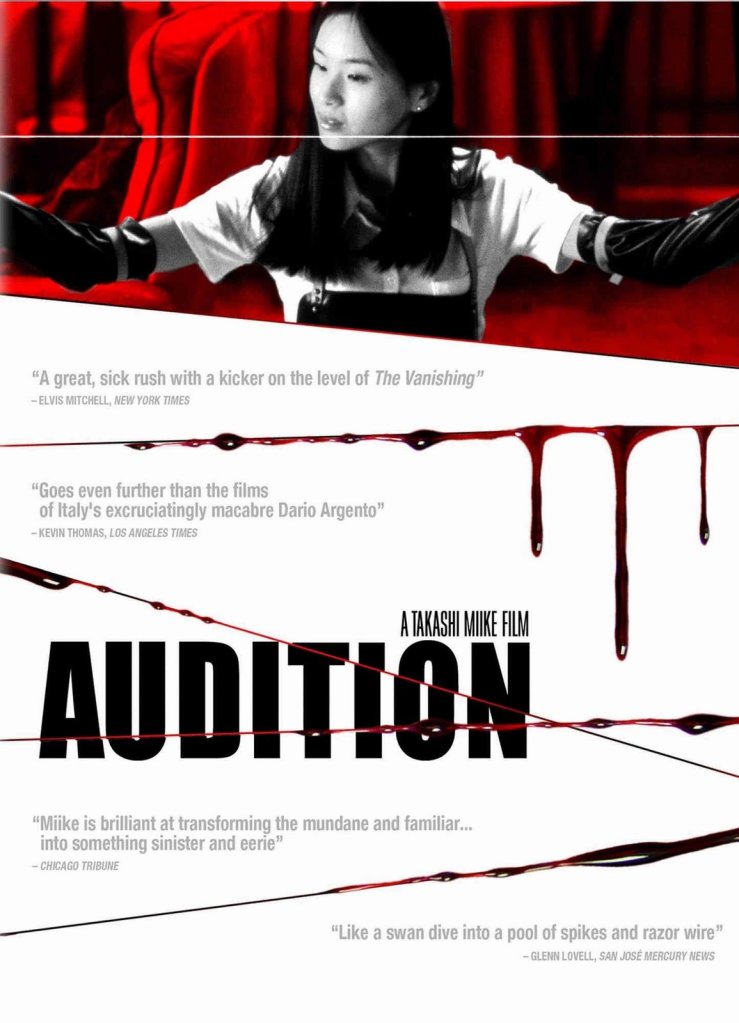
audition-posterReview of Takashi Miike’s Audition (オーディション) – first published by UK Anime Network.


The world was a much more innocent place back in 1999. Takashi Miike already had 34 films to his name before Audition became his breakout hit even whilst seeing him branded “sick” by a disgusted audience member at the film’s otherwise successful screening at the Rotterdam film festival. Based on the book of the same name by Japan’s master of the nasty psychological thriller Ryu Murakami, Audition is the twisted romantic nightmare to end all twisted romantic nightmares.

Aoyama is a widower with an almost grown-up child. Now that his parental responsibilities are changing, and spurred on by his encouraging son, Aoyama perhaps feels ready to move into another phase of his life by considering the idea of getting married again. However, Aoyama is a sensitive and romantic man who’s actually a little naive when it comes to matters of the heart and obviously hasn’t had much experience in the dating world in the last twenty years. He turns to an old friend who happens to be a casting director and comes up with the novel (if somewhat inappropriate) idea of letting Aoyama sit in on an audition to look for a new wife.

In glancing over the headshot resumés, one catches his eye – that of a former ballet dancer who equates having had to abandon her dream of becoming a professional dancer because of an injury with a sort of spiritual death. This deep sense of loss strikes a chord in the widowed Aoyama and despite his friend’s warnings that she gives him the creeps, Asami is the one he’s set his heart on. However, Asami is not the sweet and innocent girl she first appears to be…

In the intervening 15 years since its original release, Audition has amassed something of a reputation which is to say that viewers will almost certainly be aware of its “extreme” nature. However, Audition arguably works best when seen blind as it begins as a fairly straightforward romantic drama in which a broken hearted widower begins to live again thanks to the attentions of a shy young woman. Of course, Miike is peppering the otherwise anodyne love story with subtle (and not so subtle) clues all the way through, planting doubts in our minds right away. Is Aoyama just an old fool who’s lost his head over a young beauty or is he right to grow suspicious in the face of the ever increasing, yet circumstantial, evidence of Asami’s strangeness?

Is Asami hiding a dark secret, or is Aoyama projecting his fears of romantic entanglements onto her  silhouette and therefore creating, in some sense, a villainess worthy of his anxieties? According to Miike himself, Audition is not a horror movie (Japanese horror movies are linked with the supernatural and Audition’s terrors are very much of the real world) – Murakami in fact wrote the book as a strange kind of “love letter” to a woman he had wronged. Miike sought to envisage her reply and gives her an opportunity to offer a series of extremely dark explanations of her own. Neither Aoyama or Asami have been honest with themselves or each other. Aoyama is looking for a cookie cutter ideal to fit into the pre-made box marked “wife”, and well, it would be better not to go into all the various ways Asami has misrepresented herself but she does have a point when she calls Aoyama on how easy it was to make him fall for her meek and feeble innocent act.

Asami and Aoyama are always working at cross purposes to each other, engaged in a macabre dance where Asami leads by stealth, waltzing Aoyama into her spider’s web of vengeance by neatly subverting his ideas of femininity. However, this is not to cast Asami as a vile temptress or the predatory female born of male fears of emasculation (though these ideas are definitely in play), nor is she an avenging feminist warrior so much as a lonely, damaged woman. At the very end of the film the pair have perhaps reached a kind of understanding as, according to Asami, only in extreme pain does one understand one’s own mind. Left maimed and helpless, each is scarred and broken but alive and, perhaps, at peace at last.


Audition is now re-released on blu-ray in the UK from Arrow Films in a significantly better transfer than the previous US blu-ray from Shout Factory.