Beast Alley (けものみち, Eizo Sugawa, 1965)

In the opening title sequence of Eizo Sugawa’s Beast Alley (けものみち, Kemonomichi), a thick blob of inky blackness gradually expands over an aerial view of the city until it obscures it entirely. The title card which then appears is written in plain white, but will reappear at the film’s conclusion this time ashen as if it too had been singed by the deeply ironic flames with which the film ends. Based on a novel Seicho Matsumoto and scripted by The Beast Shall Die’s Yoshio Shirasaka, the film similarly takes an incredibly cynical view of the modern post-war society in which it is revealed the militarists are still basically in charge and presiding over a deeply corrupt social order. 

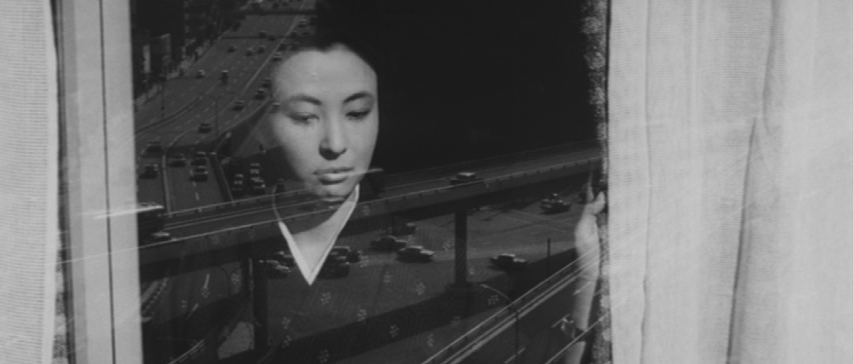
The big bad, Kito (Eitaro Ozawa), says as much when he states the need for reforming the nation’s “rotten political system” by which he means post-war democracy. Kito made his made his money doing deeply dodgy things in Manchuria in addition to running an exploitative coal mine in Japan. Now mainly bedridden, he basically runs the country as a far-right political fixer working in tandem with big business and the yakuza who have traditionally been big supporters of conservative and nationalist forces. Early on we see one of his underlings negotiating with politicians to ensure that Taiyo Roads will be hired be hired for a large scale construction project planning to put highways all the way through Tokyo. As we later discover, he’s prepared to go to great lengths in order to achieve his goal, going so far as to have a sex worker murdered to implicate the uncooperative CEO of a rival construction film into resigning by threatening to frame him for the crime so they can install their stooge in his position. 

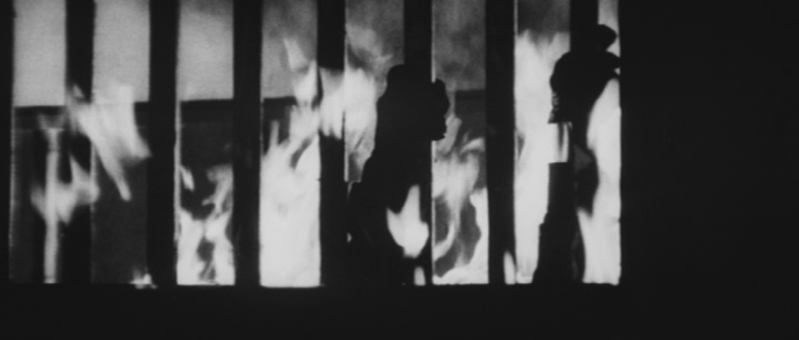
It’s into this world that everywoman Tamiko (Junko Ikeuchi) is drawn while working as a hotel maid at a traditional Japanese inn. Trapped in a bad marriage to a man who is also bedridden yet still attempts to rape her when she returns home to find him in bed with the housekeeper, Tamiko longs for escape and is therefore ripe for the picking when approached by Kotaki (Ryo Ikebe), the manager of an upscale Western hotel, to join him in an unspecified enterprise which will apparently make her very rich. The only catch is that she will have to “get rid” of her “dependent”, which she probably wanted to do anyway, by burning down her house with him inside it. Once she’s done this, there is no turning back for her even if she had not developed complicated feelings for Kotaki who is both her salvation and damnation. 

Tamiko’s husband had failed to give her the comfortable life that he had promised, something which she thinks Kotaki can deliver even if it requires her to become the plaything of Kito whom does she actually seem to like even if aware of the precarity of her position and still in thrall to Kotaki. Leaving the hotel so abruptly was however a strategic error as it arouses the suspicious of (originally) earnest cop Hisatsune (Keiju Kobayashi) who quickly realises that Tamiko set the fire to kill her husband. Though he seemed to be motivated by justice, Hisatsune too is soon corrupted explaining to Tamiko that he has become cynical and jaded. Years of police work have shown him that true criminals know how to break the law and get away with it so he can’t do anything about them, but “good” people, like he implies Tamiko, are pushed into crime by desperation and are easily caught. Tamiko wields her sexuality against him by agreeing to a tryst, though when it doesn’t go to plan he tries blackmail and then rape before she, ironically, manages to escape from his bungled crime. 

Hisatsune’s corruption is gradual and self serving. He starts with suspicion, tailing Tamiko in the interests of justice but also because he desires her, before stumbling on the conspiracy, putting the pieces together, attempting to use them for his own gain and trying to blow a whistle mostly out of resentment. Kito’s reach is all encompassing. Hisatsune is warned off investigating certain aspects of the crime by his senior officers and is then fired on Kito’s instructions for fiddling his expenses after harassing Tamiko. He tries to give his findings to his boss but it goes nowhere and then tries the press but is given the brush off, the editor his reporter friend refers him to gently implying he’s just a crank with an axe to grind. Of course, it turns out that the reporter is already in league with dodgy lawyer Hatano (Yunosuke Ito) who is Kito’s right-hand man. 

The connections between the three men, Kotaki who was once a communist, Hatano, and Kito go back to Manchuria and the corruptions of militarist era which it becomes clear has never really ended. Kito has only one rival and it’s another faction of the conservative ruling party who are probably just waiting for him die. Attempts are made on his life and they don’t go well for those who make them. Even if Hatano hoped to simply inherit an empire he, as he points out, put in much of the work to build he is sorely mistaken while Tamiko may intellectually understand that Kito’s death would place her in a precarious position but carries on regardless. “You never know who will betray you in this world” Kotaki laments, echoing Kito’s later claim that his Buddhist statues are the only ones will never betray him even as sleeps next to a statue of Aizen Myo whom he ironically claims protects mankind from their lust and desire. 

It could be said that desire is Tamiko’s undoing, but as Hisatsune had suggested perhaps you couldn’t blame her for longing to be free of the bedridden husband who had not delivered what he promised her. As she said, she was doing what could to survive even if you’d think she’d know putting on a ring taken from the finger of a murdered woman is akin sealing your own fate. Sugawa shoots with a noirish sense of dread, tracking Tamiko with her coat drawn up around her face as she tries to leave the scene of her crime, and makes the most of his fiery imagery before ending on a note of cynical laughter amid the inescapable hell the of post-war society. 


Original trailer (English subtitles)
Dodes’ka-den (どですかでん, Akira Kurosawa, 1970)

By the late 1960s, Akira Kurosawa was in the midst of a creative crisis having spent two years working on the Japanese segments of the Hollywood war film Tora! Tora! Tora before he was eventually let go by the parsimonious US producers who feared he was spending too much money and making too little progress. Meanwhile, the studio system which had supported his career was collapsing and could no longer offer the kinds of budgets necessary for his personal brand of epic cinema. Teaming up with Masaki Kobayashi, Kon Ichikawa, and Keisuke Kinoshita, he formed the Club of the Four Knights production company but the first and only film they produced, Dodes’kaden (どですかでん), was not perhaps the kind of film many were expecting.

Inspired by a novel by Shugoro Yamamoto, the film like The Lower Depths focuses on a small community living in a slum only in this case on the edge of the modern city. Shot in classical 4:3, it was also Kurosawa’s first foray into colour and makes the most of his painterly eye with its surrealist backdrops and exaggerated sunsets. Once again there is the feeling that these people are already dead or trapped in a kind of purgatory unable to escape their desperate suffering, the slum as much of a mindset as a physical place. “Life is nothing but pain to me” one man claims, stating his hope that he die as quickly as possible while relating the sad story of his life: falling into depression when his sons were killed in the war and losing his wife, business, and finally home to the Tokyo air raids. Yet he is reminded that his family live on in him as long as he does and to kill himself is to kill them too, rediscovering a desire to survive even in his suffering. 

Another man, Hei (Hiroshi Akutagawa), dresses in a soldier’s uniform and wanders around like a zombie with, as one person puts it, the eyes of a dead man. Later a woman comes to find him, but he is seemingly unable to reawaken himself and move on from his trauma, now numbed to life, an already spent force. A young woman, Katsuko (Tomoko Yamazaki), is little different. Never speaking she has been raised by her uncle who begins sexually abusing her while her aunt is in hospital. She says that she wants to die, stabbing the only boy who showed her kindness because she feared he’d forget her. 

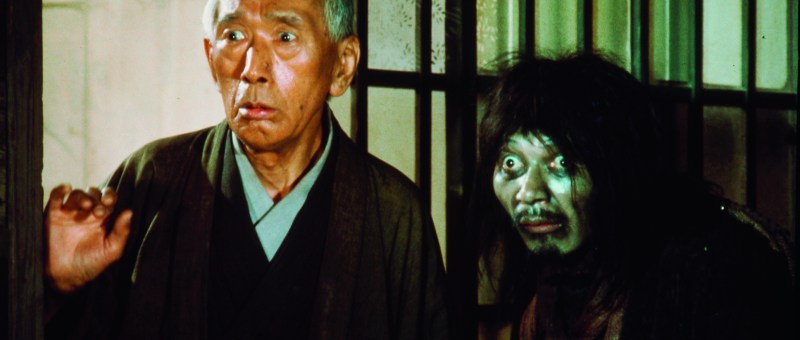
These people have largely been forgotten, living almost in another era and entirely cut off from mainstream society in a kind of etherial purgatory. Like the residents of The Lower Depths, a degree of fantasy is necessary for their survival a case in point being that of a beggar and his son who live an abandoned car and fantasise about the kind of house they’d build, a vast modernist building in white with a swimming pool. Like Katsuko, the boy is let down by his father who remains the car and sends him out to beg for food, telling him off when he lights a fire to boil fish as the man at the sushi shop had told him to do insisting, with disastrous results, that as it’s pickled it doesn’t need to be cooked. The furthest out of the residents, the pair have an almost grotesque appearance, their faces tinged with a morbid green. 

But then the couples living at the centre seemed to have found an antidote to despair in a surreal process of wife swapping now unable to remember whose husband is whose despite being neatly colour coded in matching outfits. A man with a nervous tic defends his grumpy yet fiercely loyal wife, and another man raises several children who may not be biologically his but are loved all the same. The old man who acts as a kind of confidant giving out advice and settling disputes through benevolent trickery has evidently learned how to live in this world and gets by as best he can while the son of the melancholy woman who runs the tempura stall drives an imaginary train through the slum the rhythm of which gives the film its name in its slow and certain progress towards nowhere at all. Heartbreakingly there are moments where the young man can hear the train in the distance, but it remains forever out of reach. Dodes’kaden didn’t do very well at the box office or with critics, its lack of success of cited as a factor in Kurosawa’s attempt to take his own life the following year, yet had perhaps set him on a new artistic course of colour and light which would define the further direction of his later career.


Dodes’ka-den screens at the BFI Southbank, London on 15th & 16th January 2023 as part of the Kurosawa season.

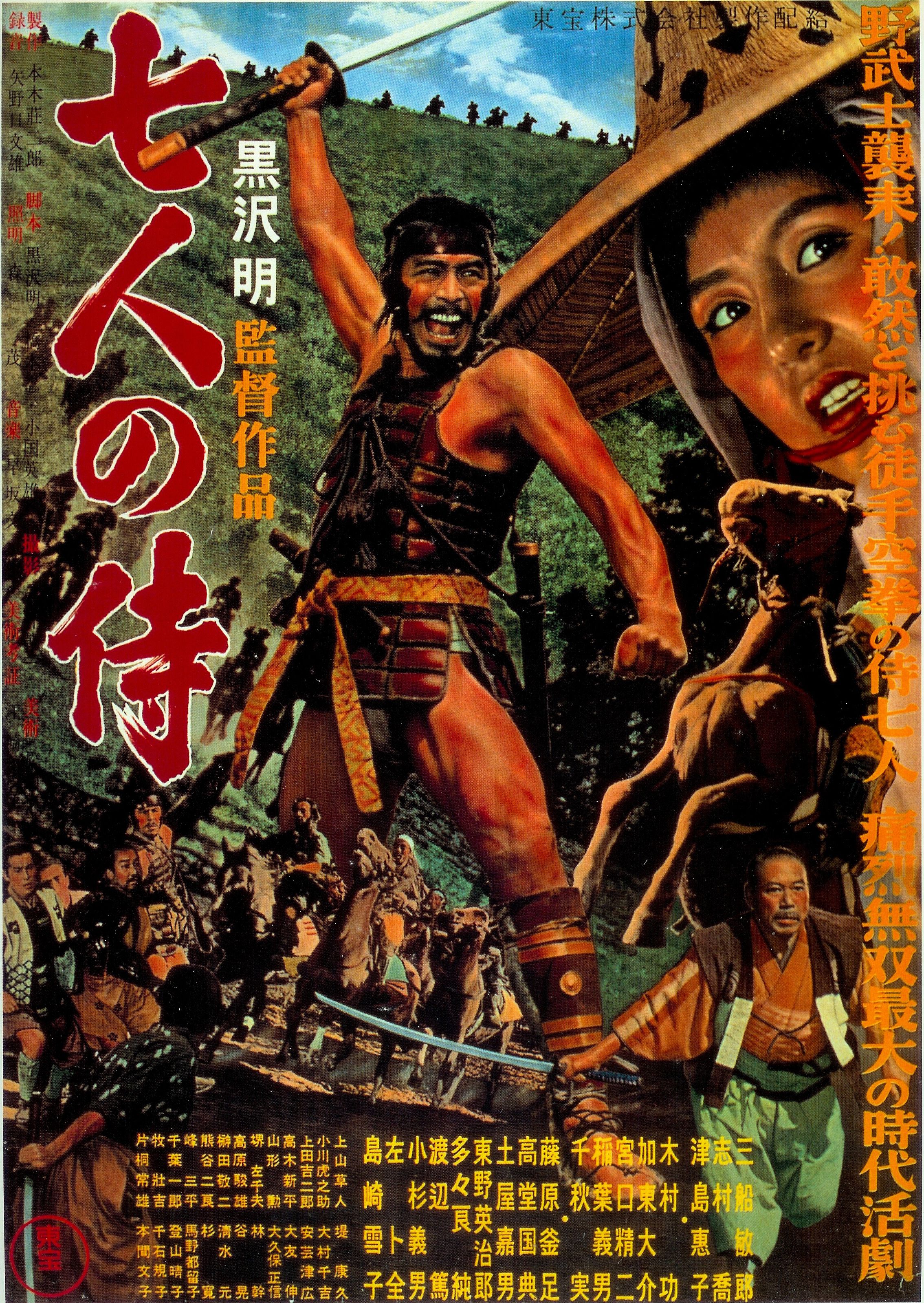
Seven Samurai (七人の侍, Akira Kurosawa, 1954)

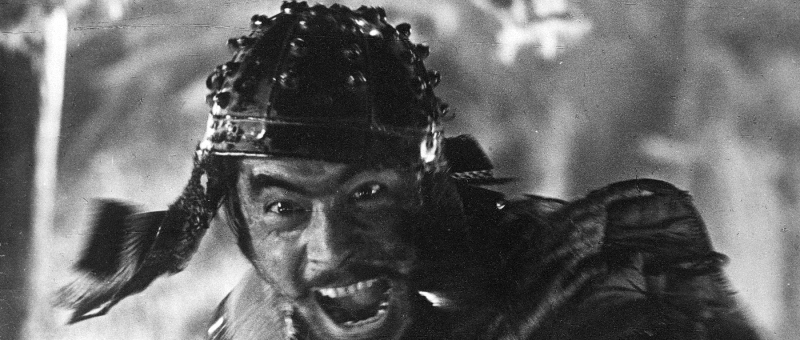
An eclipse of the accepted order allows a temporary truce in the ongoing class conflict that defines feudal society in Akira Kurosawa’s seminal post-war historical epic, Seven Samurai (七人の侍, Shichinin no Samurai). Set in the late 16th century, the action takes place in a world on the brink of collapse. The Sengoku era is drawing to a close but is also in a moment of intense crisis which has left large numbers of highly skilled warriors essentially orphaned, wandering the land torn between their basic needs for food and shelter and their dignity as members of a theoretic aristocracy. 

Plagued by bandits, many of whom may be these orphaned swordsmen, a small village contemplates the unthinkable in hiring samurai, otherwise their oppressors and uniquely responsible for the chaos which surrounds them, for protection. “Land tax, forced labour, drought…and now bandits!” one woman exclaims shortly before suggesting they simply surrender all their grain and then hang themselves. As they can offer only expenses in the form of rice, the only samurai they can hope to recruit are already desperate, so hungry that they may be willing to deign to defending their social inferiors with whom they would not usually mix unwilling to accept that they are both victims of the inherently corrupt social order. This explains why the villagers’ early entreaties are met with such scorn and cynicism, either rudely rejected out of hand or ending only in deception. 

In this there is an echo of the world of 1954 which was beginning edge away from the chaos and privation of the immediate post-war society, bandits standing in for thieves and profiteers themselves a product of intense food insecurity. Yet here it’s desperation that allows a temporary merging of the world of lord and peasant, brokered finally by unexpected compassion on the part of a noble samurai who, in an act of extreme transgression, symbolically erases his elite status by shaving his head in order to save a child taken as a hostage by another desperate man. Kambei (Takashi Shimura) may be somewhat reduced in circumstances but refuses to give in to the immorality of the world around him, finally agreeing to help the villagers essentially out of a sense of pity willing to accept only the gift of sustenance moved by the villagers’ sacrifice in discovering that they give him the last of their white rice while subsisting only on millet. 

Yet having taken this step, the villagers remain uncertain they can really trust the men they’ve hired to protect them who are after all each trained in death. Later we discover that they have, like many of the time, occasionally finished off the odd lone samurai fleeing the battlefield in order to loot the bodies as a large stockpile of samurai armour later discovered by the samurai-pretender Kikuchiyo (Toshiro Mifune) testifies. On being confronted with this uncomfortable reality, the samurai fall silent knowing this armour was stripped from men much like themselves, but can ultimately offer little by way of defence when presented with an angry rant from Kikuchiyo who points out that they are themselves responsible in having created this world of chaos through their internecine quests for power. “In war you burn their villages, trample their fields, steal their food, work them like slaves, rape their women, and kill ‘em if they resist. What to you expect ‘em to do?”

When Kambei and the others first arrive in the village, there is no welcoming committee. The villagers all hide, frightened to leave their homes partly because of paranoia spread by widowed father Manzo (Kamatari Fujiwara) convinced that randy samurai are going ravish all of their daughters who will, doubtless, be overcome with awe by these sophisticated men of the elite. In an echo of Kambei’s transgression, Manzo forces something similar on his teenage daughter Shino (Keiko Tsushima), roughly cutting her hair while she cries and resists before dressing her up as a boy so that she’ll be safe from lusty samurai. The plan, however, backfires in that she later engages in a doomed romance with the young Katsuhiro (Isao Kimura). Their eventual union is the symbolic merging of the two worlds, a moment of eclipse in the usual hierarchy, but it’s born of the same impulses than brought Kambei and the others to the village. In fear and desperation, they behave as if there’s no tomorrow, only tomorrow must come and just as sun and moon must eventually move apart and resume their regular orbits so the relationship between Katsuhiro and Shino is an impossibility. 

Like Kambei, Katsuhiro had occupied a slightly liminal position because of his relative youth, neither boy nor man. He first encounters Shino while marvelling at the natural beauty of the forest, only to berate her for doing the same. “Is this any time for an able-bodied man to be picking flowers?”, he ironically asks her, yet he is repeatedly forced back towards conventional masculinity as marker of adulthood virtually ignoring her when tasked with carrying a dummy to the ridge, while she later returns the same gesture reassuming her femininity in joining the rice planting, a peasant woman once again. “What’s wrong with two people in love?” the wounded Rikichi (Yoshio Tsuchiya) asks Manzo, trying to smooth over this moment of cross-class crisis, only for Monzo to ask what he’s supposed to now his only daughter has become “damaged goods”, unfit for marriage in a fiercely patriarchal society in which it is impossible to survive without a husband. 

Katsuhiro cannot marry her, this sense of solidarity if not quite equality can be only temporary. Kambei himself admits as much as he reflects that the battle has been won but the victory belongs not to them but to the peasants, anticipating his a sense his own obsolescence the end of the Sengoku era bringing about a change in the nature of the samurai that two centuries later will lead to its abolition. Our sympathies might shift, witnessing Kambei’s obvious disapproval of the peasants’ relish in taking revenge on the bandits who have caused them so much misery in their own way perhaps perpetuating the cycle of violence and resentment that drives the feudal engine. One cannot help but pity him, displaced once again returning to a life of ceaseless wandering, his presence in the village now no longer necessary and in fact inappropriate. 

Returning to the world of 1954, there might be something a little uncomfortable in this lament for the death of the samurai who can have no place either in the modern society or in a peasant village in 1587, as there may be in the implication that the peasants are savage and vindictive while Kambei alone is good and kind even if the roots of his compassion lie in his willingness to literally sever himself from his elite status. The roles had in a sense been reversed, the samurai hired hands to peasant bosses, but the inversion can be only temporary. In insisting that only by protecting others can one hope to protect oneself, Kambei may be advocating for a more compassionate society but as much as he has attempted to remove himself from the class system he can not in the end overcome it. Nevertheless, in the gruelling battle scene that closes the film, all rain, mud, death and misery, Kurosawa himself deals the final blow to the samurai in the nihilistic futility of violence manifesting itself once again in the lingering feudalism of the mid-century society. 


Seven Samurai is re-released in UK cinemas in its recent 4K restoration as part of BFI Japan on 29th October.

BFI re-release trailer (English subtitles)