The Ghost Cat of Otama Pond (怪猫 お玉が池, Yoshihiro Ishikawa, 1960)

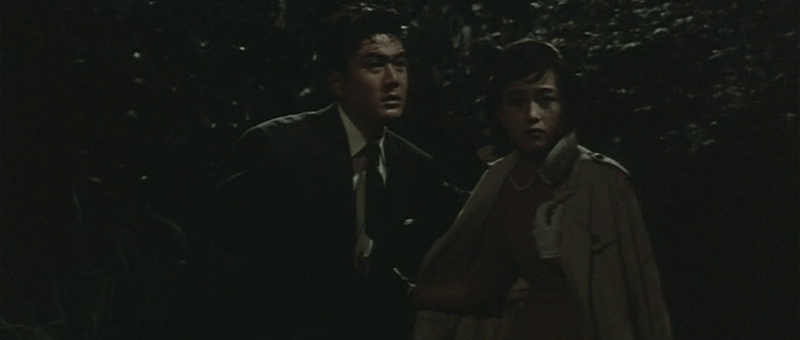
Ghost cat films can often be about the ways in which the unresolved past continues to echo in the modern era. The curse is not lifted by vanquishing the evil spirit, but only by coming to an accommodation with and making recompense for wrongdoing in the distant past. This is especially the case when the film involves bookending sequences set in the modern day as in Yoshihiro Ishikawa’s Ghost Cat of Otama Pond (怪猫 お玉が池, Kaibyo Otama-ga-ike) in which a young couple accidentally become trapped within the orbit of a vengeful spirit after stopping off on their journey to get their parents’ approval for their marriage.

To that extent, the fact that they keep walking in circles and always end up back at the lake might hint at their mutual sense of anxiety about their decision to marry. “What will marriage be like if you’re like this now?” Tadahiko (Shozaburo Date) asks in exasperation, accusing Keiko (Noriko Kitazawa) of being “difficult” as she blames him for the decision to come to the lake in the first place and insists she’s too tired to continue walking. Their relationship is further strained by the lingering possibility that the parents may object to the marriage and that arriving late for their visit might not help their chances.

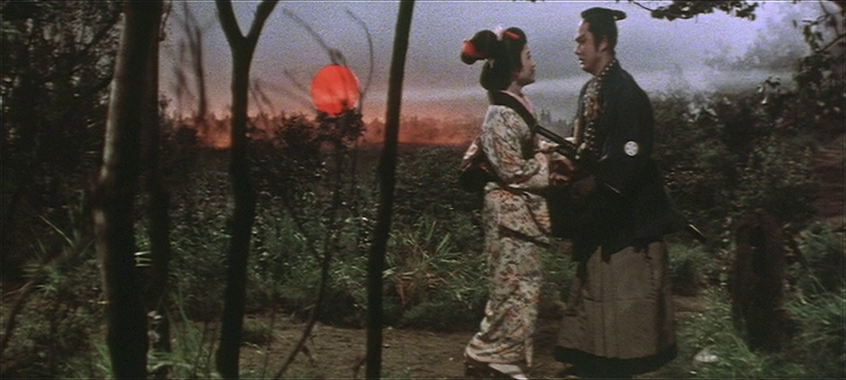
Their situation is mirrored in the circumstances that led to the creation of the ghost cat as related to Tadahiko by a local priest whom he consults after Keiko falls into a coma near the ruined house where they take shelter. Long ago, their ancestors Yochimaru (Shozaburo Date) and Kozasa (Noriko Kitazawa) were in love and wanted to marry, but their families were sworn enemies who strongly opposed the union. When Yachimaru was sent to serve in the capital swearing to call for Kozasa once he’d established himself, her villainous father Gensai (Yoichi Numata) moved against Yachimaru’s father Shinbei (Akira Nakamura) who had been attempting to protest the unreasonable taxes levied against local peasants who were on the verge of causing unrest. Consequently, they killed him and dumped his body in the pond. Shinbei’s beloved cat Tama drank some of his blood and became a ghost cat hellbent on avenging its master.

Tama is quite a popular name for a cat, but in this case it seems to be that it got its name from the lake where it was found which hints at a deeper origin story for this vengeful spirit. Unlike that in other similar films, it seems to have the power to manipulate people physically, at least to a degree, and also to pull them into an alternate reality as happens to Keiko during her coma when she is transported back to the Edo era before the house fell into ruins. It also seems to collect and unify various desires for vengeance though all against Gensai and his allies including the corrupt magistrate and entitled son Gorota (Hiroshi Shinguji). Though it originates with the death of Shinbei, the ghost cat later mainly takes the form of Kozasa after she drowns herself in the pond having been bewitched and seen the ghost of Yachimaru. 

In the end, this curse is only resolvable through the relationship between Keiko and Tadahiko. The ghost cat is vanquished by natural forces putting an end to the curse and releasing Keiko from her coma. After undergoing this experience, they are able to find their way back from the lake as Tadahiko resolves that they will still get married no matter what their parents say in direct contrast with Yachimaru and Kozasa who were constrained by samurai mores and unable to defy their families. In the modern era, they are free to live in the city and do as they please without needing to pay much attention to these outdated rituals, and so the ghost cat’s curse is no longer necessary as the rift is healed with their union just as if Yachimaru and Kozasa were finally united. Ishikawa conjures a suitably gothic, eerie atmosphere around the misty lake achieving ghost effects mainly through lighting in which they take on a familiar greenish hue. Away from the lake, however, it becomes more difficult to tell who is a ghost and who alive, while the ghost cat manipulates those that have wronged it into harming those they love and by extension themselves until finally laid to rest by a new generation resolving to leave the past behind.


Trailer (no subtitles)

Bridge of Japan (日本橋, Kon Ichikawa, 1956)

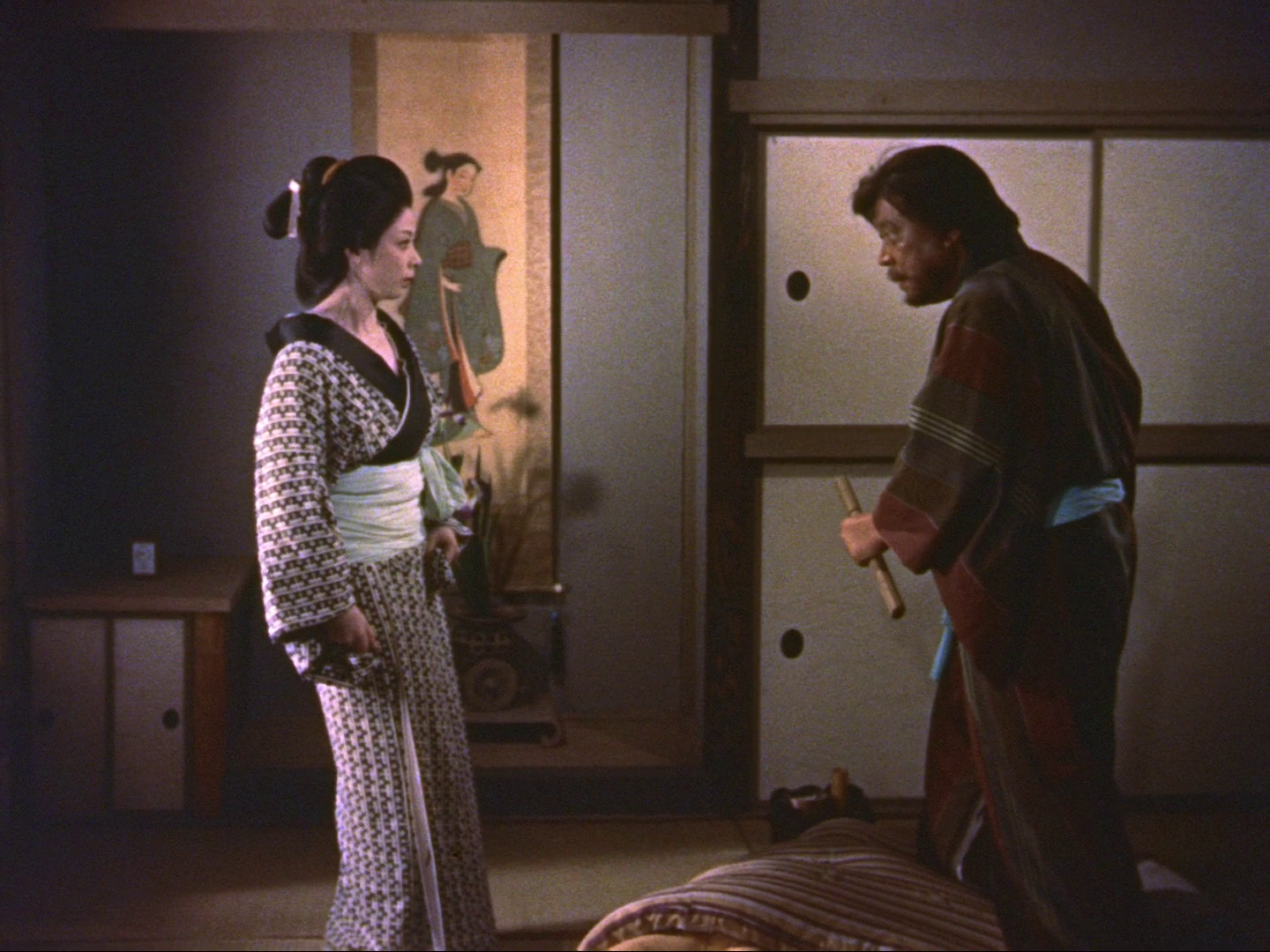
Punishment Room, released in 1956 as Daiei’s attempt to get in on the Sun Tribe phenomenon, had provoked a moral panic that brought the whole short-lived movement to a close. In considering his next film, Ichikawa consulted with Daiei executive Matsutaro Kawaguchi, who is also the father of Punishment Room’s star Hiroshi Kawaguchi, and was offered the chance to direct one of two relatively safe and subdued literary adaptations, either Izumi Kyoka’s Nihonbashi, or Kafu Nagai’s Okamezasa. Ichikawa chose Nihonbashi (日本橋), though his wife and screenwriter Natto Wada feared adapting it maybe beyond her capabilities.

The film is generally known under the The Bridge of Japan in English-speaking territories. This is either an attempt to suggest a wider thematic importance that extends across the nation, or an overly literal translation of a place name. In any case, the significance of Nihonbashi is that, during the time the film is set, it was known as an area where there were many high-class geisha houses. On the other hand, Izumi was well known for incorporating supernatural themes in his work, which  is why the film opens like a ghost story with the curtain rising on a dark and gloomy alleyway through which a geisha walks until she finally dissolves leaving only a creepy song and the sound of her geta rattling along on the cobbles. 

The messages seems to be that this is a place that consumes women. The ghost is said to be that of Owaka who, according to rumour, cheated on her husband who left her after which she died of tuberculosis. Ambitious geisha Okoh (Chikage Awashima) has just moved into Owaka’s former giesha house, apparently unperturbed by its grim history or the the possibility that it is effectively cursed. Geisha come to a miserable end if they act selfishly, according to one of Okoh’s clients who will essentially prove correct further sealing Okoh’s unhappy fate. As is common in these tales she has an entirely one-sided rivalry with local favourite Kiyoha (Fujiko Yamamoto) who her is total opposite in terms of personality. Kiyoha is kind, gentle, and dislikes her life as a geisha, not because she disapproves of it, but because of the moral compromises it requires her to make and the happiness that it denies her.

She has taking a liking to a regular customer, university professor Shin, but when he asks her to marry him, she has no choice but to refuse. Then again, Shin’s proposal is seemingly driven by his incestuous desire for his older sister, who, perhaps having realised this, has disappeared from his life apparently in shame in having become the mistress of a married man to provide for his education. Shin then bears out a sense of hypocrisy in the relationship between men and geisha in that he insists he has never seen has as one but only as his sister who was of course another woman sexually exploited for material gain. As Kiyoha is unable to marry him because she must also financially support her mother and an illegitimate daughter, as well as being indebted to her primary patron, they will not meet again as a geisha and a client.

Okoh, meanwhile, has a tendency to pick up things Kiyoha as dropped as a way of getting back her meaning she is now determined to become Shin’s lover, though he is not interested in her. After she helps in him out with a predicament with a local policeman in which she claims to be his wife, she really considerers herself to be so, though again one-sidedly. She then faces the same thing with a clingy client, Daikichi, she nicknames “Red Bear,” who has convinced himself, one-sidedly, that she is his wife despite also having a legal wife and child.

Red Bear is presented somewhat grotesquely and really takes on the position of a monster within the story. He was once a wealthy seafood wholesaler from Hokkaido who set up shop in Tokyo before an economic downturn which has also impacted the geisha world. This, along with his foolish infatuation with Okoh has ruined him financially and may also have contributed to the later death of his wife which leads him to abandon his infant son ironically dropping him off at Kiyoha’s knowing she will care for him though she rejected Red Bear on the grounds of his ugliness. Driven into a kind of madness, he now subsists on grubs and maggots that live on his distinctive but poorly made bearskin coat.

Okoh is also driven into madness when Shin decides to become a wandering pilgrim and search for his sister in order to ease the tension between Okoh, Red Bear, and Kiyoha. For her, Shin may represent a way out of this geisha world as a respectable man’s wife, something which is otherwise unobtainable to her. While in some senses, a geisha could claim greater independence as a single woman through running her own house rather than being dependent on a patron, she may also be denied the possibility of a settled domestic life or romantic fulfilment. Even if Kiyoha cannot escape her life as a geisha, she does at least have her daughter and comes to dote on Red Bear’s son, though without knowing who his parents were. 

Her parting with Shin (Ryûji Shinagawa), who does not belong in this world and has undergone a religious conversion in deciding to become a monk permanently having given up on looking for his sister and symbolically accepting Okoh as his wife, is then bittersweet but not as much of a tragedy as the fate of Okoh. The geisha house appears to have been purified, released from its cursed legacy under the ownership of Kiyoha even if geisha gossiping about the constant flow of people in this ever changing area. The alleyway which was once dark and gloomy, is now brightly lit and has lost its sense of ominousness, if otherwise seeming rather ordinary.

This was Ichikawa’s first colour film, though in order to recreate Izumi’s world he decided on a broadly grey colour palate for the props and sets, recreating all of the Meiji-era setting only to burn it down for real during the fiery climax. At that time, filming in colour also required additional lighting which meant that it was stiflingly hot on set. They eventually had to purchase industrial size air coolers of the kind that were only used in cafes, pushing up the production budget which was already high considering the painstaking attention to detail in the historical sets which included laying actual tracks to recreate the Meiji-era street car. Nevertheless, it all pays off in the exquisite visuals that bring that bring this world to life in all of its defeated hopes and melancholy. 


Seven Samurai (七人の侍, Akira Kurosawa, 1954)

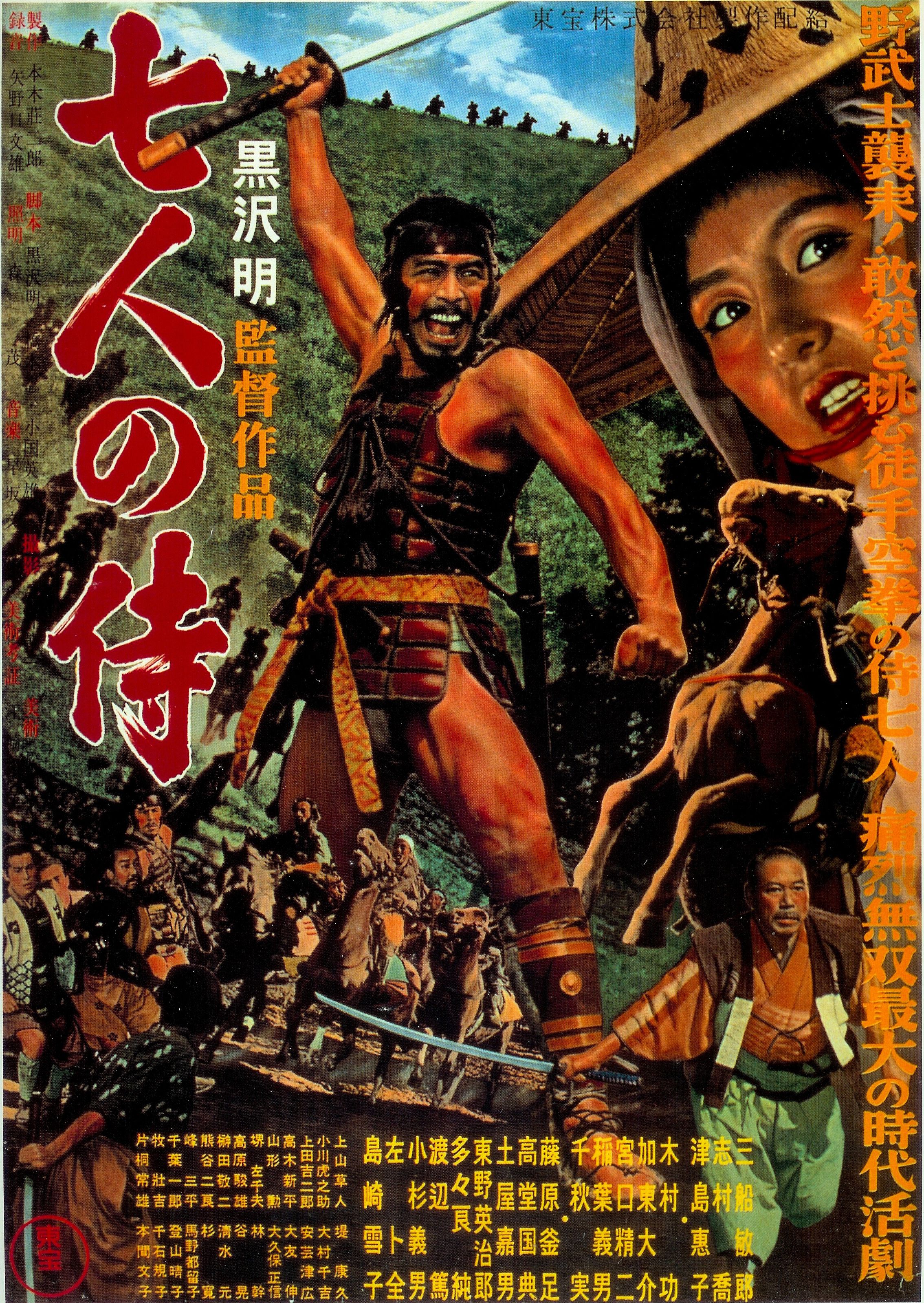
An eclipse of the accepted order allows a temporary truce in the ongoing class conflict that defines feudal society in Akira Kurosawa’s seminal post-war historical epic, Seven Samurai (七人の侍, Shichinin no Samurai). Set in the late 16th century, the action takes place in a world on the brink of collapse. The Sengoku era is drawing to a close but is also in a moment of intense crisis which has left large numbers of highly skilled warriors essentially orphaned, wandering the land torn between their basic needs for food and shelter and their dignity as members of a theoretic aristocracy. 

Plagued by bandits, many of whom may be these orphaned swordsmen, a small village contemplates the unthinkable in hiring samurai, otherwise their oppressors and uniquely responsible for the chaos which surrounds them, for protection. “Land tax, forced labour, drought…and now bandits!” one woman exclaims shortly before suggesting they simply surrender all their grain and then hang themselves. As they can offer only expenses in the form of rice, the only samurai they can hope to recruit are already desperate, so hungry that they may be willing to deign to defending their social inferiors with whom they would not usually mix unwilling to accept that they are both victims of the inherently corrupt social order. This explains why the villagers’ early entreaties are met with such scorn and cynicism, either rudely rejected out of hand or ending only in deception. 

In this there is an echo of the world of 1954 which was beginning edge away from the chaos and privation of the immediate post-war society, bandits standing in for thieves and profiteers themselves a product of intense food insecurity. Yet here it’s desperation that allows a temporary merging of the world of lord and peasant, brokered finally by unexpected compassion on the part of a noble samurai who, in an act of extreme transgression, symbolically erases his elite status by shaving his head in order to save a child taken as a hostage by another desperate man. Kambei (Takashi Shimura) may be somewhat reduced in circumstances but refuses to give in to the immorality of the world around him, finally agreeing to help the villagers essentially out of a sense of pity willing to accept only the gift of sustenance moved by the villagers’ sacrifice in discovering that they give him the last of their white rice while subsisting only on millet. 

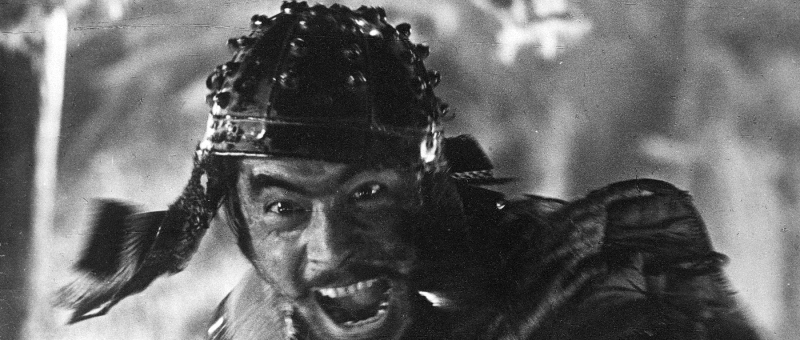
Yet having taken this step, the villagers remain uncertain they can really trust the men they’ve hired to protect them who are after all each trained in death. Later we discover that they have, like many of the time, occasionally finished off the odd lone samurai fleeing the battlefield in order to loot the bodies as a large stockpile of samurai armour later discovered by the samurai-pretender Kikuchiyo (Toshiro Mifune) testifies. On being confronted with this uncomfortable reality, the samurai fall silent knowing this armour was stripped from men much like themselves, but can ultimately offer little by way of defence when presented with an angry rant from Kikuchiyo who points out that they are themselves responsible in having created this world of chaos through their internecine quests for power. “In war you burn their villages, trample their fields, steal their food, work them like slaves, rape their women, and kill ‘em if they resist. What to you expect ‘em to do?”

When Kambei and the others first arrive in the village, there is no welcoming committee. The villagers all hide, frightened to leave their homes partly because of paranoia spread by widowed father Manzo (Kamatari Fujiwara) convinced that randy samurai are going ravish all of their daughters who will, doubtless, be overcome with awe by these sophisticated men of the elite. In an echo of Kambei’s transgression, Manzo forces something similar on his teenage daughter Shino (Keiko Tsushima), roughly cutting her hair while she cries and resists before dressing her up as a boy so that she’ll be safe from lusty samurai. The plan, however, backfires in that she later engages in a doomed romance with the young Katsuhiro (Isao Kimura). Their eventual union is the symbolic merging of the two worlds, a moment of eclipse in the usual hierarchy, but it’s born of the same impulses than brought Kambei and the others to the village. In fear and desperation, they behave as if there’s no tomorrow, only tomorrow must come and just as sun and moon must eventually move apart and resume their regular orbits so the relationship between Katsuhiro and Shino is an impossibility. 

Like Kambei, Katsuhiro had occupied a slightly liminal position because of his relative youth, neither boy nor man. He first encounters Shino while marvelling at the natural beauty of the forest, only to berate her for doing the same. “Is this any time for an able-bodied man to be picking flowers?”, he ironically asks her, yet he is repeatedly forced back towards conventional masculinity as marker of adulthood virtually ignoring her when tasked with carrying a dummy to the ridge, while she later returns the same gesture reassuming her femininity in joining the rice planting, a peasant woman once again. “What’s wrong with two people in love?” the wounded Rikichi (Yoshio Tsuchiya) asks Manzo, trying to smooth over this moment of cross-class crisis, only for Monzo to ask what he’s supposed to now his only daughter has become “damaged goods”, unfit for marriage in a fiercely patriarchal society in which it is impossible to survive without a husband. 

Katsuhiro cannot marry her, this sense of solidarity if not quite equality can be only temporary. Kambei himself admits as much as he reflects that the battle has been won but the victory belongs not to them but to the peasants, anticipating his a sense his own obsolescence the end of the Sengoku era bringing about a change in the nature of the samurai that two centuries later will lead to its abolition. Our sympathies might shift, witnessing Kambei’s obvious disapproval of the peasants’ relish in taking revenge on the bandits who have caused them so much misery in their own way perhaps perpetuating the cycle of violence and resentment that drives the feudal engine. One cannot help but pity him, displaced once again returning to a life of ceaseless wandering, his presence in the village now no longer necessary and in fact inappropriate. 

Returning to the world of 1954, there might be something a little uncomfortable in this lament for the death of the samurai who can have no place either in the modern society or in a peasant village in 1587, as there may be in the implication that the peasants are savage and vindictive while Kambei alone is good and kind even if the roots of his compassion lie in his willingness to literally sever himself from his elite status. The roles had in a sense been reversed, the samurai hired hands to peasant bosses, but the inversion can be only temporary. In insisting that only by protecting others can one hope to protect oneself, Kambei may be advocating for a more compassionate society but as much as he has attempted to remove himself from the class system he can not in the end overcome it. Nevertheless, in the gruelling battle scene that closes the film, all rain, mud, death and misery, Kurosawa himself deals the final blow to the samurai in the nihilistic futility of violence manifesting itself once again in the lingering feudalism of the mid-century society. 


Seven Samurai is re-released in UK cinemas in its recent 4K restoration as part of BFI Japan on 29th October.

BFI re-release trailer (English subtitles)

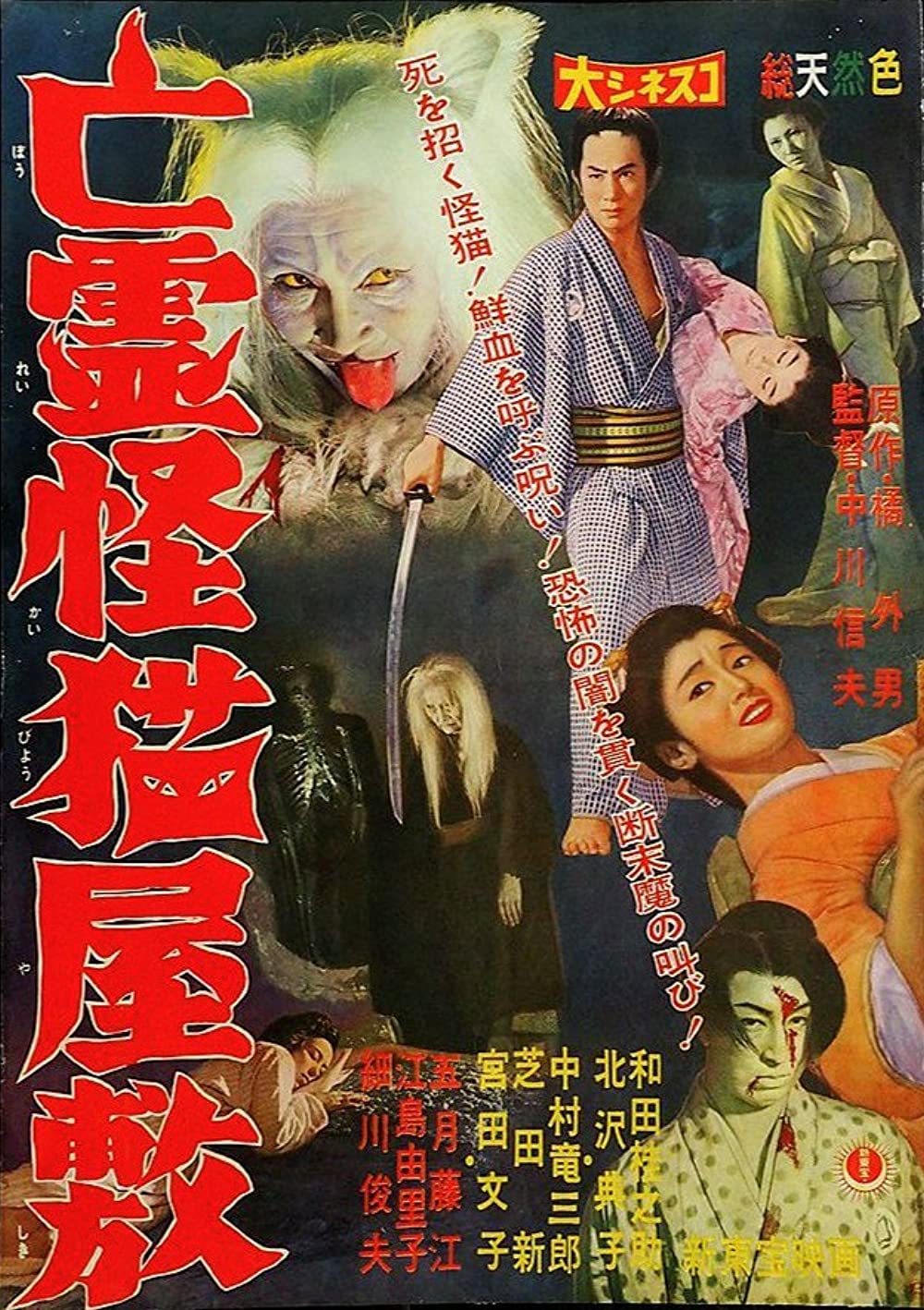
Black Cat Mansion (亡霊怪猫屋敷, Nobuo Nakagawa, 1958)

A doctor and his wife find themselves at the mercy of an ancestral curse in Nobuo Nakagawa’s eerie gothic horror, Black Cat Mansion (亡霊怪猫屋敷, Borei Kaibyo Yashiki, AKA Mansion of the Ghost Cat). Most closely associated with the supernatural, Nakagawa’s entry into the ghost cat genre is among his most experimental outside of avant-garde horror Jigoku released two years later. Employing a three level flashback structure spanning the modern day, six years previously, and then all the way back to Edo, Nakagawa positions contemporary Japan as a kind of haunted house with skeletons in its closet which must finally be exposed and laid to rest if society is to recover from the sickness of the feudal legacy. 

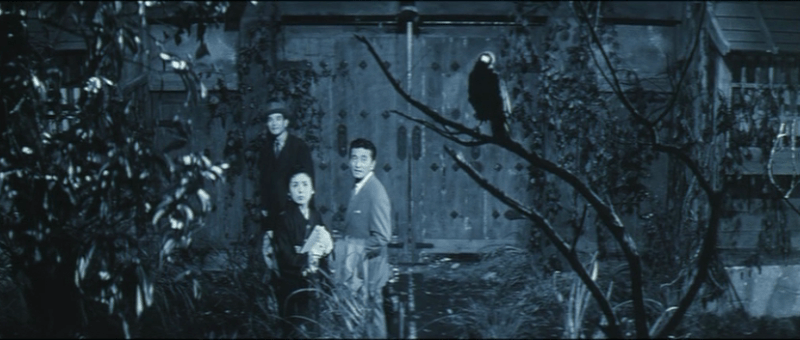
Nakagawa opens, however, with an ethereal POV shot in blue-tinted monochrome of a doctor walking through a darkened hospital armed only with a torch while a pair of orderlies silently remove a corpse on a gurney right in front of him. A man of science, the doctor, Tetsuichiro (Toshio Hosokawa), confesses that he’s tormented by the sound of footsteps on this “evil night” which remind him of a strange series of events that took place six years previously while his wife Yoriko (Yuriko Ejima) was suffering from advanced tuberculosis. In an effort to aid her recovery the couple left Tokyo to return to her hometown in the more temperate Kyushu. Yoriko’s brother Kenichi (Hiroaki Kurahashi) expresses concern over his sister’s health, wondering if she wouldn’t be better to have an operation but Tetsuichiro explains that at this stage an operation might only make things worse so they’re hoping the quiet and fresh air will allow her lungs to recover more quickly. Kenichi has sorted out a place for them to live in an abandoned mansion but the house is extremely dilapidated and in fact barely habitable especially for someone suffering with a debilitating medical condition in which it might be sensible to avoid dusty environments. Nevertheless, the couple fix the place up and Tetsuichiro opens a surgery in the front room. 

For Yoriko, however, the house is full of foreboding. On their journey there, the driver had to swerve to avoid a black cat running out in the road, nearly careering off the side of mountain, while she is also alarmed to see a crow malevolently perching on a tree outside the mansion. Once inside, she glances into a storehouse by the entrance and thinks she sees a creepy old woman silently grinding corn. Tetsuichiro sees nothing when he checks it out, but is strangely unperturbed when Yoriko spots what seems to be a bloodstain on a bedroom wall insisting that they can paint over it while the footprints of someone walking barefoot through the dusty house are probably unrelated and belong to a homeless person who’s since moved on. For a man of science, Tetsuichiro is doing a lot of overlooking but seems to believe that his wife’s distress as she continues to complain of bad dreams featuring rabid cats and the creepy old woman is mere “hysteria” provoked by the mental stress and anxiety of living with a potentially fatal medical condition. 

Unfortunately for him, however, vengeful cat spirits don’t care if you believe in them or not, what sort of person you are, or even if you have any real connection to whatever it was that turned them into a vengeful cat spirit in the first place. A visit to a local Buddhist priest reveals, in a vibrant colour filled with kabuki-esque shadows on the shoji, the reasons everyone thought the house was haunted which stem back to the Edo era and an entitled samurai lord with anger management issues, Shogen (Takashi Wada). Shogen hires a local Go master, Kokingo (Ryuzaburo Nakamura), to teach him the game and is enraged by Kokingo’s lateness for the appointment which is attributed to the fact that his mother is blind but is actually more to do with his cat’s severe separation anxiety. 

Taking this as a personal slight to his position, Shogen attacks his loyal servant Saheiji (Rei Ishikawa) and is only prevented from killing him by his levelheaded son (Shin Shibata) who makes a point of asking his grandmother to keep an eye on his dad because he’s worried his famous temper will cause embarrassment to the family. He is right to worry. Shogen takes exception to Kokingo right away, insisting on playing a “real” game but asking for take backs every five seconds when Kokingo makes a winning move. Fed up with Shogen’s behaviour, Kokingo brands him a cheat and threatens to leave the game. Shogen is once again enraged and fight develops during which Kokingo is killed. Shogen threatens Saheiji into helping him dispose of the body by walling it up inside an adjacent room while telling his mother that Kokingo was so embarrassed over losing to him that he’s gone off  in a huff for additional study in Kyoto and Osaka. Shogen doesn’t even stop there, raping Kokingo’s mother when she starts asking questions after seeing her son’s ghost leading her to commit suicide after cursing his entire family and instructing Kokingo’s beloved cat to lap up her blood and imbibe her wrath to become a vengeful cat spirit. 

Shogen is all the worst excesses of the samurai class rolled into one, narcissistic, angry and entitled as he uses the exploitation of those below him to foster a sense of security in his authority. As in any good ghost tale, the vengeful spirits distort his sense of reality forcing him to destroy himself out the guilt he refuses to feel. His son, Shinnojo, meanwhile is positioned as a good, progressive samurai determined to marry the woman he loves even though she is only a maid and therefore of a lower social class while often transgressively denouncing his father’s bad behaviour. That matters not to the ghost seeing as the curse is to Shogen’s entire bloodline meaning Shinnojo must to die and most likely at the hands of his father caught in a delusion trying to fight the ghosts of his past crimes. 

Tatsuichiro and Yoriko are “innocent” too though as it turns out Yoriko does have a connection to the house and the crimes of the past. They are still, however, trapped within the embodiment of the feudal legacy that is the former samurai mansion. Tatsuichiro’s determination that they can simply “paint over” the bloodstain is in many ways the problem and one reaching a crescendo in post-war Japan as it struggles to deal with the trauma of the immediate past while freeing itself of the latent feudalism which in part caused it. Only by facing the ghost, unearthing the bodies buried in the walls and laying them to rest, can they ever hope to make a recovery both spiritually and medically. Tatsuichiro at least seems to have cured himself even if left with a lingering sense of unease while his apparently now healthy wife seems to have overcome her fear of cats in the relative safety of modern day Tokyo. 


Original trailer (no subtitles)

A Mother’s Love (母情, Hiroshi Shimizu, 1950)

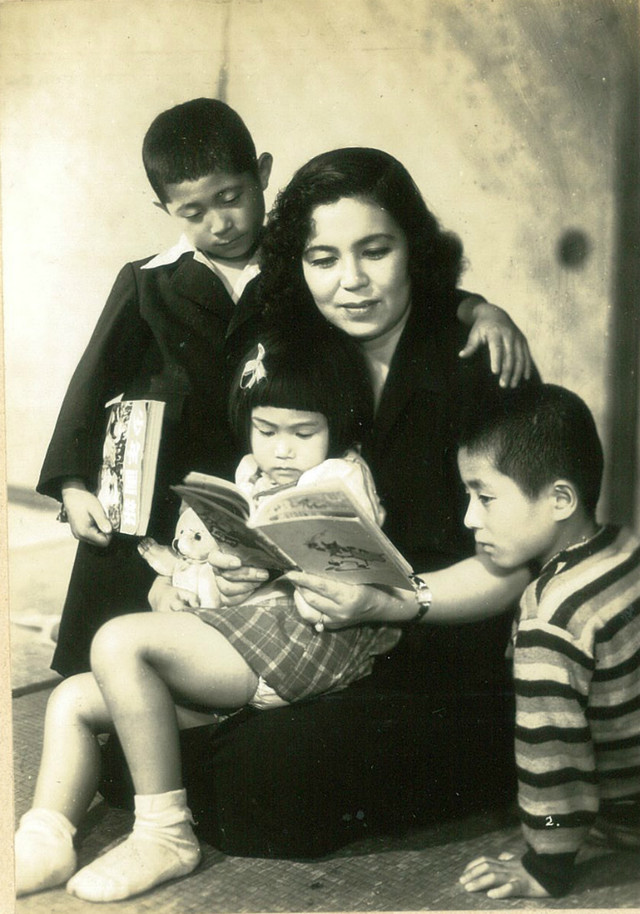
mothers-loveShimizu’s depression era work was not lacking in down on their luck single mothers forced into difficult positions as they fiercely fought for their children’s future, but 1950’s A Mother’s Love (母情, Bojo) takes an entirely different approach to the problem. Once again Shimizu displays his customary sympathy for all but this particular mother, Toshiko, does not immediately seem to be the self sacrificing embodiment of maternal virtues that the genre usually favours.
Tellingly, when we first meet Toshiko she’s asleep on a bus as her three children badger a friendly artist who’s entertaining them by drawing a picture of their pretty mother. The boys are quick correct themselves when talking about the woman they’re with – she’s their “aunt” not their mother, but the artist sees through the ruse. Toshiko is heading to visit her brother in the country in the hope that he will look after her children for awhile offering the explanation that she wants to get married again. Her brother is sympathetic to her problems, but has six children of his own already (and perhaps a seventh on the way) so taking in three extra mouths to feed is not really an option. Agreeing to look after the youngest girl, they suggest trying an elderly uncle but remind her that he has a rather conservative mindset and may ask all sorts of questions about Toshiko’s recent past which she might not want to answer.

Not to worry, the uncle seems to have mellowed with age though he can’t take in two growing boys either and suggests asking a friend of his who’s been trying for a baby for years but has been unable to have one. When that doesn’t work out Toshiko deposits her second son at the uncle’s and travels on with just her oldest boy, Fusao, but as time goes on Toshiko begins to rethink her decision to have her children fostered out and wonders if just being together might be worth more than a stable economic life founded on the pain of abandonment.

The protagonists of “hahamono” which praise the idea of the noble, self sacrificing mother are not universally saintly but the one thing they never do is consider leaving their children. In this regard Toshiko is not immediately sympathetic. Rejecting the name “mother” for “aunt” in the hope of hooking a prospective husband, Toshiko has already marked herself as falling outside of the idealised mother standards and her rather cool, snappy way of addressing the children does not go in her favour either. Her brother greets her warmly (even if he seems to suspect that she’s probably come because she wants something) and has no desire to drag up the past but points out that other people might not be so charitable given that all three children have different fathers and Toshiko has never revealed how she supported herself towards the end of the war and in its immediate aftermath. Nevertheless, Shimizu refuses to judge her. Her life has been a hard one and she herself was fostered out herself as a child. Toshiko’s decision may not be one everyone would agree with but that doesn’t mean it was an easy one for her to make, or that she feels nothing in giving up her children.

The biggest tragedy is that the kids will be separated. Apparently often left to fend for themselves at home whilst Toshiko works, the children are a mini band of three and it seems even more cruel that they will be deprived not only of a mother but of their siblings too. Though the youngest girl tries to run after her mother and brothers, and the second son cries so much that his brother goes back to give him one of his comic books to cheer him up, Fusao is even more upset and anxious as the last remaining child. Constantly wetting the bed which costs him his place at a few prospective new homes, Fusao is plagued by the idea that his mother is about to abandon him and finally pleads with her that he can take care of his siblings by himself if only they can all stay together.

Fusao’s pleas eventually soften his mother’s heart though she begins to think again after coming across a band of itinerant performers, one of whom is nursing an infant despite her poverty and the harshness of her life. The young woman seems devoted to her child and is determined to take care of it even though she has no husband to help her. The child’s grandmother urged her daughter to give the baby up to someone with more resources to raise it but the girl refused, no matter how hard it may turn out to be. Moved, and feeling even more guilty in witnessing the hardships another mother is bearing for her child, Toshiko’s resolve begins to weaken.

When Toshiko is taken ill at an inn and her friend from the city, Mitsuko, comes to visit her it is revealed that Toshiko’s plan is not another marriage but that the two women are in the process of opening a bar – hence why she needs to farm out her children. Mitsuko has also sent her daughter to a relative so that she can plow all her time and money into the enterprise though no one knows how long it will take until the place is successful enough to support the full families of both women. It may be, therefore, that Toshiko’s desire to run her own business is for the ultimate benefit of her children who will finally have a degree of economic security. On thinking again, she wonders if it isn’t selfish vanity and that she’s sacrificing her children to fulfil her own desires.

Shimizu takes a more conservative viewpoint than that found in his other work by encouraging Toshiko to reject the prospect of being her own boss to embrace the traditional values of her natural maternity. The old nurse Toshiko visits in the hope that she will take in Fusao (which she almost certainly would have done) remarks that a full belly isn’t everything and being together might be enough, but that doesn’t quite explain what the obviously desperate Toshiko is going to do to survive from here on in. One can only hope that she somehow finds a way to make the bar work (even if it takes a little longer) rather than be left with nothing all over again. Focusing less on the children than on the maternal conflict as Toshiko becomes torn by the traditional values as seen in her rural hometown and the less forgiving modernism of the city, Shimizu retains an understanding tone but also eschews the concessions to pragmatism which so often went hand in hand with his forward looking idealism, for a reassertion of conservative values which fly in the face of his usually compassionate acceptance of the very real difficulties faced by women in a conformist and male dominated society.


Mr. Shosuke Ohara (小原庄助さん, AKA Ohara Shosuke-san, Hiroshi Shimizu, 1949)

vlcsnap-2016-09-25-01h34m07s636Ohara Shousuke-san (小原庄助さん) is the name of a character from a popular folk song intended to teach children how not to live their lives. The Ohara Shosuke-san of Aizu Bandaisan has lost all his fortune but no one feels very sorry for him because it’s his own fault – he spent his days in idleness, drinking, sleeping in, and bathing in the morning. The central character of Hiroshi Shimizu’s 1937 film has earned this nickname for himself because he also enjoys a drink or too and doesn’t actually do very much else, but unlike the character in the song this a goodhearted man much loved by the community because he’s a soft touch and just can’t refuse when asked for a favour. An acknowledgement of the changing times, Shimizu’s Mr. Shousuke Ohara is a tribute to the soft hearted but also an argument for action over passivity.

If you turn up one day and ask for directions to the Sugimoto household, everyone will look at you with confusion but if you ask for Mr. Shousuke Ohara everyone will gladly walk you over and introduce you. Saheita Sugimoto (Denjiro Okochi) is the head of a once proud samurai household but his fortunes are far from those of his ancestors. Despite his pecuniary difficulties, Sugimoto is good hearted man who wants to help everyone that he can (out of a sense of altruism rather than duty or vanity). Consequently he is deeply in debt and nearing bankruptcy yet he can’t give up any of his three vices – drinking, gambling, and generosity.

The nature of the changing times is at the centre of this 1949 film. As Sugimoto is fond of telling people, his noble house used to stand for something but all of that historical influence is next to meaningless now. Though Western dress is not uncommon, the village is pretty much as it’s always been – children play in the fields and Sugimoto travels everywhere by donkey. Other than the tale of Sugimoto’s fall from grace, the central narrative concerns an election for a new village chief. Yoshida, a youngish man, wants Sugimoto’s support for his election campaign. His main campaign policy is modernisation – the introduction of electricity, modern transportation and communications, as well as greater cultural involvement starting with opening Western style ballroom dance classes for the children. Unfortunately his policies are not that firm and his motto seems to be “I’ll do that first!” to all aspects of his plan which is not very encouraging but still the desire is very much to move away from old fashioned village life towards a more sophisticated urbanism.

This of course also means an end to the inherited influence of idle nobleman such as Sugimoto. Though he’s a kind man who likes nothing other than helping other people, Sugimoto has been a passive steward, more consumed with his own idle pursuits than with making an active attempt at leading the village. This passivity has contributed to his downfall as he’s neglected the business of maintaining his own fortune. After taking out numerous loans which he only ever uses to help the villagers, Sugimoto has let the estate which ancestors founded, and which he was supposed to look after in the names of all that have gone before and all were to come after him, slip away. The ultimate failure and a disgrace to his ancestors, this loss of the ancestral home is an unforgivable betrayal yet there is something in Sugimoto which seems to regard it as right and proper that it should go.

Change is coming to the village, even if it isn’t coming with the speed that a young man like Yoshida may be hoping for. Change is also coming to Japan which is in the progress of rebuilding itself anew following long years of folly followed by confusion. There is no room for genial idleness anymore. “If you can work honestly with your hands you can make a living”, Sugimoto tells two would-be-burglars that he invites in for a drink as a apology for not having anything left for them to steal, but means the advice more for himself than anyone else. It’s time to say goodbye to Shousuke Ohara and the burden of inherited privilege and chart a new course as Seihata Sugimoto. Finishing on another of Shimizu’s much loved road shots, Sugimoto, like his nation, walks confidently along the road to an uncertain future yet he is not alone as he goes and may make something of himself yet.