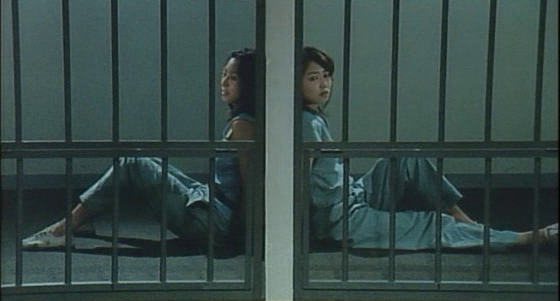
Scorpion: Double Venom (サソリ・女囚701号, Ryoji Niimura, 1998)

Scripted by Sasori in USA’s Daisuke Goto, Scorpion: Double Venom (サソリ・女囚701号, Sasori: Joshuu 701-go) brings Nami back to Japan but with an all new backstory and motivation for revenge. In the films up to this point, Nami is betrayed by a man she loves and thereafter seeks a revenge that becomes progressively less personal, striking out against entrenched patriarchy and societal misogyny. This time, however, she’s to avenge the death of a girl she couldn’t save, her sister, Yumi, who was kidnapped and murdered as a child.

Like that of Sasori in the USA, this Nami (Chiharu Komatsu) is a highly educated woman, in fact a doctor. Immediately recognising a patient as the man responsible for abducting her sister all those years ago she is left with a dilemma. She confronts him and he laughs at her. As it turns out, the statute of limitations on his crime ran out the day before, so Nami’s plan to turn him in to the police is rendered a no go. As he continues to taunt her and makes suggestive comments about the little girl inexplicably in the next bed sharing a ward with an adult man, Nami ends up stabbing him to death with her scalpel but just before he dies, he tells her that he didn’t kill her sister after all. It was his accomplice, a one-armed man!

Nevertheless, Nami’s revenge will be delayed because she’s quickly carted off to prison for 10 years of hard labour. Unlike those in the other films, this prison is mainly run by women but the warden is a predatory lesbian who extracts sexual favours from the inmates with the vague promise of early parole and claims that this place is like heaven if you play by the rules. After getting sent to solitary for fighting, Nami befriends another woman, Sayuri (Miho Kiuchi), who reminds her of her younger sister, and discovers that she is shortly to be executed at the gallows hidden in the deepest recesses of the prison. Sayuri is apparently not guilty of the crime for which she is serving her sentence but was talked into taking the fall for a sleazy politician who murdered her friend so that her older sister’s medical bills would be covered. Her death sentence is for accidentally killing a guard during a previous escape attempt. All her subsequent attempts to escape have been so that she could see her sister one last time before she dies.

The theme this time is then sisterhood as the two women fill in the missing half for the other and bond in their shared misuse at the hands of the justice system. Nami becomes determined to save Sayuri in the way she couldn’t save Yumi, but her struggle eventually takes on a larger dimension in keeping with those of the previous films as she tries to get revenge for Sayuri too after discovering that her death sentence was partly handed down by the murderous politician trying to tidy up loose ends as he plans career advancement with the aid of his entire amoral aide, Naruse (Tomorowo Taguchi). Escaping from the prison, she literally and symbolically frees all of the women who then take their own revenge on the sadistic warden.

For all of its seriousness, the film does have its faintly ridiculous qualities such as Nami’s use of electrical wiring as a defibrillator that allows her to resuscitate Sayuri after she’s hanged by the warden at the politician’s instigation. She later uses these same wires ripped from the wall to electrocute the warden’s bruiser male guard though it’s Sayuri who hot wires the prison van so they can escape. Eventually, she’s hunted down by a man with a crossbow and in a nod to the original trilogy, stabs him in the eye. Still, with her own revenge still in progress, Nami effectively avenges all her sisters while fighting for justice. Tracking down the videotape Sayuri had hidden proving the politician’s guilt, she eventually exposes him along with all his corruption bringing down the complex network that had extended out into the prison and trapped so many other women. Now a fugitive, Nami chases the one-armed man and has once again become an avenger of women bringing justice to those failed by an inherently corrupt and misogynistic justice system.


Sasori in U.S.A. (Daisuke Goto, 1997)

An attempt to reboot the Female Prisoner Scorpion series for V-cinema had stalled in the early ‘90s when the then star of Death Threat abruptly pulled out of a sequel that was to be a production with Hong Kong’s Golden Harvest. In 1997, however, Nami Matsushima was once again resurrected only this time as a US co-production with most of the film shot in Los Angeles and in a mix of Japanese and English. 

Relocating the franchise overseas is in some ways surprising given that the first film of the original series opened with the national anthem and shots of the Japanese flag. It was explicitly clear that they were talking primarily about the social conditions of Japan in the 1970s. Likewise, Sasori in U.S.A. seems to walk back on some of the themes of patriarchal oppression that informed the previous instalments preferring instead to refocus on themes such as racism, the failure of the American Dream, and the powerlessness of living under a cruel and arbitrary foreign power, which is an entirely contrary perspective to the earlier film’s attempts at critiquing corruption with Japan itself. 

It’s never really made clear why Jiro (Tetta Sugimoto) and Nami (Yoko Saito) are in the US in the first place, though Nami’s sympathetic journalist friend implies that Jiro came there to make his fortune only to become frustrated with the limits of the American Dream. This Nami is a well-paid interior designer, at least according to her prison file, if one completely in thrall to Jiro whom she met in the US an unspecified amount of time previously. When Jiro is killed by a car bomb, Nami ends up being arrested for his murder because she stood to gain 1.2 million dollars by his death (though they appeared to have a very comfortable life to begin with, so it’s not clear why she’d take such drastic action). Apparently too traumatised to defend herself, Nami failed to hire a proper lawyer or fight her case and has not launched an appeal but spends all her time vowing revenge, which of course means she has to escape from prison. 

That might be a minor problem for the film, which is to some extent in its marketing selling itself as a women in prison picture. This is indeed the most exploitative of the films so far with a salacious shower scene and titivating moments of touching and kissing each other, while Nami is also harassed by an obnoxious blonde prisoner who seems to be running the cell block while in cahoots with the sadistic warden who, as this is America, is incredibly religious and forever quoting from the Bible while raping his inmates. Nami eventually stabs him in the eye in what may be an homage to the original series. 

Nevertheless, Nami soon escapes in the company of another prisoner who is second generation Japanese-American and has been blind since birth. Like Nami, Yukiko (Shizuka Ochi) also has a mission of revenge against the American hoodlums who raped her and shot her Dominican boyfriend Dino to death. Though the narrative actually has almost nothing to do with Female Prisoner Scorpion, the twist will be very obvious to anyone familiar with the series as Nami has indeed been betrayed by a man she thought loved her. Discovering Jiro may have been embezzling money and in fact knocking off the lawyers who tried to sue the car company he worked for for making defective cars rather than being knocked off by them, Nami is forced to reckon with the illusionary quality of her American success story. Jiro meanwhile rails about entrenched racism and unfairness, decrying the police and justice system as “insane” which they well might be or at least in their treatment of Nami. Broken by the failure of his American Dream, he becomes a pitiful and tragic figure.

Even so, Nami’s revenge remains a personal affair rather than an all out attack on a corrupt and oppressive social order ruled by misogyny and male failure. Though the production values are perhaps a little higher than one might expect and the direction leaning towards the artier side with its blue-tinted eroticism, shower scenes aside, the film remains very much of its time and has very little in common with the Female Prisoner Scorpion franchise save its women in prison elements and a late allusion to an actual scorpion. It is though interesting for its perspective on the American Dream and America in general as a place of greed, violence, and intensely hypocritical religious fanaticism. 


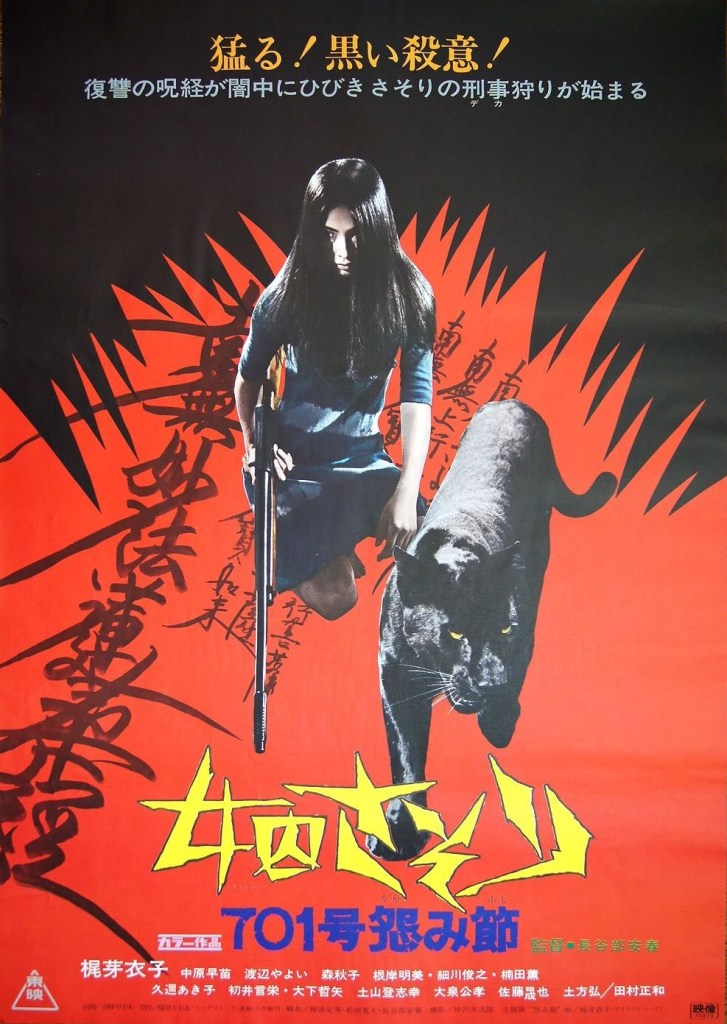
Female Prisoner Scorpion: #701’s Grudge Song (女囚さそり 701号怨み節, Yasuharu Hasebe, 1973)

The saga seemed complete with the end of Beast Stable but inevitably Matsu returns in the bonus instalment, Female Prisoner Scorpion: #701’s Grudge Song (女囚さそり 701号怨み節, Joshu Sasori – 701 Go Urami Bushi). Original director of the series Shunya Ito agreed that the ballad of Matsu was sung through, and so Yasuharu Hasebe reteams with star Meiko Kaji after their previous collaborations on Retaliation and the Stray Cat Rock series during their time at Nikkatsu. Hasebe’s style is the polar opposite of Ito’s arthouse inspired painterly majesty and heavily favours the groovy, ‘70s youth inspired aesthetic he employed in the Stray Cat Rock series. Coming as it does after Ito’s genre rocking visual tour-de-force, Grudge Song can’t help feeling a little regressive and a reminder of what a considered cash grab this fourth instalment really is but that isn’t to deny the fact that it can prove an enjoyable, genre skewing, effort when considered in isolation.
The end of Beast Song told us that Female Prisoner Scorpion served her sentence, was released and disappeared into the ether like the legendary creature she was. However, Grudge Song provides another episode to her history and begins with Matsu (Meiko Kaji) being re-arrested by police during someone else’s wedding (you have to feel sorry for the happy couple – could the police not have done this outside at least?). She fights them off in grand fashion and manages to escape though is gravely injured and not able to run very far. Luckily she is found by a damaged former protester working at a cabaret club who helps her hide out from the police. Soon the pair enter into a kind of romance but it’s not long before Matsu has some names to add to that ever increasing grudge list.

Along with the change of director comes a slight refocusing. Both the original trilogy and this fourth instalment have definite political undercurrents but Grudge Song allows these to be more overt with its constant references to the student protests of the late ‘60s and ’70s as well as to police corruption and brutality. Matsu’s ally and sometime lover, Kudo (Masakazu Tamura), had been a prominent protester picked up and repeatedly tortured by police leaving him with both physical and mental scarring. Obviously distrustful of authority but also made fearful, Kudo has been keeping his head down until he finds a kindred spirit in Matsu and decides to fight back.

The enemy here is the police – as it was to a degree in some of the other films, but Matsu’s concerns are playing second fiddle to her male saviour’s psychological traumas. This is the first film where Matsu has any kind of male help, and she’s essentially in an assisting role as Kudo attempts to defend her from the police (her injuries meaning she can’t exert the same kind of preternatural power as in the other instalments). There may be a kind of spiritual connection between Matsu and Kudo but the fact that she trusts him so quickly is strange given her behaviour throughout the series, though perhaps she has little choice given her physical condition. This is also the first time where Matsu allows an innocent woman to be killed in front of her – ironically another victim of male violence whose life is lost through no fault of her own. The other Matsu would at least find this upsetting, but this new Matsu who’s now more of an accomplice to a borderline terrorist protest cell consisting of one male member, is entirely indifferent.

Though Hasebe mimics some of Ito’s cinematography notably in the opening and his iconography of “Scorpion”, he abandons his stylistic concerns in favour of something very much more directly contemporary. In keeping with his work on the very groovy, youth orientated Stray Cat Rock movies, Hasebe turns Female Prisoner Scorpion into a standard ‘70s exploitation pic complete with gratuitous lesbianism, nudity, and random violence. Zooms, whip pans, and anarchic camera action are accompanied by jazzy electric guitar and a stoner vibe that is designed to appeal to the youth of the day but appears hopelessly dated now unlike Ito’s approach which is still of its era but manages to take on a timeless quality. As an example of ‘70s exploration cinema, Grudge Song pays its dues but as a Female Prisoner Scorpion movie, it falls far short of its predecessors.

Grudge Song marked the last outing for Kaji as the titular Scorpion, though this Matsu is not the Matsu of the rest of the series. Hasebe doesn’t seem so attached to the cult of Scorpion and more or less reboots her for a fairly straightforward genre affair which lacks the subtle intelligence of Ito’s vision. Still, taken alone Grudge Song is not without its charms though it loses the feminist edge of the rest of the series and recasts its heroine as a bit player in a game of revenge against the authorities in the name of vengeance for the death of the student movement.


Original trailer (English subtitles, NSFW)

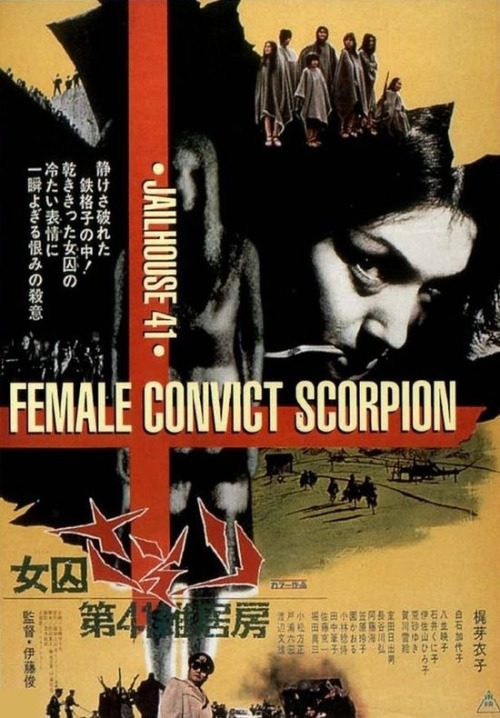
Female Prisoner Scorpion: Jailhouse 41 (女囚さそり第41雑居房, Shunya Ito, 1972)

scorpion-2Female Prisoner Scorpion: Jailhouse 41 (女囚さそり第41雑居房, Joshu Sasori – Dai 41 Zakkyobo) picks up around a year after the end of Female Prisoner #701: Scorpion and finds Matsu (Meiko Kaji) tied up in a dingy prison basement, apparently left bound and in solitary confinement for the entire interval. Once again directed by Shunya Ito, the second instalment in the Female Prisoner Scorpion series is another foray into the women in prison field but Ito resolutely refuses to give in to the exploitative genre norms, overlaying his tale of individualistic rebellion with an arthouse sensibility that has a much wider scope than its ordinary vengeance driven narrative may suggest.

Matsu may have been lying bound and gagged in a dingy underground hole for the best part of a year but today is a special day and sadistic prison warden Goda (Fumio Watanabe) is going to let her out to be shown off in front of a visiting inspector who’s paying a final visit before Goda is promoted to a top job in Tokyo. When Matsu makes a lunge for Goda, the inspector is so afraid that he wets himself, sending the other woman into a frenzy and resulting in a riot. Once again the entirety of the prison is punished, but this time Matsu is singled out for a public punishment gang rape by Goda’s goons. This kind of humiliation is too much for her fellow prisoners who instantly turn on her, but their violence provides an opportunity for escape and before long Matsu is on the run, again.

At the end of the first film, Matsu had accomplished her first round of vengeance – against the man who orchestrated her downfall and the men who secured it, but ultimately she wound up a female prisoner once again. Though Goda may have had her hidden away because of her habitual escapism, Matsu had not given up as we see from her attempts to scrape the floor away with her spoon held tight in her mouth. Barely speaking, Matsu is an unstoppable column of pure rage but an elegant one, supported by her self contained restraint.

Her anger this time is directed towards Goda himself, especially after his despicable organised punishment rape that was designed both to break her own spirit once and for all and also to damage her in the eyes of her fellow inmates who are intended to see her defeated and destroyed. The guards are a stand in for society at large, using sexual dominance and social position to keep their women in line. The visiting prison inspector makes a point of telling Matsu that “they” don’t hate her personally – they’re there for her, to help her “recover” and become a functioning member of society. Which is ironic because Goda does hate her personally as he holds her responsible for the damage to his eye sustained in the previous film. His last act before moving on is one against Mastu – an attempt by the forces of authority to crush her individual rebellion and use their victory as a coercive tool to force others to conform.

In this way, Matsu’s position as a member of a subjugated class is less important than her status as an agitator but these are women who have each suffered at the hands of men. As an extremely theatrical sequence sung in the traditional form informs us, the women who escaped with Matsu committed their crimes out of love or jealousy. Poisoned rivals, dead lovers, even children murdered to get back at their philandering father in some Medea level psychotic rage which ruins the perpetrator even more than the intended victim.

Later while the women are enjoying their brief taste of freedom, one of them is brutally raped and murdered by a troupe of feral men who boast about the wartime atrocities they committed before descending on a lone woman like a pack of rabid dogs. The others take their revenge for their friend, but also for all the women who have met a similar fate inflicted by a male dominated society which sees them as something to be controlled and then made use of, little more that cattle hemmed in and milked until dry.

As in the first film Ito makes use of expressionist techniques and strange angles to give his film a more elevated feeling that might be expected but this time he adds in a surrealist, spiritual dimension as with the old woman who sings the stories of our heroines and then dies only to bury herself in leaves and disappear into the ether, like some forgotten deity of misused women. Likewise, when one of the prisoners is raped and murdered, the men throw her body into a nearby river like an empty beer can but the waterfall behind her suddenly runs with blood as an expression of the violence which pollutes the natural world. A bus suddenly splits in two, separating our subjugated women from the violent men who mentally sentence them, given free reign simply because of their sex. Ironically enough, our last glimpse of of Matsu takes place in the reflection of Goda’s glasses and then in his false eye when she is suddenly rejoined by her compatriots for a triumphant dance of freedom on a city rooftop.

Even stronger than in the original Female Prisoner #701 Scorpion, Jailhouse 41 further advances its ideology of free individuals battling the conformist authority of the state all filtered through the prism of the patriarchy. Matsu’s vengeance is personal, she keeps her distance from the other women who do not seem inclined to band together to oppose the forces which oppress them so much as seek a wary, temporary alliance of necessity, but seeing them all reassembled in spirit at the end brings a larger dimension to Matsu’s victory which now seems much less like solving a practical problem than a deliberate strike at a wall which was solely designed to keep a certain group of people in their place. The jail is broken, all that remains is to choose to escape its restraints.


Original trailer (English subtitles, NSFW/gore)

Female Prisoner #701: Scorpion (女囚701号/さそり, Shunya Ito, 1972)

scorpion-701

Meiko Kaji had already become a familiar face in Nikkatsu’s genre output when she took on the role that would come to define her career at only 25 years of age. Toei’s Female Prisoner #701: Scorpion (女囚701号/さそり, Joshu Nana-maru-ichi Go / Sasori) would launch a series of similarly themed films and create a national pop culture icon in its central character. Based on a manga by Toru Shinohara, Female Prisoner #701 Scorpion is, at heart, a women in prison film and a cornerstone of the pinky violence genre but first time director Shunya Ito has more on his mind than salacious thrills and offers up a noticeably nuanced approach to his material filled with impressive art house flourishes.

701 is the number printed on the back of the prison uniform worn by inmate Nami Matsushima (Meiko Kaji). She makes a valiant escape attempt with a fellow prisoner, Yuki (Yayoi Watanabe), but the pair are caught and put into solitary confinement where they experience torturous treatment both at the hands of the guards and their fellow prisoners. Mostly known as Matsu but also given the nickname of “Scorpion”, Prisoner #701 is not exactly popular with the other ladies in the joint who seem to resent her escape attempts and quiet dignity, annoyed by her above it all demeanour.

Matsu has just one mission in life – vengeance, on the man who wronged her, on the society that allowed her to be wronged, and on the prison system with its sadistic guards and turncoat inmates. Once an ordinary, law abiding woman, Matsu had the misfortune to fall in love with a vice cop who convinced her to go undercover in a yakuza club to get some vital info he needs to bust it. However, Sugima (Isao Natsuyagi) turns out to be the biggest crook of them all and was merely using her to try and take out the local yakuza to get in with a bigger yakuza boss and key into a slice of the drugs trade. Matsu is brutally gang raped after her cover is blown and ends up being sent to prison after making an attempt to ice her former lover with the desire to get out and complete her mission the only thing that’s keeping her going.

Ito begins with an ironic scene in which one of the prison guards is receiving a commendation for his honourable service, Japanese flag flying proudly behind above, until the occasion is interrupted by the escaped prisoner alarm. Later Ito puts the yakuza boss in a building bearing the large banner “Beautiful Soul and Harmony of Japan” and he even adds in an expressive moment as Matsu surrenders her virginity to Sugima, staining her white sheets with a large red circle. Society is corrupt everywhere from Sugima’s bent copper to gang raping yakuza and the prison system itself.

The guards are effectively running their own little empire, cut off from mainstream law enforcement and left to their own “corrective” impulses. Ito gives us salacious shower scenes and women being marched around in the nude but he places us in the place of a voyeur, making it plain that the prison guards are sating their lust for power through humiliating their charges in sexual dominance and violence. Divide and rule is the name of the game as a top tier of prisoners are “employed” in various prison tasks earning them a different colour uniform and a status bump. These ladies are even worse than some of the male guards and are responsible for much of the cruelty inflicted on Matsu and Yuki during their time in solitary.

Inter-prisoner conflict is not the central theme of the film as Matsu continues to plan for her eventual escape and revenge on the man who has ruined her life. A slight spanner is thrown in the works when an inside woman is recruited to take Matsu out, but Matsu is painted as a the ultimate vengeful warrior. Barely speaking (the bulk of her dialogue is actually voice over for her flashback scene), Matsu waits silently, observing and plotting. Biding her time she manages to take an extremely skilful and poetic revenge against her solitary abuser despite her hands and feet being bound, and when a police mole is placed in a cell with her Matsu sees through the ruse straight away. Seducing her new cellmate, Matsu neutralises the threat with ease maintaining her trademark intense elegance all the way through.

Though the synopsis smacks of cheap and nasty exploitation Ito doesn’t see it that way and films with an art house aesthetic rather than a salacious eye. Matsu’s flashback takes a very theatrical form with a rotating set and Matsu remaining present in the corner as she narrates. Her rape scene is grotesque and nightmarish, shot through a see-through floor as her attackers grin and gurn away at her like fairytale monsters. Likewise, when Matsu traps another prisoner in her own scheme, the woman turns into a classic ghost creature, face white and staring, broken glass firmly gripped manically in front. The acting style is broad and absurd. Policeman laugh loudly and for too long, blood is an artificial kind of red, gloopy like paint, and pantomimeish grotesquery is everywhere. Ito’s backgrounds are expressionist rather than realist but always perfectly pitched.

You can tell a lot about a place from the way it treats its prisoners and when its as bad as this, you start to wonder which side of the bars you’re really on. The guards are only a representation of a consistently exploitative society, but they can at least be outsmarted. “To be deceived is a woman’s crime”, says Matsu, but it’s one she fully intends to atone for – in blood, settling not just her own score but those of all her fellow prisoners caught in the patriarchal trap of hollow promises and abused honour.


Original trailer (English subtitles)