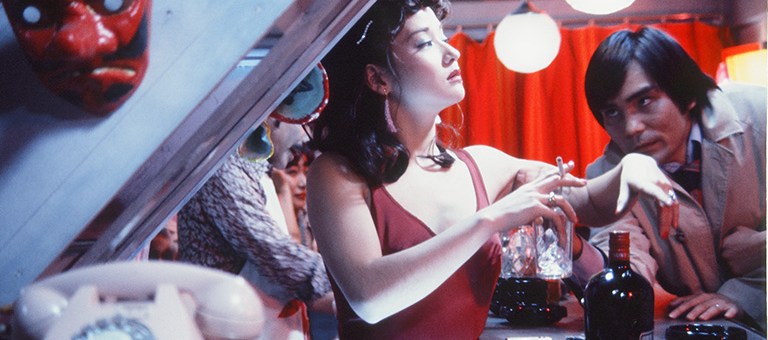
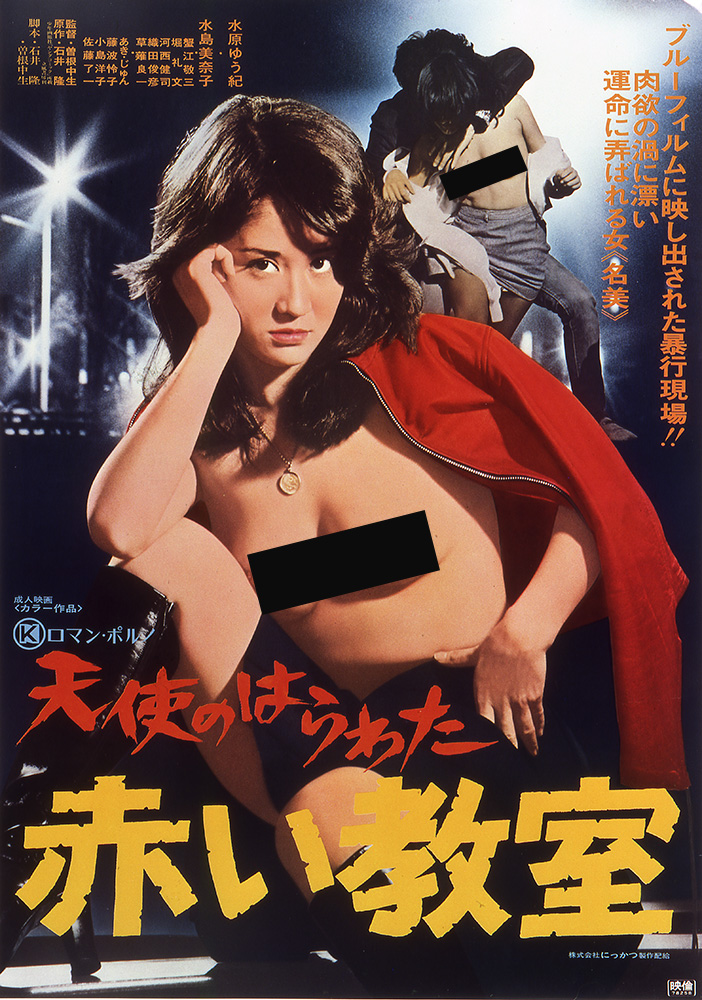
Angel Guts: Red Classroom (天使のはらわた 赤い教室, Chusei Sone, 1979)

Chusei Sone’s Angel Guts: Red Classroom (天使のはらわた 赤い教室, Tenshi no Harawata: Akai Kyoshitsu) opens with grainy 8mm footage of a woman being gang raped, but this turns out to be a film being watched by the protagonist, Muraki (Keizo Kanie), rather than the one we’re actually watching. Nevertheless, in presenting the footage in this way, the film has made us somewhat complicit in witnessing this woman’s exploitation for the purposes of entertainment. A producer of pornographic magazines, Muraki is captivated by the woman’s ruined innocence and becomes obsessed with the idea of finding her.

Though he says he doesn’t think she belongs in this world, Muraki does not so much want to save Nami (Yuki Mizuhara) as get her to work for his magazine. He declares that years of this kind of work have left him numbed and desensitised. Watching her video was the first time he’s felt moved in years. However, it turns out that this may be because the video wasn’t a movie in which the actress had consented to appear, but raw footage of an actual gang rape committed against a trainee teacher. The implication is that this traumatic incident has numbed Nami in the same way Muraki has been numbed by his exposure to pornography, leaving her with a permanently vacant, inscrutable expression and reducing her to nothing but a sexual object. Though the 8mm “blue movie” is an illegal form of pornography that can be watched only in underground clubs, she claims to have run into several men like Muraki who recognise her and has concluded that the only way to get rid of them is to satisfy their desire by sleeping with them. She says she won’t feel anything anyway, but has scars on her wrist and seems to have turned to potentially dangerous sex with random men as a means of self-harm.

Muraki refuses to sleep with her, but in Nami he seems to be looking for his own buried innocence and masking the shame he feels towards his line of work. His parents think he publishes books for children, he tells Nami, but rants to another woman that his magazines are all the same and he doesn’t know how to make them better. He can’t take the kind of pictures he wants to, because he wouldn’t be able to publish them under the increasingly strict censorship laws. Repeated references are made to the need to avoid showing any pubic hair which is considered obscene under Japanese law, though they’re otherwise free to depict scenes of sexual violence and degradation. Ironically, Muraki is unable to meet Nami at their rendezvous because he’s been arrested for breaking the Protection of Minors Act after having photographed a 15-year-old girl, though Muraki claims he was just trying to help her. He says she told him she was 19, recently arrived from Aomori and had been reduced to shoplifting, so he gave her a job out of the kindness of his heart.

It’s things like this that might have Muraki desperate to prove he’s not “scum” but a good man and an artist rather than a purveyor of pornography and exploiter of women. The film has its cake and eats it too, critiquing female exploitation but simultaneously trading on it, if doing its best to make the viewer feel at least conflicted. Three years later, Muraki is in a relationship with a woman he once exploited who couldn’t let him go and has fathered a child, but the papers are full of news about suicides and domesticity does not seem to him provide much of a refuge. He continues to search for Nami in order to reclaim his innocence, but discovers that she has become a vacant sex worker, ironically working at a bar called “blue” and the plaything of a man in a James Dean-style red jacked who has broken dreams of his own. Unlike Muraki, she has only fallen further, and he is ultimately forced to watch what his business has reduced her to as a group of men set on a captive high school girl like a pack of wolves, ironically echoing the opening sequence. Yet in the end, it’s Nami who frees him by literally showing Muraki the way out of this place as he urges her to leave though she seems to say it’s already too late. Looking at her own distorted image in a puddle, she no longer knows who she is and has no identity that is not forced upon her by a violent male gaze.


Angel Guts: Red Classroom is available as part of The Angel Guts Collection released on blu-ray 23rd February courtesy of Third Window Films.

Black Sun (黒い太陽, Koreyoshi Kurahara, 1964)

black sun still 2The Warped Ones showed us a nihilistic world of aimless youth living not so much on their wits as by their pleasures, indulging their every animalistic whim while respectable society looked on in horror. By 1964 things have only got worse. Tokyo might have got the Olympics, Japan might be back on the international map, and economic prosperity might be on the rise but all around the city there’s an arid wasteland – a literal dumping ground in which the unburied past has been left to fester as a grim reminder of historical follies and the present’s reluctance to deal with them.

Akira (Tamio Kawaji), now calling himself “Mei” (perhaps a play on the reading of the character for his name 明), seems to have mellowed since the heady days of his youth. Living alone save for a dog named Thelonious Monk, Mei has co-opted a disused church and turned it into a shrine for jazz. The walls and ceilings are covered in photographs of famous jazz musicians and posters for club nights and solo shows. He has his own turntable and a well stocked selection of LPs, though he still seems to frequent the same kind of jazz clubs that so defined his earlier life.

Change arrives when Mei boosts a fancy car and is almost caught in a police net caused by the body of an American serviceman found floating in the harbour. Apparently the crime is the product of an internal GI squabble, but the offending soldier is on the run with a machine gun. As coincidence would have it, the wounded killer, Gil (Chico Lourant), fetches up at Mei’s church and, as Gil is a black man, Mei assumes that they will definitely be friends. It is, however, not quite that simple.

As in the earlier film, jazz is the force which keeps Mei’s mind from fracturing. His life still moves to improvisational rhythms even if apparently not quite so frenetically as it once did. Rather than the rampant animal of The Warped Ones, this Mei has embraced his outsider status through literally removing himself from the city in favour of self-exile and isolation as a squatter in the house of God – a place about to be torn down.

While Mei has been literally pushed out with only his beloved dog as evidence of his latent human feelings, his formerly delinquent friend, Yuki (Yuko Chishiro), has gone on to bigger and better things. No longer (it seems) a casual prostitute catering to foreigners, Yuki has repurposed the skills her former life gave her to shift into an aspirational middle-class world as a translator for those same American troops she once performed another service for. The American occupation is long over, but the US Army is everywhere.

Mei thinks of himself as one of Japan’s oppressed outsiders – an outcast in a land subjugated by a foreign power. He squats in a ruined church while the Americans “squat” in his ruined country. He likes jazz because it fits the rhythms of his mind but also because he believes it to be the music of the oppressed. In Gil he thinks he sees another like him, a man oppressed in his own homeland and ironically enough by the same forces that are (in part) oppressing him. Mei has a lot of strange, stereotypical ideas about black men – he’s excited to meet Gil because he thinks all black men must love jazz and that Gil must be some kind of jazz god, but Gil is a frightened rabbit on the run, terrified and bleeding. Thinking he’s in the middle of a visitation, Mei tries to make plain his enthusiasm despite the obvious language barrier, pointing wildly at his shrine to jazz, but all Gil wants is quiet and help with the bullet wound currently suppurating on his thigh.

The “relationship” deteriorates, but a strange kind of camaraderie is eventually born between the two men. Things take a turn for the surreal when Mei dons black face and paints Gil’s white, only to get stopped by GIs who want to see an ID from a “foreigner” driving a fancy car, and for Mei to introduce Gil at his favourite jazz bar as his new “slave”. In hindsight it’s all a little awkward as Kurahara throws in stock footage of the civil rights movement and tries to equate it both to the recent protest movements in Japan and to Mei’s self-identified status as one of Japan’s oppressed masses. Still, you can’t argue with the fact that the two men have found a bond in their shared alienation and desire to escape from the impotence of their current situations.

Ironically enough Kurahara does seem to believe in an escape, though it’s perhaps not so positive as it sounds. The tragic friendship of the two men in which one must save the other by releasing him towards the sea and the sun pushes Mei out of his self-exile and back into the “real” world even if he still considers himself to be an outsider within it. The sun is bright but it’s also dull, shining not with hope but with consolation for a hopeless world in which the only victory lies in the final act of surrender.


Short scene from the beginning of the film (English subtitles)

Youth of the Beast (野獣の青春, Seijun Suzuki, 1963)

youth of the beast posterSeijun Suzuki had been directing for seven years and had made almost 20 films by the time he got to 1963’s Youth of the Beast (野獣の青春, Yaju no Seishun). Despite his fairly well established career as a director, Youth of the Beast is often though to be Suzuki’s breakthrough – the first of many films displaying a recognisable style that would continue at least until the end of his days at Nikkatsu when that same style got him fired. Building on the frenetic, cartoonish noir of Detective Bureau 2-3: Go to Hell Bastards!, Suzuki once again casts Jo Shishido in the the lead only this time as an even more ambiguous figure playing double agent to engineer a gang war between two rival hoodlums.

Suzuki opens in black and white as the bodies of a man and a woman are discovered by a small team of policemen. Finding a note from the deceased female which states that she settled on taking her own life because she loved her man and thought death was the only way to keep him, the police assume it’s an ordinary double suicide or perhaps murder/suicide but either way not worthy of much more attention, though discovering a policeman’s warrant card on the nightstand does give them pause for thought.

Meanwhile, across town, cool as ice petty thug Jo Mizuno (Jo Shishido) is making trouble at a hostess bar but when he’s taken to see the boss, it transpires he was really just making an audition. The Nomoto gang take him in, but Mizuno uses his new found gang member status to make another deal with a rival organisation, the Sanko gang, to inform on all the goings on at Nomoto. So, what is Mizuno really up to?

As might be expected, that all goes back to the first scene of crime and some suicides that weren’t really suicides. Mizuno had a connection with the deceased cop, Takeshita (Ichiro Kijima), and feels he owes him something. For that reason he’s poking around in the local gang scene which is, ordinarily, not the sort of world straight laced policeman Takeshita operated in which makes his death next to a supposed office worker also thought to be a high class call girl all the stranger.

Like Detective Bureau 2-3: Go to Hell Bastards!, Youth of the Beast takes place in a thoroughly noirish world as Mizuno sinks ever deeper into the underbelly trying to find out what exactly happened to Takeshita. Also like Detective Bureau 2-3: Go to Hell Bastards!, Youth of the Beast is based on a novel by Haruhiko Oyabu – a pioneer of Japanese hardboiled whose work provided fertile ground for many ‘70s action classics such as The Beast Must Die and Resurrection of the Golden Wolf, but Suzuki’s ideas of noir owe a considerable debt to the gangster movies of the ‘30s rather than the moody crime dramas of twenty years later.

Jo Shishido’s Mizuno is a fairly typical ‘40s conflicted investigator, well aware of his own flaws and those of the world he lives in but determined to find the truth and set things right. The bad guys are a collection of eccentrics who have more in common with tommy gun toting prohibition defiers than real life yakuza and behave like cartoon villains, throwing sticks of dynamite into moving cars and driving off in hilarious laughter. Top guy Nomoto (Akiji Kobayashi) wears nerdy horn-rimmed glasses that make him look like an irritated accountant and carries round a fluffy cat he likes to wipe his knives on while his brother Hideo (Tamio Kawaji), the fixer, is a gay guy with a razor fetish who likes to carve up anyone who says mean stuff about his mum. The Sanko gang, by contrast, operate out of a Nikkatsu cinema with a series of Japanese and American films playing on the large screen behind their office.

The narrative in play may be generic (at least in retrospect) but Suzuki does his best to disrupt it as Mizuno plays the two sides against each other and is often left hiding in corners to see which side he’s going to have to pretend to be on get out of this one alive. Experimenting with colour as well as with form, Suzuki progresses from the madcap world of Detective Bureau 2-3: Go to Hell Bastards! to something weightier but maintains his essentially ironic world view for an absurd journey into the mild gloom of the nicer end of the Tokyo gangland scene.


Original trailer (no subtitles)