The Good Fairy (善魔, Keisuke Kinoshita, 1951)

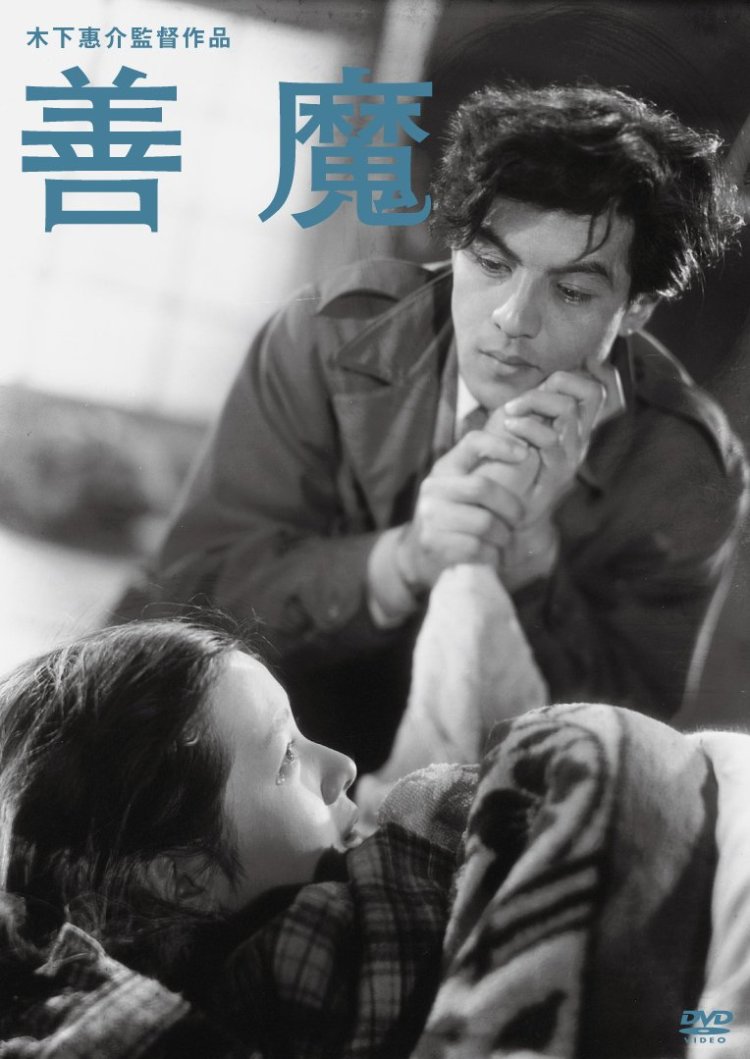
Good fairy DVDAlthough one of the more prominent names in post-war cinema, the work of Keisuke Kinoshita has often been out of fashion, derided for its sentimental naivety. It is true to say that Kinoshita values heroes whose essential goodness improves the world around them though that is not to say that he is entirely without sympathy for the conflicted or imperfect even if his equanimity begins to waver with age. 1951’s The Good Fairy (善魔, Zemma), however, working from a script penned not by himself but Kogo Noda and adapted from the novel by Kunio Kishida, seems to turn his life philosophy on its head, wondering whether the tyranny of puritanical goodness is an evil in itself or merely the best weapon against it.

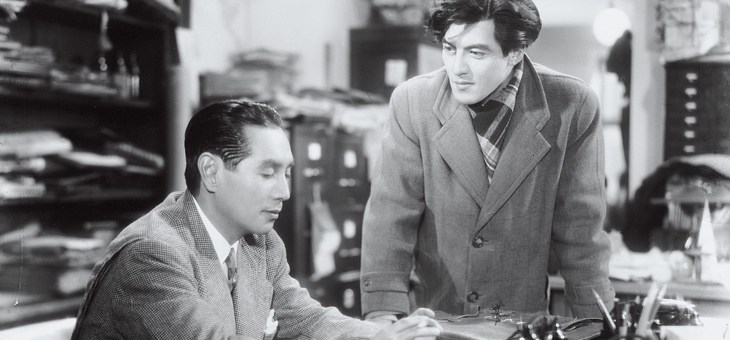
After beginning with a hellish, ominous title sequence set against the flames, the film opens with newspaper editor Nakanuma (Masayuki Mori) getting a hot tip regarding a politician’s wife who seems to have mysteriously disappeared. He hands the assignment to rookie reporter Rentaro Mikuni (played by the actor Rentaro Mikuni who subsequently took his stage name from this his debut role) who specialises in political corruption. Mikuni doesn’t like the assignment. He thinks it’s unethical and whatever happens between a man and his wife is no one’s business, but ends up going to see the politician, Kitaura (Koreya Senda), anyway and instantly dislikes him. Mildly worried by Kitaura’s lack of concern over his wife’s sudden absence, Mikuni stays on the case and visits the wife’s father (Chishu Ryu) up in the mountains where he also meets her sister, Mikako (Yoko Katsuragi), who eventually leads him to the woman herself, Itsuko (Chikage Awashima), who has taken refuge with a friend after becoming disillusioned with her husband’s “vulgar” pursuit of success at the continuing cost of human decency.

To pull back for a second, in any other Kinoshita film, Itsuko would be among the heroes in standing up against her husband’s corrupting influences, but for reasons which will later be explained she lingers on the borders of righteousness owing to having made a mistaken choice in her youth which was, in many ways, defined by the times in which she lived. Nukanuma had not been entirely honest with Mikuni in that he had known and secretly been in love with Itsuko when they were both students but he was poor and diffident and so he never declared himself, his only attempt to hint as his feelings either tragically or wilfully misunderstood. Where Itsuko, who married for money and status as a young woman was expected to do in the pre-war society, has mellowed with age and gained compassionate morality, Nakanuma who became a reporter to fight for justice against the background of fascist oppression has become cynical and selfish. Never having quite forgotten Itsuko, he has been in a casual relationship with a young actress, Suzue (Toshiko Kobayashi), for the last two years never realising that she has really fallen in love with him.

Thinking back on his college relationship with Itsuko, Nakanuma remembers talking with her about unsuccessful romances, that if a man tries his best to make a woman happy but isn’t able to then it must be because she doesn’t love him. Itsuko agrees, adding that men never seem to know what makes a woman happy in love but that friendship is a different matter. She says something similar when she tells him she’s getting married but doesn’t want to lose his friendship, and when he begins floating the idea of marriage hinting that he wants to marry her but perhaps giving the mistaken impression that there’s someone else in stating that it’s sad when a friend marries because the relationship with never be the same again and knowing that he intends to marry she now treasures their friendship even more. In a sense, Nakanuma thinks of Suzue as a “friend” with whom he occasionally sleeps, believing that their relationship is only ever liminal and temporary but mutually beneficial and capable of continuing even if the sexual component had to end.

Having failed once in love, Nakanuma is resolved not to do so again and determined to fight to win Itsuko rather than lose her through cowardice, but to do so he will cruelly wound Suzue who has treated him with nothing other than tenderness. By this time, Mikuni has fallen in chaste, innocent love with Mikako who reminds him of the parts of himself he feels are being erased by his compromising job as part of the mass media machine. Mikuni’s terrifying “goodness” is largely a positive quality which leads him to fight for justice against oppression even within his own organisation but his love for the saintly Mikako only intensifies his moral purity and threatens not only to turn him into an insufferable prig but to create in him a new oppressor, spreading guilt and unhappiness like the self-righteous hero of an Ibsen play.

Early on, following their mild disagreement about journalistic ethics, Mikuni and Nakanuma have dinner together over which they debate the power of the press to bring about social change and hold power to account. Nakanuma says he’s become cynical because hating injustice isn’t enough and there’s nothing that the individual can do against an oppressive system. What he’s telling Mikuni is that he used to be like him, but time has taught him righteousness is not an effective weapon against entrenched social privilege. He recounts a dark story from a Buddhist monk who told him that good can never win over evil because it isn’t strong enough, only evil is strong enough to fight evil and so in order to counter it you will need to affect its weapons. Later, crazed by grief and exhaustion, Mikuni’s “goodness” seems to pulse out of him with ominous supernatural force as he takes Nakanuma to task for his callous treatment of Suzue only for he and Itsuko to come to the conclusion that they’ve heard the voice of “evil” and are now condemned by their past choices to lives of morally pure unhappiness.

This central conundrum seems to contradict Kinoshita’s otherwise open philosophies in its unwelcome rigidity which says that there are no second chances and no possibility of ever moving on from the past with positivity. Itsuko made the “wrong” choice when she was young in choosing to marry for material gain, but she was only making the choice her society expected her to make in the absence of other options – it wasn’t as if she had any reason to wait around for Nakanuma whose regret over his romantic cowardice has made him cold and bitter. She realised her mistake too late and resolved to correct it, but the “Good Fairy” won’t let her, it says she has to pay (for the crimes of an oppressive society) by sacrificing again her chance of happiness in the full knowledge of all she’s giving up. Kinoshita’s films advocate the right to love by will, free of oppressive social codes or obligations but Itsuko is denied a romantic resolution despite having “reformed” herself and made consistently “correct” choices since discovering her husband’s “fraud”. She is denied this largely because of Nakunuma’s failing in being unkind to one who loved him, which is, in a round about way, still her fault for not having realised he loved her and deciding to marry him instead. In fact, the only one who seems to get off scot-free is Kitaura whose fraudulent activities will be covered up on the condition he consent to Itsuko’s divorce petition and sets her fully “free” so she can be fully burdened by the weight of her romantic sacrifice.

In the end, it’s difficult to see a positive outcome which could emerge from all this unhappiness which seems primed only to spread and reproduce itself with potentially disastrous consequences. Mikuni’s purity has become puritanical, unforgiving and rigid, condemning all to a hellish misery from which there can be no escape. The cure is worse than the disease. No one could live like this, and no one should. Goodness, tempered by compassion and understanding, might not be enough to fight the darkness all alone but it might be better to live in the half-light than in the hellish flickering of the fires of righteousness.


Title sequence and opening scene (no subtitles)
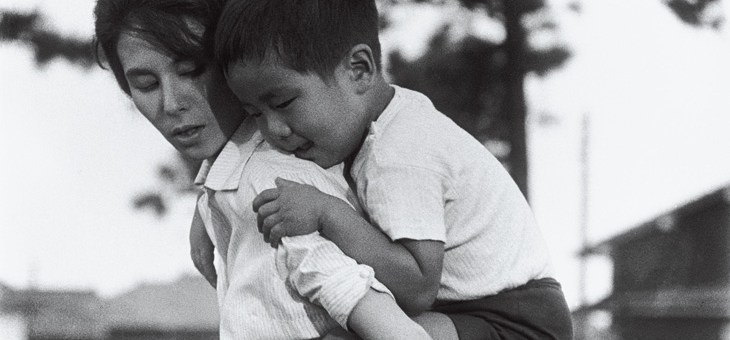
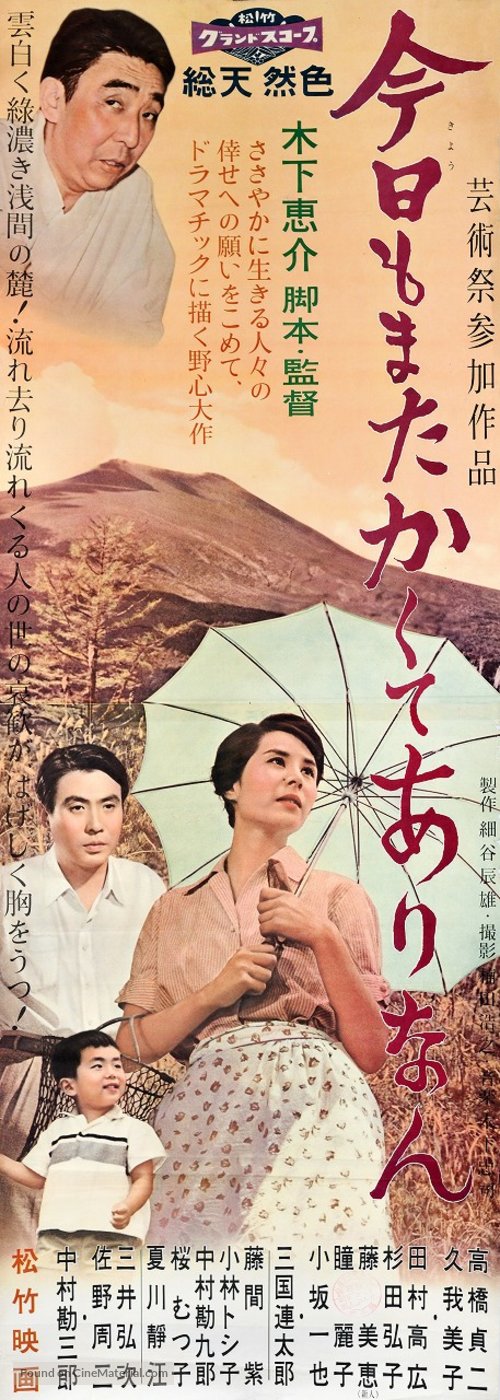
Thus Another Day (今日もまたかくてありなん, Keisuke Kinoshita, 1959)

Thus Another Day vertical bannerThe cinema of the immediate post-war era, contrary to expectation, is generally hopeful and filled with the spirit of industry. Keisuke Kinoshita might be thought of as the primary proponent of post-war humanism in his fierce defence of the power of human goodness, but looking below the surface he’s also among the most critical of what the modern Japan was becoming, worried about a gradual loss of values in an increasingly consumerist society which refuses to deal with its wartime trauma in favour of burying itself in intense forward motion.

The housewife at the centre of Thus Another Day (今日もまたかくてありなん, Kyo mo mata Kakute ari nan), Yasuko (Yoshiko Kuga), is a perfect example of this internal conflict. She and her husband Shoichi (Teiji Takahashi) have built a modest house way out of the city in the still underdeveloped suburbs for which they are still burdened by an oppressive mortgage. Shoichi has a regular job as an entry level salaryman but his pay is extremely low and Yasuko is forced to scrimp and save just to get by. The central conflict occurs one summer when Shoichi’s boss declares he’s looking to rent a summer house in the quiet area where the family live. Shoichi thinks it would be a great idea to rent out their house to his boss earning both money and favour. Yasuko can go stay with her family who live in a pleasant resort town while he will stay with a friend in a city apartment. Yasuko does not really like the idea, but ends up going along with it.

Shoichi is trying to live the salaryman dream, but it isn’t really going anywhere. Yasuko is home alone all day with the couple’s small son, Kazuo, who is too young to understand why the family lives the way it does and continuously asks probing questions which upset and embarrass his mother. Watching her painstakingly washing clothes by hand, Kazuo wants to know why they don’t have an electric washing machine like some of his friends’ mothers do. Yasuko tells him they’re saving money to get one, at which point he pipes up that he personally would rather have a TV set. Like his father, he is rather self-centred but being only four can perhaps be forgiven. Nevertheless, Yasuko is constantly embarrassed by the family’s relative poverty. When another neighbour spots her out shopping and decides to accompany her, she is visibly distressed that the stall she takes her to is a little more expensive than the one she had in mind. Wanting to save face, she buys expensive fish but is mindful of there being less money for the rest of the week.

Meanwhile, Shoichi is obsessed with “getting ahead” by ingratiating himself with his bosses – hence why he decided to let out his own house over the summer. The house is, after all, Yasuko’s domain and she perhaps feels family atmosphere isn’t something you should be selling. She resents that the family will be split up over the summer even if it gives her an opportunity to visit her mother and sister out in the country. Even when Shochi arrives to visit, he makes them trot out to a neighbouring town to visit his boss’ wife also on holiday in the area, and stays there all day playing mahjong while Yasuko and Kazuo are bored out of their minds sitting idly by. The second time he doesn’t even bother to invite them.

The small resort town itself is something of a haven from the demands of the city but there is trouble and strife even here. Shortly after her arrival Yasuko meets a strange, rather sad middle-aged man who is a stay at home dad to his beloved little girl, Yoko. Takemura (Nakamura Kanzaburo XVIII) came of age in the militarist era, attending a military university to become one of the elite. The world changed on him and he remains unable to reconcile himself to the demands of the post-war society. Experiencing extreme survivor’s guilt, Takemura is filled with regret and resentment towards the ruined dreams of his misguided youth in which he abandoned a woman he loved to marry a wealthy man’s daughter who he has also let down by refusing his military pension, forcing her into the world of work and eventually onto the fringes of the sex trade as a hard drinking bar girl.

As if to underscore the looming danger, a thuggish gang of yakuza have also decided to spend the summer in the resort, holing up at the inn where Takemura’s wife is working. The young guys terrorise the youngsters of the town, disrupting the well established social hierarchy with acts of violence and intimidation. The punks cause particular consternation to Takemura who remembers all the men their age who went to war and never came back only for the successive generation to live like this. Having lost everything which made his life worth living, Takemura decides to take a stand against modern disorder, hoping to die in battle the way he feels he ought to have done all those years ago.

Thus Another Day is among the darkest of Kinoshita’s post-war dramas, suggesting that there really is no hope and that past innocence really has been lost for good. The values of Takemura’s youth, however, would not perhaps line up particularly well with those most often advanced in Kinoshita’s cinema, as kind and melancholy as he seems to be. Yasuko goes back to her crushing world of unfulfillable aspirations with her obsequious husband and demanding son with only gentle wind chimes to remind her of happier days while she tries to reaccommodate herself to the soullessness of post-war consumerism .


Original trailer (no subtitles)

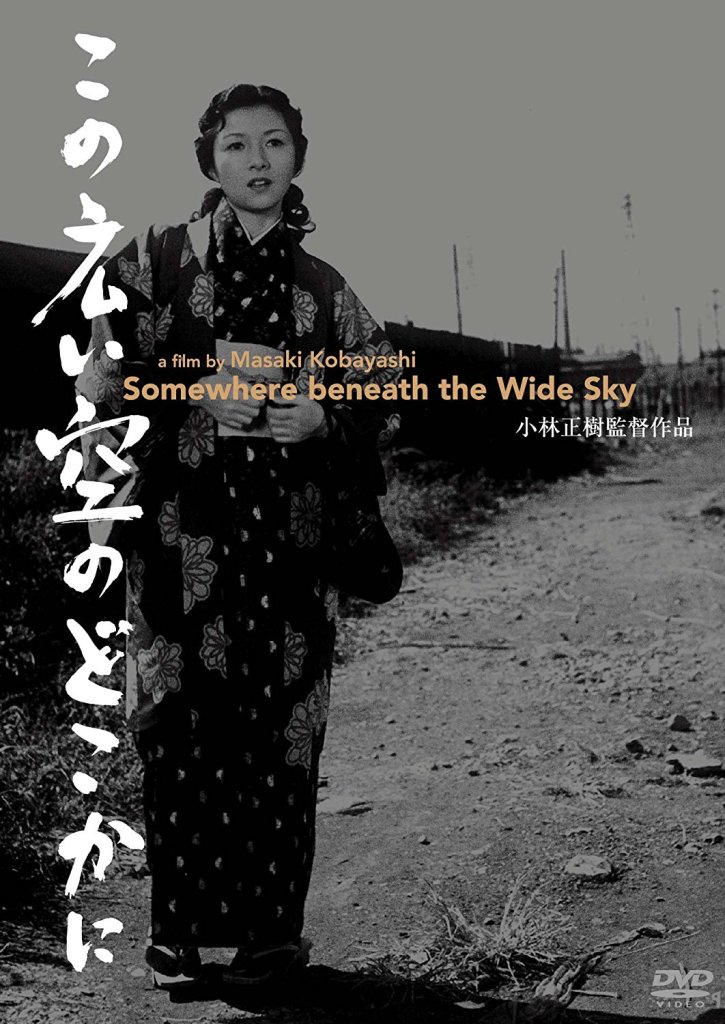
Somewhere Beneath the Wide Sky (この広い空のどこかに, Masaki Kobayashi, 1954)

somewhere-beneath-the-wide-skyOf the chroniclers of the history of post-war Japan, none was perhaps as unflinching as Masaki Kobayashi. However, everyone has to start somewhere and as a junior director at Shochiku where he began as an assistant to Keisuke Kinoshita, Kobayashi was obliged to make his share of regular studio pictures. This was even truer following his attempt at a more personal project – Thick Walled Room, which dealt with the controversial subject of class C war criminals and was deemed so problematic that it lingered on the shelves for quite some time. Made the same year as the somewhat similar Three Loves, Somewhere Beneath the Wide Sky (この広い空のどこかに, Kono Hiroi Sora no Dokoka ni) is a fairly typical contemporary drama of ordinary people attempting to live in the new and ever changing post-war world, yet it also subtly hints at Kobayashi’s ongoing humanist preoccupations in its conflict between the idealistic young student Noboru and his practically minded (yet kind hearted) older brother.
The Moritas own the liquor store in this tiny corner of Ginza, where oldest brother Ryoichi (Keiji Sada) has recently married country girl Hiroko (Yoshiko Kuga). The household consists of mother-in-law Shige (Kumeko Urabe), step-mother to Ryoichi, unmarried sister Yasuko (Hideko Takamine), and student younger brother Noboru (Akira Ishihama). Things are actually going pretty well for the family, they aren’t rich but the store is prospering and they’re mostly happy enough – except when they aren’t. Ryoichi married for love, but his step-mother and sister aren’t always as convinced by his choice as he is, despite Hiroko’s friendly nature and constant attempts to fit in.

As if to signal the dividing wall between the generations, Somewhere Beneath the Wide Sky opens with a discussion between two older women, each complaining about their daughters-in-law and the fact that their sons married for love rather than agreeing to an arranged marriage as was common in their day. These love matches, they claim, have unbalanced the family dynamic, giving the new wife undue powers against the matriarchal figure of the mother-in-law. While the other woman’s main complaint is that her son’s wife is absent minded and bossy, Shige seems to have little to complain about bar Hiroko’s slow progress with becoming used to the runnings of the shop.

Despite this, both women appear somewhat hostile towards Ryoichi’s new wife, often making her new home an uncomfortable place for her to be. Though Hiroko is keen to pitch in with the shop and the housework, Shige often refuses her help and is preoccupied with trying to get the depressed Yasuko to do her fair share instead. At 28 years old, Yasuko has resigned herself to a life of single suffering, believing it will now be impossible for her to make a good a match. Yasuko had been engaged to a man she loved before the war but when he returned and discovered that she now walks with a pronounced limp following an injury during an air raid, he left her flat with a broken heart. Embittered and having internalised intense shame over her physical disability, Yasuko finds the figure of her new sister-in-law a difficult reminder of the life she will never have.

A crisis approaches when an old friend (and perhaps former flame) arrives from Hiroko’s hometown and raises the prospect of abandoning her young marriage to return home instead. No matter how her new relatives make her feel, Hiroko is very much in love with Ryoichi and has no desire to leave him. Thankfully, Ryoichi is a kind and understanding man who can see how difficult the other women in the house are making things for his new wife and is willing to be patient and trust Hiroko to make what she feels is the right decision.

Ryoichi’s talent for tolerance is seemingly infinite in his desire to run a harmonious household. However, he, unlike younger brother Noboru, is of a slightly older generation with a practical mindset rather than an idealistic one. Ryoichi simply wants to prosper and ensure a happy and healthy life for himself and his family. This doesn’t mean he’s averse to helping others and is actually a very kind and decent person, but he is quick to point out that he needs to help himself first. Thus he comes into conflict with little brother Noburu from whom the film’s title comes.

Noburu is a dreamer, apt to look up at the wide sky as symbol of his boundless dreams. His fortunes are contrasted with the far less fortunate fellow student Mitsui (Masami Taura), who comes from a much less prosperous and harmonious family, finding himself working five different jobs just to eat twice a day and study when he can. Noburu wants to believe in a brighter world where things like his sister’s disability would be irrelevant and something could be done to help people like Mitsui who are struggling to get by when others have it so good. Ryoichi thinks this is all very well, but it’s pie in the sky thinking and when push comes to shove you have to respect “the natural order of things”. Ryoichi wants to work within the system and even prosper by it, where as Noburu, perhaps like Kobayashi himself, would prefer that the “natural order of things” became an obsolete way of thinking.

Nevertheless, it is the power of kindness which cures all. Gloomy Yasuko begins to live again after re-encountering an old school friend and being able to help her when she is most in of need of it. Being of use after all helps her put thoughts of her disability to the back of her mind and so, after hiding from a man who’d loved her in the past out of fearing his reaction to her current state (and overhearing his general indifference on hearing of it), she makes the bold decision to strike out for love and the chance of happiness in the beautiful, yet challenging, mountain environment.

Like many films of the era, Somewhere Beneath the Wide Sky is invested in demonstrating that life may be hard at times, but it will get better and the important thing is to find happiness wherever it presents itself. This is not quite the message Kobayashi was keen on delivering in his subsequent career which calls for a more circumspect examination of contemporary society along with a need for greater personal responsibility for creating a kinder, fairer and more honest one. A much more straightforward exercise, Somewhere Beneath the Wide Sky is Kobayashi channeling Kinoshita but minimising his sentimentality. Nevertheless, it does present a warm tale of a family finally coming together as its central couple prepares to pick up the reins and ride on into the sometimes difficult but also full of possibility post-war world.


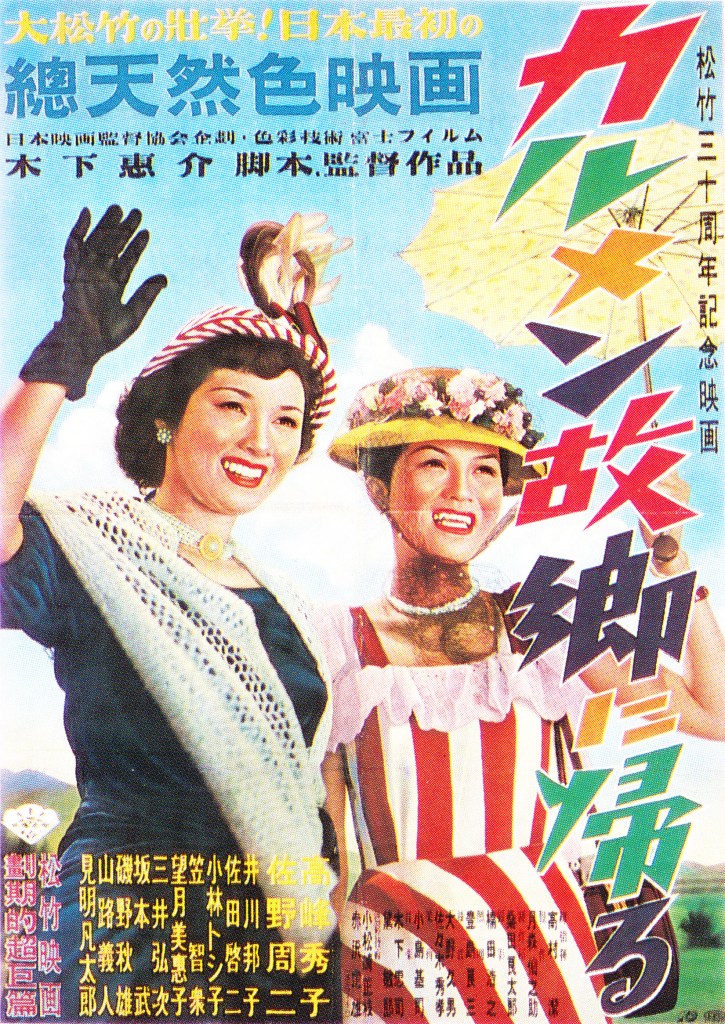
Carmen Comes Home (カルメン故郷に帰る, Keisuke Kinoshita, 1951)

Carmen Comes HomeShochiku was doing pretty well in 1951. Accordingly they could afford to splash out a little in their 30th anniversary year in commissioning the first ever full colour film to be shot in Japan, Carmen Comes Home (カルメン故郷に帰る, Carmen Kokyou ni Kaeru). For this landmark project they chose trusted director Keisuke Kinoshita and opted to use the home grown Fujicolor which has a much more saturated look than the film stocks favoured by overseas studios or those which would become more common in Japan such as Eastman Colour or Agfa. Fujicolour also had a lot of optimum condition requirements including the necessity of shooting outdoors, and so we find ourselves visiting a picturesque mountain village along with a showgirl runaway on her first visit home hoping to show off what a success she’s made for herself in the city.

Famous Tokyo showgirl “Lily Carmen” (Hideko Takamine) was once plain old Kin from the cow farm. When the family receives a letter written in grand style and signed with Kin’s stage name explaining she’ll be coming to visit, her sister may be excited but her father has much more mixed emotions. When Carmen comes home she does so like she’s on a victory parade. Wearing her Westernised, colourful outfits fashionable in the city but like something from outer space here, Carmen becomes the show but oddly seems uncomfortable with the predictable amount of attention she’s getting around town. The presence of Carmen and her equally pretty friend, Maya (Toshiko Kobayashi), threatens to destabilise this otherwise peaceful mountain village but just what sort of chaos can two beautiful women really create over the period of a few days?

The villagers react to Carmen’s return with a series of ambivalent emotions. Of course, they’re glad to see their own girl back, especially as she’s been so successful in the city, but this Carmen is not the same as the Kin who ran away. Slightly in awe of all this visiting urban sophistication, the villagers are also scandalised by Carmen’s modern attitudes to fashion and vulgar behaviour. Striding around the village like as it were a tourist attraction and she a visiting monarch, Carmen chews gum, breaks in to song at random and dances happily in her underwear on the green mountain hillsides.

The village is smallish community but fiercely proud of their local traditions. Many of the residents are happy to think that a “great artist” of the pedigree of Lily Carmen could have been born in their little village. In fact, this tiny settlement is something of a crucible for artistic talent and the extremely pompous school headmaster has a bee in his bonnet about bringing forth the future of Japan through cultural education. However, not quite all of the residents are so liberal and many live in fear of a feudalistic money lender named Maruju (Koji Mitsui) who runs the local transportation business (such as it is) but makes most of his money out of issuing exorbitant loans to desperate local people. Recently, he’s pointlessly repossessed an organ from the home of a man who was blinded during the war.

The headmaster is very keen for Carmen to come and bring some of her city sophistication back to the village, but no one has actually asked what kind of “art” Carmen is involved in. After a lot of chat from Carmen about how seriously she takes her work, people start wondering about this cutting edge performance art that their homegirl has apparently surrendered her life to. As if it weren’t obvious from her name, Carmen is a burlesque dancer. Quite a good, high grade burlesque dancer and, in fact, an artist, but essentially a stripper who really does take it all off in the end. Ever the enterprising businessman, Maruju decides to put on a show which he advertises with a big cart bearing the slogan “wild dancing by nude beauties” plastered on the side.

Needless to say this does not go down well with pompous headmaster and his plan to create a great city of highbrow artists. Striding straight over to talk to Carmen’s father Shoichi who’s only just got up from a few days in bed after Carmen’s last embarrassing faux pas, the principal intends to talk Carmen and her friend out of their scheduled performance. Her father, however, has a surprising reaction. He had an inkling what kind of life his runaway daughter must have been living. Shoichi put much of Carmen’s lack of acumen down to being kicked in the head by a cow as a child and realised it would be hard for her to find “respectable” work. He doesn’t want to see her “indecent” show and thinks the professor shouldn’t go either, but also thinks that if she’s good at it and it makes her happy then maybe that’s OK. After all, if it was that bad they wouldn’t allow it in the city and whatever’s good enough for the city ought to be good enough for the mountains. The headmaster, momentary stunned, is now confused and wondering if stopping the performance is an infringement on Carmen’s human rights.

Kinoshita refuses to take a side, he shows the ridiculousness of both the isolated villagers and the sophisticated city dwellers to great comic effect. Hideko Takamine is something of a revelation, cast completely against type as a bubbly, airhead showgirl. As is true with a lot of early colour films, or even a lot of early talkies, Carmen Comes Home has a built in gimmick and doesn’t really worry about doing very much beyond it. As such it keeps things light and bright and breezy, emphasising its high contrast colour palate every step of the way. A gentle comedy of manners as small town comforts rival big city liberalism with the obvious trade offs involved on either side, Carmen Comes Home might lack the substance of some of Kinoshita’s other work but makes up for it with general sunniness and effortlessly timeless humour.


Original trailer(s) (no subtitles):

https://www.youtube.com/watch?v=-2zwkGWPejQ

The Thick-Walled Room (壁あつき部屋, Masaki Kobayashi, 1956)

4473285465_b5cf3a248fThere’s a persistent myth that Japanese cinema avoids talking about the war directly and only addresses the war part of post-war malaise obliquely but if you look at the cinema of the early ‘50s immediately after the end of the occupation this is not the case at all. Though the strict censorship measures in place during the occupation often made referring to the war itself, the rise of militarism in the ‘30s or the American presence after the war’s end impossible, once these measures were relaxed a number of film directors who had direct experience with the conflict began to address what they felt about modern Japan. One of these directors was Masaki Kobayashi whose trilogy, The Human Condition, would come to be the best example of these films. This early effort, The Thick-Walled Room (壁あつき部屋, Kabe Atsuki Heya), scripted by Kobo Abe is one of the first attempts to tell the story of the men who’d returned from overseas bringing a troubled legacy with them.

The Thick-Walled Room is set inside an American detention centre for soldiers who have been declared B or C class war criminals. In essence, these are the rank and file men who were “just following orders” or committed random acts of desperation because they believed it was necessary to survive. The men are kept fairly well in the prison, they aren’t treated cruelly though they are sent for forced labour in a stone quarry. The main protagonist of the story, Yamashita, insists on maintaining a beard as a form of mini rebellion (quipping that he’s trying to grow a rope to hang himself). He feels betrayed by a superior officer,  who ordered him to commit an atrocity and then cut some kind of deal to deny it afterwards and get off scot free – he returned to Yamashita’s home town, has married and is lording it over Yamashita’s own family as some kind of devious landlord.

The others in the cell include a young romantic dreaming of a girl he met in the war who, it turns out, has long forgotten him and is now living in the pleasure quarters. The film also doesn’t shy away from the other implications of the war with a Korean soldier also among the detained who laments what’s happening both to the country of his birth which is now once again at war and his adopted country tearing itself apart in guilt and defeat. When asked whether he’s from North or South Korea the soldier hesitates, perhaps offended by the question, and simply replies “I am Korean” before walking off. Others dream of home and wives and families and this whole thing being over. However, they’re all at the mercy of two governments – the Americans and the Japanese and though they believe they may finally be released when the treaty is signed, it’s never that simple.

Masaki Kobayashi begins the themes he would return to over and over again – the depths of human cruelty, repression, indifference, vengeance. These are man who risked their lives for a god only to find he was a man and nothing more. They’ve come back alive, but different. Not only must they deal with the shame of defeat and now being prisoners of their enemies but also with entire war guilt of a nation. These are just the little guys, they did as they were told even if they didn’t want to or they killed and stole to survive. They have done terrible things to those who had no role in the conflict, this is not in dispute, and they pay a heavy spiritual toll for those actions. The people who ordered and orchestrated these deliberate reigns of terror, however, have largely escaped or lied and cheated their way out of the hangman’s noose.

Kobayashi uses a lot of expressionist techniques more reminiscent of silent cinema than of the more recent films of the era. Whilst the men are inside the cell there is nothing outside it, the war still exists in here and in their minds. We start off leaning on the walls of the cell only to find ourselves thrown back into the heat of the jungle and finally thrown out again after encountering our dramatic event. The faces of the dead pass in montages across the screen crying “murderer” and “war criminal” in a constant vision of recrimination. Even if they are eventually released, these men will be in prison for the rest of their lives.

In fact, the film was so controversial that the release was held back until 1956 even though the American occupation was technically over before it was completed. Though it isn’t the most accomplished of Kobayashi’s films, The Thick-Walled Room includes many of the ideas and motifs that he would return to throughout his career. Kobayashi wants us to see things as they are and were from all angles. He sympathises with these men but doesn’t excuse what they or the nation as a whole has done, as he would continue to do he seeks a way forward that acknowledges the past but will bring us to a more compassionate future.


The Thick-Walled Room is the first of four early films from Masaki Kobayashi available in Criterion’s Eclipse Series 38: Masaki Kobayashi Against the System DVD boxset.