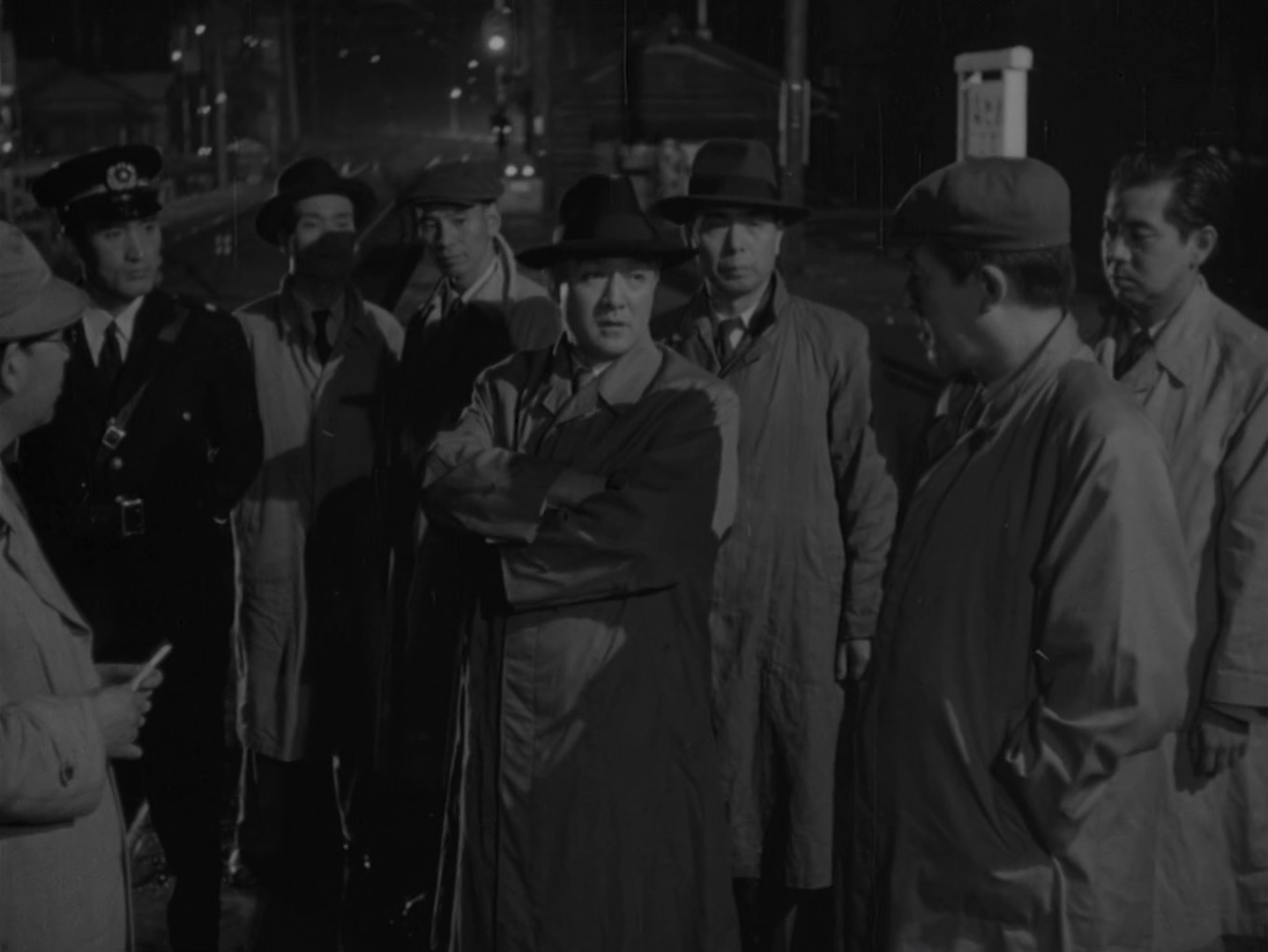
Four Hours of Terror (高度7000米 恐怖の四時間, Tsuneo Kobayashi, 1959)

It seems quite strange now to think of a time when air travel was both new and exciting and as easy as catching a bus. It’s this juxtaposition that Tsuneo Kobayashi’s hijacking thriller Four Hours of Terror (高度7000米 恐怖の四時間, Kodo Nanasen Metoru: Kyofu no Yojikan) plays with as an armed fugitive takes a passenger plane hostage in an attempt to escape after committing a murder while those on board struggle to accommodate themselves to this new form of transportation. 

This sense of exoticisation is obvious from the opening voiceover which sings the praises of Haneda airport as the gateway to a newly internationalised Japan though in actuality the flight in question is a domestic service travelling from Tokyo to Sapporo. The voiceover also introduces us to each of the passengers which come from differing strata of society and even includes a middle-aged American couple. There are in fact three generations of couples on board who seem to represent different stages of life from the newly wed students so wrapped up marital bliss that they barely notice anything else, to a long-married reporter and his wife on their first holiday together since their honeymoon, and an elderly couple returning from a trip to the capital who are mystified by this new age of mass media and air travel. The newlyweds apparently won this free trip on an aeroplane after agreeing to have their wedding broadcast on television in an early example of reality TV, reinforcing the sense of irony that they weren’t necessarily supposed to be on this doomed flight after all. 

Neither was car saleswoman Kazuko (Hitomi Nakahara) who has apparently been pulled away to Sapporo by a short notice business opportunity. She gets a standby ticket, as does her boyfriend/rival Fujio (Tatsuo Umemiya) who is also on track to the same opportunity. Weirdly, Kazuko is not overly sympathetic having randomly kicked a basket containing a little dog about to be smuggled on the plane by its doting owner, but does perhaps represent something of a more independent post-war womanhood even as she effortlessly deflects unwanted attentions from a client she may also have been exploiting in order to obtain his business. Having boarded the plane, she ends up sitting next to another man who requested a standby ticket and was using a surname that was the same as hers but evidently turns out to have been assumed. So lax is the security, you don’t necessarily have to travel under your legal name. In any case, she briefly flirts with him as an overture to a business relationship and also to annoy Fujio before overhearing a news report about the escaped fugitive on her portable radio.

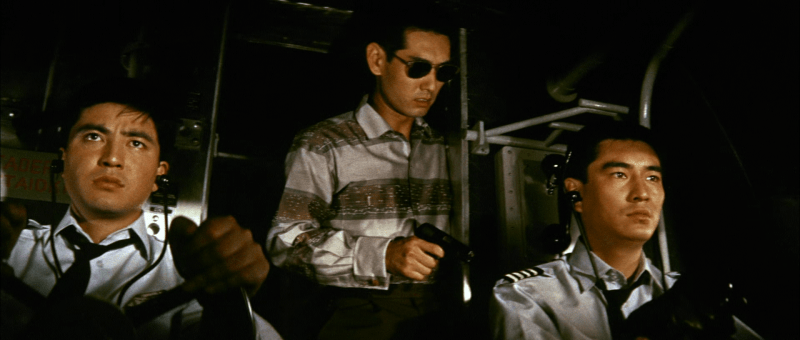
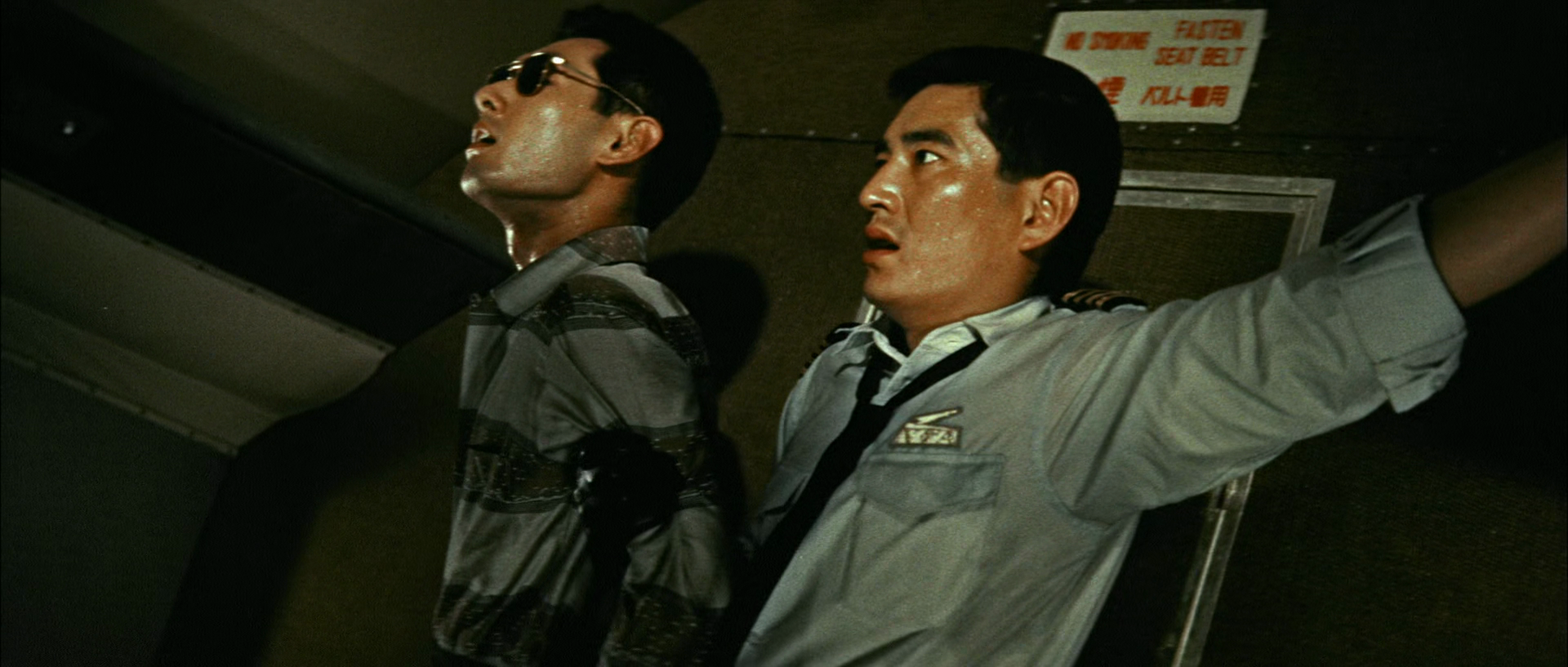
Kida (Fumitake Omura), the fugitive, is dressed like a stereotypical yakuza which makes it odd that no one treats him with suspicion until they spot he’s carrying a gun which he had no trouble at all bringing on board. Though hijackings are not exactly unheard of, they aren’t particularly common either so no one would really suppose anyone had any reason to take a domestic flight to the provinces hostage, and really that was never Kida’s intention merely a last resort after being discovered. Later he gives a partial justification for his life of crime in that his mother beat him and then threw him off a cliff which is why he has a false leg. In any case, there’s a small moment of potential redemption towards the end when the kindly old lady tells him he can’t undo what he’s done, but could still resolve to change assuming they all survive this difficult situation with the plane which now has mechanical problems thanks to the gun going off. 

Even so, it’s the passengers who tie Kida up after the pilot ,Yamamoto (Ken Takakura), manages to disarm him by weaponising the plane. By flying to a high altitude, they knock him out with the air pressure, but are then faced with the mechanical failure of the landing gear which seems to be linked to with Yamamoto’s wartime trauma. A secondary drama revolves around his stoical character with one of the stewardesses apparently in love with him while simultaneously wary of his iciness given that he apparently showed no emotion after receiving the news his wife had passed away but simply flew the plane home as normal. Some see this as his devotion to the aircraft which is in a way a commitment to his duty over his human feelings, the factor that perhaps allows him to save the plane and get the passengers home safely. He is however saved by his love for his late wife with the cigarette case that contains her photo saving him from the worst effects of a bullet. 

The same may go for the co-pilot Hara (Kenji Imai) who is dragging his feet over his marriage to Yamamoto’s sister because he wants to achieve 3000 flight hours before getting married so he can call himself a real pilot. Though the film plants the seeds of these random plot threads and the social commentary that goes with them, it does not particularly engage while the hijacking itself remains fairly low key given that Kida is not a particularly “bad” bad guy. He just wants to go to a random place where the police won’t be waiting for him, but otherwise refrains from harassing the passengers save threatening a little boy travelling on his own to return to his parents after visiting his grandfather in Tokyo. In essence, there’s a kind of innocence and naivety in play which speaks to something of post-war hopefulness and a wonder in the frantic pace of progress in which the day is saved by keeping calm and carrying on even in the face of severe adversity.


Trailer (no subtitles)

The Deep Blue Sea (青い海原, Tsuneo Kobayashi, 1957)

Deep Blue Sea posterHibari Misora turned 20 in 1957, but she’d already been working for eight years and was well on her way to becoming one of the most successful stars of the post-war era. The Deep Blue Sea (青い海原, Aoi Unabara) is one of her earliest grown up musical dramas and finds her sharing the bill with another of the biggest acts of the day in Hachiro Kasuga who, despite being stuck in second lead limbo, does the bulk of the musical heavy lifting. It also sees her star opposite an actor who would become her frequent leading man which might come as something of a surprise to those most familiar with his later work – Ken Takakura, then very fresh faced and playing the juvenile lead.

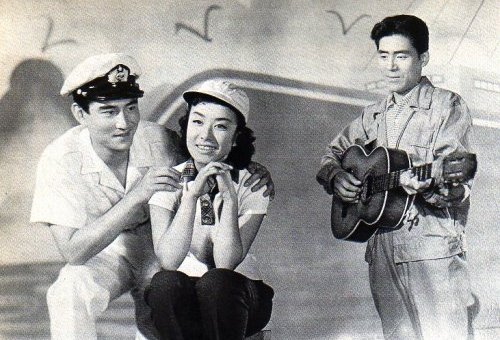
The action begins with Takakura’s Ken as the stranger who walks into town. In fact he’s not that much of a stranger – he runs into an acquaintance, Saburo (Hachiro Kasuga), right away, but he’s come on a mission. He’s looking for the friend of a man who died in an accident on his boat in order to give him a photograph and some money he’d saved for the daughter he had to leave behind. Before any of that happens, however, he ends up in a meet cute with Misora’s Harumi who manages to tip a whole bucket of water over him, and then later a jug of beer when he fetches up at the bar where she works (and where Saburo is a regular). As coincidence would have it, the man Ken is looking for also lives at the bar and is actually Harumi’s father. Harumi never knew she was adopted and is stunned when she overhears the conversation between the two men but decides to go on pretending not to know anything.

The real drama revolves around a lecherous gangster, Sakazaki (Isamu Yamaguchi), who is having an “affair” with the owner of the bar where Harumi and her dad live. He’s taken a liking to Harumi who wants nothing to do with him, but when her dad gets into an accident and needs money for medical treatment, Saburo makes a deal and unwittingly gives him an additional angle to start railroading Harumi into his arms.

Director Tsuneo Kobayashi would later be best known for genre pieces and tokusatsu. Besides some quite beautiful and unusually convincing work with backdrops, there are no shocks or special effects in Deep Blue Sea but there is plenty of music, most of it sung by Hachiro Kasuga with Misora taking centre stage for a few solo numbers of her own as well as humming an odd tune here and there. Despite not being an integrated musical (all of the songs have a diegetic genesis) and in contrast with many of Misora’s films, The Deep Blue Sea is otherwise a fairly typical musical drama in which the songs drive the narrative rather than being an aside to it.

It does however begin to blur genres, shifting into familiar Toei territory with the introduction of the sleazy yakuza tough guys who are willing to go to quite a lot of trouble to ruin the life of an ordinary girl like Harumi. The central romance follows a familiar pattern as Ken comes to care about Harumi and her dad through his connection with her birth father and becomes their noble protector, while Saburo, who’d silently harboured a crush on Harumi all along hovers sadly on the sidelines, wanting to support his friends in their romantic endeavour but also somewhat grateful when Ken decides to sacrifice himself on Harumi’s behalf. Ken’s sacrifice, however, doesn’t entirely work – you can’t get rid of men like Sakazaki through honest or logical ways and simply paying them off is never enough, in fact it might just make everything worse.

The Deep Blue Sea may be a little darker than most musical romances with its seedy port town setting, gangsters, smuggling action, and the constant sense of things always floating away with the boats that come and go, but in true musical fashion it all works out in the end. Despite learning that she is adopted and that a wealthier blood relative was keen to take her in, Harumi chooses to stay with her adopted father, steadfastly choosing real feeling over blood ties or pragmatic concerns – unlike the greedy bar owner who steals the money her father left her, or the nefarious gangster who tries to manipulate her into giving up her principles and stepping into his world of betrayal and avarice. As usual for a Toei film, the forces of good (for a given definition of “good”) eventually triumph and the bad pay for all their mistakes while the merely unlucky accept their fates with good grace and resolve to make the most of new opportunities. It may not have made any great waves, but The Deep Blue Sea is cheerful and fun and chock full of post-war humanism as the noble Ken comes to the rescue of the goodhearted Harumi and her steadfast father to stand up against the forces of corruption.


Some of Hibari’s musical numbers (no subtitles)

https://www.youtube.com/watch?v=3pInl0wDGHY