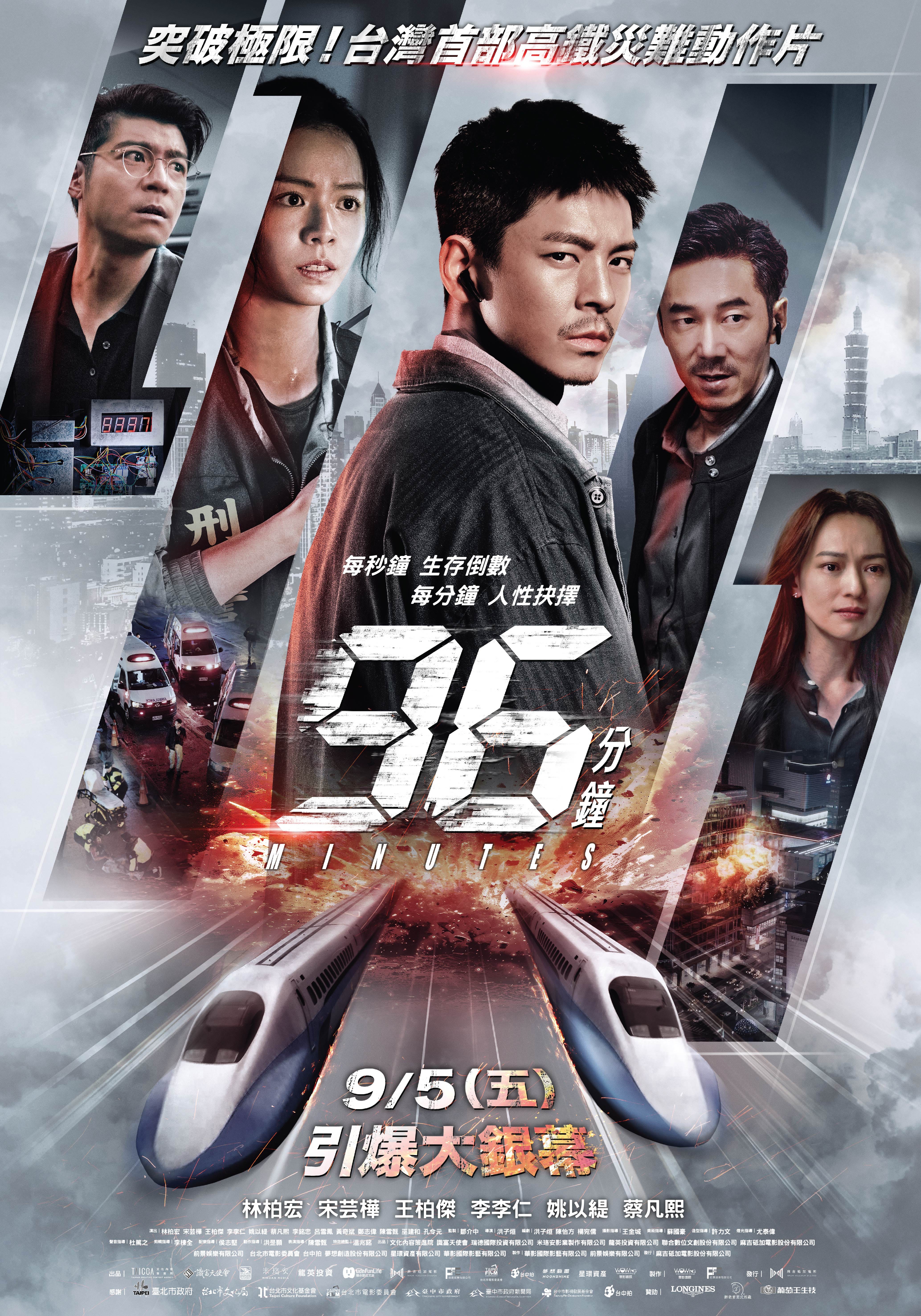
96 Minutes (96分鐘, Hung Tzu-Hsuan, 2025)

The needs of the many outweigh the needs of the few, as the famous goes. Prioritising saving lives where you can rather than risk spreading yourself too thin and not helping anyone as a result may be a sensible decision. But what if you or a loved are among those who’ve been deprioritised? Like many things, now it’s not just theory but here right in front of you and victims are real people not just anonymous numbers, it looks quite different.

At least, that’s how it is for A-Ren (Austin Lin), a brash bomb disposal expert. Though he disarmed a bomb in a cinema, another one went off across the road in a department store. The bomber had warned them that might happen, but A-Ren’s commanding officer Liu (Wang Bo-Chieh) convinced him they were probably bluffing. They were told there were two more bombs, one located in their command centre, and the other in the department store, and given a choice. Save the people in the department store by heroically blowing themselves up, or choose to save themselves even though this time they’re in the minority. 

Three years later, A-Ren has never forgiven himself, or Liu, for the bomb going off. He’s quit the police and though he’s married fellow officer Huang Xin (Vivian Sung), they never had a wedding and still haven’t been on honeymoon. His guilt is compounded by the fact that he’s been feted as a hero even though he knows he’s directly responsible for everyone who died in the department store. He gets a shot at redemption when the train he’s travelling on returning home after a memorial service for victims of the bombing receives a bomb threat, but at the same time he fears the eventual exposure of what really happened three years ago and is too ashamed to get his mind fully on the job.

On the other hand, it’s true that, ironically, no one on the train has been able to move on from the incident. All of them are mired in their grief and confusion, while looking for someone to blame. Needing to solve the case quickly, the police named a random victim with a criminal past as the bomber rather than admit they didn’t know who did it, making the police themselves a legitimate target for the resentment of the victims’ families given their cavalier attitude to life and death. Liu reminded A-Ren that the policemen in the command centre had families too, as if the people in the department store didn’t or that having a family made their lives weigh more, while Huang Xin was there too further influencing their decision and feeding into A-Ren’s guilt wondering if he was just selfish and made a choice to save her at the expense of the lives of a large number of people he didn’t know.

The bomber essentially gives him the same choice again, putting two bombs on two trains and leaving A-Ren with a binary choice of choosing to sacrifice one or the other to see if he will make the same hypocritical decision again in opting to save the minority because he is among them. Of course, they try a number of other high-risk strategies to disarm both bombs and/or evacuate passengers, but the bomber leaves them with little choice other than to accept the fact that one of the bombs has to go off. A-Ren and Liu can either blow themselves up figuratively by admitting that they chose to sacrifice the lives of the department store victims, or they can save themselves by blowing up the other train.

During a train derailment incident, Liu had cited his greater good philosophy in prioritising passengers who remained outside the tunnel rather than those trapped in the carriages inside, but he perhaps he was wrong to do so and should either have made more of an effort to help everyone or refrained from announcing his decision to let some of the victims die live on television. But then again, the victims’ families are also torn now they are directly involved with some leaning towards saving themselves rather the passengers on the other train whom they don’t after all even know. A-Ren, meanwhile, is in a race against time to restore his sense of integrity by disarming the bombs inside his mind to cure the lingering trauma of the department store bombing as the train rockets forward with only him between it and certain destruction.


96 Minutes screened as part of this year’s LEAFF.

Trailer (Traditional Chinese / English subtitles)

My Heavenly City (我的天堂城市, Yu Sen-I, 2023)

After taking a job as an interpreter working with the social and courts systems, overseas student Mavis (Vivian Sung) sits under a sign at centre for teens reading “you are not alone.” As she reveals to her client, alone is something she’s often felt while living in New York where everyone has “people to see, things to do, and homes to go to” while she feels herself in limbo with nothing and no one to turn to for support. Inspired by her own experiences, director Yu Sen-i’s My Heavenly City (我的天堂城市, wǒ de tiāntáng chéngshì) explores both the freedom and loneliness that can come with living abroad through the stories of three Taiwanese migrants who share unknown connections. 

Mavis is nursing heartbreak and finding it difficult to concentrate on her studies while her money runs out and she feels as if she isn’t getting anywhere. When an opportunity teaching Mandarin to the son of a Taiwanese-American couple falls through, she applies for a job as an interpreter but soon discovers that it requires more than language skills not least because many of the cases she’s called in on are emotionally difficult. Though reminded that an interpreter should maintain a professional distance and avoid becoming friends with a client, she can’t help bonding with 16-year-old Xiao Jian. Suspected of having come to the US undocumented, Xiao Jian was found wandering around alone in Bryant Park and is refusing to speak. 

What Mavis discovers is that she can’t really help him and no one wants to hear what he’s got to say anyway but in any case she comes to see him as a mirror for herself, another lost soul struggling to find a footing in the city. The same is true of street dancer Jack (Keung To) who is conned out of money by duplicitous locals but bonds with a young woman from Singapore, Lulu (Jessica Lee), who hoped that she’d find herself in New York but discovers only more lonely rootlessness and uncertainty. Even her connection with Jack is threatened by looming visa issues. Even so, in New York, Jack discovers greater freedom to be himself in embracing his love of dance if fulfilling parental expectation by continuing to study computer science.

Jack describes his mother’s micromanaging as oppressive, and is relieved to be if not freed from it that at least at a greater distance. These differing ideas of parenthood are also beginning to erode the relationship between successful architect Jason (Jack Yao), who came to the US 20 years previously, and his Taiwanese-American wife Clare (Mandy Wei) who struggles to deal with her own fiercely authoritarian father. The couple have a son, Jasper, who is autistic and also has emotional problems that have resulted in problematic violence that echoes a case that Mavis was brought in on of domestic abuse. Only nine years old, Jasper explains that he gets “very, very angry” when frustrated and it seems that he may not be well suited to busy city life. Clare’s father doesn’t believe in mental illness and assumes it’s discipline issue, believing that Clare and Jason are at fault for spoiling him rather than correcting his behaviour.

The conflict may echo a cultural divide between the authoritarian patriarchy of traditional culture and the aspirations of Clare who says she wants to try a new parenting style founded on love, but the fundamental problem for the family is in effect and absence of the father. The economic demands of living in an expensive city have forced Jason to abandon his family while he also seems unprepared to deal with Jasper’s complex needs and leaves everything to Clare who is then overburdened on the brink of burn out. Jasper’s increasing volatility and its effects on his mother finally convince Jason that he must find a way to rebalance his commitments and be emotionally, rather than just financially, present in the family and in his relationship with Clare.

A final visit to a lost and found office echoes the sense of displacement each of them feel but also what they discover in the city and the connections they make there whether they plan to stay or not. Though it may sound bleak in its exploration of the difficulties of living in an unfamiliar culture, the film discovers a sense of serenity in the improbably sunny city that cuts through its shadows and offers an unexpected of connection between its melancholy exiles. 


My Heavenly City opens in UK cinemas on 10th November courtesy of CineAsia.

Original trailer (Traditional Chinese & English subtitles)

Nina Wu (灼人秘密, Midi Z, 2019)

Nina Wu poster 1“They’re not just destroying my body but my soul” complains an exploited woman in a film within a film, “I’ll do something you’ll all regret” she adds, only the actress never will. Penned by leading actress Wu Ke-xi, Nina Wu (灼人秘密, Zhuó Rén Mì) provides a timely exploration of the gradual erasure of the self the pursuit of a dream can entail in a fiercely patriarchal, intensely conservative culture. Arriving in the wake of the #metoo scandal the film goes in hard for industry exploitation but never tries to pretend that these are issues relating to the film industry alone or deny the various ways it informs and is informed by prevailing social conservatism.

Originally from the country, the titular Nina Wu (Wu Ke-xi) has been in Taipei for eight years trying to make it as an actress but is still awaiting that big break. Aside from some small bit parts and commercial jobs, she supports herself by working in restaurants with a side career as a live-streaming webcam star. Then, just as she’s starting to think it’s too late, a call comes through – she’s in the running for the lead in a high profile period spy thriller. The only snag is that the part requires full frontal nudity and explicit sex scenes.

Nina is understandably conflicted. Aside from the potential discomfort, taking a part in the kind of film this could turn out to be is a huge gamble that could either make or break her career (just look at what happened to Tang Wei after Lust Caution, itself a period thriller about a female assassin who falls for her target). Nina’s unsympathetic agent skirts around the fact this might be her last chance while promising to respect her decision, implying it’s this or nothing. Of course, neither he nor the sleazy director inviting parades of identically dressed hopefuls up to his hotel room where he forces them to engage in dubious acts of degradation for his own enjoyment will admit that the reason they want a “fresh face” isn’t for any artistic motivation but that no well established actress with a proper agent would ever take a role like this (and even if she did, she couldn’t be pushed around in the same way).

Convincing herself to do whatever it takes, Nina takes the part but goes on to suffer at the hands of a controlling and tyrannical director who psychologically tortures and physically abuses her supposedly in order to get the performance he wants rather than the one she chooses to give him. A repeated motif sees hands continually around Nina’s throat as if she were being permanently strangled, unable to speak or express herself, permitted breath only when compliant with the desires of men.

Subsuming herself into the part, Nina avoids having to think about the various ways her offscreen life is also a performance or of her own complicity in the erosion of her emotional authenticity. A visit home reveals a difficult family environment with a father (Cheng Ping-chun) losing out in the precarious modern economy, while she, now the “famous actress”, wonders if she was happier as an am dram bit player staging inspirational plays for children. The secret she seems so desperate to conceal seems to be her same sex love, sacrificed for a career in Taipei and now perhaps unsalvageable. Her lover has moved on, preparing to marry a man and embark on a socially conventional life. If she too has made her peace with sacrificing a part of her true self, she does at least seem superficially “happy” in contrast to Nina’s gradually fracturing psyche.

Meanwhile, Nina becomes paranoid that a mysterious woman is stalking her. Apparently another hopeful also driven mad by the demands of an exploitative industry, the woman is convinced Nina has taken what was rightfully hers and done so by selling her body for career advancement. Yet as time goes on we begin to wonder if the film ever happened at all or is only a part of Nina’s fabricated delusion sparked Marienbad-style by the single traumatic event on which the film ends, filled as it is with a lingering sense of tragic defeat. Nina Wu never takes her longed for revenge, even if she (perhaps) gains it in a kind of success, but silently endures as the misuse of her body begins to destroy her soul and leaves her nothing more than an empty vessel on which the desires of others are projected.


Nina Wu was screened as part of the 2019 London East Asia Film Festival.

Original trailer (English subtitles)

Take Me to the Moon (帶我去月球, Hsieh Chun-Yi, 2017)

take me to the moon posterShould you continue pursuing your dreams even after you know they won’t come true or just give in and live a dull but comfortable life of conformity? These are questions most young people face at one time or another, but for the hero of Hsieh Chun-Yi’s Take me to the Moon (帶我去月球, Dài Wǒ Qù Yuèqiú), they take on an extra dimension when he is suddenly thrown back into the past with an opportunity to “save” the life of a friend if only he can convince her to abandon her dreams of stardom and stay home instead. A melancholy nostalgia fest for late ‘90s Taiwan (and the late ‘90s in general), Take me to the Moon is an ode to lost opportunities, words unsaid, and the immutability of the past which nevertheless makes room for the odd miracle or two as its hero realises perhaps he’s not grown up as much as he thought.

Three years prior to the main action, 30-something Wang (Jasper Liu) takes a business trip to Tokyo where he reconnects with high school friend Emma (Vivian Sung) who won a prestigious competition to go to Japan and train with a big idol producer. Sadly, Emma’s dreams have not panned out and she’s embarrassed to let her old friend see just how badly things have been going for her. Fast-forward three years to the present and Emma has unfortunately passed away at only 38 after years of hard drinking in hostess bars, poor nutrition, and overwork finally caught up with her. The once tight group of high school bandmates, two of whom have become a married couple, argue over their collective failure to save their friend at which point Wang walks out, meets a weird old woman who gives him some strange flowers, and is knocked over by a car only to wake up back in 1997. Desperate to save Emma, Wang thinks his best bet lies in ruining her chance to go to Japan so that she will never experience the failure of her hopes and dreams and will stay home to live a simpler, safer life.

Filled with a youthful nostalgia and feeling of authenticity, Take me to the Moon makes the most of its ‘90s setting, recreating the late 20th century city through impressive CGI. Wang reacquaints himself with his teenage self, retrieving his well hidden box of tame pornography and enjoying another few bowls of his mother’s delicious fish soup, but his main goal is essentially to ruin the dreams of his friend – an act of betrayal which might be in her interest, but then again it isn’t Wang’s choice to make and perhaps Emma would rather follow her heart even if it means it’s going to get broken.

What Wang eventually realises, as one of the Tom Chang tracks which pepper the narrative points out, is that what he should have been treasuring was the extra time spent with friends rather than worrying about the future. Back in his teenage years Wang was too shy to confess his lifelong crush on Emma and then went on to be plagued by classic bad timing in adulthood until finally it was too late. His attempts to “save” Emma by ruining her life are in part selfish but also cowardly in taking the place of simply saying the things he needed to say at the right time. Finally figuring this out, Wang realises that he can’t “save” Emma like the hero of a time travel movie by manipulating the past, but he has been given a second chance to let her know how he felt. This, in the end, is what may finally, really “save” his friend – simply letting her know that he is there supporting her, that she’s fine as she is and doesn’t need to be “perfect” to be loved as her overbearing parents have led her to believe.

Though Wang awakens to a more positive change than he might have expected, the general idea is that you can’t rehash the past and should make sure that you’re happy with your present to avoid the desire to try. Having given up on his youthful dreams for a lonely corporate existence, middle-aged Wang regains a little of his essential self and decides to fight for a more authentic way of life even if it doesn’t really go anywhere. Warm and fuzzy yet also strangely melancholy, Take me to the Moon is another in a long line of Taiwanese high school nostalgia movies but proves a fitting tribute both to its era and the singer songwriter featured throughout who himself died young in a tragic car accident in 1997 aged just 31.


Screened at the 20th Udine Far East Film Festival.

Original trailer (English subtitles)

Original 1997 music video for Tom Chang’s Take Me to the Moon