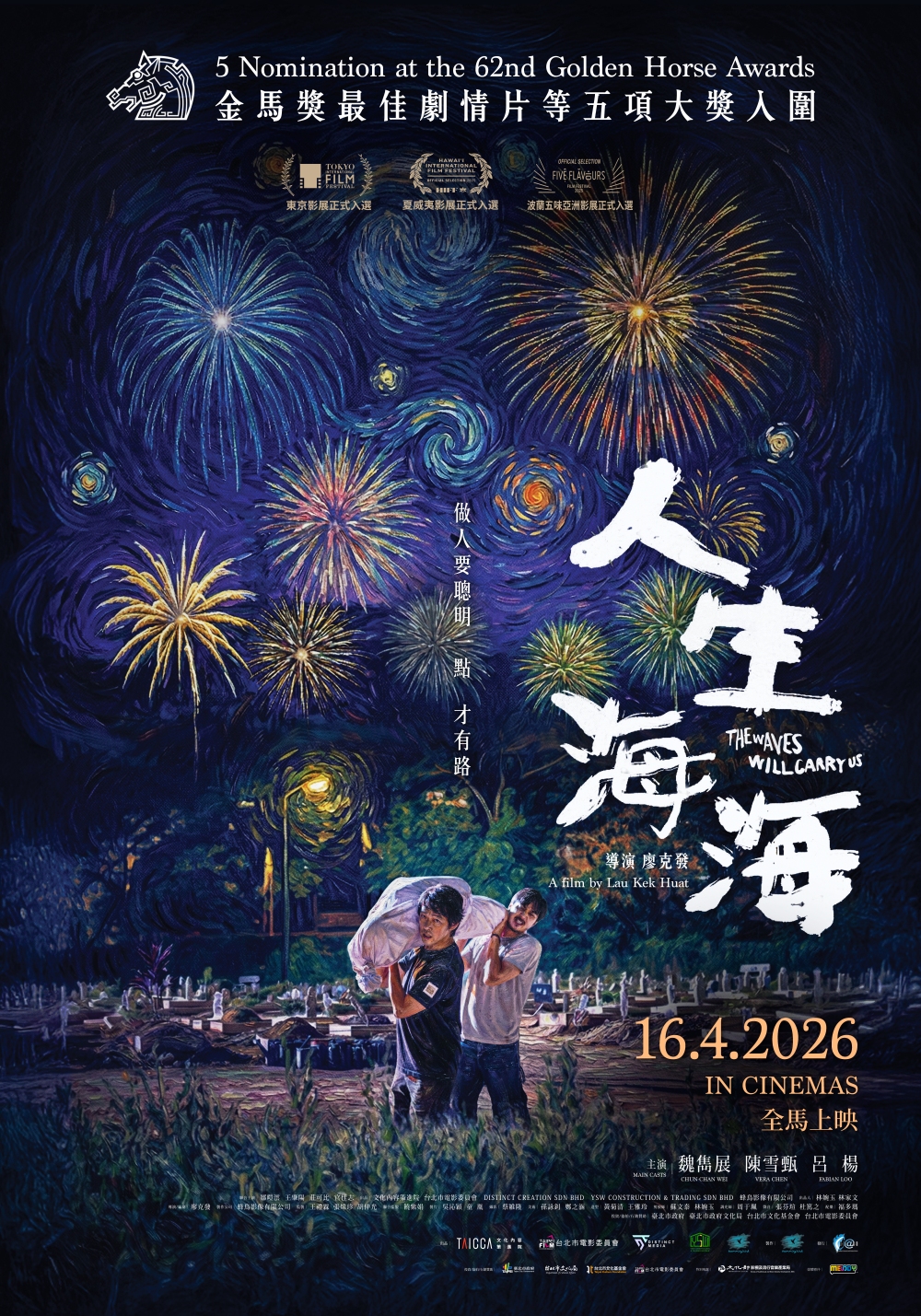
The Waves Will Carry Us (人生海海, Lau Kek-huat, 2025)

Yao explains to a wealthy couple in Taiwan how they can change their nationality to preserve their wealth, “investing” in another country in order to buy citizenship to a place that has a taxation system that is more advantageous to their circumstances. But the people he’s talking to remark on his accent and after learning he came from Malaysia jokingly tell him that he passes himself off as Taiwanese quite well with the implication being he’s deceived them in some way, while it’s ironic that someone who’s immigrated to Taiwan is helping them “emigrate” from it.

This seems to upset Yao a little bit. Just as it does when he goes to donate blood with some Taiwanese friends, but is refused because he comes from a “high-risk area”. He points out that they might not reject someone from Europe or America in the same way as someone from South East Asia, while this very denial of his blood seems to suggest that it’s not possible for him to ever be “Taiwanese” no matter no long he might have lived there. Any children he might have would not really be either. Lau Kek-huat’s The Waves Will Carry Us (人生海海, rénshēnghǎihǎi) jumps back over a hundred years to ask what really is a “homeland” and what meaning there is in this world of borders and documentation that take questions of identity and belonging out of the individual’s hands.

Yao came from Malaysia, but as a member of the ethnic Chinese community, he isn’t completely accepted there either. His grandfather came as a child from China, but when independence was granted, he was excluded from citizenship applications because he did not speak Malay and risked losing his land and farm as an undocumented person. He had come there with his uncle who dreamed of untold riches in South East Asia, but found only hard work and dire conditions. Before they left, their relatives had performed a ritual which taught them never to become “barbarians” or risk losing their way home. Quan and his uncle keep their hair in pigtails despite the mocking of those around them and are discouraged from eating the local durian fruit which becomes a favourite of Yao’s father. 

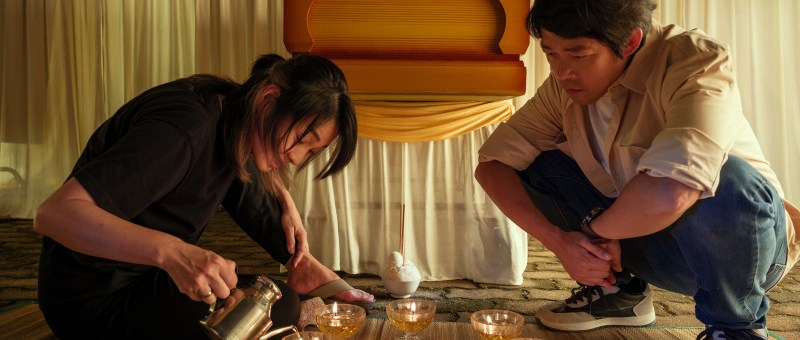
Yet when government officers march into his father’s funeral for which his sister has splashed out on a traditional Taoist burial suit, he learns his father secretly converted to Islam and must be laid to rest in the Muslim burial ground having undergone an Islamic funeral. As he says to his brother Cai who is an activist protesting the corrupt government, it is easier to be a Muslim in this society. You can get cars and loans more easily, not to mention have multiple wives. The government officer looks at him with similar suspicion to the Taiwanese couple, claiming that he understands the “Chinese mindset,” and is sick of people who convert to Islam for purely cynical reasons and never practise the religion. This is what you get, he seems to say as he rejects Yao’s attempts to bribe him and confiscates his father’s body.

It turns out that the reason may not have been so cynical after all, but nevertheless the family is forced through the farce of burying a doll in order to complete the Taoist funeral rites without which they cannot really lay their father to rest. Yao’s and Cai’s mad decision to exhume him from the Muslim burial ground is then an attempt to bring him “home,” though the concept is one that’s in other ways constantly shifting. Yao’s niece asks her mother where Yao’s “home” is now, though the answer they come up with is only that home is wherever he is. That the body ends up getting lost is an indication of its statelessness but also a restoration of freedom in being uncoupled from the notion of national identity. 

Still, young Quan wondered if the stars here were the same as they were back home or if they’d travelled so far the ancestors could no longer protect them. Everyone must find a way to survive, Yao’s father had told him, though his brother Cai may think he’s coward for going to Taiwan rather than staying in Malaysia and trying to make things better like he is with the protest movement. The irony is that their father died on Independence Day draped in a Malaysian flag, while they later use it as a bandana to cover their faces when confronting the police as they try to rescue their father’s body only to enter another kind of in between space, if one in which they are freer to claim their own identity.


The Waves Will Carry Us screened as part of this year’s CinemAsia Film Festival.

Trailer (English subtitles)

Nina Wu (灼人秘密, Midi Z, 2019)

Nina Wu poster 1“They’re not just destroying my body but my soul” complains an exploited woman in a film within a film, “I’ll do something you’ll all regret” she adds, only the actress never will. Penned by leading actress Wu Ke-xi, Nina Wu (灼人秘密, Zhuó Rén Mì) provides a timely exploration of the gradual erasure of the self the pursuit of a dream can entail in a fiercely patriarchal, intensely conservative culture. Arriving in the wake of the #metoo scandal the film goes in hard for industry exploitation but never tries to pretend that these are issues relating to the film industry alone or deny the various ways it informs and is informed by prevailing social conservatism.

Originally from the country, the titular Nina Wu (Wu Ke-xi) has been in Taipei for eight years trying to make it as an actress but is still awaiting that big break. Aside from some small bit parts and commercial jobs, she supports herself by working in restaurants with a side career as a live-streaming webcam star. Then, just as she’s starting to think it’s too late, a call comes through – she’s in the running for the lead in a high profile period spy thriller. The only snag is that the part requires full frontal nudity and explicit sex scenes.

Nina is understandably conflicted. Aside from the potential discomfort, taking a part in the kind of film this could turn out to be is a huge gamble that could either make or break her career (just look at what happened to Tang Wei after Lust Caution, itself a period thriller about a female assassin who falls for her target). Nina’s unsympathetic agent skirts around the fact this might be her last chance while promising to respect her decision, implying it’s this or nothing. Of course, neither he nor the sleazy director inviting parades of identically dressed hopefuls up to his hotel room where he forces them to engage in dubious acts of degradation for his own enjoyment will admit that the reason they want a “fresh face” isn’t for any artistic motivation but that no well established actress with a proper agent would ever take a role like this (and even if she did, she couldn’t be pushed around in the same way).

Convincing herself to do whatever it takes, Nina takes the part but goes on to suffer at the hands of a controlling and tyrannical director who psychologically tortures and physically abuses her supposedly in order to get the performance he wants rather than the one she chooses to give him. A repeated motif sees hands continually around Nina’s throat as if she were being permanently strangled, unable to speak or express herself, permitted breath only when compliant with the desires of men.

Subsuming herself into the part, Nina avoids having to think about the various ways her offscreen life is also a performance or of her own complicity in the erosion of her emotional authenticity. A visit home reveals a difficult family environment with a father (Cheng Ping-chun) losing out in the precarious modern economy, while she, now the “famous actress”, wonders if she was happier as an am dram bit player staging inspirational plays for children. The secret she seems so desperate to conceal seems to be her same sex love, sacrificed for a career in Taipei and now perhaps unsalvageable. Her lover has moved on, preparing to marry a man and embark on a socially conventional life. If she too has made her peace with sacrificing a part of her true self, she does at least seem superficially “happy” in contrast to Nina’s gradually fracturing psyche.

Meanwhile, Nina becomes paranoid that a mysterious woman is stalking her. Apparently another hopeful also driven mad by the demands of an exploitative industry, the woman is convinced Nina has taken what was rightfully hers and done so by selling her body for career advancement. Yet as time goes on we begin to wonder if the film ever happened at all or is only a part of Nina’s fabricated delusion sparked Marienbad-style by the single traumatic event on which the film ends, filled as it is with a lingering sense of tragic defeat. Nina Wu never takes her longed for revenge, even if she (perhaps) gains it in a kind of success, but silently endures as the misuse of her body begins to destroy her soul and leaves her nothing more than an empty vessel on which the desires of others are projected.


Nina Wu was screened as part of the 2019 London East Asia Film Festival.

Original trailer (English subtitles)