
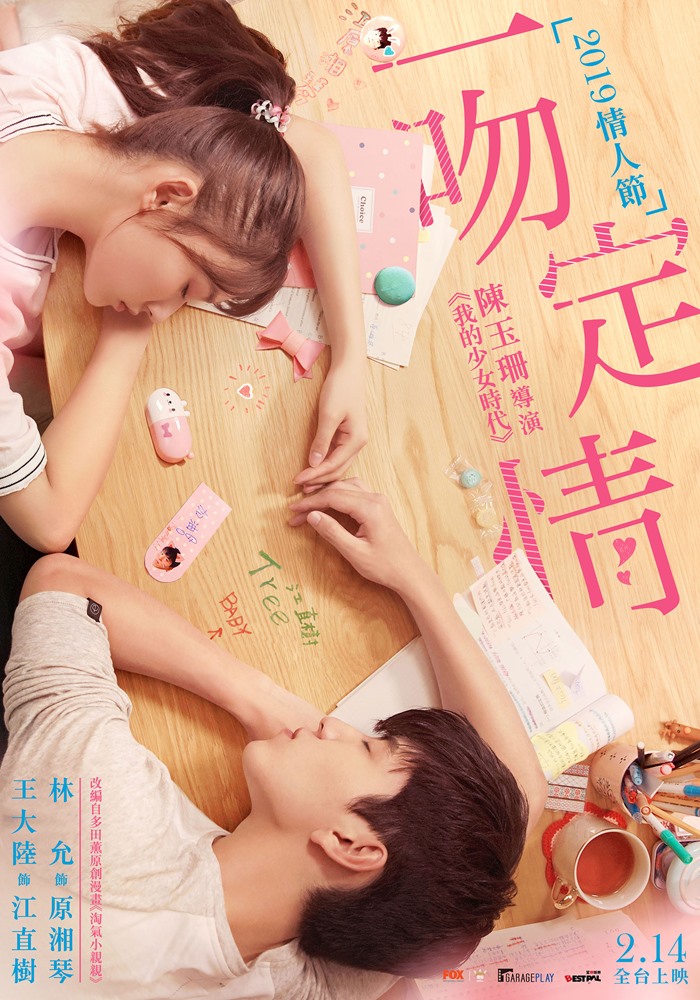
 Our Times’ Frankie Chen Yu-Shan returns to the tricky world of high school romance with an adaptation of the perennially popular ‘90s manga, Itazurana Kiss. Fall in Love at First Kiss (一吻定情, Yī Wěn Dìngqíng) is in fact the third time the manga has been adapted in Taiwan following a hit 2005 TV drama and a remake in 2016. Updated for the present day, Chen’s adaptation retains the manga’s trademark zany humour and often questionable approach to romance but imbues it with characteristic warmth and mild social commentary.
Our heroine, Xiangqin (Jelly Lin Yun), falls hopelessly in love with high school superstar Jiang Zhishu (Darren Wang Talu) when she accidentally trips and kisses him on her first day. Zhishu is, however, somewhat untouchable to a Class F no hoper like Xiangqin – Class A students like him have their very own building inaccessible to those without the proper credentials. Despite outsmarting the system in order to hand him her letter of confession, Xiangqin is cruelly rejected with a video of Zhishu’s cool response going viral among her friends. However, when Xiangqin’s house is demolished thanks to an extremely localised earthquake, she finds herself moving into Zhishu’s family home (it turns out their dads are old friends) where she might perhaps be able to get to know him better.
Like the original manga, Fall in Love at First Kiss revolves around Xiangqin’s lovelorn existence as she becomes increasingly obsessed with her apparently unrequited love for the sullen Zhishu whose behaviour is often hard to read. Zhishu’s mother (Christy Chung), a highlight of any adaptation, is a woman much like Xiangqin which is to say extremely cute and cheerful. Having long wanted a daughter she is delighted to have Xiangqin move in with the family and is virtually painting a nursery in the hope that Xiangqin and Zhishu might one day end up together. This is however partly because she knows both her sons are objectively awful – a pair of self-centred, emotionless hyper rationalists and overachievers who might be popular thanks to their successes but have few friends owing to not being very nice. She hopes some of Xiangqin’s unsophisticated cheerfulness might help open them up to the pleasures of being alive.
Zhishu, however, blows hot and cold. He ignores Xiangqin’s attentions until the point she vows to move on, at which time he kisses her to prove that despite everything he is still the sun in her mad little solar system. This is obviously not a very healthy relationship dynamic even as it insists that Zhishu’s arrogance is part of his “cool” rather than a symptom of his insecurity. Even his final declaration of love is shot through with “you know you want me” logic rather than a heartfelt explanation of his reasoning for having been so cavalier Xiangqin’s feelings. Nevertheless, like every other “difficult” romantic hero, we eventually discover that Zhishu is just awkward rather than actually cruel as he finds himself continually conflicted in wanting to be nice to people but somehow thinking it would be inappropriate to do so.
This is largely because he and his brother are snobbish elitists who’ve been led to believe that social inequality is the proper order of things. Xiangqin, a proud Class F sort of girl, wants to show him that they are all “on the same page”, equals despite what the “rankings” might say. Nevertheless she does this in a rather odd way by remaining deferent to his supposedly admirable qualities and following him around despite his constant rejections. In any case, Zhishu’s class conflict is at the heart of his emotional repression as he struggles with his filial duty to inherit his father’s company when what he’d really like to do is become a doctor to be able to help people – a choice he doesn’t quite feel he has the freedom to make and one which feels too warm and fuzzy for the ultra-capitalist, success at all costs philosophy he seems to have been brought up with by everyone except his cheerful mother.
Sadly Zhishu does not undergo much of a humbling and remains annoyingly successful and prince-like, while Xiaoqing does not suddenly discover her own worth or another purpose in life, but they do perhaps begin to find happiness in acknowledging their fated connection. Chen keeps the increasingly absurd action grounded as time moves on at frantic pace from high school first love to awkward grown up confession but manages to find the sweetness in a sometimes problematic romance as her lovestruck heroine does not much of anything at all other than remain true to herself in order to win her man.
Currently on limited release in UK cinemas.
Original trailer (English subtitles)


 Windows on Worlds