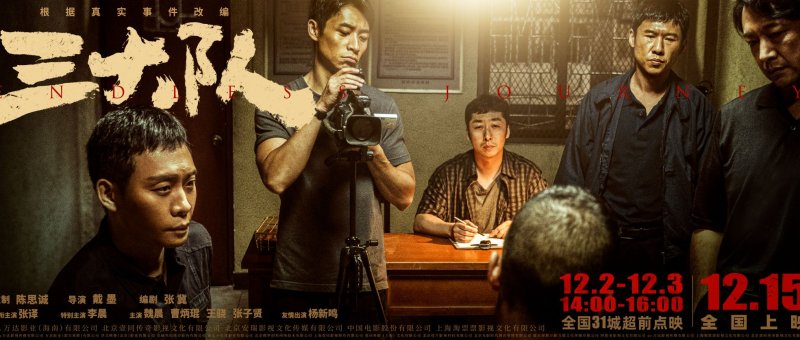
Endless Journey (三大队, Dai Mo, 2023)

The police officers at the centre of Dai Mo’s Endless Journey (三大队, Sān Dàduì) are soon stripped of their badges, accused of excessive force contravening laws existing since the medieval era to prevent vigilante justice. Yet in someways that’s essentially what they end up doing, extra-judicial investigators with a personal vendetta rather than a pure-hearted interest in justice even if the victim of the crime weighs heavily on their conscience. 

Though the film plays into the recent trend in Sino-noir and popularity of mystery thrillers at the Chinese box office, it is surprising that a film that is at least subtly critical of the justice system, featuring police who break the rules and are sent to prison, was approved by the censors board even if the central message is one of heroism as Captain Cheng (Zhang Yi) doggedly chases his suspect all over China for several years. Then again, the hero of this true life case turns out to be China itself as Cheng is reminded that his search is unnecessary given that the fugitive, Eryong (Zheng Benyu), is sure to be captured by the burgeoning surveillance network of CCTV cameras then being rolled out across the country. Years later, it’s the system that allows Cheng to identify Eryong as his DNA and fingerprints throw up positive matches within seconds of samples being taken thanks to the nation’s DNA database. 

Even so, as the veteran officer, Zhang (Yang Xinming), reminds the rookie behind every major case there’s a ruined family broken by their loss which is one reason why he doesn’t relish the prospect of investigating one so late in his career. This particular crime is so heinous that it’s become front page news which means that they’ve also got their boss breathing down their necks to get it solved as soon as possible with the existence of Division 3 itself on the line. Cheng pops home for a matter of minutes to check on his wife and daughter, shutting down his wife’s suggestion that they get a security system for their windows on the grounds that it would be an embarrassing thing for a detective’s home to have. The reason she wants one is that the victim in this case had been a little girl of around their daughter’s age unexpectedly home alone when thieves broke in by climbing over their aircon unit and smashing a window. Finding nothing of value they raped and killed the daughter. 

After a police officer dies as a result of the investigation, the squad take things too far questioning the first suspect leading to his death which is how they end up disgraced and sent to prison. After his release, Cheng has lost his family, his home, his job and identity as a protector of justice yet his determination to catch Eryong is born more of his desire to avenge a friend than it is to prevent further crime. His fellow officers join him in the beginning, but during the endless searching each make the decision to move on for easily understandable reasons such as their marriages, children, and illness but Cheng cannot let go even when prompted by an old friend from the force who tells him they have this in hand though there is perhaps a subtle implication that the police force isn’t really doing enough otherwise Cheng wouldn’t have to be chasing Eryong all over the country. 

But haunted by reflections of his own face, ageing, at times dishevelled and hopeless, Cheng is also searching for himself and a means to reclaim the self he once was by vindicating himself as a policeman along with Division 3 in finally completing their mission. The ominous score by Peng Fei with its stinging strings adds to the noirish feel as does the perpetual inevitability of Cheng’s forward motion in the dogged pursuit of his prey, unable to rest until Eryong has been brought to ground. His quest robs him of his life, but there is an undeniable poignancy to it in Cheng’s inability to find himself outside of the chase only to be left with a moment of uncertainty no longer sure who he is or where he goes now, left alone and with no sense of direction in the absence of his quarry.


Endless Journey is in UK cinemas now courtesy of CMC.

International trailer (English subtitles)

A Summer Trip (川流不“熄”, Feng Keyu, 2021)

Societal change and rising economic prosperity threaten the foundations of the family in Feng Keyu’s charmingly nostalgic intergenerational adventure A Summer Trip (川流不“熄”, Chuān Liú Bù “Xī”) elegantly lensed by Mark Lee Ping-Bing and boasting a typically whimsical score from Joe Hisaishi. In the run-up to the Beijing Olympics, the nation is in a celebratory mood but in a society where everybody works all the time something may be in danger of getting lost. Young Xiaosong (Hu Changlin) is going off the rails (in a fairly minor way) with both the school and grandpa, often left with childcare duties he feels might not quite be his responsibility, leaning towards blaming the parents who are simply not present enough in his life to be able to offer much in the way of guidance. 

A Korean War veteran, grandpa Zhang Dachuan (Yang Xinming) is beginning to feel as obsolete as the discontinued parts he needs to repair his ancient jeep. He can’t get his head round mobile phones, forever pressing hang up when he means to press answer and causing accidental offence in the process. Resenting the implication that he’s not got much to do all day, he finds himself enlisted by his overworked son to represent the family when his wayward grandson Xiaosong gets into trouble at school. This particular time, it’s apparently because he’s been bothering a female student by taking photos of her with a professional DSLR camera (the teacher later gives Dachuan an envelope to pass to his son and daughter-in-law which turns out to contain a love letter Xiaosong attempted to pass to the object of his affection). Slightly annoyed to be seeing Dachuan again instead of the boy’s parents, the teacher makes herself clear that the cause of Xiaosong’s poor behaviour and declining grades is most likely a lack of parental attention. Chastened, the parents discuss finding a cram school but nothing is really done about his problematic approach to romance, especially as they each need to return to work soon after dinner leaving grandpa sitting alone at the table. 

Perhaps strangely, Xiaosong seems to have forgotten that his grandpa even has a name, hanging up on a caller thinking they’ve got the wrong number only to realise they wanted grandpa and redial upon which Dachuan discovers that his greatest wartime friend has passed away in Beijing and the funeral is in a few days’ time. Though Xiaosong had technically been “grounded” for the summer, the idea was that grandpa was supposed to supervise him while he stayed home and studied. So begins their awkward road trip, passing first through the home of Dachuan’s daughter Ling (Dai Lele) in a town closer to the capital and a lengthy train ride away before pressing on to the city. 

As his opening voiceover explains, Xiaosong never really understood his grandfather thinking of him as a grumpy, stubborn old man stuck in the past. Yet as grandpa later sadly laments reflecting on his friend’s final days, people talk about the past a lot when they’re unhappy in the present. Everyone is always keen to pay respect to Dachuan and his wartime generation, though not all of them have good intentions such as the overfriendly young man they meet on the train who enthusiastically listens to his stories, or the older woman (He Zaifei) who reminds Dachuan of his late wife but leverages his desire to show off by getting him to pay for an expensive lunch. For his part, Dachuan resents his declining capacity and finds himself at odds with the modern world, unable to access technology or understand the changing nature of society. His quest to get to Beijing under his own steam is a way of rebelling against his age, proving he’s still capable and independent though his slightly narcissistic can-do attitude often backfires, his offer to fix a broken-down bus exposing his lack of acumen while his petulant decision to leave finds him stubbornly insisting on walking the remaining 30km to the capital. 

Highlighting the corporate obsession, meanwhile, another stranded bus passenger makes constant phone calls to his less than understanding boss to explain the delay. While Dachuan and his grandson experience set backs on the road, the boy’s father Jianguo (Tu Songyan) chases a reluctant client who won’t sign a contract and returns late to a dark and empty home while his wife (Yang Tongshu) works the nightshift as a surgeon at the hospital. Unbeknownst to Dachuan, Ling and her husband (Gong Zheng) are about to split up apparently because he spent too much time at work and the relationship has fallen apart as a result. Young Xiaosong says he wants to be a photographer to “document all the beautiful things and moments” lamenting that they never took a family photo with his late grandmother. In the absence of his father and son and forced to humiliate himself repeatedly at work, Jianguo comes to regret having deprioritised his family life and recommits himself to repairing their fractured bonds perhaps with a family holiday lamenting that they never got round to it while his mother was alive. The Olympics Opening Ceremony becomes, its own way, a second New Year with the TV broadcast taking the place of the Spring Gala as the family finally come back together again having gained new understandings of themselves and others through their various summer adventures. Society might have changed, those exciting KFC “family buckets” from the city apparently not going quite as far as you’d think, but the family can apparently still be saved with a little mutual understanding and a dose of self-reflection.


A Summer Trip screened as part of the 2021 Osaka Asian Film Festival.

Original trailer (Japanese subtitles only)

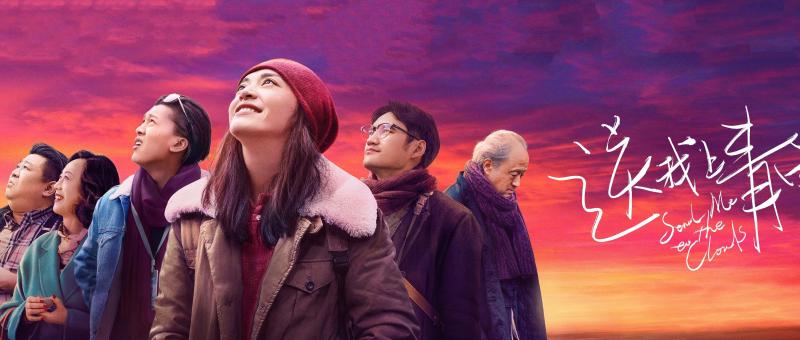
Send Me to the Clouds (送我上青云, Teng Congcong, 2019)

Send me to the clouds posterWomen hold up half the sky, Chairman Mao once said, but in contemporary China sexual equality is an unrealised dream of a previous era. The debut feature from Teng Congcong, Send Me to the Clouds (送我上青云, Sòng Wǒ Shàng Qīngyún) follows one “left-over” woman as she attempts to assert her independence in a world which still expects her to accept her subjugated position in a male dominated society by marrying and subsuming herself within a man’s career.

Ageing investigative journalist Shengnan (Yao Chen) whose name literally means “surpass men” has a cynical eye and fiercely independent nature but is struggling to make a living while protecting her integrity in an increasingly acquisitive culture. Getting kicked in the stomach by a “nutcase” while looking for evidence to support her theory that a local wildfire was started by a politician hoping to capitalise on successfully putting it out forces her to make a long delayed trip to the doctor who tells her that the pain in her abdomen is a result of advanced ovarian cancer and that she needs expensive surgery as quickly as possible.

As she’s been keen to ensure she acts ethically, ready money’s something Shengnan doesn’t have a lot of. Confiding in her cynical, ambitious best friend Simao (Li Jiuxiao) who has no such scruples, Shengnan finds him unwilling to help because, after all, there’s a chance Shengnan might die anyway which would mean it’s a bad investment because she won’t be able to pay him back. He does, however, offer her a job ghostwriting an autobiography for the eccentric father of the local official she was just in the business of exposing for shady double dealing. Understandably she doesn’t want to take the job and decides to try asking her parents without disclosing what the money’s for. Shengnan’s skeevy industrialist father (Shi Qiang), however, is currently losing out in the precarious Chinese economy and actually deigns to ask Shengnan for a loan before she can even broach the subject leading to a spiky father daughter argument. Shengnan has to take the job and throw her lot in with Simao even if she doesn’t feel quite right about it.

Simao cynically affirms that a problem which can be solved with money isn’t a problem, but unlike Shengnan he has no qualms about bowing before power if he feels there’s something to be gained by it. Shengnan nearly blows the gig when she takes offence to the official’s extremely condescending attitude but does after all have little choice given that her life is on the line. Meanwhile, the job is further complicated by the unexpected arrival of her mother (Wu Yufang) who decides to tag along while feeling neglected seeing as her now estranged husband is having yet another affair leaving her entirely alone in a culture which expects women to go back in their boxes until the menfolk want to take them out.

Shengnan and her mother come from very different generations, but in essence not much has changed. Shengnan’s mother married young and had her only daughter at 19 only to see her husband tire of her and the deeply entrenched idea that a woman’s career is a home and family exposed as a fallacy. Shengnan meanwhile was born during China’s reformist period and told that she had total equality only to be frequently criticised for her “manliness” in her desire to assert her independence. On visiting the doctor she displays worryingly little awareness of her health in her confusion regarding the cause of her cancer, stating that her love life ended years ago, but even if she’s quick to roll her eyes at Simao’s insensitive story about a woman who had the surgery and found it ruined her sex drive eventually decides she’d like to have one last hurrah with someone she really likes only to have her proactive stance on female desire rejected as unfeminine.

Yet this hyper capitalistic, intensely sexist environment is also harming men as Shengnan discovers in her unsatisfying encounters both with Simao and with a philosophical photographer she meets on a boat. Shengnan develops an attraction for Guangming (Yuan Hong) because of his softness and seeming desire to see further than others but eventually he disappoints her, trapped as he is by a hierarchal system to which he can offer only token resistance while hating himself for his cowardly complicity. Simao meanwhile has jumped headlong into the consumerist dream, obsessed with getting rich and not particularly caring what he has to do to make that happen.

The most meaningful connection Shengnan makes turns out to be with the subject of her biography, a randy 80-year-old poet (Yang Xinming) who quickly sets about romancing her mother with a series of cryptic text messages. The old man knows his son is a “complete moron” and even changed his name to something bland and commonplace so that the police might arrest someone else by mistake if he got caught while committing a crime, but has a sort of exasperated love for him and for the world that transcends his failing body and worldweary philosophy. Thanks to his refreshing earthiness, Shengnan starts to see a way forward, once again claiming her independence and resolving to live her life in the way she chooses for as long as it lasts while the men around her largely crumble under the weight of social expectations and a rampantly capitalist society.


Send Me to the Clouds  was screened as part of the 2019 London East Asia Film Festival.

International trailer (English subtitles)