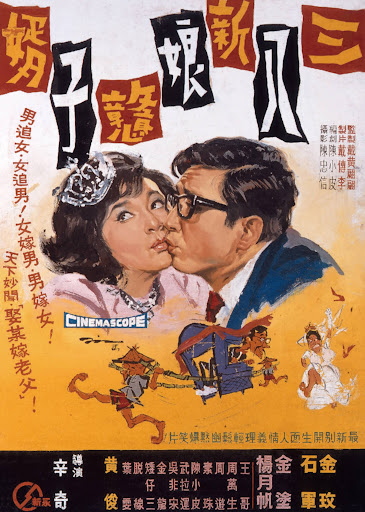
Even in the Taiwan of 1967 things were changing but not perhaps as quickly as elsewhere. Hsin Chi’s delightful “taiyupian” Taiwanese-language screwball rom-com Foolish Bride, Naive Bridegroom (三八新娘憨子婿) is a fairly late take on the arranged marriage vs love match debate which, perhaps surprisingly given the increasing conservatism of the era, comes down firmly on the side of the youngsters’ right to choose even while subtly poking fun at them for being naive and irresponsible, unable to forge independent lives for themselves and expecting the older generation to fix their mistakes while the parents eventually soften and in a sense free themselves from the oppressive values which defined their youths.
As the film opens, grumpy father A-Kau (Chin Tu) is complaining that his pot is already boiling but his son Bun-ti (Shih Chun) has not yet returned with the rice he sent him out to get. That’s because Bun-ti has taken the opportunity of the errand to meet up with his girlfriend, Kui-ki (Chin Mei), who is also out on an errand having been sent grocery shopping by her mother (Yang Yue-fan). The pair can only meet on occasions such as these because their overly possessive parents refuse to let them leave the house without good reason and firmly disapprove of romantic relationships.
In an amusing reversal of accepted gender norms, it’s A-Kau who plays the wounded widower, afraid that some young woman is coming to steal away his son and then there’ll be no one to look after him. Nevertheless, he’s simultaneously proud of his son’s popularity with the opposite sex despite describing him as having a “ladies curse” which he attributes to a constant need for female affection caused by the early death of his mother when he was only a few months old. In a running gag, the house is frequently beset by the young women of the neighbourhood pushing notes through the window and demanding to see the handsome young man. A-kau’s solution is to literally shut his son away by having the windows boarded over despite the carpenter’s cautioning that most people are looking for more ventilation, not less.
Kui-ki’s mother, by contrast, is a much feistier figure directly telling her daughter that she’s no wish to meet her boyfriend because marriage is a matter for the parents. A-Kau later says something similar, concerned that “love heats up fast but often cools”, believing perhaps that an arranged marriage can provide greater longterm stability and is no more likely to fail than a love match. As we later discover, however, the parents’ animosity is rooted in youthful tragedy. In a staggering coincidence, it turns out that they were once young lovers like Bun-ti and Kui-ki who wanted to marry but fell foul of parental disapproval. Each accuses the other “abandonment”, but the cause is found to lie with A-Kau who, like Bun-ti, failed to be “resolute in love”, refusing to fight for Kui-ki’s mother and simply backing off when her father told him he wasn’t good enough. His own father then apparently forced him into the arranged marriage which produced Bun-ti while Kui-ki’s mother held out for a few years and was then forced into an arranged marriage herself. The pair of them fail to see the parallels with their children’s romance and have over invested in the idea of properness in traditional values in an attempt to ease the pain and disappointment of being denied the right to marry the person they loved.
On recognising A-Kau, Kui-ki’s mother chases him out of the house with a broom and vetos the marriage, causing the young couple to elope to Taipei in an attempt to escape their parents’ authority. Each of them is sorry, but still wedded to their position as parental authorities, too proud to cede ground and simply give their blessing to the union to get their kids to come home. In an echo of an earlier scene in which he went on the prowl looking for Bun-ti, A-Kau roams the local park and spots young couples everywhere some of them engaging in public displays of affection which one might have assumed would have annoyed the censors. He’s approached first by a disabled beggar who explains that he, like Bun-ti, did not listen to his parents and eloped to Taipei with a woman they wouldn’t let him marry. But he couldn’t find work, went broke, and became ill. Finally she left him, and he’s too ashamed of his filial failure to go home which is why he’s begging in this park. A-Kau seems to find vindication rather than a warning in the story, glad to hear the young man admit that his parents were right rather than fearful that the same will happen to Bun-ti if he does not eventually accept his decision to marry. Later, a young couple approach him looking distressed, offering to sell the woman’s coat for money to elope. Feeling sorry A-kau gives them twice as much as they asked for and drops the coat behind him as he leaves, but then gives a long and painful lecture reflecting on his plight and encouraging the young couple to go home, “your filial duty is to avoid worrying your parents” he goes on. The young couple eventually make a sneaky escape while he’s turned around mid-monologue, rejecting his melancholy defence of feudal patriarchy.
Meanwhile, in the city, Bun-ti and Kui-ki have got what looks to be a rather nice apartment together and are living it large but we later discover that they’re months behind on their rent (not to mention the rice bill) and the reality of their situation is beginning to place a strain on their relationship. He accuses of her of being a spendthrift, wanting to go out for dinner and a movie on a Sunday when they owe so much money already, while she blames him for failing to provide. In a strange and uncomfortable defence of domestic violence, Bunt-ti and Kui-ki chance on an apparently happily married couple making a spectacle of themselves during their weekly bout of fighting after which they both emerge bloody and bruised but seemingly cheerful after having worked out all their frustrations. Bun-ti and Kui-ki decide to try it for themselves and find that it works, later getting into a blazing row caused by Bun-ti’s staying out late drinking without phoning home.
This last argument which signals the failure of their attempt to live as independent adults in the modern city leads to an intervention from the district chief/landlord and rice merchant, each of them instructing the creditors to call their parents to settle the debts. Ah-kau and Kui-ki’s mother dutifully arrive, launching a mini trial to discover who’s at fault including a full reconstruction of the events of the previous night which results in another violent fight after which the couple threaten to break up and marry other people only to reconcile while A-Kau and Kui-ki’s mother are then forced to deal with their “grudge” and end up getting engaged.
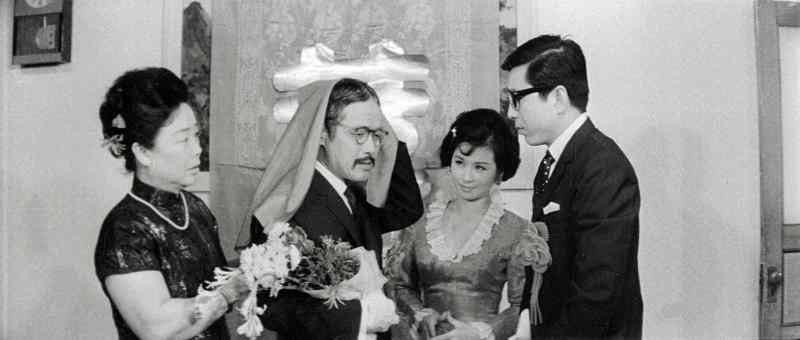
“Parents don’t understand the way young people do things” Kui-ki had explained, but they are eventually compelled to shift ground as they take back what was taken from them in finally being allowed to marry. Hsin doesn’t let anyone off the hook, neither the naive and feckless lovers nor their embittered parents whose hurt eventually turns into an unexpected opera duet as they rehash the failure of their youthful romance. He does however leave room for an unambiguously happy ending in which, ironically, the traditional family is repaired but only in its subversion as the young lovers are validated in their desire for love and freedom while A-Kau abandons the patriarchal order by assuming the role of the bride, carried in a palanquin to Kui-ki’s mother’s house wearing a veil, as he removes himself from his son’s family and surrenders his authority to his new wife in affirmation of a new social order struggling to be born in the increasingly repressive martial law era.
Remaster trailer (English/Traditional Chinese subtitles)
 Windows on Worlds