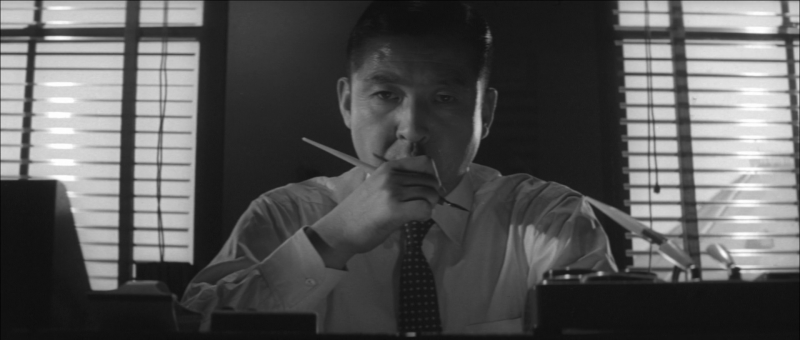
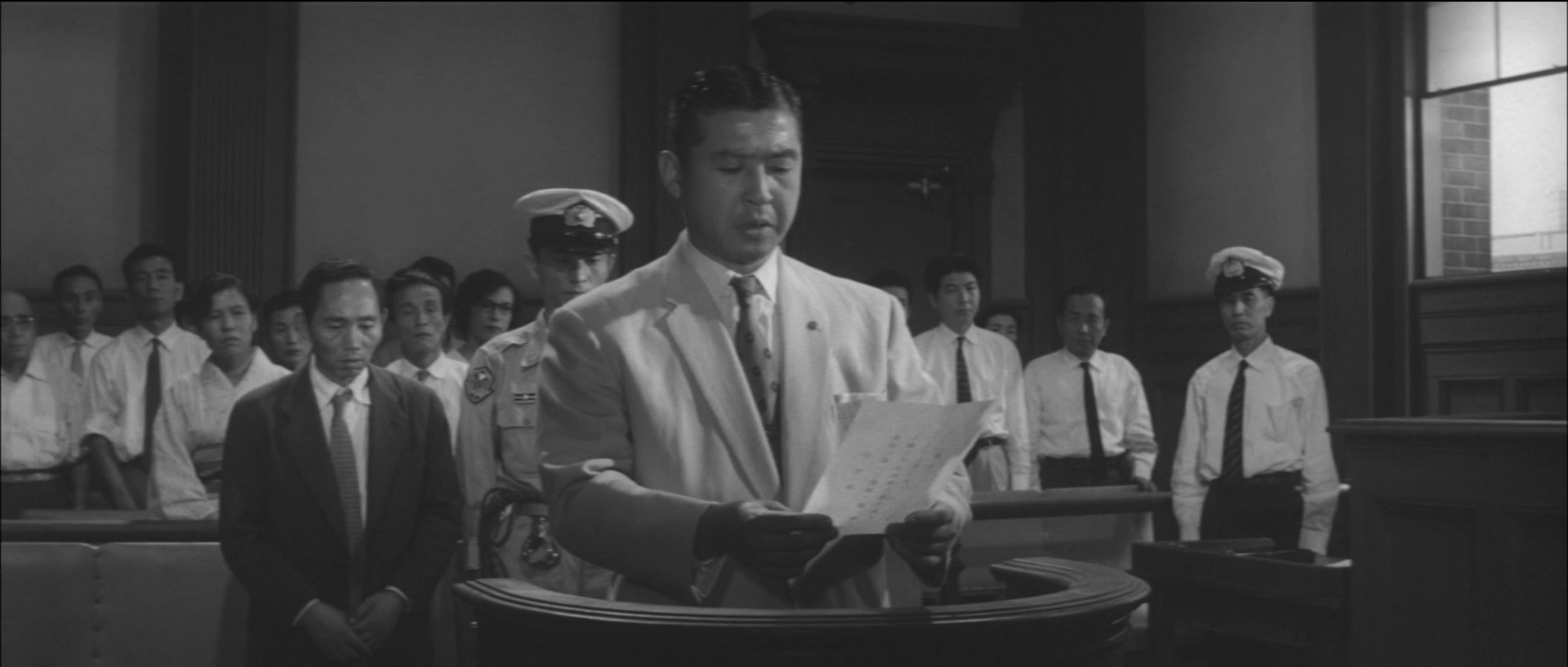
“What did I do to deserve this?” the hero of Hiromichi Horikawa’s The Lost Alibi (黒い画集 あるサラリーマンの証言, Kuroi Gashu: Aru Sarariman no Shogen) ironically asks himself, as if he assumed the answer to be “nothing at all”. Adapted from one of Seicho Matsumoto’s “Black Album” novellas, as in much noir fiction even small transgressions can have drastic consequences and even a step out of line can seriously derail an otherwise ordinary life. Ishino’s (Keiju Kobayashi) dilemma is that he knows if he speaks the truth he may damn himself and ruin the “boring, routine” life he’d built, but if he says nothing another man may pay with his life for a crime he didn’t commit.
The film’s Japanese title is “testimony of a salaryman,” and that’s really want Ishino is giving in his opening voice over. He explains that he’s a high-ranking executive on a good salary living a fairly successful life working not at the top company in his field but the second best, which he’s fine with. He gets on with his boss precisely because he’s not interested in his job and is even hopeful he could stay on past retirement if he wanted to for that exact reason. But on the other hand, he’s 42 and has 13 years until he’s able to retire. He has no more ambition and his life is essentially on autopilot. All he has to do is stay the course for the next decade or so and everything will be fine.
But when he leaves the office, Ishino doesn’t go straight home as he tells his colleague he will when refusing an invitation, but hangs out in the city drinking and playing pachinko before going to see his mistress, Chieko (Chisako Hara), one of the secretaries working in his office. The affair may be a way of rebelling against his ordinary life or of playing with fire knowing that he could lose everything if his sexual transgression were exposed. Then again, he tells his wife he’s been to the cinema on his own, which in some ways isn’t all that different from having an affair seeing as he’s still skipped out on his domestic responsibilities and left her home alone to look after the children.
The film is mildly critical of this modern salaryman tendency in drawing a direct link between a series of murders of women who were home alone, as if their men had left them vulnerable by vacating the domestic space. Ishino’s wife Kuniko (Chieko Nakakita) even says that she feels a little afraid seeing as she’s home on her own all day while the children are at school and Ishino at work. Ishino suggests they get a dog and in the back of his mind wonders if he should get one for Chieko too. It’s not immediately clear what she is getting out of this affair, though it seems fairly likely that Ishino is paying for her upkeep which is why it’s so easy for him to force her move after they’re unwittingly dragged into the spotlight when the accused man, Sugiyama (Masao Oda), tries to use Ishino as an alibi after bumping into him in the street leaving Chieko’s apartment.
Sugiyama is his neighbour and Ishino only knows him on nodding terms, but he’s immediately worried that he may expose him. After all, he regards this as a low-class area he had no real reason to visit and does not want to have to explain what he was doing there. It doesn’t occur to him that his neighbour may not have wanted to either, if he not been accused of murder. The situation looks quite bad for Sugiyama given that the police have a lot of circumstantial evidence against him, though Ishino alone knows that Sugiyama didn’t do it because he really did see him at a time that makes it difficult to place him at the scene of the crime. But Ishino denies that he was ever there. Those around Ishino seem to condone the idea that he should just keep quiet. He’s under no obligation to help Sugiyama and it’s really nothing to do with him, anyway.
But the irony is that as things spiral out of control even Ishino seems to believe in the absolute power of a confirmatory witness. When he imagines himself talking to the police, the policeman doesn’t believe him because he lied the first time and the information is inconvenient to his case. He tells Ishino that his confession isn’t worth anything without a secondary witness to back it up, meaning he’d have to produce Chieko. It doesn’t really occur to Ishino that if he had told the truth to begin with the police might have been discreet about it. After all, admitting you were with another person whose reputation you do not wish to compromise seems to work well in crime novels. When he finds himself blackmailed by a student living in Chieko’s building, he too tries to get the student’s friend to come as a witness, bizarrely thinking that having someone else there ought to provide security seeing as he could also go to the police and accuse him of extortion if something went wrong never quite thinking that the friend might simply lie just as he did.
A kind of comparison is indeed being drawn between Ishino and Matsuzaki (Tatsuyoshi Ehara), the student, who is painted as someone with a bad character who has got himself into debt not solely because of his economic circumstances but greed and an irresponsibility with money. Matsuzaki also behaves in an inappropriate way with Chieko in making passive-aggressive romantic overtures and becoming angry when she brushes them off, later basically forcing himself on her having just threatened blackmail. They are each in their way symptoms of post-war moral decline in their intense selfishness. Ishino has achieved the salaryman dream, but now he feels hemmed in by it and empty inside. Matsuzaki, meanwhile, is greedy and amoral, desperate enough to resort to loan sharks and blackmail while chasing the dream that Ishino has already achieved all too easily.
But the truth is that Ishino had done a lot to deserve this, and got off fairly lightly in the end. A single moral transgression can snowball, and it’s true enough that none of this would have happened if he hadn’t had the affair in the first place. If he’d only told the truth about it, Sugiyama may not have had to go to trial and it would never have come out. If Sugiyama had been executed for this crime, Ishino would be a murderer, and maybe twice over as the person who killed the woman, and maybe several others, may have gone on to kill again until someone finally caught them, if ever. He’s endangered his wife and family, quite literally in physical terms, but also their future and wellbeing given the possibility of his reputation being ruined leading to losing his job while his children would suffer the stigma of his disgrace. He felt conflicted, chased to the brink and even considering suicide knowing his cowardice could condemn Sugiyama to death, but still chose the path of extreme selfishness which seems to be that which defines the post-war era. Even when all’s said and done, he can’t help thinking it’s all a little unfair. All he did was cheat on his wife and lie about it, why is he the one losing everything? But in the end, that’s exactly why. He cheated the salaryman dream, and the retribution was swift. Only too late did he realise the value of his “boring, routine” life of easy comfort in the increasingly compromised post-war society.
Trailer (no subtitles)
 Windows on Worlds