

If you can judge a society by the way it cares for its most vulnerable, then at least according to Yuya Ishii’s The Moon (月, Tsuki), adapted from the novel by Yo Hemmi, Japan is not doing very well. Inspired by a real life incident in which a disaffected young man went on a rampage murdering patients at a facility for the disabled claiming they were a drain on national resources, the film probes into some dark areas of the human psyche asking what people really think deep down and who we do and don’t see as being human just like us.
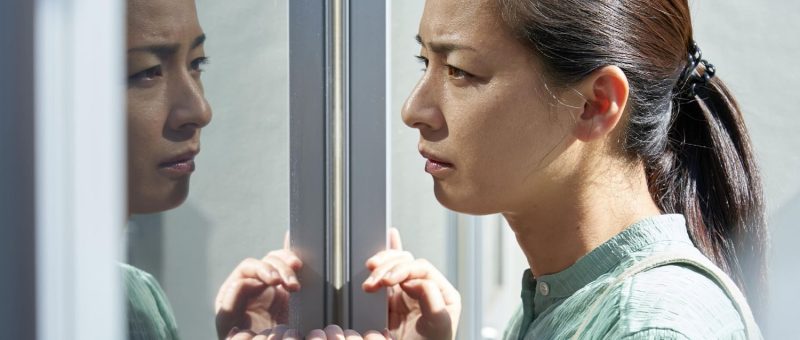
Blocked writer Yoko (Rie Miyazawa) only takes the job at a care facility because her literary career has stalled and her husband (Joe Odagiri) is out of work. Each of them is still reeling from the death of their three-year-old son who was born with a heart defect and suffered brain damage during an operation that meant he never spoke and was fed through a feeding tube. Working at the care facility brings up painful memories and directly confronts Yoko with realities of her son’s life and death while she later discovers that she is pregnant again and isn’t sure whether or not to have the baby fearing it may have the same condition and knowing that as a woman over 40 there is an increased chance she may give birth to a child who has complex needs.
In many ways it’s Yoko’s own reaction to her pregnancy which underlines the film, the lunar imagery intensely linked with that of her ultrasounds while she reckons with her own feeling of perhaps not wanting to bear an “abnormal” child, as someone puts it. Of course, this very personal sentiment is informed by the loss of her son and the experience of living and caring for him for the three years he was alive, but it also informs her perspective on the care, or lack of it, sees at the facility where patients are sometimes confined to their rooms indefinitely, left covered in their own excrement, or allowed to harm themselves through lack of stimulation. Like Yoko most of the other orderlies seem to have no medical training and two in particular mistreat the people in their care for their own amusement. On witnessing an orderly strike a patient for no reason while frogmarching him back to his room, she asks him if that’s really okay but he just replies that okay or not it’s the way they do things here. She tries to take her concerns to the facility’s director, but he basically tells her the same thing and even threatens her employment if she continues to make a fuss.
Yoko closely identifies with another woman who happened to be born on exactly the same day she was yet has been confined to bed for 10 years and is assumed to be unable to communicate. According to another orderly, also called Yoko (Fumi Nikaido), Ki-chan could walk and was partially sighted when she arrived but someone decided that it would be easier to care for her if she stayed in her room so now her muscles are too wasted to walk while they also covered up her windows because they thought dim lighting would keep her more docile. Essentially, they further disabled her for their own convenience and concluded that because she could not communicate with them in a way they considered usual that she had nothing to communicate. It doesn’t seem to occur to them that biting the other Yoko’s arm, for instance, is also communication as are some of the behaviours exhibited by the other patients which the orderlies respond to with force or violence.
Shoko, the girlfriend of another orderly Sato (Hayato Isomura), is deaf and remarks to the other Yoko that she doesn’t need to hear to be able to understand yet a value judgement seems to have been placed on these people’s lives based solely on their ability to communicate through conventional means. Yoko is accused of romanticising notions of disability, while many people may outwardly say they believe those with physical or intellectual disabilities are equal to themselves and deserve the same levels of respect and dignity they are also unwilling to deal directly with the unpleasant side of their care such as cleaning up bodily fluids which may have strong and penetrating odours. Both the other Yoko, who has literary aspirations of her own, and Sato make frequent reference the stench of reality, something which often left out or not spoken of. The other Yoko accuses Yoko of leaving the smell of decay out of her award-winning book on the Great Kanto Earthquake of 1923 which she later reveals was something urged by her editor who instructed her to soften the edges to create a story that readers would find uplifting and inspirational.
One of the unpleasant things glossed over about 1923 earthquake was the pogrom against Koreans which took place in its wake, something that is tacitly referenced during the attack on the care facility as the killer determines to ask each of the victims if they have a soul despite having already decided that those who cannot speak do not. During the pogrom, those suspected of being Korean were often asked to pronounce certain words to see if they had a Korean accent, only many people from other areas of Japan also pronounce them in the same way so the test proved nothing. The killer wants to see themselves as “normal”, that their way of thinking is just the same as everyone else’s only they don’t have the courage to speak and that their course of action is one most people tacitly support because they also do not believe that the people at the care facility are human or that they have a soul.
Raising her concerns, Yoko has a long philosophical conversation with Sato which doubles as a self-interrogation while it is also in some senses true that the people at the care facility are each refractions of herself. In any case, the conditions and contradictions of the facility appear to place a strain on the mental health of those who work there who are encouraged to simply get used to the way the system works rather than attempt to change it. Sato complains that he struggles to discern dream from reality, while reality itself is often distorted by a lack of desire to talk about anything that might be unpleasant or inconvenient.
Even a discussion that might have been unpleasant or inconvenient to have is interrupted in the closing moments, though the most important things are indeed said while Yoko and her husband are able to sit face to face and begin rebuilding their relationship in the wake of the loss of their son. Ishii conjures an atmosphere of true dread as events slowly creep towards an inevitable conclusion, but also peppers Yoko’s life with small moments of joy if underscored by a searing horror that many are prepared to unsee until brought to a violent confrontation with the contradictions and hypocrisies that dwell deep within their own hearts.
The Moon screened as part of this year’s Camera Japan.
Trailer (English subtitles)
 Windows on Worlds