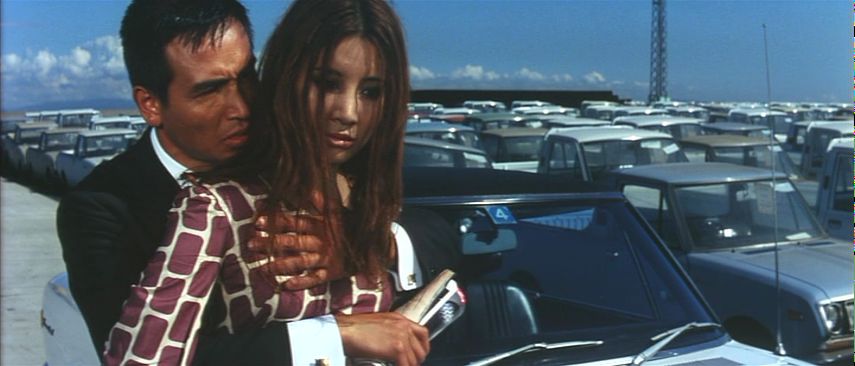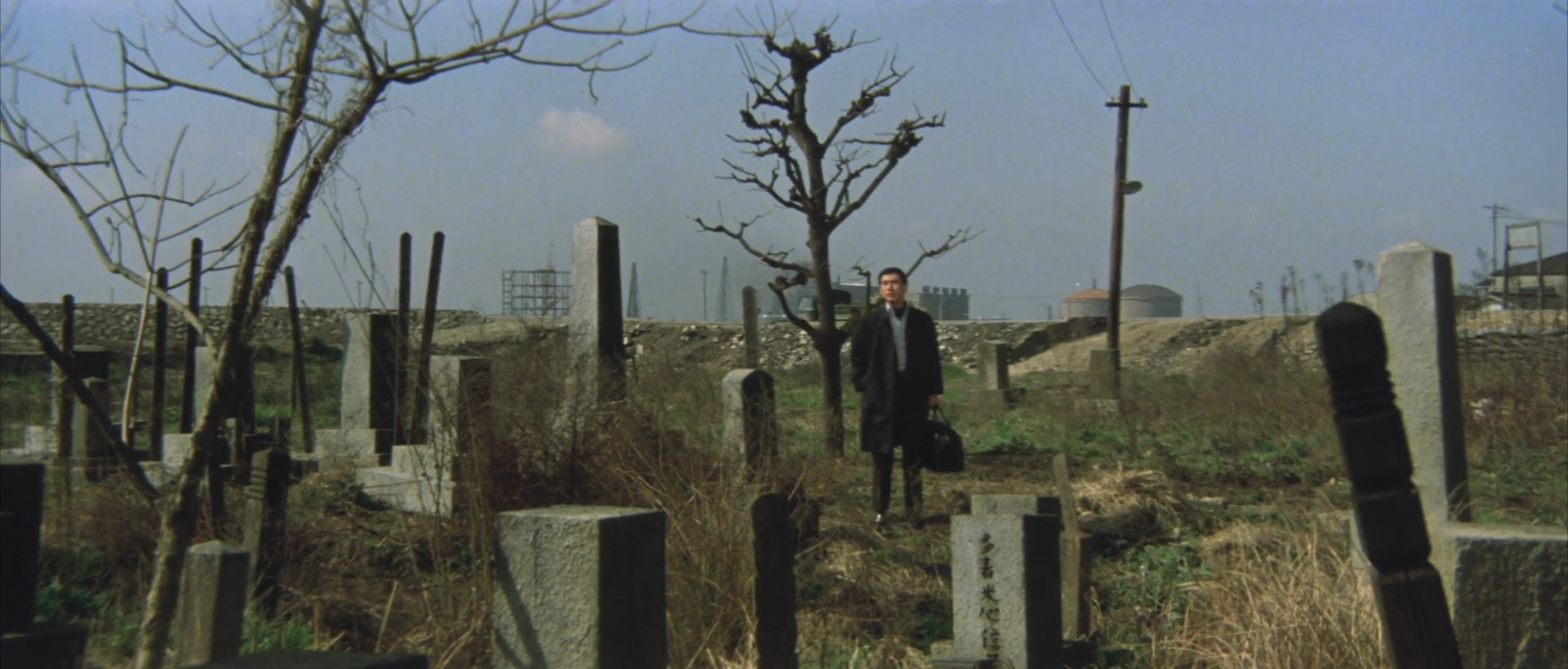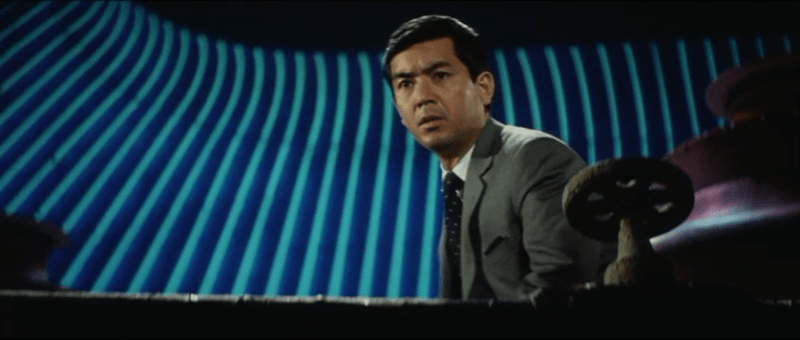
The Creature Called Man (豹は走った, Kiyoshi Nishimura, 1970)

By the late 1960s, Japan had more or less achieved its economic miracle yet there was still a degree of political tension manifesting itself in a second round of widespread protests towards the automatic renewal of the security treaty with the Americans in 1970. The third feature from Kiyoshi Nishimura, The Creature Called Man (豹は走った, Jaga wa Hashitta) anticipates the cinema of paranoia which was to take hold in the 1970s but as confused as its internal politics sometimes are, reflects the continuing sense of dissatisfaction in the wake of the student movement’s failure in its attempt to critique ongoing complicity with American foreign policy in Asia as well as Japan’s checkered geopolitical history. 

As such, Nishimura opens with hand-coloured stock footage of civil unrest in an Asian nation while the accompanying voiceover features protestors chanting “down with Jakar”, later revealed to be the ousted dictator of “Southnesia”, seemingly a stand-in for the recently assassinated Sukarno of Indonesia. As opposed to the rather pompous English title, the Japanese is simply “Jakar got away”, a phrase repeated during the opening titles and which appears as “Jaguar got away” on a typewriter sitting above the Japanese title in red which uses the character for leopard in place of Jakar’s name. In fact, animal codenames will later become something of an ironic motif with the hero referred to as a German shepherd while his rival brands himself a wolf and is referred to by his handlers as the black panther. 

This slightly tongue-in-cheek use of spy movie cliche is in keeping with the brand of humour often found in Toho’s ‘60s spy spoofs though this is largely a much more serious affair if one with an undercurrent of absurdity. The hero, Toda (Yuzo Kayama), is an Olympic sharpshooter working for the Tokyo police before he is abruptly asked to resign so that he can take part in a “special mission” which turns out to be as a backup bodyguard for Jakar who has been smuggled out of his home nation and intends to defect to America which has, it is implied, been backing his regime as a bulwark against communism in Asia while his rise to power was facilitated by Japanese soldiers who stayed in the country after the war. He’s supposed to be staying for a few days in a top hotel while the Americans figure out the paperwork for him to seek asylum at their embassy but the top brass are worried the revolutionaries might try to assassinate him on Japanese soil which would be very bad for diplomatic relations and potentially create political instability across the continent. 

As Toda later says, he’s just doing his job (even though he’s technically no longer a policeman), so he doesn’t give much thought to the wider political context of his actions only concentrating on preserving a man’s life no matter now steeped in blood that life might be. Meanwhile, a duplicitous corporation, Dainihonboeki (lit. Great Japan Trading) is attempting to cut some shady deals apparently having facilitated Jakar’s escape but now frustrated that the Revolutionary Government won’t honour their contracts for military equipment and so is offering to help assassinate him to prevent his forming an alternative government in exile and creating additional problems for the new regime. 

Kujo (Jiro Tamiya), the killer for hire, and the dutiful policeman Toda are exposed as two sides of the same coin, Toda later killing an innocent woman mistaking her for a member of the conspiracy against Jakar only to later learn she is in fact a war widow whose fiancé was an American GI killed in Vietnam. Her exaggerated death sequence filmed with expressionist flare in mimicking that of a soldier gunned down in battle. The two men face off against each other in what is essentially a battle of wits, Toda not taking aim at Kujo but anticipating his plan and foiling it before it takes effect. Leaning in to the Toho spoof, there is considerable absurdity in their machinations, waiters falling to the ground after the rope they were climbing to sneak in through a window is shot through, or sex workers brought in to shine a guiding light towards the target, but there’s a lot of blood and terror too not to mention some sleaze and a general sense of nastiness. Once the Jakar matter is concluded, the men still have a score to settle, facing off in a one-on-one duel in a disused aircraft hangar firing potshots at each other from behind various pieces of military equipment their life and death struggle shot in elegant slow motion until they each collapse into the swirling dust in a moment of nihilistic futility as another civil war quietly brews in Southnesia precipitated by their actions. 

Strikingly composed capturing the neon-lit nightscape of an increasingly prosperous Tokyo filled with the shining lights of new corporate entities and scored with noirish jazz and occasional flights into expressionism, Nishimura’s paranoid political thriller takes aim at a new world of geopolitical instability while making villains of amoral capitalists and indulging in a mild anti-Americanism but most of all is a tug of war between a hitman inconveniently regaining his humanity and a policeman temporarily abandoning his in questionable national service. 
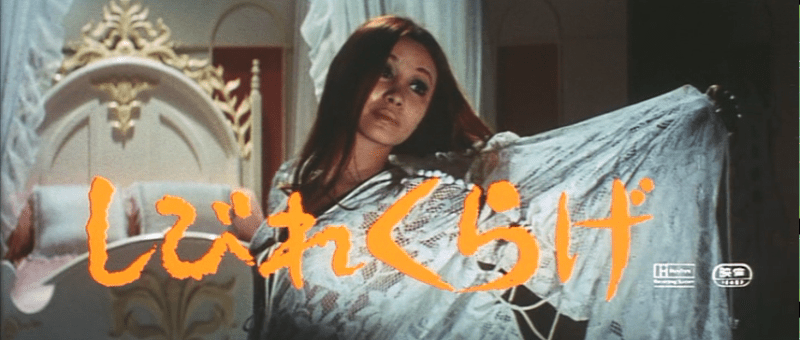

The Hot Little Girl (しびれくらげ, Yasuzo Masumura, 1970)

“Using women to make money is the same as a yakuza” a repentant gangster insists on confronting the real big bad of exploitative corporate power in Yasuzo Masumura’s ironic exploration of corruptions of a consumerist society. Ironically given the rather salacious title The Hot Little Girl (しびれくらげ, Shibure Kurage), the Japanese a more suggestive Numbing Jellyfish, Masumura’s spicy drama finds an exploited woman fighting back to reclaim her own image and agency by seizing the tools used against her in the company of a sensitive yakuza himself tiring of the amoral world of contemporary gangsterdom. 

Once an ordinary coffeeshop waitress, Midori (Mari Atsumi) is now a successful model thanks to the efforts of her salaryman boyfriend Hiroshi (Yusuke Kawazu). Completely in love with him, Midori is convinced they will one day be married while Hiroshi is obsessed with corporate success and ultimately intends to buy his own advancement with her body by acquiescing to an indecent proposal from an American department store owner to strike a massive trade deal none of his colleagues had been able to broker. Shocked and disgusted Midori refuses but is later won over by Hiroshi’s rather dubious arguments that she must sleep with the American for the good of Japan along with their personal happiness, insisting that nothing will change between them while her sacrifice will buy a more secure footing for their mutual future. 

After the deed is done she seeks additional reassurance, heading straight to Hiroshi’s apartment where they again make love he insisting she is “clean” as the day she was born. In this instance he sells her body directly, though as others point out he was already doing something similar in selling her image for his own gain. Yet he is not the only person to do so, Midori’s feckless father who ruined himself embezzling money to spend on a bar hostess and thereafter going to jail, goes out on the town claiming to be a movie star and showing off Midori’s magazine spread to a woman at a bar who turns out to be there with a petty yakuza. They decide to run a scam on him, demanding compensation for messing with a yakuza’s girl while setting the amount so high they know he’ll never pay intending to press the pretty daughter, should he have one, into sex work in a fairly common gangster manoeuvre. 

The flaw in their plan is that the feisty Midori is less than attached to her dad who continues to ruin her life with his fecklessness, a drunken fool who steals her money and gets himself into trouble. It’s clear that he sees Hiroshi as something of a meal ticket, while Midori sees a marriage to him as a path towards a more stable, conventional life. Nevertheless, she finds herself unable to abandon her father, bravely standing up to the yakuza who threaten her and eventually saved by sensitive gangster Kenji (Ryo Tamura) who instantly sympathises with her situation having grown up with an abusive father he once tried but failed to kill. The gang he’s with are old school yakuza not yet part of the newly corporatising breed, still running petty scams pressing women into sex work through blackmail or parental debt. 

Yet those two worlds are, the film suggests, beginning to merge. The corporation is founded on an image of female exploitation, Hiroshi pimping out his girlfriend while his bosses giggle about it jokingly referring to her as a secret weapon for the company. On being confronted with her father’s problematic past, Hiroshi makes Midori an ultimatum to sever ties with her dad or break up with him because associating with the yakuza will ruin his career despite the fact that he is really no different himself in his desire to exploit her. Kenji’s boss Yamano (Daigo Kusano) instructs him to make Midori his woman and then put her work, but he refuses while Midori eventually opts for an ironic revenge that will quite literally buy her freedom not only from the corporate world but from yakuza threat in allowing Kenji to free himself. Together they determine to “become ordinary people again”, attempting to shake off both parental failure and the corruptions of a rabidly consumerist society to resist the commodification of body and image in world in which everything has a price and nothing any value. 


A Certain Killer (ある殺し屋, Kazuo Mori, 1967)

A nihilistic hitman safeguards the post-war future in Kazuo Mori’s chivalrous B-movie noir, A Certain Killer (ある殺し屋, Aru Koroshiya). Set against the backdrop of the Vietnam War with US airplanes flying constantly overhead, Mori’s crime thriller situates itself in the barren wasteland of a rehabilitated city in which betrayal, exploitation and duplicity have become the norm while a former tokkotai pilot turned killer for hire takes his revenge on social hypocrisy as a product of his society, a man who did not die but knows only killing. 

Shiozawa (Raizo Ichikawa) runs a stylish restaurant by day and supplements his income by night as a killer for hire, apparently highly regarded by the local underworld. As such, he’s approached by a yakuza underling, Maeda (Mikio Narita), on behalf of the Kimura gang who want him to off another gangster, Oowada (Tatsuo Matsushita), who double crossed them in contravention of the yakuza codes of honour. Shiozawa is resolutely uninterested in yakuza drama and so turns the job down but changes his mind when he’s paid a visit by boss Kimura (Asao Koike) himself who sells him a different kind of mission. Kimura characterises Oowada as a “bad” yakuza, one has subverted the traditional gangster nobility by dealing in the “dirty” sides of organised crime, corrupting the modern society by trafficking in illegal prostitution, drugs, and extortion, where as he is a “good” yakuza mostly running construction scams and therefore building the post-war future. His crime is, literally, constructive, where Oowada’s is not. 

Shiozawa doesn’t quite buy his justifications, but men like Oowada represent everything he hates. “They’re not worthy of this world. They’re nothing but cockroaches” he laments, recalling the young men who served with him and gave their lives because they believed in a country which betrayed them. He agrees to take the job in rebellion against post-war venality, but only at a price, asking for four times the original fee. Kimura is willing to pay, because his true aim is profit more than revenge. He plans to take over Oowada’s remaining business concerns. 

Fully aware of this, Shiozawa seems almost uninterested in the money despite having asked for so much of it. He runs his shop as a front for his side business and otherwise lives a quiet, unostentatious life keeping mostly to himself. He is not, it would seem, a cold blooded killer, often making a point of leaving those who get in his way incapacitated but alive. Targeted by a street punk for supposedly messing with his girl he cooly disarms him and walks away, only for the girl to follow attracted partly by his icy manliness and partly by the thickness of his wallet as glimpsed when he made the fatal decision to offer to pay for her meal in order to save the chef from embarrassment over her attempts to pay with things other than money. Unable to get by on her own, Keiko (Yumiko Nogawa) attaches herself to various capable men beginning with the pimp, transferring her affections to Shiozawa whom she petitions to marry her, and then to Maeda, eventually vowing to find a new partner and make lots of money. 

Both Maeda and Keiko chase Shiozawa and are rebuffed. Impressed by his cool handling of the Oowada affair, not to mention the amount of money he now realises you can make in his line of business, Maeda asks to become his pupil in order to become a “real man”. Shiozawa doesn’t regard his work as something “real men” do, and in any case prefers to work to alone. Maeda repeatedly asks to be allowed to accompany him even after plotting betrayal, only to be rejected once again as Shiozawa tells him that he doesn’t like people who don’t know the difference between the job and romance, flagging up the homoerotic subtext for those not paying attention. Maeda parrots his words back to Keiko with whom he had begun a halfhearted affair as joint revenge against Shiozawa’s indifference. 

Following the successful offing of the mob boss, Shiozawa finds himself coopted into another job robbing a drug handoff between Oowada’s former associates, the illicit narcotics ironically packaged inside cartons intended for baby powder. Shiozawa apparently doesn’t object to profiting off the drug trade himself, but later abandons the loot in protest while the remainder is lost or squandered during the final battle with the remaining gang members, Shiozawa’s cartons left sitting ironically on top of a gravestone taken by no one. Cool as ice, Shiozawa places himself above petty criminality, always one step ahead, trusting no one and looking out for himself but reacting as a man created by his times, forged by a war he was a not intended to survive while looking on at another cruel and senseless conflict across the sea. Adapting the hardboiled novel by Shunji Fujiwara, Yasuzo Masumura’s jagged, non-linear script (co-written with Yoshihiro Ishimatsu) is imbued with his characteristic irony but also coloured with nihilistic despair for the post-Olympics society and its wholesale descent into soulless capitalistic consumerism.


Update, 13th February 2025: now available to stream via Arrow Player.

Original trailer (no subtitles)