Vital (ヴィタール, Shinya Tsukamoto, 2004)

“There is the vast realm of the unconscious,” one of the professors explains to vacant medical student Hiroshi a soon-to-be physician attempting to heal himself from a trauma he doesn’t fully understand. Perhaps as the title implies, Vital (ヴィタール) sees Tsukamoto branch out from his vistas of urban alienation to find a new paradise in nature albeit one that it exists largely in the mind and that the hero can never fully return to because this place of life is also one of death which exists inside a kind of eternity.

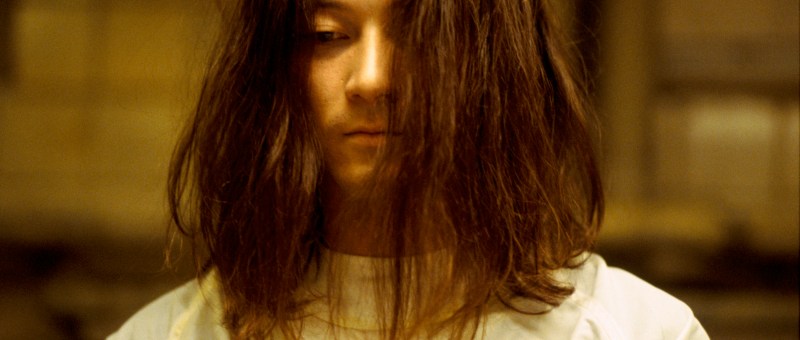
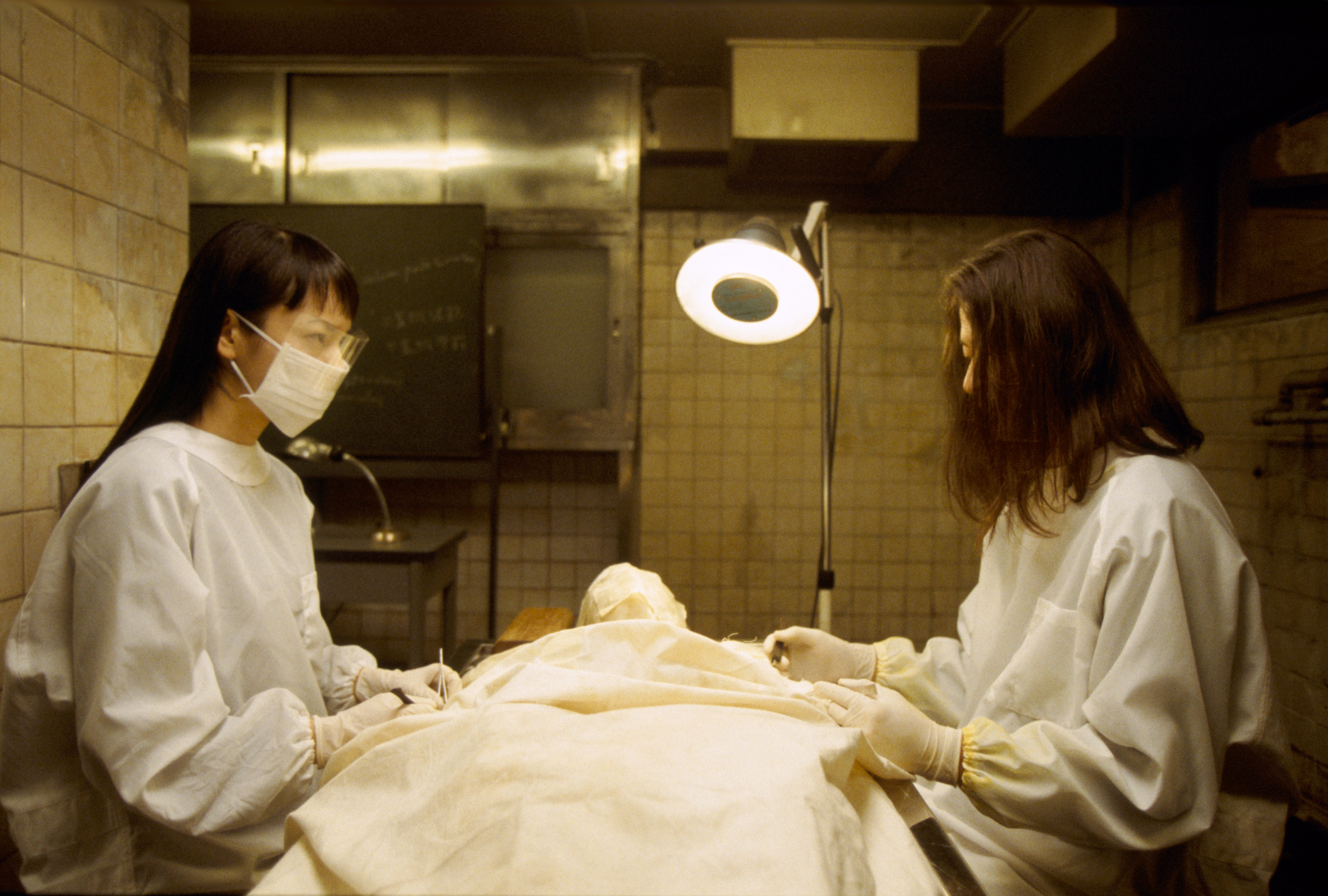
This explains to some extent Hiroshi’s (Tadanobu Asano) temporal confusion. Having lost his memory following a car accident in which he later learns his girlfriend Ryoko (Nami Tsukamoto) was killed, he shifts between “reality” and what first seems to be flashbacks of his unremembered past but are actually taking place in a kind of alternate, perhaps idealised reality in the “vast realm of the unconscious” as Hiroshi attempts to reconstruct his image of Ryoko along with that of himself. Another of his professors more philosophically asks were lies the seat of the soul in the human body and is this something that Hiroshi maybe unconsciously looking for during his anatomy classes in which he is coincidentally assigned Ryoko’s body to work on only realising when he sees her tattoo in one of his visions. 

In some ways this grim task of dissection is a bid for greater intimacy, to take Ryoko apart and then put her back together as the students diligently do at the end their studies reassembling the bodies and placing them in coffins in keeping with culturally specific death rituals. The faces of the cadavers are covered with a bag until the students are instructed to remove them, but they are always reminded to treat the dead with dignity and that their role here is one of understanding as they attempt to work out not only how these people died but also how they may have lived. Hiroshi causes conflict with some of his fellow students on just this point, seeming rather creepy in his vacant intensity over the body while also wanting to take ownership over that of Ryoko rather than work as part of the group complaining that the others are too clumsy and it’s affecting his ability to learn. 

Ryoko’s father comes to say that though he once blamed Hiroshi, his daughter had been in a way dead for a long time before she died, the light apparently going out of her eyes when she was still in high school. Only in Hiroshi’s unconscious does she say that she didn’t want to die despite an apparent obsession with death in Hiroshi’s other resurfacing memories/visions of her as symbolised in her repeated requests for him to strange her during in sex. Another of the professors had said that the suppressed desires of the unconscious could create conflict and this alternate reality is also in some senses Hiroshi’s own latent desire for death, to be with Ryoko in this new paradise that is founded on an idyllic beach rich with nature and sunshine where they are free to be together liberated from the oppressions of civilisation. 

Indeed, it’s been raining all through the film as if in expression of Hiroshi’s gloomy mental state but we later learn that Ryoko’s most treasured memory was simply standing in the rain with him and breathing in its scent. Verdant nature is aligned with the vitality that is often absent from the soulless concrete of a city in which everyone seems to exist in tiny, separate worlds which only border on but never join each other. Ikumi (Kiki), a strange female student who develops a fascination with Hiroshi, has an illicit conversation with a professor she’s apparently been sleeping with each of them speaking into mobile phones while standing steps apart. Tsukamoto often isolates the protagonists, placing them in corners or blurring the periphery as if they alone existed in this moment. In Hiroshi’s idealised alternate reality, these barriers disappear as he and Ryoko share an entire world in love and freedom. 

The irony is that he resurrects himself through the process of dissecting Ryoko’s dead body. His Da Vinci-like sketches begin to shift as do the ink-like shadows on the wall amid the reflection of the rain as Hiroshi stares vacantly trying to reassemble his past. Through accepting Ryoko’s death, he rediscovers life and is in a sense reborn insisting he will continue medicine even though his professor and parents advise him not to given what he’s just been through though his parents had also said that before the accident they didn’t really think he had it in him to become a doctor. Their disapproval may explain some of the pressures he was experiencing as perhaps was Ryoko that may have urged them to long for death. In any case, what the film presents is the archaeology of grief, a prolonged period of introspection and loneliness and a seeking of intimacy no longer really possible but discovered only in the vast realms of the unconscious.


Vital is released on UK blu-ray 30th September courtesy of Third Window Films.

Original trailer (English subtitles)

Crazy Thunder Road (狂い咲きサンダーロード, Sogo Ishii, 1980)

If you’re pushed out of the only group you’ve ever belonged to, where is it that you’re supposed to go? Produced as a graduation film, Sogo (now Gakuryu) Ishii’s second feature, Crazy Thunder Road (狂い咲きサンダーロード, Kuruizaki Thunder Road) captures a sense of youthful alienation in an age of prosperity in following in essence two men who choose to leave a group to which they have devoted their lives each for different reasons but both discovering that their new paths lead them nowhere but nihilistic despair. 

After a brief opening sequence foreshadowing the conclusion in which a ruined motorcycle lies abandoned amid the smoke of a volcanic explosion, the main action begins with the abdication of the previous leader of the Maboroshi biker gang, Ken (Koji Nanjo), who feels he’s aged out of the bosozoku lifestyle and hopes to settle down with his barmaid girlfriend Noriko (Michiko Kitahara). The Maboroshi gang is about to join an alliance with two other local outfits, Dokuro and Gaya, to put an end to the internecine street violence. Young hothead Jin (Tatsuo Yamada) decides he wants no part of this soft and cuddly version of the biker life and abruptly leaves with three of his friends to start his own gang, Maboroshi Kamikazes, declaring that his old outfit should now consider him an enemy.  

The problem is that system doesn’t like it if you step out of place and so the Elbou Alliance doesn’t really like it that Jin wouldn’t join, capturing and killing one of his friends to make a point. The more he tries to claim his independence, the more he is forced to realise that he is an ineffectual leader and being outside the group makes him vulnerable. His four guys are no match for the combined forces of three gangs which is one reason he later finds himself joining a new outfit, an ultra-nationalist militarist biker gang operated by former Maboroshi founder Takeshi (Nenji Kobayashi) who turns up in full infantry gear singing an imperial song, only to again become disillusioned because a life of order and austerity is the very opposite of everything he wanted which would be control and agency over his own life. 

In another way, that might what Ken wanted too but he doesn’t find it either and in the film’s hyper masculine worldview he appears weakened in his choice. An entirely passive figure, he is even seen wearing a pretty pinny while helping Noriko out at the bar otherwise usually looking blank or sullen like a man half alive who’s already given up on life. To ram the point home we discover at the film’s conclusion that Noriko eventually leaves him essentially for not being manly enough now that he’s left the biker subculture though her new squeeze is clearly a yuppie salaryman which itself points to a paradigm shift in contemporary visions of masculinity. 

Meanwhile, we’re suddenly presented with a new challenger, Shigeru (Masashi Kojima), who began as a shy foot soldier lead away by Jin but later finding a home with the nationalists, becoming Takeshi’s lover after Jin rejects the rigidity of militarism. Shigeru promises to protect both the town and Takeshi in an expression of the archetypal vision of masculinity as a protector, but love is it seems incompatible with this way of life in which strength is the only thing that matters. Ken loses Noriko because his desire to escape a life of violence renders him unmanly, while love doesn’t save Shigeru either because in the hyper masculine world in which he lives attachment is never anything other than weakness. 

Literally maimed by his failed attempt at dominance, Jin is cast out further into the post-war industrial wasteland where he encounters a teenage boy selling drugs and an old man weapons implying that the mediation of death has shifted with the generations only to be undercut with another piece of shocking and random violence that reminds us of the arbitrary meaninglessness of these petty struggles for dominance. True freedom, the film implies lies only in death, Jin the ultimate outsider a man who cannot be part of any group and must always remain outside of the pack while it remains impossible to survive alone. Set in the near future inches closer to an apocalypse, Ishii’s proto-cyberpunk aesthetic owes as much to The Warriors as it does to Mad Max painting pre-bubble provincial Japan as a post-war wasteland inhabited only by the hopeless perpetually fighting over the scraps of an increasingly prosperous but oppressively conformist society. 


Crazy Thunder Road is released on UK blu-ray on Feb. 21 courtesy of Third Window Films in an edition which includes an audio commentary by Tom Mes and video essay on jishu eiga by Jasper Sharp.

Trailer (English subtitles)

Kitchen (キッチン, Yoshimitsu Morita, 1989)

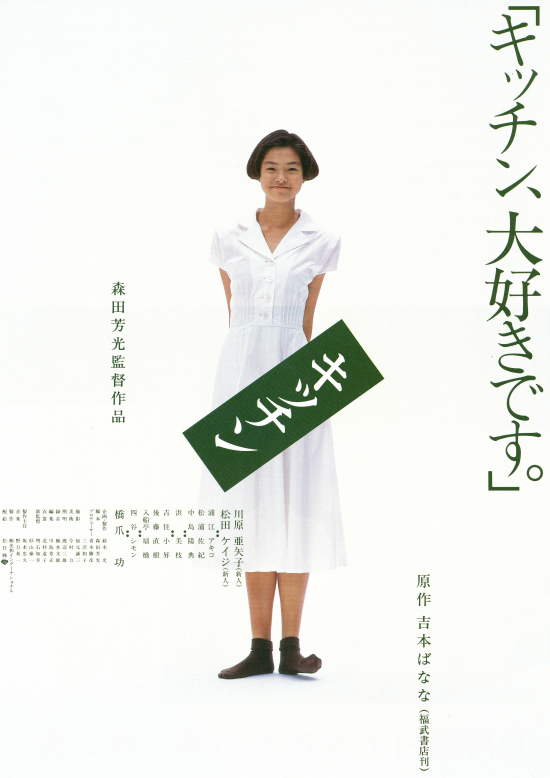
KitchenBanana Yoshimoto’s debut novel Kitchen was first published in 1988 and instantly became a publishing phenomenon. The first film adaptation came not long after with the identically titled Kitchen (キッチン) directed by Yoshimitsu Morita in 1989. Like most of Yoshimoto’s work, Kitchen deals with people learning to live with grief and cope with the aftermath of tragedy. However, though Morita’s script sticks closely to the novel for the first half of its running time, he later deviates into a conventional romantic youth drama much like his more populist offerings of the time.

The film opens with a strange image of a young woman asleep in front of a fridge in an otherwise entirely darkened kitchen. The young woman is Mikage Sakurai – orphaned at a young age, Mikage (Ayako Kawahara) was raised by her grandmother who has recently also passed away leaving her entirely alone in the world. The one place Mikage has learned to feel at peace is in a kitchen and she has her sights set on a culinary career.

At the funeral, Mikage meets a young man who had apparently become good friends with her grandmother through his part-time job at a florist. After striking up a friendship with Mikage, Yuichi (Keiji Matsuda) invites her to the upscale apartment he shares with his mother, Eriko (Isao Hashizume). Mikage falls in love a little bit with their well appointed and spacious Western style kitchen which is filled to the brim with all the latest gadgets. Soon after, Mikage moves in with Yuichi and Eriko and begins to rebuild her life with a new family beside her.

It’s difficult to avoid spoilers in this respect but for anyone who is familiar with Yoshimoto’s novel, it’s important to note that one particular tragedy which informs the entirety of book has been completely eliminated in this adaptation. The biggest change Morita has made is in his depiction of Eriko who is a trans woman and the father of Yuichi having undergone gender reassignment after the death of Yuichi’s mother.

The film is actually very positive in dealing with Eriko’s character and doesn’t try to elide or make a joke out of her. However, whereas Eriko in the book is described as an extremely glamorous and beautiful woman to the extent that she may seem slightly intimidating at first despite her warm and loving nature, here she is played by a male actor with a man’s haircut and slightly frumpy fashion sense as well as being depicted more like a stereotypically gay male character. Likewise, though Eriko’s friend Chika-chan is still in the movie, we never see anything of Eriko’s life at the gay club she runs or much of her life away from Yuichi and Mikage. That said, the change in question does offer a little more hope and happiness for Eriko than her outcome in the novel.

Morita also gives the film more of the quirky, light hearted feel he adopted in many of his other populist films from the ‘80s. Yoshimoto’s work often successfully straggles a difficult tonal gap in which it’s filled with a kind of existential despair but simultaneously light and cheerful. Though Mikage is numbed with grief throughout the novel which prevents her from assessing what it is she really wants from life, the film is satisfied with depicting her as a fairly ordinary young woman whose problems stem more from trying to step out alone for the first time rather than trying to emerge from a life altering tragedy like the death of your last remaining family member.

However, Morita retains the magical realist qualities of the novel through his use of dream sequences and expressionist imagery. Juxtaposing bright colours of nature with the often extremely dark backgrounds, he creates an impressive sense of differing realities with Mikage’s cheerful on the surface yet depressed inner life recreated through iconography rather than through performance or dialogue. He also retains the use of the moon as symbol for life and happiness, presenting a source bright light in an otherwise dark world which can help to guide the way in times of trouble.

As a film in its own right, Morita’s Kitchen is certainly very much of its time though perhaps not unwatchable, but as an adaptation of Yoshimoto’s novel it ultimately fails on all counts. Veering way off tone in its second half, Kitchen takes on much more of a conventionally romantic narrative eschewing Yoshimoto’s major messages about the need to come to terms with a traumatic past in order to move on and the importance of understanding your true feelings while there’s still time to act on them. Yoshimoto is more concerned with showing that joy and sorrow are two sides of the same coin and you can’t have one without the other but Morita’s story creates a much smoother, more natural path for a romance between Mikage and Yuichi which ultimately robs it of much of its power. That said even if Kitchen disappoints as a literary adaptation it isn’t entirely without interest and does at least offer several examples of Morita’s idiosyncratic gift for composition.


Opening scenes of the film (dialogue free)

Kitchen was also adapted as film in Hong Kong directed by Ho Yim in 1997, starring Yasuko Tomita and Jordon Chan. Banana Yoshimoto’s source novel was first published in English in 1993 (translated by Megan Backus) and is still in print from Faber & Faber in the UK and Grove Press in the US.