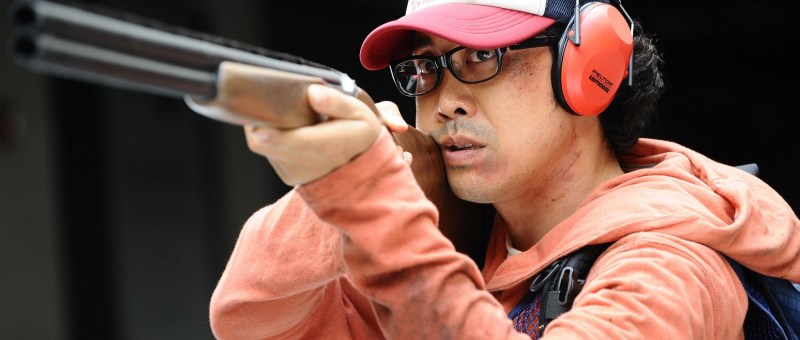
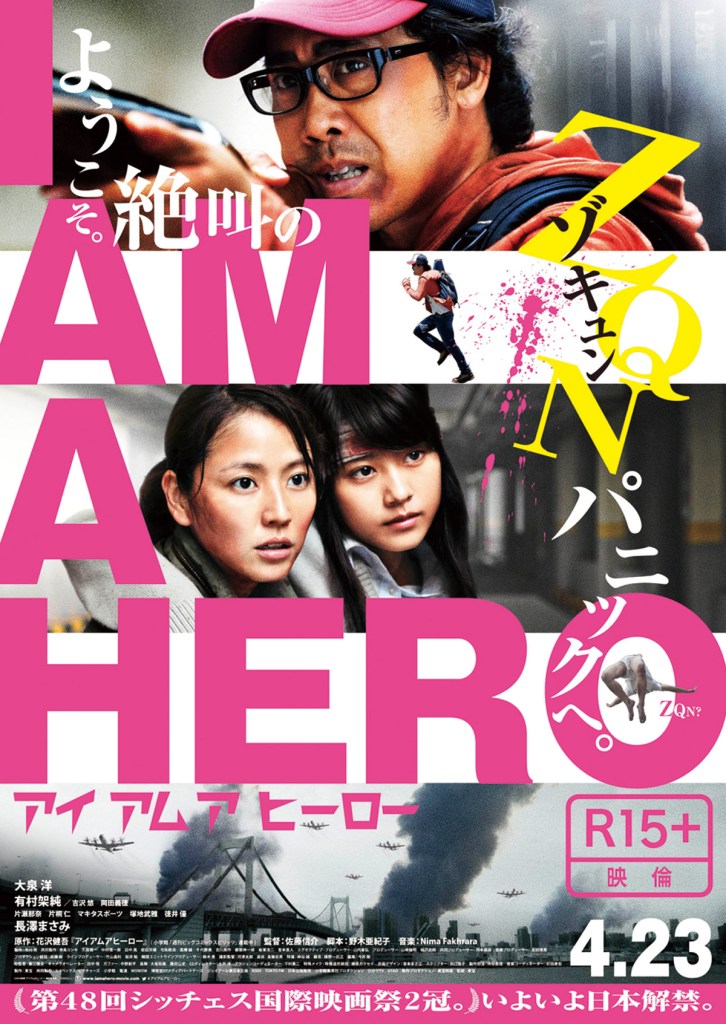
 Japan has never quite got the zombie movie. That’s not to say they haven’t tried, from the arty Miss Zombie to the splatter leaning exploitation fare of Helldriver, zombies have never been far from the scene even if they looked and behaved a littler differently than their American cousins. Shinsuke Sato’s adaptation of Kengo Hanazawa’s manga I Am a Hero (アイアムアヒーロー) is unapologetically married to the Romero universe even if filtered through 28 Days Later and, perhaps more importantly, Shaun of the Dead. These “ZQN” jerk and scuttle like the monsters you always feared were in the darkness, but as much as the undead threat lingers with outstretched hands of dread, Sato mines the situation for all the humour on offer creating that rarest of beasts – a horror comedy that’s both scary and funny but crucially also weighty enough to prove emotionally effective.
Strange things are happening in Tokyo. The news has just had to make a correction to their previous item – apparently, it was the woman who bit the dog and no, they don’t as yet know why. Hideo Suzuki (Yo Oizumi), sitting in the corner apart from his sardonic colleagues, is a 35 year old manga assistant with dreams of creating his very own franchised series. Sadly, his ideas are always shot down by the publisher who barely remembers his name but does note that there’s always the same problem with his protagonists. They’re just too…”normal’? Returning home to his previously patient girlfriend with the news that he has, once again, failed, Hideo is unceremoniously thrown out as Tekko (Nana Katase) charges him with exactly the same complaint as his publisher had – only special people can achieve their dreams, she says. You’re not special, you’re just ordinary. Throwing out his ridiculous shotgun purchased for “research” alongside him, Tekko slams the door with an air of frustrated finality.
A short time later, some of Hideo’s co-workers are feeling unwell, as is Tekko who calls him to apologise but when he arrives at her flat what he finds there is obviously not Tekko anymore. Returning to work, Hideo also finds one of his colleagues wielding a bloody bat next to the body of another assistant. Heroically cutting his own throat on realising he’s been bitten, his friend passes the bat(on) to Hideo, now on the run from a falling city. Teaming up with high school girl, Hiromi (Kasumi Arimura), he heads for Mt. Fuji where it’s hoped the virus may not be able to survive but the pair eventually run into another group of survivors holed up in a outlet mall where the undead may be the last of their worries.
Sato gleefully ignores the genre norms, refusing to give in to cinematic rules by consistently moving in unexpected directions. Thus, Hideo remains a cowardly fantasist throughout much of the film. In an odd kind of way, this refusal to engage is his manner of heroism. Though he is afraid and avoids reality through frequently trying write his way out of a situation, cleverly manifested by nicely integrated fantasy sequences, Hideo does not run away and consistently refuses to abandon those around him even if might be to his own advantage. Eventually he does get his hero moment, finally finding the courage to fire the shotgun which has so far remained an empty symbol of his unattainable dreams, stopping to pick up his all important hat as every bona fide hero must, but his true moment of realisation comes when he’s forced to acknowledge his own ordinariness. Having been accustomed to introduce himself with the false bravado that his name is Hideo – written with the character for hero, his post-zombie warrior persona can finally consent to just being “the regular kind of Hideo”. Heroes are not a magic breed, they’re regular guys who are OK with who they are and are prepared to risk all for someone or something else.
The fact that Hideo has a gun at all is a strange one when guns are so rare in Japan though his devotion to the precise rules of his license even in this quite obviously lawless environment proves an ongoing source of comedy. It also makes him an unwitting target for the unscrupulous and puts him in danger with the unpredictable leader of the survivor community he accidentally wanders into. As with any good zombie tale, the undead are one thing but it’s the living you have to watch out for. Holing up in an outlet store of all places can’t help but recall Dawn of the Dead and Sato does, indeed, make a little of its anti-consumerist message as expensive trinkets firstly seem pointless trophies, unceremoniously heaped together in Tupperware, but ultimately prove a kind of armour against zombie attack.
The ZQN are classic zombies in many ways – you need to remove the head or destroy the brain, but they’re also super strong and have a poignant tendency to engage in repetitive actions from their former lives or repeatedly make reference to something which was obviously in their mind as they died. Thus Tekko has enough time to ring Hideo before the virus takes hold and a politician to vent about the incompetence of his colleagues but the ZQN turns salarymen into babbling choruses of “thanks for everything”, dooms shop assistants to exclaim “welcome” for eternity and leaves baristas stuck with “What can I get you today?”. Unlike your usual zombies, the ZQN retain some buried consciousness of their inner selves, able to recognise those close to them but condemned to devour them anyway.
Placing character development ahead of the expected genre trajectory, Sato weaves a nuanced essay on the nature of heroism and humanity as Hideo is forced to confront himself in order to survive. Though he tantalises with a possible deus ex machina, Sato never gives in to its use – if our heroes are going to survive, they have to save themselves rather than wait for someone with the hero genes to suddenly appear. Of course, they do so in an elaborate blood soaked finale which more than satisfies in the zombie action stakes. Witty yet heartfelt, if I am a Hero has a message it’s that if I am a Hero then you can be too – no one is coming to save us, except us, but if we’re going to do so then we have to conquer ourselves first so that we might help each other.
Original trailer (English subtitles)
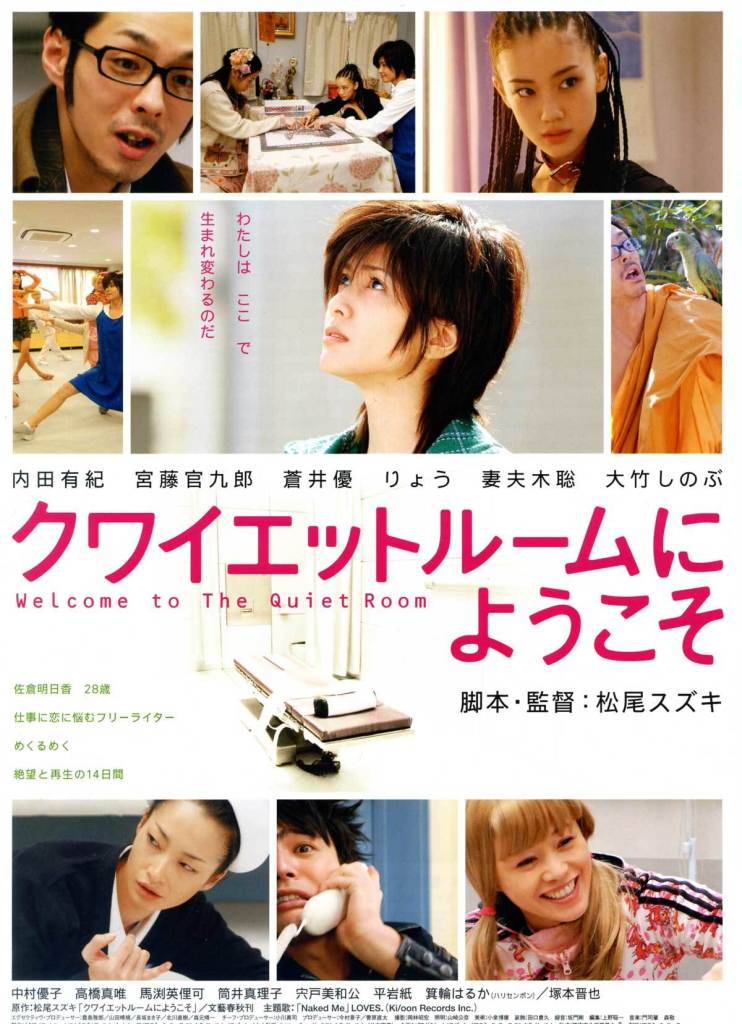 Everyone has those little moments in life where you think “how did I get here?”, but thankfully most of them do not occur strapped to a table in an entirely white, windowless room. This is, indeed, where the heroine of Suzuki Matsuo’s adaptation of his own novel Welcome to the Quiet Room (クワイエットルームにようこそ, Quiet Room ni Yokoso) finds herself after a series of events she can’t remember but which seem to have involved pills and booze. A much needed wake up call, Asuka’s spell in the Quiet Room provides a long overdue opportunity to slow down and take a long hard look at herself but self knowledge can be a heavy burden.
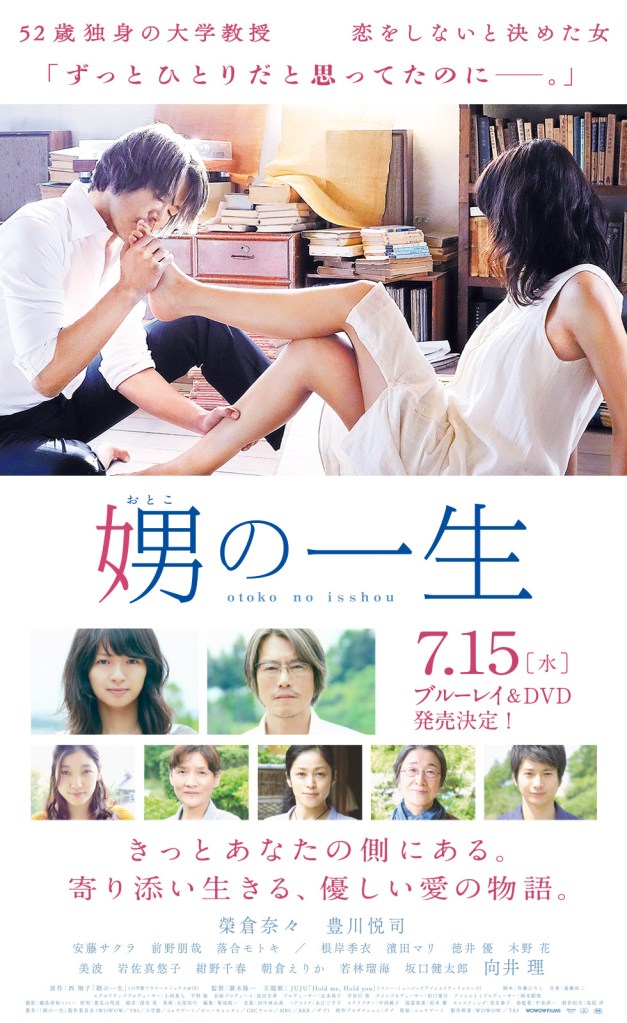 Ryuichi Hiroki has one of the most varied back catalogues of any Japanese director currently working. After getting his start in pink films and then moving into V-Cinema, Hiroki came to prominence with 2003’s Vibrator – an erotically charged exploration of modern alienation, but recent years have also proved him adept at gentle character drama. Her Granddaughter (娚の一生, Otoko no Isshou), though coming with its own degree of strangeness, is another venture into the world of peaceful, if complicated, adult romance.
 It used to be that movies about marital discord typically ended in a tearful reconciliation and the promise of greater love and understanding between two people who’ve taken a vow to spend their lives together. These endings reinforce the importance of the traditional family which is, after all, what a lot of Japanese cinema is based on. However, times have changed and now there’s more room for different narratives – stories of women who’ve had enough with their useless, deadbeat man children and decide to make a go of things on their own.
 Windows on Worlds