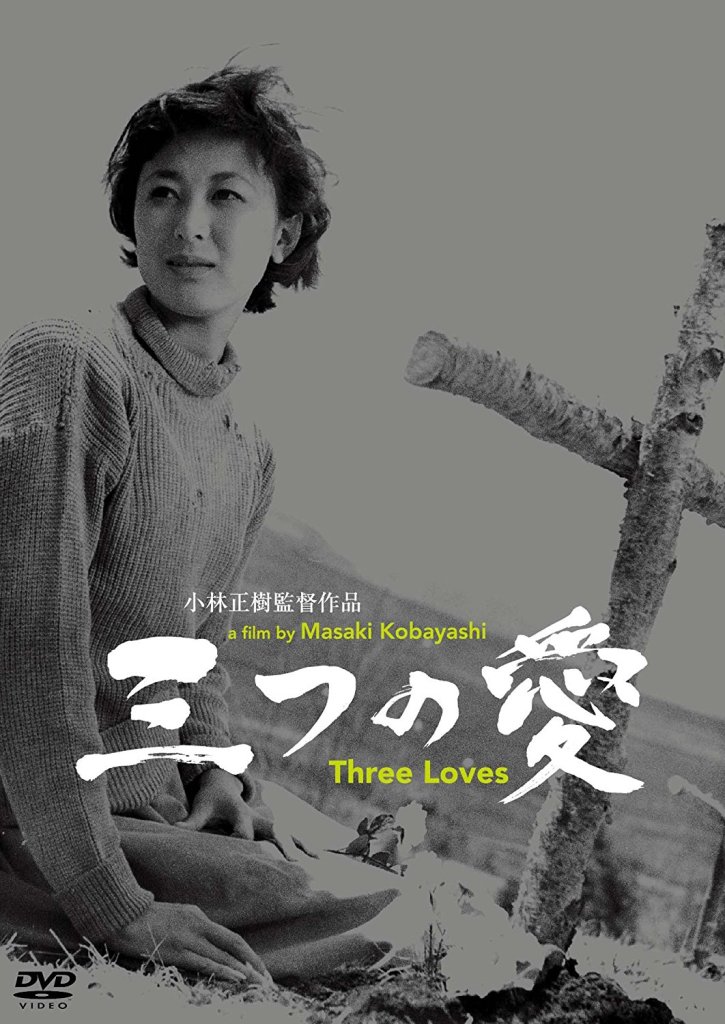
 Masaki Kobayashi had a relatively short career of only 22 films. Politically uncompromising and displaying an unflinching eye towards Japan’s recent history, his work was not always welcomed by studio bosses (or, at times, audiences). Beginning his post-war career as an assistant to Keisuke Kinoshita, Kobayashi’s first few films are perhaps closer to the veteran director’s trademark melodrama but in 1953 Kobayashi struck out with a more personal project in the form of The Thick-Walled Room which dealt with the fates of lower class war criminals. Based on a novel by Kobo Abe, the film was sympathetic to the men who had only been “following orders” but was careful not to let them off the hook. Still far too controversial, The Thick-Walled Room could not be released until 1957 and Kobayashi went back to more conventional fare such as this Christianity infused tale of three kinds of frustrated loves – romantic, spiritual, and familial, Three Loves (三つの愛, Mittsu no Ai).
Ikujiro is riding into town on a donkey cart, playing his flute which attracts the attention of a strange boy who exclaims that he is a butterfly. Following the death of his father, Ikujiro’s mother has apprenticed him to a man who owns a sake brewery but is also a member of the school board and has promised that he will get his education. Riding the same cart in is a down on his luck artist, Nobuyuki (Ko Mishima) – the lover of the town’s new music teacher, Michiko (Keiko Kishi), who has travelled to this remote country spot both for the benefit of her health and to help provide for her struggling artist boyfriend. This slightly unusual town is also home to a humble church whose Holy Father, Yasugi (Yunosuke Ito), came to the town as an evacuee alongside the now professor father of the little boy with a pigeon obsession, Heita.
Somewhat unusually, Three Loves opens with a choral rendition of a Christian hymn followed by a brief voice over and intertitle-style caption bearing the message that only those who live sincerely and seriously will be granted true joy but that this same joy is born from the bitterness and sadness of life. There are certainly an array of bitter circumstances on offer but Kobayashi choses to focus on them as filtered through three very different stories of love as children are separated from their parents, lovers are kept apart by cruel twists of fate and the love of God is both keenly and invisibly felt by those who take refuge at the underused church.
Ikujiro has been “sent away” by his mother who has been convinced to allow her oldest child to be raised by foster parents given that it will now be difficult for her to support all of the children in the absence of her husband. Feeling alone and unloved though missing his family, Ikujiro does not quite fit in at the local school but faces even more problems at his new home where it transpires that his foster father is not quite as altruistic as he originally claimed. Forming an odd friendship with Heita, Ikujiro begins to find some comfort in the place but nevertheless continues to suffer.
Heita, is, in many ways the heart of the film though his status as a kind of holy fool is perhaps uncomfortable from a modern standpoint. Yasugi, who has developed the closest relationship with the boy outside of his mother, describes him as beautifully sensitive and someone who requires especial care. Yet, his mother found it difficult to connect with him until he was allowed to return to nature, and his scholarly father mostly ignores him, describing his work as a kind of “atonement” for the way his son has turned out. Even given Heita’s unorthodox relationship to his environment in which he feels himself more bird or butterfly than human, he experiences only warmth and occasional exasperation from those around him rather than outright hostility.
These kinds of frustrated familial or social loves feed back into the intertwined romantic melodrama as tortured artist Nobuyuki has an attack of male pride in partially rejecting Michiko over her decision to become the major breadwinner despite her failing health. Professing love but remaining unwilling to marry because of his lack of financial security, he only wounds the woman he loves who wants nothing other than for him to go on painting and thinks of what he regards as a “sacrifice” of herself in working to support them both as part of their shared struggle. Becoming gloomy and depressed, Nobuyuki posits giving up on love, but eventually comes around, realising some things are more important than pride though old fashioned ideas about illness still pose a problem.
This in turn drives the central spiritual dilemma as Father Yasugi is forced to face his own emotional pain which he has long been trying to sublimate with service to something higher. Ten years previously, his wife left him for another man but his continuing love for her is the very reason he cannot bring himself to do what his own religion requires and forgive her for the pain and suffering which now cloud his heart. God is love, but love is pain and suffering without end. Thus he councils the romantically troubled couple against a marriage which may end suddenly creating even more heartbreak and everlasting sadness, which seems at odds with his own, and the film’s, insistence on the joy that life brings even whilst filled with sorrow and regret.
An early effort from Kobayashi, Three Loves is not as successful as his other work from the period offering none of the rawness or innovation of The Thick-walled Room, falling back on established melodrama techniques though making interesting use of montages and dissolves even if coupled with familiar horizontal wipes. The tone is more forgiving than Kobayashi’s later angry social tirades, but the muddled structure and strange use of religious themes make for a frustrating experience which ends in a traditionally melodramatic way offered abruptly and without further comment. A death of innocence may be Kobayashi’s concession to his own bleaker world view but feels like a standard Shochiku tearjerker ending, an afterthought tacked on as a concession to studio requirements. Still, an interesting meditation on the nature of love in all its different forms, Three Loves is an unusually contemplative piece even if frustrated by a slight clumsiness of execution.
 Shochiku was doing pretty well in 1951. Accordingly they could afford to splash out a little in their 30th anniversary year in commissioning the first ever full colour film to be shot in Japan, Carmen Comes Home (カルメン故郷に帰る, Carmen Kokyou ni Kaeru). For this landmark project they chose trusted director Keisuke Kinoshita and opted to use the home grown Fujicolor which has a much more saturated look than the film stocks favoured by overseas studios or those which would become more common in Japan such as Eastman Colour or Agfa. Fujicolour also had a lot of optimum condition requirements including the necessity of shooting outdoors, and so we find ourselves visiting a picturesque mountain village along with a showgirl runaway on her first visit home hoping to show off what a success she’s made for herself in the city.
 A Japanese tragedy, or the tragedy of Japan? In Kinoshita’s mind, there was no greater tragedy than the war itself though perhaps what came after was little better. Made only eight years after Japan’s defeat, Keisuke Kinoshita’s 1953 film A Japanese Tragedy (日本の悲劇, Nihon no Higeki) is the story of a woman who sacrificed everything it was possible to sacrifice to keep her children safe, well fed and to invest some kind of hope in a better future for them. However, when you’ve had to go to such lengths to merely to stay alive, you may find that afterwards there’s only shame and recrimination from those who ought to be most grateful.
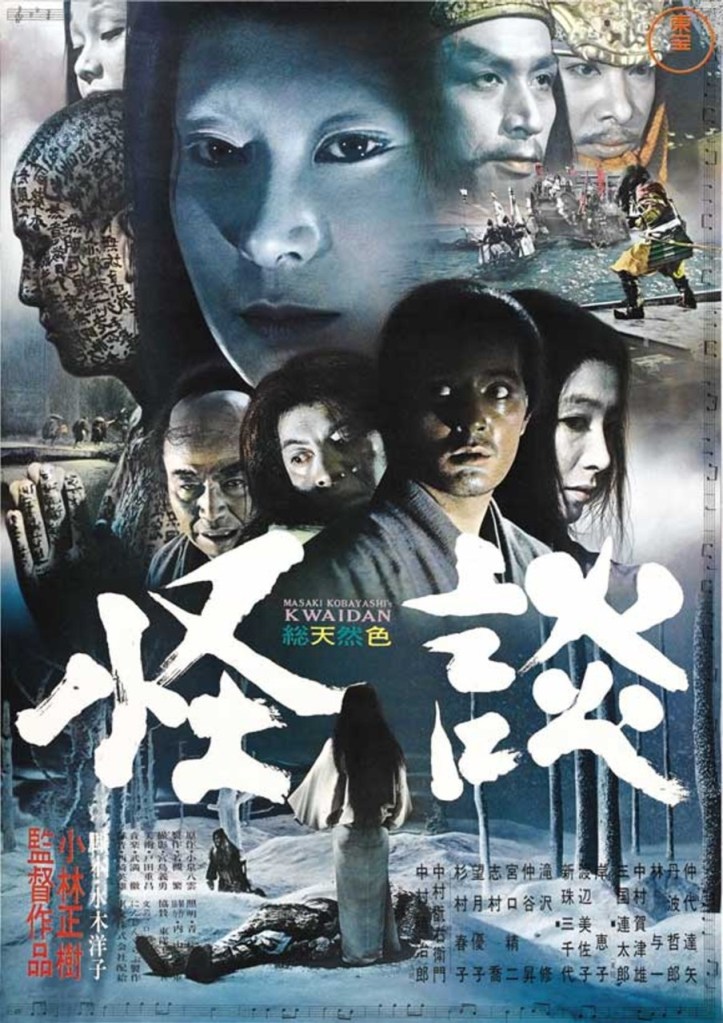 Kwaidan (怪談) is something of an anomaly in the career of the humanist director Masaki Kobayashi, best known for his wartime trilogy The Human Condition. Moving away from the naturalistic concerns that had formed the basis of his earlier career, Kwaidan takes a series of ghost stories collected by the foreigner Lafcadio Hearn and gives them a surreal, painterly approach that’s somewhere between theatre and folktale.
 Windows on Worlds