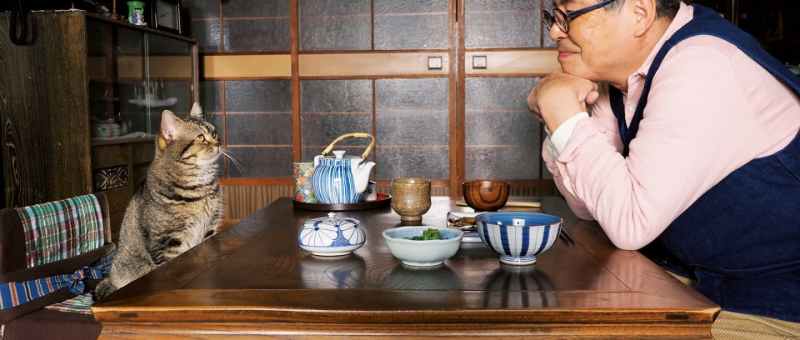
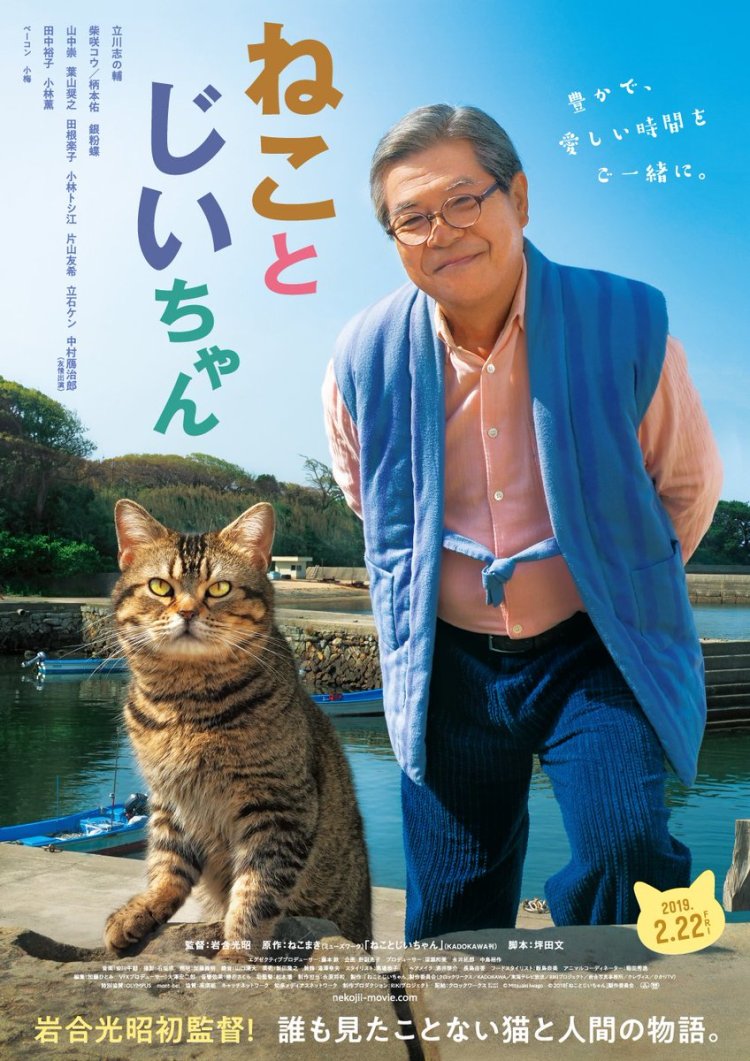
 “The best is yet to come” resolves 70-year-old Daikichi (Shinosuke Tatekawa) at the conclusion of The Island of Cats (ねことじいちゃん, Neko to Jiichan). Inspired by the manga by the appropriately named Nekomaki, the debut feature from wildlife photographer Mitsuaki Iwago is a decidedly laidback affair, neatly fusing two genres of Japanese comfort cinema – cats and cuisine. It’s also another in the recent run of films deliberately targeting the older generation in its quiet celebration of community and late life serenity, but it’s very existence is also perhaps a mild dig at cold and frenetic Tokyo which can’t help but pale next to the island’s inherent charms.
Daikichi has lived alone with his cat, Tama (who neatly introduces himself using the exalted “Wagahai” in a reference to Soseki’s famous novel), since his wife Yoshie (Yuko Tanaka) passed away two years previously. He has a grown-up son (Takashi Yamanaka) who is married with a teenage daughter of his own in Tokyo, but mostly spends his life hanging out with his old friends and playing with the island’s many cats. His peaceful days begin to change, however, when a pretty middle-aged (“young” to Daikichi and his friends) woman, Michiko (Kou Shibasaki), arrives from Tokyo and opens a cafe – the island’s first. In fact, the older generation find the cafe slightly intimidating, thinking such modern innovations are only for the youngsters, but are finally tempted in when directly invited by Michiko herself who serves up a selection of cream sodas and tasty ice creams in addition to slightly more rarefied treats like fish carpaccio.
In contrast to many an island drama, though the bulk of the population is older there are a fair few youngsters around and plenty of children too – at least enough to keep the local school open and the ferries running frequently. It is true however that most leave when they come of age either heading off to university on the mainland or seeking their fortunes in the cities. Nevertheless, the despite the absence of family the elderly are well cared for by the recently arrived young doctor (Tasuku Emoto) who takes his responsibility extremely seriously and is grateful for the opportunity to come to the island because it’s enabled him to become the kind of doctor he always wanted to be.
Michiko, meanwhile, has come to the island in search of relief from city life which she felt was gradually crushing her. An instant hit with the local cats as well as Daikichi and his friends, her presence adds a new energy to the island as the older generation start to enjoy both trying new things they thought perhaps were “inappropriate” when you’re old, and revisiting those they missed out on in their youth. Friends reconnect, bickering is exposed as an odd kind of affection, and cats just generally make everything better. The island may be dull compared to the bright lights of Tokyo, but it has its charms and those that live there are one big family taking care of each other and enjoying the laidback rhythms of coastal life.
Daikichi’s son, visiting when he can, is keen for him to come and live with the family in Tokyo but he and Tama are happy enough on the island just muddling through the way they always have surrounded by friends and happy memories. Reconnecting with his late wife through the recipe book she left behind, he resolves to learn a few dishes of his own – filling the rest of the pages with recipes learned from Michiko, his friends, newspapers and TV, determined to go on learning as long as he can. Sharing his life with others on the island, Daikichi too finds a new zest for living even as his days pass much as before, resolving that there is still plenty more to enjoy as he enters his twilight years. Gentle and mellow in the extreme, The Island of Cats is not promising much more than living up to its name but does its best to sell the charms of serene island life as Daikichi and his friends rejoice in the simple pleasures of shared cuisine and admiring “everybody’s” cats as they continue to do pretty much whatever they please while warming the hearts of the kindly islanders as they enjoy their days of fun and sunshine with nary a care in the world.
The Island of Cats screens in New York on July 20 as part of Japan Cuts 2019. It will also screen in Montreal as part of the 2019 Fantasia International Film Festival on July 28.
Original trailer (English subtitles)
 Never one to be accused of clarity, Seijun Suzuki’s Capone Cries a Lot (カポネおおいになく, Capone Ooni Naku) is one of his most cheerfully bizarre movies coming fairly late in his career yet and neatly slotting itself in right after Suzuki’s first two Taisho era movies,
  Yaro Abe’s manga Midnight Diner (深夜食堂, Shinya Shokudo) was first adapted as 10 episode TV drama back in 2009 with a second series in 2011 and a third in 2014. With a Korean adaptation in between, the series now finds itself back for second helpings in the form of a big screen adaptation.
 Windows on Worlds