Tokarev (トカレフ, Junji Sakamoto, 1994)

The discovery of a pistol concealed under a vending machine provokes a prolonged crisis of power and masculinity in Junji Sakamoto’s tense psychological drama, Tokarev (トカレフ). So named for the guns at its centre, the film roots itself in post-Bubble anxiety in the push and pull between two very different men mediated through the kidnapping of an innocent child who in the end pays a very heavy price for the anxieties and resentments that drive his parents’ generation.

That said, the kidnappers are actually very nice to little Takashi who looks strangely happy in the videotaped ransom note as the friendly voice of a youngish man encourages him to look towards the camera. They take him to an amusement park, buy him new shoes and ice cream, and even let him wave the gun around during the money drop but are it seems otherwise callously indifferent to his fate.

The boy’s father, Nishiumi (Takeshi Yamato), has just moved onto a danchi housing estate with his wife Ayako (Yumi Nishiyama). They seem very excited to start their new life, yet the danchi itself speaks of a post-war aspiration which now seems dated and largely absent in the contemporary society. Nishiumi drives the bus to the local kindergarten picking up the surprisingly large number of children from their block each morning. Meanwhile, their neighbour, Matsumura (Koichi Sato) seems irritated by their presence perhaps jealous of their happy family life as he returns home alone and angrily flips the cover over his motorbike before opening the door. 

On the morning in question, Matsumura has trouble kickstarting his bike yet Ayako seems strangely drawn to him perhaps attracted by a different and older kind of masculinity. Unlike her husband, Matsumura wears a suit to work everyday and carries a little salaryman-style purse yet he works a job that could be considered manual in a printing press where they produce newspapers. He later excitedly tells Ayako that he gets to read the news before anyone else, though his hands glide over notices of violent crimes including a shooting which may seem additionally exciting to him given that he is the man who discovered a gun under a vending machine in Christmas-set opening sequence. His cluttered home otherwise at odds with the sense of order he projects is full of old newspapers while he seems to listen to the same weather broadcast every day. 

The gun is later used by another man who fires it at Nishiumi before abducting Takashi from the kindergarten bus. It takes Nishiumi a few seconds to realise it’s Takashi who’s been taken, suddenly taking off at speed after him endangering the lives of the other kids. The sense of guilt and inadequacy slowly consumes him. “Takashi must be so disappointed,” he later laments to Ayako over the phone in his failure to live up to the socially defined codes of masculinity. His son was taken from him in front of his eyes yet he couldn’t do anything to save him. Matsumura meanwhile turns up near the crime scene having been shot in the shoulder claiming the kidnapper stole his bike. 

Perhaps it’s this uncanny proximity along with his odd expression and obvious effect on Ayako that leads Nishiumi to believe that Matsumura was somehow involved in the crime. In another instance of mid-90s technophobia, the clue is once again discovered via videotape as a guiltridden Nishiumi spots Matsumura in the crowd at his son’s sports day which is odd considering he has no children of his own and no reason to be there. The kidnapper also films the random drop on camcorder, black and white images capturing a crowded Shibuya presumably as some kind of insurance plan.

After being attacked and seriously injured, Nishiumi ends up in hospital where he ironically discovers a gun of his own stashed in the restroom by a visiting yakuza. As it had Matsumura, the gun gives him a new sense of power but also drives him into a frenzied obsession, dressing like a yakuza himself in a suit and dark glasses having alienated Ayako who eventually leaves him for Matsumura who has by this point usurped him as a man and patriarch, taking everything he ever had. No longer wishing to live, he embarks on a suicide mission to get his revenge on Matsumura. The pair of them essentially trade places, Matsumura now in check shirt and jeans while Nishiumi approaches in a suit each of them corrupted by the illusionary power of the gun. 

It later transpires that the kidnapper was also facing a crisis of masculinity in that his business was about to go bust, though Nishiumi was not a wealthy man or particularly good candidate for a ransom. The police, who are in fact completely useless, bungling their only opportunity to retrieve Takashi because they were caught off guard by the kidnapper giving him the gun, keep asking him if there’s anyone who might have held a grudge but as he points out there must have been thousands of incidents of petty annoyance that may have pushed someone over the edge dating all the way back to his childhood. The battle he finds himself in is one of vengeance to reclaim his wounded sense of masculinity while Matsumura in turn is determined to defend the new life he’s bought for himself or perhaps stolen from Nishiumi as a happy family man. Sakamoto keeps the tension high through the near wordless closing sequence in which the two men square off against each other with the intention of meeting their endgame each victims of the pervading sense of futility of the post-Bubble era.

Kaisha Monogatari: Memories of You (会社物語 MEMORIES OF YOU, Jun Ichikawa, 1988)

Kaisha monogatari dvd coverJapanese corporate life is a strange thing – sometimes more cult than job, the company demands absolute dedication from its devotees though it promises them little more than a guaranteed life of toil. Being cast out from one’s company is akin to being robbed of one’s identity. Retirement is therefore not quite so much of a reward as an excommunication – especially to those who have given so much of themselves to an employer that they don’t quite know who they are when the suit comes off. This is especially true of the hero of Jun Ichikawa’s 1988 existential drama, Kaisha Monogatari: Memories of You (会社物語 MEMORIES OF YOU). The title is deceptively romantic – in fact there was an identically titled idol starring melodrama released the same year, but it is in a way a love story of an old man who finally gets a chance to reunite with the dreams he abandoned in youth while coming to terms with his old age and the various ways the world has moved past him.

Very early one morning, veteran salary man Hanaoka (Hajime Hana) stares into the empty screen of his television set from the comfort of his kotatsu, examining his own tearful face before his wife gets up to prepare breakfast. Hanaoka is set to retire soon, after 34 years of corporate life. His career has been unremarkable and he has few friends at the office – he feels he most likely will not be missed when he goes. Home life is not too successful either. Hanaoka’s grown-up daughter has come home with a daughter of her own after a divorce, and Hanaoka’s son is currently a NEET would-be-student supposedly studying to retake entrance exams though his mother is convinced he’s just messing around and avoiding getting a job.

Though Hanaoka is a section head, it’s clear he’s not rated by his colleagues who gossip about him behind his back while his mild and timid nature sees him sitting quietly forgotten in the back of meetings. He does however have admirers including one of the older ladies in the admin staff who has always been comforted by Hanaoka’s gleeful laughter, suddenly feeling the world expand as she watched him beavering away earnestly. Despite this, nobody is very excited about his leaving party. Discussing things among themselves, the office ladies lament that planning farewell parties is either too depressing to just too much hassle, while gossiping guys in the men’s room complain that Hanaoka was never very good at his job anyway and his leaving do will be a “pitiful” affair. All of this proves too much for the kind hearted, shy, Hanaoka who eventually decides to have a goodbye note distributed around the office in which he tells everyone that there’s no need to bother with yet another office party in the overly festive December to the relief (and consternation) of all.

Hanaoka does, however, have to write his official goodbye for the company newsletter (1000 characters due by Dec. 15). Struggling to find the words, he writes a first draft in which he declares the deep sorrow he feels on having to leave his corporate family behind – after all these are people he’s dined and gone drinking with for 34 years, through good times and bad, company picnics, and away days. He’s spent longer with the office ladies than his wife, had more conversations with his subordinates than with his son. The company has been his life, and leaving it is a kind of death. Embarrassed he screws up the draft and throws it away, only to encounter another salaryman returning late (and more than a little the worse for wear) who lets him have a go on the very high tech laser guns he’s just won at bingo.

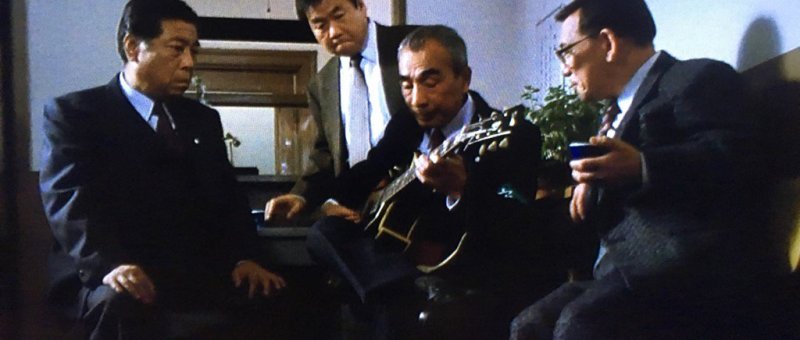
Yet Hanaoka does manage to find a solution in reconnecting with his younger self and makes a few new friends in the process. In his youth, Hanaoka was a jazz drummer – sophisticated as it is, jazz was the music of his glory days and so he finds many of the other men in his position share his love of music and were also forced to abandon their musical dreams for corporate careers. Now freed of the burdens of the salaryman, they decide to form a band of their own and even to give a special concert in place of Hanaoka’s leaving do.

Meanwhile, Yumi (Yumi Nishiyama), the office lady who reminds Hanaoka of his younger self, is undergoing something of a crisis when she realises that her boyfriend is not as serious about the relationship as she is and has been seeing someone else behind her back – the CEO’s daughter whom he intends to marry to further his career. Kaisha Monogatari is, in many ways, the passing of a baton from the post-war generation to the bubble era though getting ahead through advantageous arranged marriage is apparently still a viable option. Those of Hanaoka’s age had to work hard, rebuilding the nation after crushing wartime defeat from bombed out ruins to the economic miracle of the East. Their children, by contrast had things easy – they hardly have to worry at all. Hanaoka’s son, apparently a delinquent lost and confused by the comparative freedom of economic stability, has no need to submit himself to the insane demands of life as a company man but millions like him will, because that’s just what you do.

Hanaoka finds a way to break out of the corporate straightjacket through re-embracing his love of jazz, proving there is something left inside him when you strip the company man away but there is nevertheless something sad in having wasted so much time slaving away for a organisation that is ultimately so ungrateful for the sacrifice. A gloomy picture of bubble era Japan in which families are fragmenting, young men choose career over love, and old men are made to feel worthless once their economic function is spent, Kaisha Monogatari: Memories of You does offer the faintest glimmer of hope in the goodness of men like Hanaoka, no matter how they may have failed those around them, whose lives may be brighter when finally allowed to be themselves again.