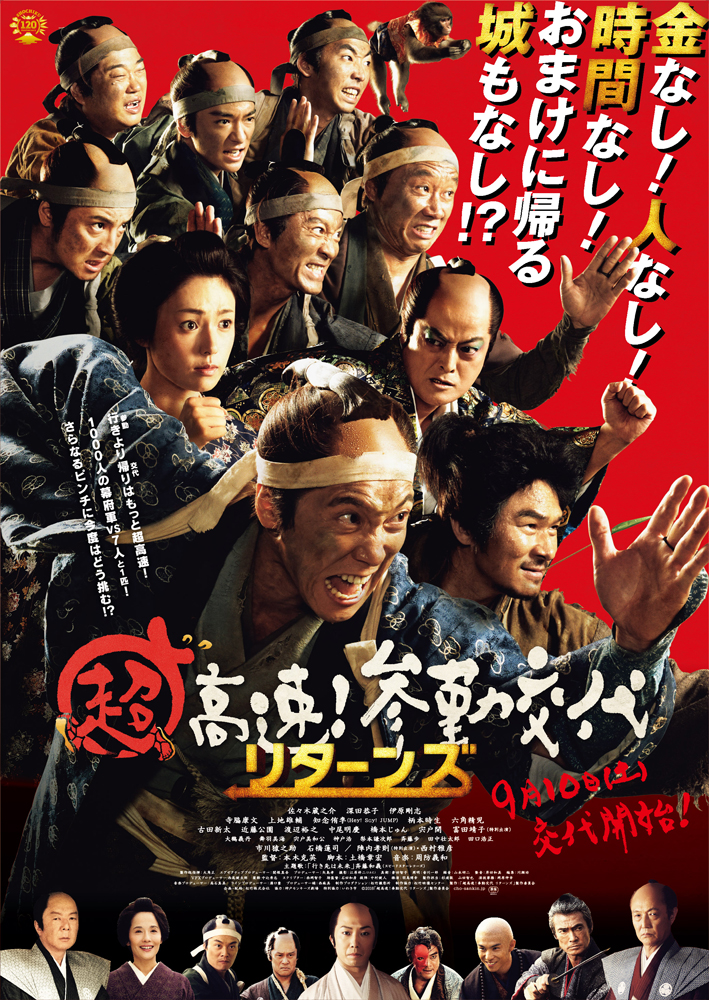
Samurai Hustle Returns (超高速!参勤交代 リターンズ, Katsuhide Motoki, 2016)

At the conclusion of 2014’s Samurai Hustle, it seemed that samurai corruption had been beaten back. Corrupt lord Nobutoki had got his comeuppance and the sympathetic “backwoods samurai” Naito was on his way home having found love along the way. Of course, nothing had really changed when it comes to the samurai order, but Naito was at least carving out a little corner of egalitarianism for himself in his rural domain. 

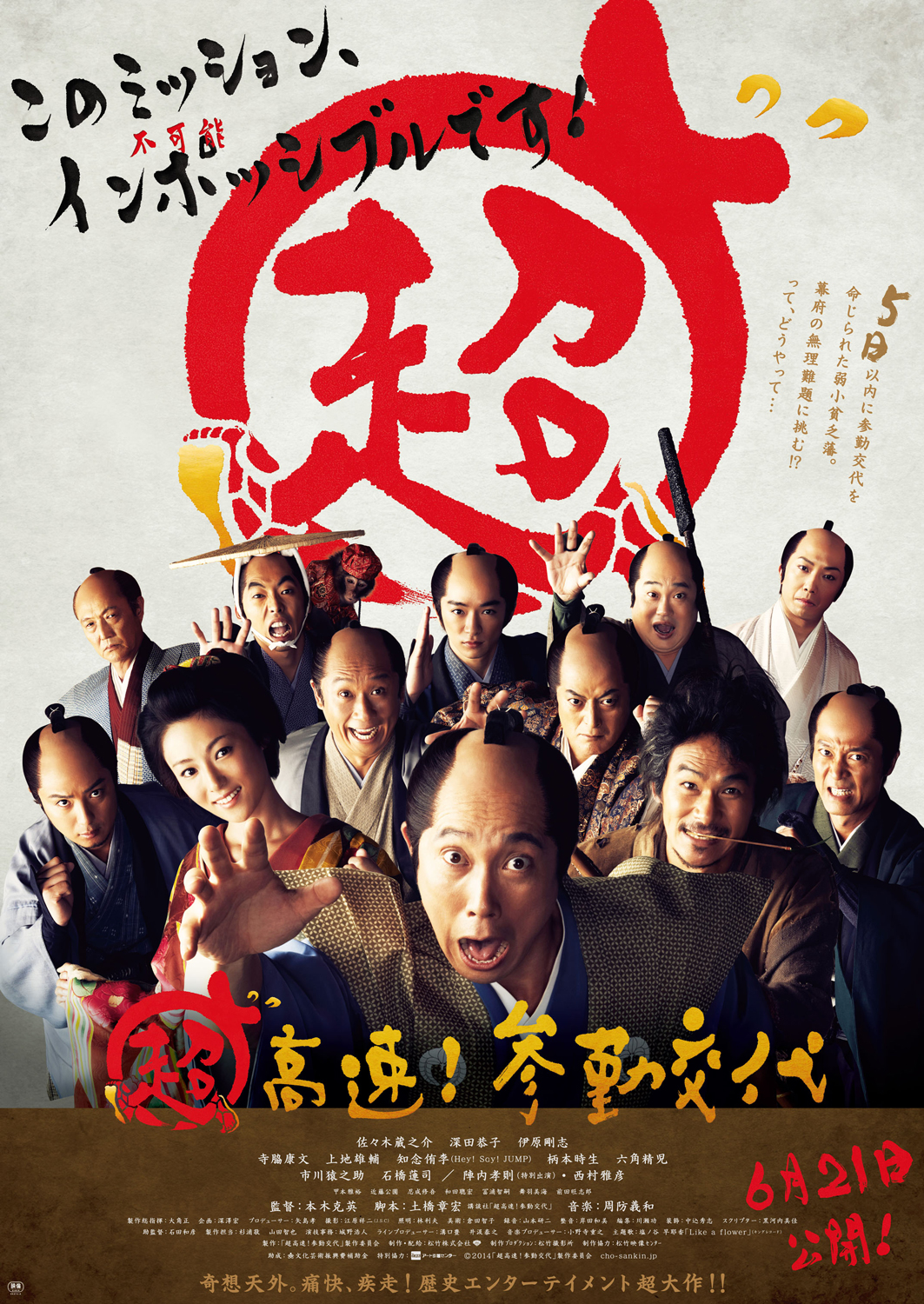
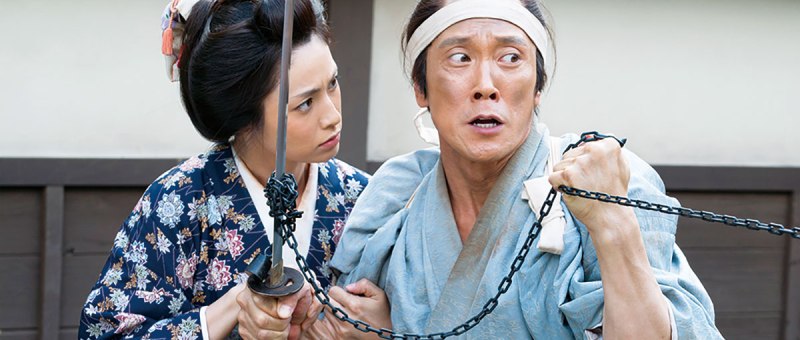
The aptly named Samurai Hustle Returns (超高速!参勤交代 リターンズ, Cho kosoku! Sankin kotai returns) picks up a month later with Naito (Kuranosuke Sasaki) taking a rather leisurely journey home in preparation for his marriage to Osaki (Kyoko Fukada) only to receive news that there has been a “rebellion” in Yunagaya. Predictably, this turns out to have been orchestrated by none other than Nobutoki who has been released early from his house arrest thanks to his close connections with the shogun but has been humiliated at court and is otherwise out for revenge with a slice of treasonous ambition tacked on for good measure. Just as in the first film, but in reverse, Naito and his retainers must try to rush home to get there before the imperial inspector arrives or else risk their clan being disbanded. 

Meanwhile, the shogun is absent at the wheel after having decided to resurrect an old tradition abandoned because of its expense and inconvenience to make a pilgrimage to Nikko. In an interesting parallel, the farmers are uncharacteristically upset with Naito, blaming him for the destruction of their fields because he wasn’t there to protect them. Naito also feels an additional burden of guilt given that, having run flat out all the way to Edo, he took his time coming back leaving his lands vulnerable to attack while he now risks losing the castle. Nobutoki wastes no time at all looking for various schemes to undermine him while secretly plotting to overthrow the shogun and usurp his position for himself. 

As in the first film, the battle is between samurai entitlement and the genial egalitarianism of Naito’s philosophy. “The real lords of Yunagaya are people like you who are one with the soil,” he tells the farmers, while Nobutoki sneers that “lineage rules supreme in this world, inherited wealth breeds more”. It doesn’t take a genius to read Nobutoki’s machinations as a reflection of his insecurity, that he invests so much in his rights of birth because he has no confidence in his individual talents. Naito counters that it’s the people around him that matter most, “people are priceless. Friends are priceless,” but Nobutoki rather sadly replies that people will always betray you in the end. Even the shogun eventually agrees that “anger brings enemies, forbearance brings lasting peace” but treats Nobutoki with a degree of compassion that may only embolden him in his schemes.

“Nepotism has endangered the shogunate,” the shogun ironically sighs apparently lacking in self-awareness even if beginning to see the problems inherent in the samurai society but presumably intending to do little about them. “No government should torment its people,” Naito had insisted on boldly deciding to retake his castle but even if this particular shogun is not all that bad, it’s difficult to deny that his rule is torment if perhaps more for petty lords like Naito than for ordinary people or higher-ranking samurai. Naito struggles to convince Osaki that she is worthy of his world and only finally succeeds in showing her that she has nothing prove and love knows nothing of class. The people of Yunagaya are impoverished but happy, satisfied with the simple charms of pickled daikon unlike the greedy Nobutoki whose internalised sense of inadequacy has turned dark and self-destructive. 

Then again, Naito is still a lord. He obeys the system out of love for his clan and a genuine desire to protect those around him but otherwise has little desire to change it actively even if his quiet acts of transgression in his closeness with the villagers and professions of egalitarianism are in their own way a kind of revolution in a minor rejection of the shogun’s authority to the extent that the time allows. Nevertheless, with his return journey he once again proves the ingenuity of a backwoods samurai getting by on his wits as he and his men race home to save their small haven of freedom from samurai oppression from the embodiment of societal corruption.


Trailer (no subtitles)
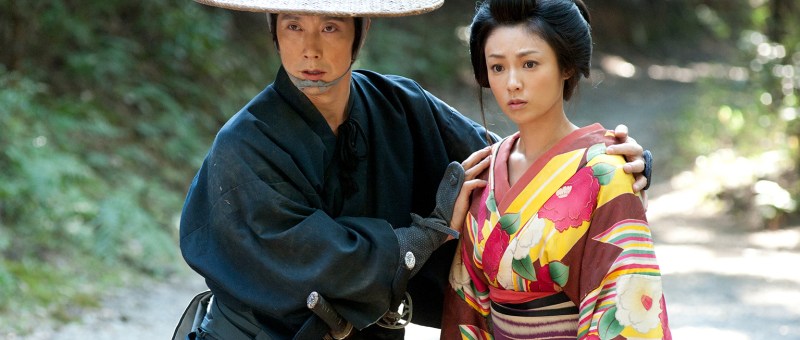
Samurai Hustle (超高速!参勤交代, Katsuhide Motoki, 2014)

A kindhearted lord finds himself in deep trouble when he’s suddenly called back to Edo despite having just returned from his biennial service in Katsuhide Motoki’s jidaigeki comedy Samurai Hustle (超高速!参勤交代, Chokosoku! Sankin Kotai). Set in 1735, the film is in some senses unusual in pointing the various class biases even with the hierarchal samurai society as the tiny rural clan at the film’s centre are swept into intrigue by the machinations of an ambitious courtier who thinks they lied about their goldmine being extinct and plans to get his hands on it by dobbing them in to the Shogun.

The problem is that they really weren’t lying. The Yunagaya clan is dirt poor, especially after having spent a small fortune travelling to Edo and back. In this era, even distant lords were called to Edo every two years to serve at court. They were expected to parade to the capital in style, showing off their wealth and status as they go which is of course inordinately expensive. The expense was the point. Practices like these along with forcing clans to move domains on a whim were designed to weaken their resources so they’d have no recourse to rebellion even if they were even more annoyed about being forced to travel back and fore for no real reason. 

It took Lord Naito (Kuranosuke Sasaki) and his retinue 10 days to walk home, which is why it’s even more of a shock to get a letter telling them to high-tail it back in five or risk being dissolved by the shogun. Evil retainer Nobutoki (Takanori Jinnai) knows it’s impossible for them to arrive on time which is how he plans to get his hands on the gold. What he didn’t count on, however, is the unexpected scrappiness of a “backwoods samurai” who’s used to having to find ingenious solutions to difficult problems because he doesn’t have the money to solve them. Nobutoki is essentially a snob who looks down on country folk and thinks Naito does not befit the rank of a samurai anyway, sneering at his humble gift for the Shogun of some locally sourced daikon pickles. 

The homeliness of the daikon signals Naito’s down to earth nature as a fairly egalitarian samurai who doesn’t really care about hierarchy and status even if he knows he has to play the game. What he cares about is the safety and happiness of his people, which is one reason he’s going to bust his arse to get back to Edo and clear his name. Aside from his humanitarian principles, also giving away some of their rice stocks to neighbouring clans suffering during a time of famine, Naito is also thought of as an eccentric because of his severe claustrophobia which makes it impossible for him to close the door when using the bathroom, let alone travel in a palanquin, though he’s found an ingenious solution for that one too. 

In an odd kind of paradox, he becomes a defender to proper samurai values in his opposition to Nobutoki who plays fast and dirty, sending out ninja assassins on the road to try to ensure he won’t make it to Edo before the deadline. Meanwhile, he bonds with a feisty sex worker who, like him, is dealing with childhood trauma and is sick of entitled noblemen who look down on the poor despite being a fellow human who as she puts it poops and screws just like everyone else. In a way she frees him from the confines of his hierarchal existence by helping him overcome his claustrophobia, at least while she’s at his side, while he saves her from her oppression by transgressing class boundaries and bringing her into the samurai world if only as a concubine.

Nevertheless, as he warns her, being poor is hard even when you’re a samurai, and ironically his circumstances aren’t much better than hers even if he has a superficial level of comfort and security tempered by his genuine ability to appreciate the simple charms of daikon over fancy Edo cuisine. After all, sometimes samurai become peasants or peasants become samurai and for an impoverished lord like Naito the distinction is fairly thin, though he evidently does his best to protect those around him from both sides of the class divide while remaining unafraid to tell the Shogun exactly what he thinks of him. After all, you’ve got to roll with the times, especially if you’re a backwoods samurai at the mercy of a harsh and arbitrary system but also far enough away from the mechanisms of power to begin to ignore them. 


Trailer (no subtitles)

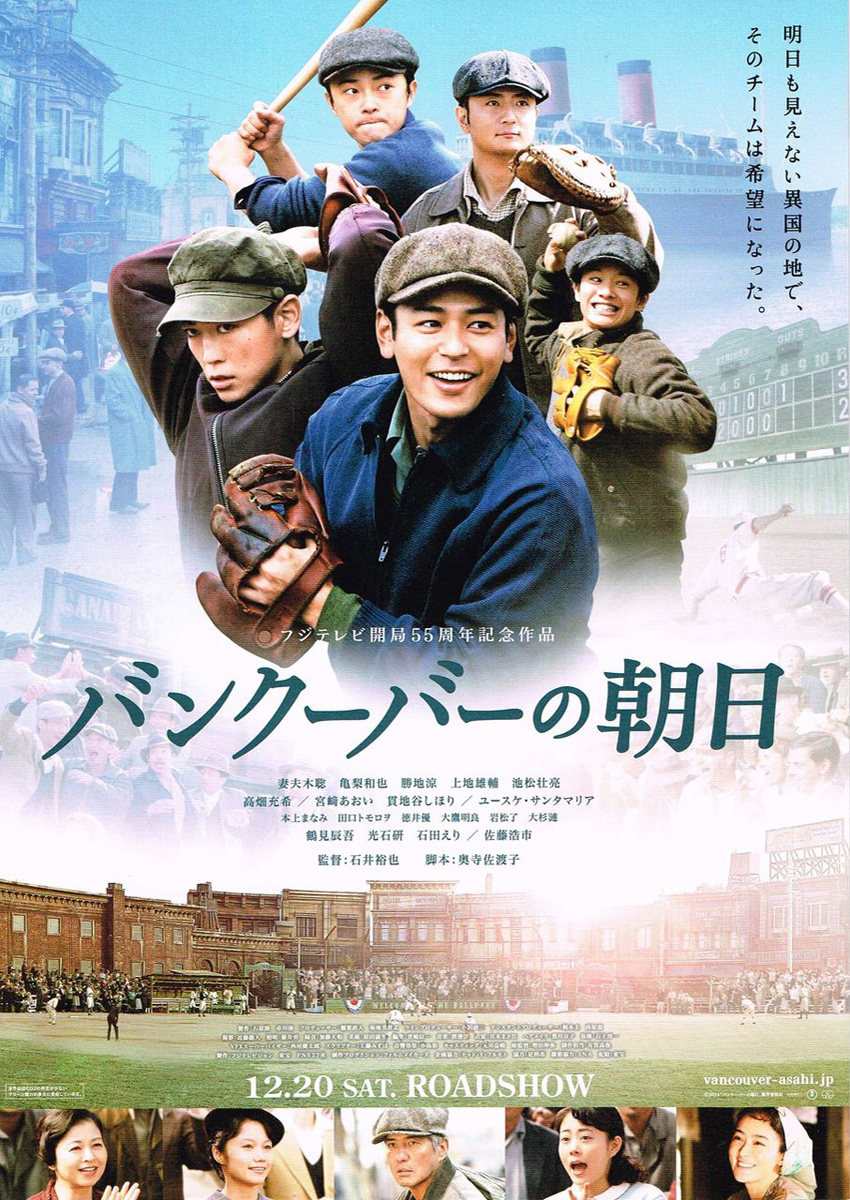
The Vancouver Asahi (バンクーバーの朝日, Yuya Ishii, 2014)

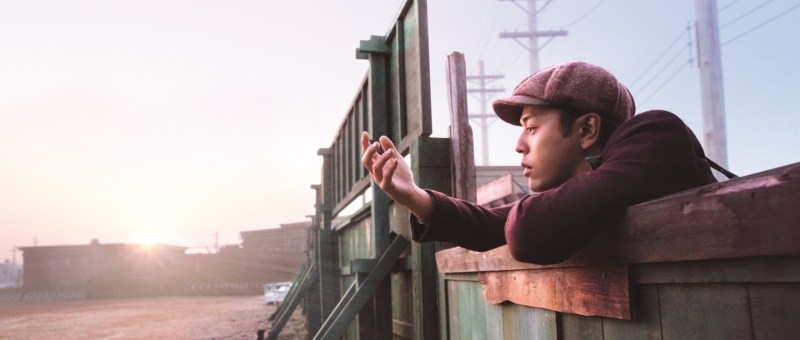
Second generation Japanese-Canadians stake their hopes on baseball in Yuya Ishii’s historical drama The Vancouver Asahi (バンクーバーの朝日, Vancouver no Asahi), inspired by the story of the Vancouver Asahi baseball team which was belatedly granted a place in the Canadian Baseball Hall of Fame in 2003. In many ways a conventional sporting movie in which the underdogs eventually triumph, Ishii does not shy away from the dark shadows of the 1930s even while framing the Asahi’s path to glory as a symbolic punch back against discrimination and oppression. 

As the hero, Reggie (Satoshi Tsumabuki), relates, many like his parents came to Canada at the beginning of the 20th century planning to work for three years and then return to a more comfortable life in Japan only to find themselves trapped in low-paid and exploitative work. Reggie’s main concern is that his drunken and dejected father Seiji (Koichi Sato) still sends the majority of his pay back relatives in Japan meaning their family live like paupers while as he never meant to stay he hasn’t bothered to learn the language or attempt to integrate into the local community. In fact, Reggie is their major breadwinner with his job at the sawmill but the only thing that makes his life worth living is playing baseball with the Vancouver Asahi baseball team even though they are regarded as something of a joke, always at the bottom of the league tables and never actually winning a game. 

The plight of Asahi is closely aligned with that of the immigrant community, divided as it is in its approach to integration with some feeling they should abandon their Japaneseness in order to better get along with Canadians and others fiercely determined to hang on to their traditions. When Reggie admits that they can’t win against the power of the Canadians it feels as if he’s talking about more than just baseball though his solutions are perhaps apt for both in realising that to beat strength you need to be smart. What he comes up with is essentially a bunt and run strategy that plays to their advantages of speed and lightness but also at times feels to him like a trick or a gimmick, an admission that they can’t compete in the normal way. “Why are you always apologising?” Reggie is repeatedly asked, his shyness and mumbling speech always seeking to keep the peace while his desire to offer justification is less as one Japanese old lady puts it “a bad habit of their culture” but a defence mechanism in an environment of potentially violent oppression. 

As Japanese migrants the family faces constant xenophobic micro aggressions, a woman at the hotel refusing to let Reggie’s bellboy friend Frank (Sosuke Ikematsu) carry her bags while they are also suspected as thieves or harassed by the local Canadians. Reggie’s hothead friend Kei (Ryo Katsuji) finds it increasingly difficult to keep his cool, not least as it turns out because his father was killed fighting for the Canadians in the last war and yet he is still treated as a dangerous outsider. Meanwhile, they are paid only half the wages of the Canadian workers, expected to work unreasonable hours, and can be fired without warning. Now an ageing man, Seiji is still a casual labourer fighting for a place on a truck to work at a quarry or construction site often in other towns away from his family in order to get more money. The team is constantly losing players because men lose their jobs and focus on finding new ones or moving away. As one old man laments, there’s no job security and even if you go to a Canadian university it won’t make any difference to your job prospects. Reggie’s sister Emi (Mitsuki Takahata) was on track for a scholarship only to have it pulled at the last minute when parents of the other kids complained it wasn’t right it was going to a Japanese girl. 

After the hotel fires all of its Japanese staff, Frank decides to go “back” to Japan where relatives will help him find work but pointing out to Reggie that he’ll still be seen as an outsider even there and there’s no guarantee anything will be any better in Japan. Poignantly the guys later catch sight of him in a newsreel as a soldier having been sent to the Machurian front. Once war breaks out they are discriminated against again, forced out of their homes and interned leaving all their property behind and destroying their small community, the Asahi included. The team’s unexpected success had forged a bridge between the Japanese and Canadian communities but it was not strong enough to survive the war. Stepping away from the sports movie, Ishii concentrates more on the ways they were betrayed, the team’s success later buried and forgotten while they find the advances they’d made washed away on the shore as if to suggest their strike back against an oppressive society could never be more than superficial while their position remains so precarious. 


Trailer (no subtitles)

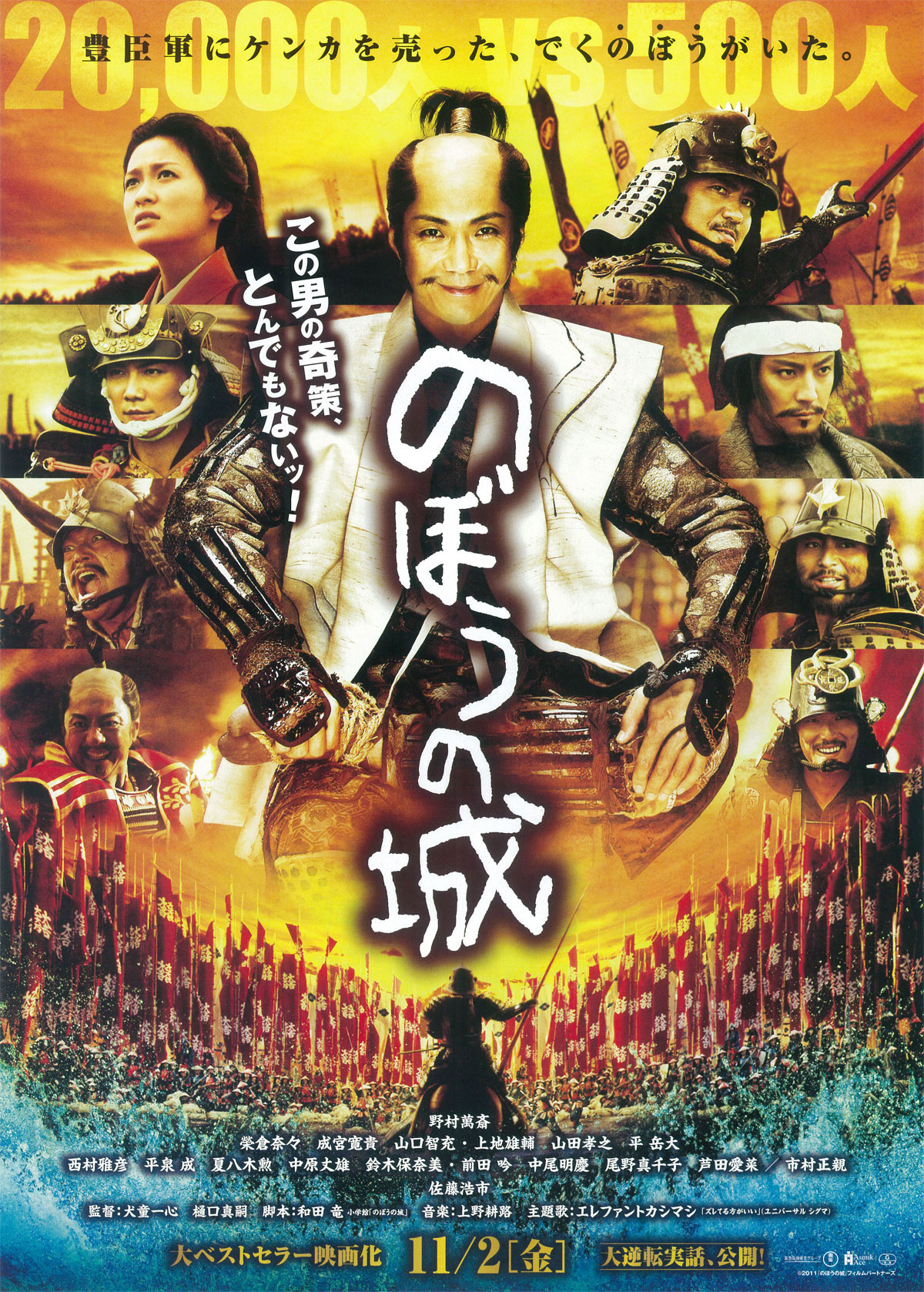
The Floating Castle (のぼうの城, Isshin Inudo & Shinji Higuchi, 2012)

What happens if you call the bluff of those who thought they could take your complicity for granted? As it turns out, at least in the case of a small provincial outpost in Isshin Inudo & Shinji Higuchi’s lighthearted historical drama The Floating Castle (のぼうの城, Nobo no Shiro), something and nothing. Inspired by a real life incident which took place in 1590, 10 years prior to the era defining battle of Sekigahara, the film asks how far standing up to corrupt authority will get you but as history tells us this this is the twilight of the Sengoku warring states period and in the end any victory can at best be only partial and temporary. 

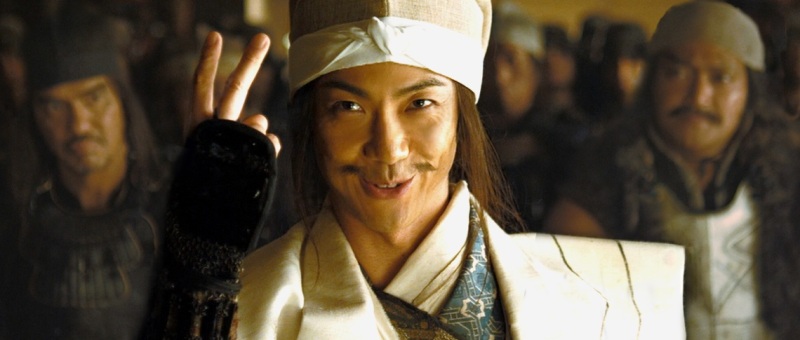
With Hideyoshi Toyotomi (Masachika Ichimura) poised to unify all of Japan under his rule he turns his gaze towards Hojo, the last remaining hold out in the East of Japan. The small castle of Oshi is asked to commit its forces to protecting the main castle at Odawara where lord Ujinaga (Masahiko Nishimura) is to meet with the head of the clan which has decided to resist the Toyotomi invasion. Ujinaga meanwhile is privately doubtful. He knows they do not have the manpower to protect themselves and the only viable course of action is immediate surrender though he cannot of course say this openly even if buffoonish lord in waiting Nagachika (Mansai Nomura) is brave enough to raise the idea of neutrality in front of the messengers. Preparing to head to Odawara, Ujinaga tells his closest retainers to strengthen defences but to open the castle should the enemy approach while revealing that he plans to write to Hideyoshi, whom he apparently knows personally, and privately pledge allegiance in order to avoid destruction. 

Nagachika, however, eventually makes the decision to resist following the arrogant entreaty from Natsuka (Takehiro Hira), the right-hand man of the Toyotomi retainer leading the assault, Mitsunari Ishida (Yusuke Kamiji). He does this largely because Natsuka makes the unreasonable demand that they surrender their princess, Kai (Nana Eikura), herself a fearsome warrior though somewhat sidelined here relegated to the role of contested love interest, to be sent to Hideyoshi as a concubine but also correctly reads that Natsuka and Ishida are overreaching and actually have little more than their bluster to leverage other than the 20,000 men standing behind them which they may not know how to use. Nagachika may play the clown, but he’s not stupid and knows that the 20,000 men are there for the purposes of intimidation and are not expecting a force of a mere 500 to tell them where to go so it stands to reason to think they are not entirely prepared for battle. 

In this he’s mostly correct. Hideyoshi has essentially given Ishida, previously in finance, an easy ride to improve his reputation among the other lords instructing the more experienced Yoshitsugu Otani (Takayuki Yamada) to ensure he comes back painted in glory. Otani had said that others admired Ishida for his “childlike sense of fair play”, but his sense of fair play is often childish as in his gradual realisation that everyone is surrendering to him because of the 20,000 men rather than his prowess as a general annoyed with his enemies for backing down from a challenge which is why he sends Natsuka to alienate Nagachika hoping to provoke a battle which no rational person could ever describe as “fair”. Having assumed that Nagachika would back down or that the castle would be easy to take with only 500 country bumpkin soldiers defending it, the Toyotomi are in for a rude awakening discovering the extent of the counterstrategies in place to protect the small provincial outpost, forced into a humiliating defeat licking their wounds from a nearby hill. 

But then, as Ishida manically proclaims power comes from one thing, gold, using his vast resources to dam two nearby rivers and then burst them to drown the town as Hideyoshi had done once before. Designed by effects specialist Higuchi the flooding of the town is indeed terrifying, a spectacle which delayed the film’s release as the eerie similarities with the catastrophic tsunami of the year before may have been too traumatic for audiences, and speaks to nothing if not Ishida’s intense cruelty in which he is willing to go to any lengths in order to win even destroying the lives of innocent farmers far removed from these petty samurai games. As the film would have it, his arrogance and entitlement eventually come for him, his trap turned back on himself after an ill-advised potshot at Nagachika, a natural leader beloved by all because rather than in spite of his deceptive clownishness, causes disillusionment with his leadership. 

In any case, we already know how this story ends, Ishida is defeated at Sekigahara and beheaded in Kyoto. Nagachika’s victory can be only partial and in fact does not even win him the thing he went into battle for even if he strikes a blow at corrupt government in refusing to simply give in to intimidation, calling their bluff and showing them they cannot continue to push smaller clans around solely with the threat of extinction. In the end they are all at the mercy of their superiors, a truce imposed and imperfect to each side in an act of compromise which spells the end of an era many of those surviving the battles voluntarily renouncing samurai status as if realising their age is drawing to a close, Nagachika proved on the right of history in cultivating links with the Tokugawa soon to take the Toyotomi’s place as rulers of a unified Japan. His resistance was then not foolhardy but justified, necessary, and principled in standing up to injustice even if it could not in the end be fully stopped. 


The Floating Castle streamed as part of Japanese Film Festival Online 2022.

International trailer (English subtitles)

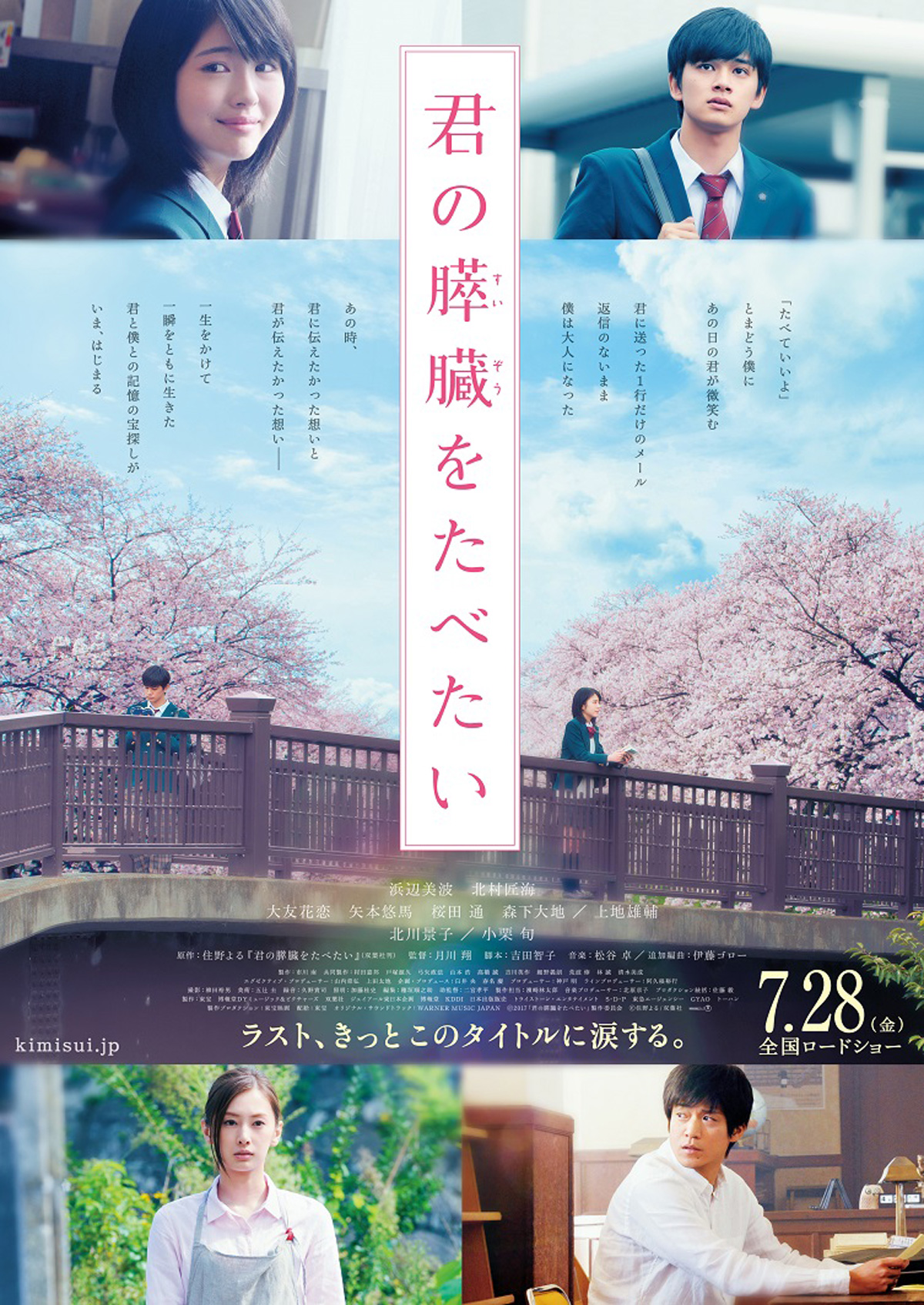
Let Me Eat Your Pancreas (君の膵臓をたべたい, Sho Tsukikawa, 2017)

Let me eat your pancreas posterBack around the turn of the century, a new kind of melodrama was taking the Japanese box office by storm. “junai” or “pure love” was not exactly new in terms of genre but began to grow in popularity in the early 2000s thanks to growing interest in Korean television drama, finally hitting its zenith in 2004 with Crying Out Love in the Centre of the World. The junai boom lasted only a couple of years, but Japanese cinema has never been able to get enough of tragic stories of first love destroyed by cruel fate and, ironically enough, returns with the improbably titled Let Me Eat Your Pancreas (君の膵臓をたべたい, Kimi no Suizo wo Tabetai) which sets its fictional past in 2003 – exactly the same time as the contemporary presents of the junai classics.

In 2012, Haruki Shiga (Shun Oguri) is a melancholy high school teacher who can’t decide if teaching is really his vocation and has a resignation letter sitting in his desk. Meanwhile, he is handed a slightly upsetting task by his boss – the school library has become too rundown to consider renovating and so it’s going to have to close. When Shiga was a high school student at this very school, he also ran the library club (he now has a qualification in librarianship) and so he seems to be the perfect person to ensure everything gets packed up and dealt with in the proper fashion. The library, however, holds some painful memories for him – of a girl he grew close to for only a few months while she battled a terminal illness and changed his life forever.

12 years previously, Sakura (Minami Hamabe), a popular young woman, drops her sickness diary on leaving the hospital, whereupon Shiga picks it up and unwittingly becomes the only person outside of Sakura’s family to know that she is suffering from a degenerative pancreatic illness and has only a couple of years at most to live. She knows her case her is hopeless and the treatment she receives will only prolong her life temporarily while easing her symptoms, but is determined to live out the rest of her days to the fullest.

Unlike Sakura, Shiga (Takumi Kitamura) describes himself as a loner who isn’t good with people. He spends his days with a book in his hand and is thought of by most of his classmates (if they think of him at all) as the creepy silent boy. Thus his unexpected friendship with Sakura raises more than a few eyebrows with the other kids, especially Sakura’s best friend Kyoko (Karen Otomo) who is both jealous and confused as to why her friend has suddenly started hanging out with the loser boy. Then again it’s precisely because of this aloofness that Sakura first believes she can entrust her final days to Shiga – as virtual strangers it’s much easier to process the idea of an ending, if Sakura had tried to confide in Kyoko about her illness it would only have marred the end of their friendship. Shiga is detached, he doesn’t get emotionally involved, but despite himself still cares which makes him the ideal point of support for a girl longing to escape a carefully ordered life to get a taste of everything she knows she will miss.

Let Me Eat Your Pancreas may situate itself in the junai era of the early 2000s, but owes an undeniable debt to Shunji Iwai’s seminal 1995 romantic melodrama Love Letter and even borrows its central library conceit with a hidden message which eventually reaches its destination much later than intended. Like Love Letter, in which one of the heroines is perpetually worried about the possible repercussions of minor illnesses, Pancreas is keen to remind us that the truth is we are all dying and illness or not today might be our last day – it’s best to make the most of it without sitting around worrying about what the future might hold.

Sakura, dying yet so full of life and energy, is keen to impart her life philosophy to the introverted Shiga. For Sakura life is about connection, sharing experiences with others be they joy or pain. Shiga, though loathed to admit it, is in his own way desperately lonely but has resolved himself to surviving alone, believing that he lacks the ability connect meaningfully with other people. His nascent connection with Sakura is destined to end in tragedy but does at least begin to release something in him which had long been suppressed. Even so, as an adult he’s just as withdrawn and isolated as he’d been as a teen and it’s not until he’s forced to revisit this traumatic incident in his early life that he learns the full value of its lessons. Let Me Eat Your Pancreas, though wilfully embracing some of the genre’s more problematic elements, is a beautifully affecting return to the world of junai which manages to turn a story of death and tragedy into a celebration of life and love as its isolationist hero begins to find the strength to embrace the art of being alive no matter how painful it may turn out to be.


Original trailer (no subtitles)

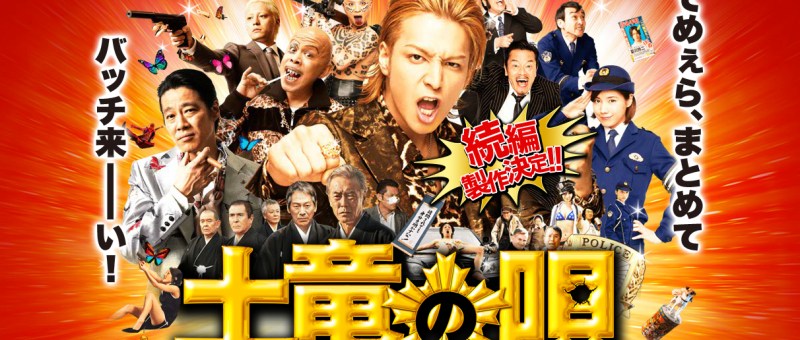
The Mole Song: Undercover Agent Reiji (土竜の唄 潜入捜査官 REIJI, Takashi Miike, 2013)

mole song under cover agent reiji poserYakuza aren’t supposed to be funny, are they? According to one particular lover of Lepidoptera, that’s all they ever need to be. Scripted by Kankuro Kudo and adapted from the manga by Noboru Takahashi, Takashi Miike’s The Mole Song: Undercover Agent Reiji (土竜の唄 潜入捜査官 REIJI, Mogura no Uta: Sennyu Sosakan Reiji) is the classic bad spy comedy in which a hapless beat cop is dragged out of his police box and into the field as a yakuza mole in the (rather ambitious) hope of ridding Japan of drugs. As might be assumed, Reiji’s quest does not quite go to plan but then in another sense it goes better than anyone might have hoped.

Reiji Kikukawa (Toma Ikuta) is, to put it bluntly, not the finest recruit the Japanese police force has ever received. He does, however, have a strong sense of justice even if it doesn’t quite tally with that laid down in law though his methods of application are sometimes questionable. A self-confessed “pervert” (but not a “twisted” one) Reiji is currently in trouble for pulling his gun on a store owner who was extracting sexual favours from high school girls he caught shop lifting (the accused is a city counsellor who has pulled a few strings to ask for Reiji’s badge). Seizing this opportunity, Reiji’s boss (Mitsuru Fukikoshi) has decided that he’s a perfect fit for a spell undercover in a local gang they suspect of colluding with Russian mafia to smuggle large amounts of MDMA into Japan.

Reiji hates drugs, but not as much as his new best buddy “Crazy Papillon” (Shinichi Tsutsumi) who is obsessed with butterflies and insists everything that happens around him be “funny”. Reiji, an idiot, is very funny indeed and so he instantly gets himself a leg up in the yakuza world whilst forming an unexpectedly genuine bond with his new buddy who also really hates drugs and only agreed to join this gang because they promised him they didn’t have anything to with them.

Sliding into his regular manga mode, Miike adopts his Crows Zero aesthetic but re-ups the camp as Reiji gets fired up on justice and takes down rooms full of punks powered only by righteousness and his giant yakuza hairdo. Like most yakuza movies, the emphasis is on the bonds between men and it is indeed the strange connection between Reiji and Papillon which takes centerstage as Miike milks the melodrama for all it’s worth.

Scripted by Kankuro Kudo (who previously worked with the director on the Zebra Man series), Reiji skews towards a slightly different breed of absurdity from Miike’s patented brand but retains the outrageous production design including the big hair, garish outfits, and carefully considered colour scheme. Mixing amusing semi-animated sequences with over the top action and the frequent reoccurrence of the “Mole Song”, Miike is in full-on sugar rush mode, barely pausing before moving on from one ridiculous set piece to the next.

Ridiculous set pieces are however the highlight of the film from Reiji’s early series of initiation tests to his attempts to win the affections of his lady love, Junna (Riisa Naka), and a lengthy sojourn at a mysterious yakuza ceremony which Reiji manages to completely derail through a series of misunderstandings. At 130 minutes however, it’s all wearing a bit thin even with the plot machinations suddenly kicking into gear two thirds of the way through. Nevertheless, there’s enough silly slapstick comedy and impressive design work at play to keep things interesting even if Reiji’s eventual triumph is all but guaranteed.


Screened as part of the Japan Foundation Touring Film Programme 2018.

Screening again:

  • Queen’s Film Theatre – 21 February 2018
  • Phoenix Leicester – 24 February 2018
  • Brewery Arts Centre – 16 March 2018
  • Broadway – 20 March 2018
  • Midlands Arts Centre – 27 March 2018
  • Showroom Cinema – 28 March 2018

Original trailer (English subtitles)