River Returns (光る川, Masakazu Kaneko, 2024)

At the beginning of Masakazu Kaneko’s River Returns (光る川, Hikaru Kawa), a little boy asks his father where water comes from. It’s one of those questions that children ask but adults find difficult to answer. In any case, his father tells him that it comes from the sky, travels down leaves and branches, and then makes its way to the river. But what if all the trees are felled, the boy asks. His father tells him not to worry, they only cut down “useless” trees in order to plant “money-making” ones in their place.

This is the conflict at the centre of the film and to some extent that at the centre of all of Kaneko’s films so far in the changing relationships between man and landscape. The boy, Yucha (Sanetoshi Ariyama), is too young to fully understand what’s going on but has an inkling that might not be good for his beloved mountain which is somehow linked with the fate of his sickly mother, Ayumi (Kinuo Yamada). His father, Haruo (Tomomitsu Adachi), is one of the younger men in the village in favour of a plan to sell off the mountain for industrial construction with the building of a modern roadway and a dam project which he says will make everyone in the village rich. It’s 1958, and the nation is fast recovering from post-war privation. The population is increasing. New homes will need to be built so there’s money in timber. He wants to use some of it to treat Ayumi’s illness, but his mother has her doubts even if her son dismisses them as backward superstition. 

Haruo worries that their old-fashioned, rundown home may not survive a severe typhoon nor the flooding that often accompanies them. If you fear floods, then cutting down trees is obviously not a good idea and there is something quite unsettling about the imposition of the dam that would interfere in this ancient and natural process that keeps the rivers flowing. Yet this particular river also has a quasi-mystical quality that Yucha learns of from his grandmother and a kamishibai storyteller who recounts a local folktale about a girl who drowned herself in the pool at the river’s source after falling in love with a nomadic mountain woodcutter. It is said the girl’s despair sometimes brings about terrible floods and that the one who receives a wooden bowl from the river must return it full or a loved one will be taken by the waters.

Yucha had been worried about this before, frightened that his mother would not be able to escape the rising waters because of her illness. What he learns is that time flows differently at the source and in temporal terms, this river also flows backwards. He becomes a kind of conduit and saviour of the mountain in going back to right a wrong, ensuring that man and landscape are joined once again and can live in a more natural harmony. By saving the mountain, he can also save his mother whose condition it is implied is partly caused by a corrupted modernity. Haruo could not save her with money gained by nature’s destruction, only by restoring nature itself and making a commitment to keep the pool as clear and blue as the cormorant’s eye. 

The nomadic woodcutters after all know that too much felling ruins the mountain which would take generations to recover. They kneel and pray after felling their trees and respectfully move on at the full moon. Kaneko structures his tale elliptically, like a river that constantly returns in which all is a harmonious cycle that man threatens to interrupt, arrogantly thinking that it can improve upon nature. The middle part of the film is a lengthy flashback transitioning out of the kamishibai folktale set sometime in the feudal past in which even then there was division between the “civilisation” represented by the village and the natural world of the mountains which would be healed in the union of Oyo and the woodcutter Saku and is opposed both by the mountain nomads and Oyo’s widowed father Tsunekichi (Ken Yasuda). Only the mute boy can in the end resolve this romantic tragedy and ensure the river continues to flow. Elegantly lensed to capture the majestic quality of the mountain landscape, River Returns is a timely reminder of the importance of protecting the natural environment which in return will also protect us. 


River Returns screens as part of this year’s Cinema at Sea.

Trailer (English subtitles)

Hijacked Youth – Dare to Stop Us 2 (青春ジャック 止められるか、俺たちを2,  Junichi Inoue, 2024)

A loose sequel to 2018’s Dare to Stop Us, Hijacked Youth (青春ジャック 止められるか、俺たちを2, Seishun Hijack Tomerareruka, Oretachi wo 2) picks up a decade later with an autobiographically inspired tale from writer director Junichi Inouchi but in its way also becomes the latest in a series of indie films to offer a celebration of Japan’s mini theatres still struggling with the fallout from the COVID-19 pandemic while exploring the origins of the contemporary independent film scene. 

The allusion seems clear even from the film’s opening in which cinephile and former programmer Kimita (Masahiro Higashide) fears for the future of cinema amid the arrival of the VCR. Having quit his job to support a young family, he is puzzled but eventually won over when unexpectedly contacted by notorious film director Koji Wakamastu (Arata Iura) who has apparently decided to open a cinema in provinciail Nagoya after the screening of Ecstasy of the Angels was restricted because someone bombed a police box for real. Kimita wants to run it as a rep cinema, but Wakamatsu sees it partly as a vanity project and a side business so has his eye on the bottom line. Making the mistake of programming films he thinks are good rather than ones people want to see quickly puts them in the red with Wakamatsu pressuring Kimita to give in and agree to screen pink films even though he himself had admitted that pink cinema had had its day. 

Wakamatsu is forever taking Kimita to task for having a prejudice against these kinds of films which are after all the kind that Wakamatsu makes though he does concede that there are talented directors working in pink film who may someday become the leading lights of the Japanese cinema industry. Some of that is hindsight, but what the film is working towards is a link between pink film, which was independently produced in contrast to something like Roman Porno which was made by a studio with much higher budgets and production values, and the rise of independent cinema which is largely dependent on the mini cinema ecosystem to it keep going. 

But then the film is also a nostalgic memoir revolving around the director’s teenage dreams and his eventual meeting of Wakamatsu thanks to the cinema in Nagoya. The irony is that the first film had been titled “Dare to Stop Us,” focussing on Wakamatsu Pro during the turbulent days before Asama-sanso as an anarchic force in a sometimes staid film industry. But the through line here is that everyone gives up far too easily. Kimita abandoned his dreams to sell video recorders, while the young woman who works for him believes she has three strikes against her, the first being her gender, the second a lack of talent, and the third which she does not disclose that she’s a member of the Zainichi community of ethnic Koreans often discriminated against even the Japan of the 1980s and in fact today. 

Junichi gives up a bit easily too after making a twit of himself on Wakamatsu’s film set, though the picture he paints of him is larger than life. Fatherly and compassionate, he gives him solid advice to go to a proper uni and learn filmmaking with him while otherwise taking him under his wing, but also pretty much takes over after giving him his first opportunity to make a film and has a tendency to take no prisoners when it comes to his crew members. At least as far as the film would have it, he’s become a rather lonely figure now that his more politically minded friends have scattered following he decline of the student movement in Japan. As much as anything else, the film is a sort of hagiography as evidenced by the surreal coda which seems to reference the director’s early death in traffic accident in 2012, jumping forward 30 years to find the cinema still open and celebrating his legacy more literally yet also in its existence in supporting the indie scene Wakamatsu helped to birth. According to Wakamatsu, the most important thing is finding your own angle and sticking to it, something his rebellious spirit at least may have fostered in the many directors who started their careers at Wakamatsu Pro and not least Inoue himself.

Hijacked Youth – Dare to Stop Us 2  screened as part of this year’s Nippon Connection

Original trailer (English subtitles)

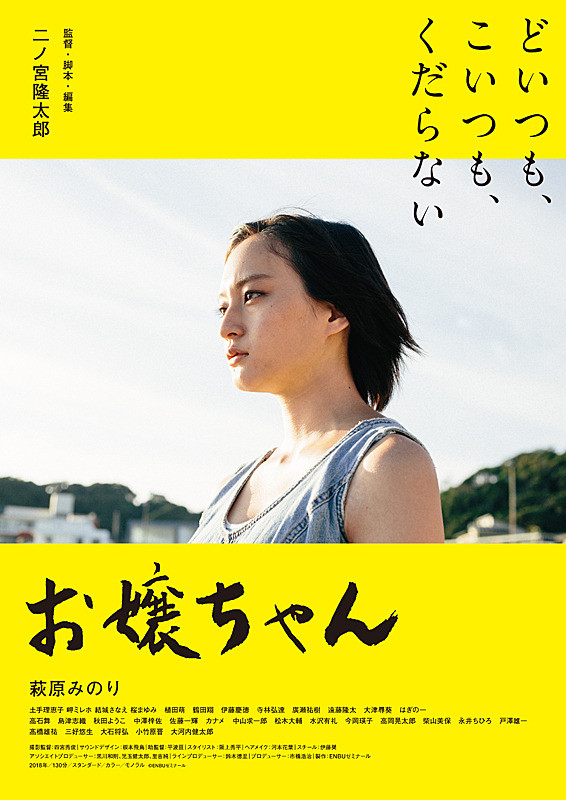
Minori, On The Brink (お嬢ちゃん, Ryutaro Ninomiya, 2019)

“Days like this make me feel I’m wasting my life” sighs just another dejected youngster in Ryutaro Ninomiya’s quietly enraged takedown of millennial malaise in a fiercely patriarchal society, Minori, On The Brink (お嬢ちゃん, Ojochan). In a culture which often favours politeness and avoids confrontation, Minori is a rare young woman determined to speak her mind though always with patience and grace and in turn a willingness to apologise if she feels that she has acted less than ideally, but her words often fall on deaf ears while those around her stumble through their lives chasing conventional illusions of happiness to mask a creeping despair. 

We first meet 20-something Minori (Minori Hagiwara) as she challenges a man who tried to force himself on her friend, Rieko, cowering quietly behind her. Minori wants an apology, but predictably he denies everything and quickly becomes angry, held back by his equally skeevy friend who advises him to apologise if only to defuse the situation. In the end Minori doesn’t get her apology and has to settle for having made a stand, retreating to avoid causing her friend more harm, but on exit the third man chases after her to ask for her contact information. Really, you couldn’t make it up. 

Part of Minori’s anger is bound up with being a so-called “cute girl” and everything that comes with it in a society still defined by male desire. Parades of idiotic young men, for some reason always in threes, come through the cafe where she works part-time expressly because a “cute girl” works there, while she’s forever being invited out by female friends who want to bring a “cute girl” to the party. Somewhat insecure, Minori worries that people are only interested in her cuteness and might otherwise reject her if, say, she were badly disfigured in some kind of accident. But what she resents most is that it’s other women who enable this primacy of the cute, the way her bashful, “homely” friend Rieko is always apologising for herself, while the other women who self-identify as “ugly” willingly cede their space to the conventionally attractive. 

In short, they submit themselves totally to pandering to male desire while men feel themselves entitled to female attention whether they want to give it or not. Dining in a local restaurant, Minori and Rieko are invited to a party by the proprietress which neither of them seem keen to go to but Rieko is too shy to refuse even when Minori reminds her of the traumatic incident at the last party with the guy who forced himself into the ladies bathroom and tried to kiss her against her will. The older woman laughs it off, affirming that he “meant no harm”, he was just drunk. This is exactly what Minori can’t stand. She keeps telling people she isn’t angry, but is she is irritated by Rieko’s need to apologise for something that isn’t her fault, seeing it as enabling the culture that allows men to do as they please while women have to obey a set of arbitrary rules of which remaining quiet is only one. 

In her own quiet way, Minori refuses to toe the line but is constantly plagued by unwanted male attention. Getting into an altercation with a creepy guy who waited outside her place of work to find out why she didn’t reply to his texts, she explains that he was just a casual hookup and that she finds his overly possessive behaviour frightening even as he continues not to take no for an answer, eventually branding her a “slut” for daring to embrace her sexuality. She demands an apology, not for what he called her but for the use of such misogynistic language. Earlier, in the trio of friends which contained Rieko’s attacker, another man had claimed he remembered Minori from a previous gathering, branding her as a “pigheaded mood wrecker” for daring to take them to task for their bad behaviour. The men talk about women only in terms of their desirability, the same man insisting that he has no interest in “strong willed women”, probably for obvious reasons. Another recounts having bullied a girl he fancied in middle-school, unable to understand why she avoided him despite bragging about having terrorised her and organising her ostracisation by the other girls (supposedly, he could do this because he was “popular”) until she finally transferred out (whether or not this actually had anything to with him remains uncertain). 

Perhaps to their credit, the other two guys immediately declare him uncool and are mildly horrified that he sold this to them as a funny story from his youth with absolutely no sense of repentance or self awareness. But their response is also problematic and born more of their boredom than their outrage, engaging in a bet over who can make him cry first as they “bully” him so that he’ll develop empathy for people who are “bullied”, never actually explaining to him why he’s being “punished”. Minori questions the problematic attitudes around her with straightforward candour, taking her cafe friend to task for her hypocrisy in taking against older men while expressing an uncomfortable preference for the very young.  

Nevertheless, Minori remains exhausted by the hypocrisies of the world around her. She declares herself “happy” with her ordinary life, a 4-day part-time job, low rent thanks to living with grandma, and spare time spent playing games. To that extent she has no desire to change her life, but the very fact of her “happiness” also depresses her in its banal ordinariness. “It’s all worthless” she suddenly cries, stunned by the inescapability of her ennui. On the brink of despair, Minori finds herself sustained only by rage not only towards an oppressive society but her own inability to resist it.


Minori, On The Brink was streamed as part of this year’s online Nippon Connection Film Festival. It will also be available to stream worldwide (excl. Japan) as part of this year’s Udine Far East Film Festival.

Original trailer (no subtitles)