
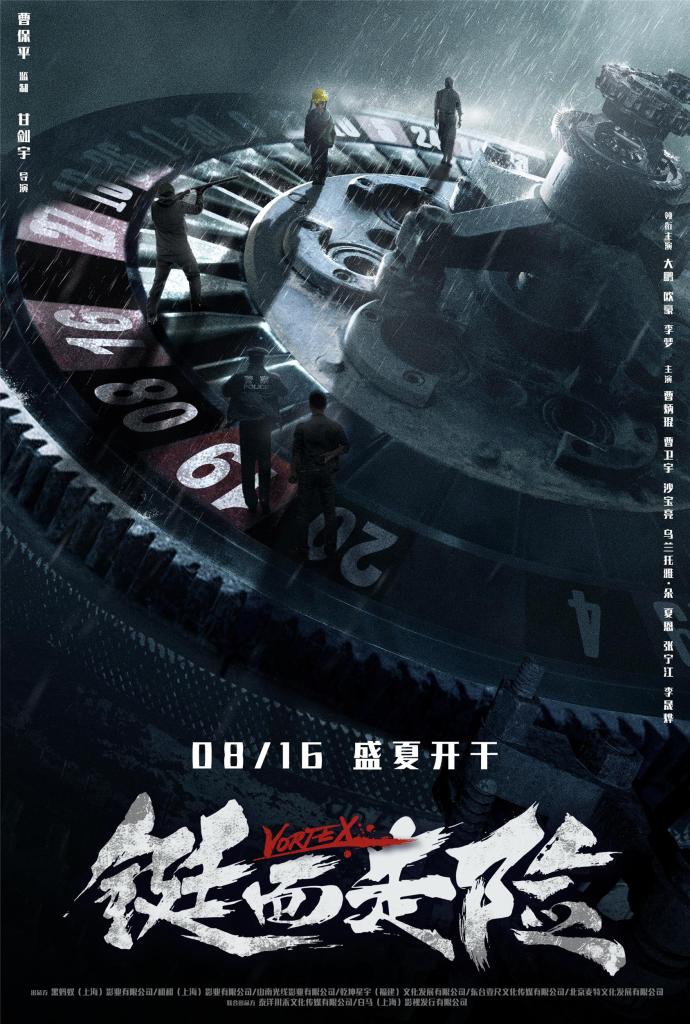
“Only with money are you treated like a person” according to cynical gangster Xia Tao, another embattled soul turning to the dark side to try and survive after multiple betrayals in a cruel and unforgiving society. Anchored by a standout performance from comedian Da Peng in a rare dramatic role, Vortex (铤而走险, Tǐng’érzǒuxiǎn) sees one feckless young man falling into a web of criminality after succumbing to the temptation of an easy fix to all his problems. As he and others will discover, however, actions have consequences and there are no victimless crimes.
Liu Xiaojun (Da Peng) is an embittered young(ish) man left orphaned and resentful after his policeman father died on the job. Nominally a mechanic with his own repair shop he also has a self-destructive gambling problem that’s left him deep in debt to local mobsters. He tries to hit up an old friend, Brother Wan (Cao Bingkun), recently released from prison, but he offers him a job rather than money, explaining that it’s only crime adjacent not actually illegal. All he has to do is drive unregistered cars back to the depot where Wan can resell them, and he’ll get 10,000 a pop. Xiaojun isn’t really into crime so he’s reluctant to take Wan up on his offer, trying his policeman uncle (Cao Weiyu) for yet another loan instead, but when he blows that too in reckless gambling he realises he has no other choice. The plan goes badly wrong, however, when the car Xiaojun is supposed to pick up turns out to be occupied and he finds himself in a fight with the Xia brothers. He manages to get it back to the depot but there’s another problem. The car was carrying cargo, a little girl, Qiqi (Audrey Duo / Doo Ulantoya), hidden in the boot apparently at the centre of a kidnapping plot.
Xiaojun wants to call the police, but Wan is against it. He urges him to dump Qiqi somewhere and hope the authorities find and return her to her parents, but Xiaojun finds himself keeping the little girl. When Qiqi’s frantic mother calls the cellphone that was left in the car he realises she’s worth around two million and it’s too good an opportunity to pass up. After all, it’s a win/win. Xiaojun isn’t going to hurt Qiqi like the kidnappers might so he’s keeping her safe and he gets to pocket the money in return.
So begins his series of moral justifications for the vortex of crime that began with his decision to drive the car for Wan which was itself caused by his gambling problem and addiction to quick fix solutions. Later, we can see that his self-destructive streak is a kind of despair, an act of self-harm taken in revenge against the unfairness of losing his father who apparently did everything right but paid a heavy price in attempting to serve justice. Xiaojun unfairly blames his uncle for failing to save his dad in choosing to do his job as a policeman and fiercely resists his well-meaning, paternal attempts to save him from his life of crime adjacent activity, but later perhaps comes to understand after unwisely becoming involved in the kidnapping plot, bonding with the innocent Qiqi, and then bitterly regretting his foolishness in placing her in danger to chase the money.
Yet money, as Xia Tao (Sha Baoliang) says, is only thing that counts and you’re nothing without it. Xia Tao too turned to crime following parental betrayal, no longer seeing the point in playing by the rules if all it gets you is a lifetime of righteous suffering. Wan’s bar hostess friend, Zhao Qian (Li Meng), seems to be mixed up in the plot too though as her role becomes clear we realise that she has also succumbed to a quick fix solution out of desperation, trying to save a man she loves but later describes as “only a friend” by resorting to desperate measures to ensure he gets a life saving operation. Even little Qiqi seems to feel betrayed by mum and dad, answering Xiaojun’s question about who she thinks loves her more with a sad “neither”, while asking not to be returned to her mother because she’s been stopping her seeing her father and she misses him.
As we later find out, there might be quite a good reason for that which Qiqi is too young to understand, but still she wants to try and find him and seems cheerful enough with Xiaojun while he says he’ll help her. Until then, Xiaojun becomes an awkward paternal presence, touched by Qiqi’s earnestness and lost in a moral quagmire trying to work out where the best place to send her might be while still hoping to get his hands on the cash. Redeeming himself by, in a sense, paying the ransom by deciding to prioritise saving Qiqi from the Xia brothers, Xiaojun begins to extricate himself from the vortex of crime, rediscovering a more positive paternal presence of his own in forgiving uncle Wang and his own father in coming to an understanding of their choices through being forced to make his own. A minor condemnation of the modern China’s wealth obsession and growing social inequality, Vortex finds its villains less villainous than one might expect, succumbing to the slippery slope of criminality in desperation and a sense of abandonment in a society which seems content to leave them behind.
Vortex is represented by Fortissimo Films.
International Trailer (English subtitles)


 Windows on Worlds