
New Life (我会好好的, Dong Hongjie, 2025)

A lost young woman begins to find new purpose in life after taking in a stray dog in Dong Hongjie’s tearjerking drama, A New Life (我会好好的, wǒ, huì hǎohǎo de). A tribute to the healing power of a dog’s unconditional love, the film is partly about the grieving process and learning to let go, but also about what it’s like to feel abandoned and hopeless. Having something to look after gives Xiaoman (Zhang Zifeng) a reason to look after herself as well as her heartbroken father who’s turned to drunken rages in the wake of his wife’s death and subsequent loss of his business.

Ironically, Zhao Bujin’s (Wang Jingchun) old wood carving shop has been taken over by a vet, though Bujin can’t seem to let it go and is intent on causing trouble there. Having lost her mother due to an illness, Xiaoman is intent on not taking up her place at university and instead is earning money as a removals driver often helping to clear houses after the death of the owner. It’s during one particular job that she’s confronted by an angry dog who refuses to leave a cardboard box where, a neighbour explains, it stayed with its mother until she died. Ever since then, he’s been unable to get out, much like Xiaoman who also remains trapped within the box of her grief.

Identifying with the dog, she begins to worry about him during a rainstorm and decides to rescue him as a means of rescuing herself. But at the same time, she doesn’t really want to keep him and continues referring to the dog as “doggie” rather than naming him while he imprints on her as a new maternal figure. There’s a half an idea in the back of her mind that there might be money in it if she cleans the dog up a bit and sells him on with the help of the vet, Chuan (Zhang Zixian), who promises to help her find a good home for it. The first couple he suggests appear to be extremely wealthy and keen to adopt, but the film seems to be critiquing the idea that a life of material comfort is better than one spent struggling with family. The wealthy couple clearly have ideas about their ideal dog and how it would fit into their Instagram-worthy life including a name that skews feminine while Xiaoman’s dog is a boy. Predictably, the couple eventually send it back when it fails to bond with them and insists on returning to Xiaoman. 

Then again, Xiaoman and her father don’t necessarily seem to be struggling all that much. Though they don’t have much money, they’ve managed to keep their sizeable home and furniture even they’re economising on food and worrying about how to make ends meet with Bujin unable to find work. Xiaoman attributes this to his drinking, though it seems he actually sustained an injury he never got treatment for which has damaged his ability to carve. In any case, his industry has also changed. Though Xiaoman is led to believe he’s found a well-paying job at a factory producing wooden statues, she later learns that he’s being paid a pittance to do an apprentice’s job doing things like prepping wood. His friend explains that only elite master carvers make money these days because all the lower grade stuff is all mass-produced by machine so there aren’t any jobs for mid-grade craftsmen like Bujin. Bujin keeps on about finding an amazing log he’ll use for his masterpiece, but like so much in his life it seems like an impossible pipe dream.

Meanwhile, Xiaoman tries to keep it together with her only goal being to buy a proper grave for her mother overlooking ocean. Nevertheless, bonding with the dog, whom she later names Xiaoyi as if it were really her brother gives, her new reasons to look after herself and think about her future. Identifying with it closely, she also comes to realise how little people value the lives of cats and dogs and by extension other people too. That’s one reason why she begins holding proper funerals for pets to give them a little dignity in death when some owners just tell the vets to get rid of their remains and don’t even bother to collect the ashes. Adopting a quasi-maternal position in caring for Xiaoyi also helps her process her own mother’s death and begin letting her go so that both she and her father can start to move on. Truly tugging at the heartstrings, Dong’s film is a tribute to the unconditional love of a dog and the healing effects it can have on a life if only someone is willing to offer it the same in return.


Trailer (no subtitles)
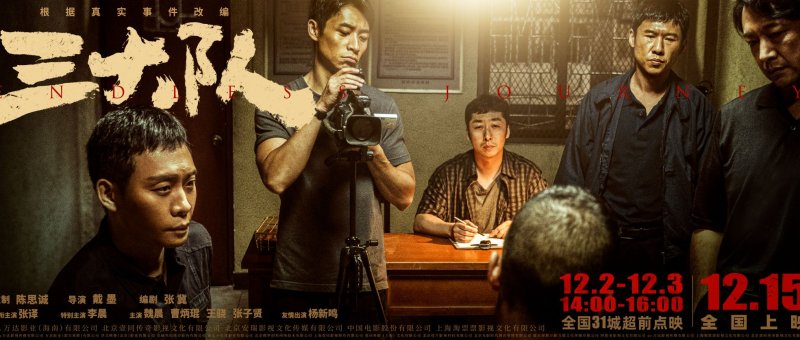
Endless Journey (三大队, Dai Mo, 2023)

The police officers at the centre of Dai Mo’s Endless Journey (三大队, Sān Dàduì) are soon stripped of their badges, accused of excessive force contravening laws existing since the medieval era to prevent vigilante justice. Yet in someways that’s essentially what they end up doing, extra-judicial investigators with a personal vendetta rather than a pure-hearted interest in justice even if the victim of the crime weighs heavily on their conscience. 

Though the film plays into the recent trend in Sino-noir and popularity of mystery thrillers at the Chinese box office, it is surprising that a film that is at least subtly critical of the justice system, featuring police who break the rules and are sent to prison, was approved by the censors board even if the central message is one of heroism as Captain Cheng (Zhang Yi) doggedly chases his suspect all over China for several years. Then again, the hero of this true life case turns out to be China itself as Cheng is reminded that his search is unnecessary given that the fugitive, Eryong (Zheng Benyu), is sure to be captured by the burgeoning surveillance network of CCTV cameras then being rolled out across the country. Years later, it’s the system that allows Cheng to identify Eryong as his DNA and fingerprints throw up positive matches within seconds of samples being taken thanks to the nation’s DNA database. 

Even so, as the veteran officer, Zhang (Yang Xinming), reminds the rookie behind every major case there’s a ruined family broken by their loss which is one reason why he doesn’t relish the prospect of investigating one so late in his career. This particular crime is so heinous that it’s become front page news which means that they’ve also got their boss breathing down their necks to get it solved as soon as possible with the existence of Division 3 itself on the line. Cheng pops home for a matter of minutes to check on his wife and daughter, shutting down his wife’s suggestion that they get a security system for their windows on the grounds that it would be an embarrassing thing for a detective’s home to have. The reason she wants one is that the victim in this case had been a little girl of around their daughter’s age unexpectedly home alone when thieves broke in by climbing over their aircon unit and smashing a window. Finding nothing of value they raped and killed the daughter. 

After a police officer dies as a result of the investigation, the squad take things too far questioning the first suspect leading to his death which is how they end up disgraced and sent to prison. After his release, Cheng has lost his family, his home, his job and identity as a protector of justice yet his determination to catch Eryong is born more of his desire to avenge a friend than it is to prevent further crime. His fellow officers join him in the beginning, but during the endless searching each make the decision to move on for easily understandable reasons such as their marriages, children, and illness but Cheng cannot let go even when prompted by an old friend from the force who tells him they have this in hand though there is perhaps a subtle implication that the police force isn’t really doing enough otherwise Cheng wouldn’t have to be chasing Eryong all over the country. 

But haunted by reflections of his own face, ageing, at times dishevelled and hopeless, Cheng is also searching for himself and a means to reclaim the self he once was by vindicating himself as a policeman along with Division 3 in finally completing their mission. The ominous score by Peng Fei with its stinging strings adds to the noirish feel as does the perpetual inevitability of Cheng’s forward motion in the dogged pursuit of his prey, unable to rest until Eryong has been brought to ground. His quest robs him of his life, but there is an undeniable poignancy to it in Cheng’s inability to find himself outside of the chase only to be left with a moment of uncertainty no longer sure who he is or where he goes now, left alone and with no sense of direction in the absence of his quarry.


Endless Journey is in UK cinemas now courtesy of CMC.

International trailer (English subtitles)

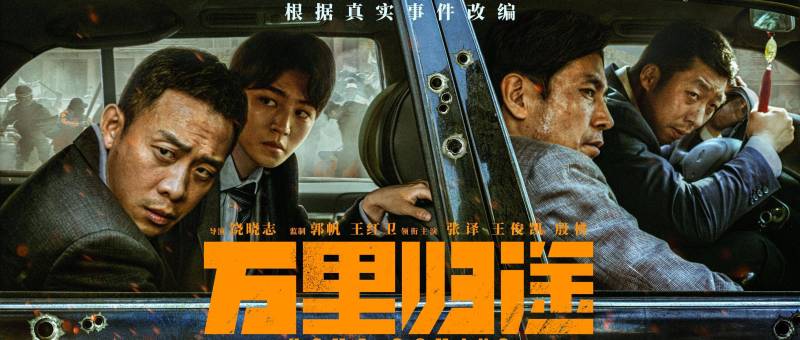
Home Coming (万里归途, Rao Xiaozhi, 2022)

A pair of Chinese diplomats find themselves the last hope of stranded construction workers when civil war erupts in a middle-eastern nation in Rao Xiaozhi’s visually impressive action drama, Home Coming (万里归途, Wànlǐ Guītú). A “Main Melody” National Day release, the film is less heavy on jingoistic patriotism than might be expected if slotting neatly into the recent trend of celebrating various branches of officialdom, this time foreign service consular staff, but nevertheless leans into the recurrent “just stay in China” message of government-backed big budget cinema in insisting that nowhere is the Chinese citizen safe other than at “home”. 

According the closing titles inspired by a series of real life events, the film opens in the fictional nation of Numia which is currently experiencing a period of instability with widespread protests against the government. As tensions quickly rise amid a full-scale uprising led by rebel warlords, consular staff are tasked with evacuating Chinese citizens. Jaded consular attaché Zong (Zhang Yi) has a heavily pregnant wife at home, but gives up his seat on the last plane out to a “Taiwanese compatriot” in what can only be read as a less than subtle advocation for a One China philosophy. Booked on the next boat out, Zong nevertheless ends up staying behind to help rescue a contingent of construction workers who are unable to cross the border as they have lost their documentation and require consular assistance to secure exist visas to a neighbouring nation. 

The message of the film might in some ways seem confusing. The by now familiar inclusion of stock footage featuring Chinese citizens overjoyed to arrive home thanks to the assistance of the consular officials emphasises that the Chinese government will always be committed to protecting the interests and safety of Chinese citizens abroad, but it’s also clear that the safest thing of all is not to leave or else to return home as quickly as possible. “Let’s go home” becomes a recurring motif as the construction workers and diplomats will themselves forward fuelled by hometown memories and a desire to see their families as much as simply to survive. Then again, there is also a subtle defence of the role of Chinese corporations overseas. An elderly driver from the local area makes a point of defending his friends and employers to a warlord as he points a gun at his head, reminding him that the Chinese do them a service by building railways and hospitals though it seems this corporate intrusion is one of the things the warlord is rising up against.

No information is really given as to why there is animosity towards the ruling regime, but the film nevertheless goes out of its way critique dissent by suggesting that it is the rebels who are in the wrong. Bodies are frequently seen hanging from billboards and bridges, and rebel leader Mufta tortures and pillages while playing sadistic games with captives. A secondary plot strand seems to suggest that a good leader must sometimes mislead those around them for their own good. Zong finds himself in conflict with his young and naive partner Lang who thinks they should be honest and admit that even if they make it to the next town there may be no one waiting for them while Zong knows that if they tell the construction workers that they’ll never reach it anyway in which case there’s nothing else to do but stay still and die. Zong is proved right, implying that Lang’s problem was that he had insufficient faith in China to protect them (which they can largely because of their massive satellite surveillance network) and endangered the lives of others because of it. But then Mufta also makes a strategic error in a bit of showmanship that effectively unmasks him in front of his men as a duplicitous coward rather than the grizzled revolutionary they thought they were following. 

In any case the closing news reports emphasise the rescue’s value in demonstrating that China is a strong and reliable country capable of protecting its people abroad, though the flip side of that is also seen in Zong’s insistence to the warlord that China will retaliate if any of his people are harmed. Meanwhile, Zong also seems keen to prove that China is a more inclusive place than many others, offering to take their driver back with them if he wanted to come. When the rebels finally concede the Chinese can leave, they refuse permission for an orphaned local girl who had been adopted by a Chinese couple but Zong refuses to leave without her insisting that as she has been adopted she is now incontrovertibly Chinese and he will protect her too. Rao shoots with a gritty roving camera drawing inspiration from the paranoid thrillers of the 1970s along with similarly themed contemporary pictures such as Korea’s Escape From Mogadishu and Hollywood’s Argo, while making the most of incredibly high production values with a series of explosive action sequences but does his best to mitigate the jingoistic undertones through his uncertain, battle weary hero even if ending on a slightly ironic note with an unexpected, post-credits appearance from a National Day movie icon.


international trailer (English / Simplified Chinese subtitles)

My Dear Liar (受益人, Shen Ao, 2019)

My Dear Liar poster 1The Chinese censors board can sometimes be unpredictable, but the one thing that remains absolutely certain is that crime cannot pay in a contemporary mainland movie. That’s why so many recent films from China end with an incongruous piece of on screen text telling us how long everyone is going to jail for after being convicted of the crimes we just saw them commit, often with a supplementary paragraph expressing their remorse and hope to make it up to the people and the party. All of this merely makes the existence of unconventional, dark rom-com My Dear Liar (受益人, Shòurén) even more improbable than it already seemed seeing as the entire conceit is the murder of an innocent woman for financial gain.

Shen opens with childhood friends Zhong (Zhang Zixian) and Hai (Da Peng) rehearsing the story they will give to the police assuming their plan comes off. Zhong, an accountant, has been part of a large scale embezzlement scam which is currently under investigation. He needs to find a large amount of money quickly to cover up his crimes, getting together with Hai, a widowed single-father to a little boy with severe asthma, to commit small acts of minor extortion. When their random schemes stop paying the bills, Zhong makes a radical suggestion – insurance fraud. He proposes that Hai marry an internet web streaming star named “Foxy Fairy” (Liu Yan) so that he can start an affair and then drive over a bridge with her on the back of his motorcycle to collect the life insurance pay out. This whole plan hinges on the fact that Zhong knows Foxy Fairy can’t swim because she mentioned it on one of her live streams.

As plans go, it could use some work. Neither Zhong nor Hai seem to be particularly worried about the fact that they’re plotting to deceive and then murder a young woman solely for financial gain. Hai, who otherwise seems sweet and naive, is expected to live with and pretend to love a woman he is going to kill for money. One gets the impression he’s been doing Zhong’s bidding since they were kids without really thinking about it, but you’d expect him to at least ask a few more questions about being involved in an elaborate conspiracy to murder aside from clarifying that he won’t be expected to off her himself (except that he might, because Zhong’s plan isn’t as “watertight” as he first thought it to be).

Hai’s motivation for going along with all this, besides wanting to help the sociopathic Zhong, is his son’s health. Perhaps surprisingly, the film makes an implicit criticism of the declining air quality in the modern Chinese city, almost as a sort of metaphor for a moral decline coupled with a critique of increasing social inequality in suggesting that this is a problem which disproportionately affects the poor not least because they cannot afford to buy expensive machinery to improve it. Hai’s wife apparently died of a lung complaint, and his son Yoyo is in constant discomfort because living above the smoky internet cafe where Hai works irritates his asthma. In the park one day, Hai runs into a sales point for a new development, Diamond Bay, built out on the coast where they promise access to clean air. It sounds like a dodgy timeshare pyramid scheme, but it’s the only source of hope in Hai’s wretched life and so he sets his heart on getting enough money together for a luxury condo on the beach where Yoyo could breathe freely.

To get it, he sends his son away and makes an unconvincing attempt to play the part of “Big Ben” – one of China’s new brand of sleazy millionaires and a character apparently played by Zhong online for some time in order to romance the money hungry Foxy Fairy through her live stream channel. Why exactly Zhong picked her isn’t clear, save that he hopes to exploit her greed, justifying the scam with the rationale that she is also a “fraud” extorting money from her deluded fans under false pretences. Lacking the resources and an ill fit for the “Big Ben” mould, Hai struggles to win “Miaomiao’s”, to go by her “real” name, heart, but eventually begins to fall for her after seeing the woman underneath the makeup.

Once married, Miaomiao quickly slides into the conventional roles of wife and mother, even bonding with little Yoyo who makes an unscheduled reappearance mid-scam. Despite her rabidly consumerist online persona, it turns out that what Miaomiao wanted wasn’t riches but the warmth of a family home which is something she’s unexpectedly found living in the cramped apartment above the internet cafe. She remains completely clueless as to Hai’s true motives and desperately tries to make the marriage work, even going on TV to talk about what a good man her husband is.

One begins to wonder if Miaomiao is going to turn the tables on the scheming guys, but her big secret is just that she’s actually “nice” and wants to settle down for a conventional home life she assumed might have already passed her by. Hai hypocritically tells his son who keeps forging his signature on subpar report cards that the most important thing about being a man is “honesty”, but continues lying to Miaomiao right until the very end, getting cold feet only moments before it’s too late. Addressing some fairly subversive themes from the clean air issue to social inequality, institutionalised property fraud, corporate corruption, and organised embezzlement, My Dear Liar nevertheless refuses to engage with the deeply troubling nature of its central conceit even when indulging in the incongruous sweetness of its otherwise “wholesome” romance.


Currently on limited release in UK cinemas courtesy of CMC Pictures.

International trailer (English subtitles)