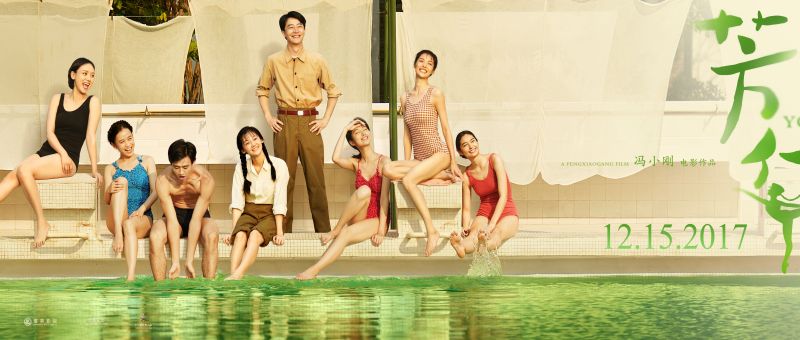
Youth (芳华, Feng Xiaogang, 2017)

youth posterOn the surface of things, one might be forgiven for thinking that Feng Xiaogang, “China’s Spielberg” – the director of such fluffy hits as If You Are the One and the prestige picture The Banquet, might not be the one to look to for nuanced takes on the state of his nation but, as he proved with the irony filled I am Not Madame Bovary, there has always been a persistent resistance in his superficially crowd-pleasing filmography. The exact nature and extent of that resistance is however harder to assess. Youth (芳华, Fāng huá), Feng’s latest historically probing epic, made headlines when its mainland release was blocked at short notice immediately before its international premiere at the Toronto International Film Festival and in some respects it’s easy to see why it may have raised an eyebrow or two at the censor’s board. A literal story of “youth” and the various ways that the concept becomes romanticised even when one’s own coming of age took place in otherwise difficult times, Feng’s film is also the story of modern China, baptised in the fire of the Cultural Revolution only to finally succumb to the consumerist one 15 years later.

Narrated by bystander Suizi (Zhong Chuxi), later a successful author apparently looking back on her own “youth” with a writerly eye, the tale begins in the early 1970s with two pillars of the arts division of the People’s Liberation Army. Suizi informs us the the protagonists of this story are Lui Feng (Huang Xuan) – a model soldier, and Xiaoping (Miao Miao) – a poor girl mercilessly tormented by everyone throughout her entire life. Xiaoping’s birth father has long been languishing in a re-education camp but as she’s taken her step-father’s name, Liu Feng assures her that he’s kept her bad class background off her record and will make sure no one else knows about it.

Performing propaganda ballets, the arts division is at its zenith at the height of the Cultural Revolution. The troop as a whole enjoys extreme privilege – they are well fed and cared for, evade the dangerous front line work many other members of the armed forces are subject to, and receive the respect due to them as the embodiment of a revolutionary ideal. They are, however, still guilty of the various hypocrisies coded into the system. Though many of the dancers have family members with “bad class backgrounds”, undergoing re-education or otherwise better not mentioned, the top guys and girls are the ones with parents high up in the party who use their untouchable status to paper over cracks in their own development with inherited superiority.

Lui Feng is perhaps an aberration. Nicknamed “Lei Feng” – a mythical figure created for propaganda purposes to embody the “ideal” revolutionary soldier in his selfless dedication to his comrades and communist virtues, Lui Feng is indeed a model party member whose goodness and kindness know no bounds. Unlike Lei Feng, however, he is a real man of flesh and blood not some far off and untouchable god. Having sanctified him in this way, the collective has effectively raised Lui Feng up to an unfair and unattainable ideal and is then “betrayed” on realising that Lui Feng is a man with a man’s hopes and desires. Lui Feng’s transgression is inappropriate to be sure but also somehow innocent in its naivety and his counter betrayal by the system to which he has dedicated his life all the more difficult to bear because of the unfair deification his better qualities have earned him.

Xiaoping meanwhile, who expected only betrayal, betrays the system through passive resistance in resentment of the way it has treated her friend. “Abandoned” by the collective which is the arts troop, Xiaoping exiles herself from a society she thinks has little need of her yet she then continues to serve it fully as a frontline nurse. The “youthful” idealism of Lui Feng and Xiaoping is tested as they find themselves caught up in a far off war while their former comrades dance around with wooden swords on a painted stage. Wounded in body and mind, the pair continue onwards even as their nation conspires to leave them behind.

Shifting into the ‘90s and then the 21st century, Feng’s messages become muddier and harder to grasp. In one sense what is celebrated is “youth” itself which, in this case, happened to take place against the backdrop of terrible events (albeit it ones from which many of the protagonists save Lui Feng and Xiaoping were largely shielded) enabling the growth of a generational family destroyed by a change in the political wind. It is however hard not to infer that everything was better during the turbulent ‘70s in which the delusion of innocence, if not its actual existence, was easier to bear than the soulless march into the future of Coca-Cola signs, Transformers toys and fathers who never come home because they’re too busy making money. Feng’s heroes are the ones who exiled themselves from the reality of China as a modern economic superpower, holding fast to their innate senses of honour and justice, yet in this Feng does to them exactly what he criticises his society for doing – he makes them martyrs, mythologises them as embodiments of revolutionary ideals, a pair of real life Lei Fengs all over again. In telling a story of how the revolution betrays and is betrayed, Feng makes the heroes emerge damaged but unbroken, chaste children trapped by the “innocence” of the pre-capitalist age, but whether their survival is victory or defeat remains unclear. 


Youth is currently screening at selected cinemas across the UK courtesy of CineAsia.

UK release trailer (English subtitles)
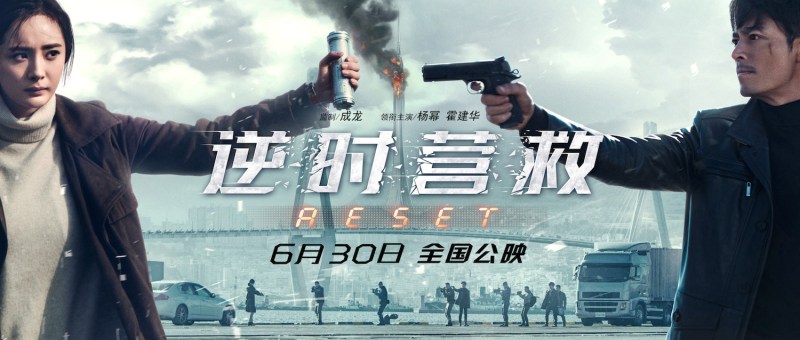
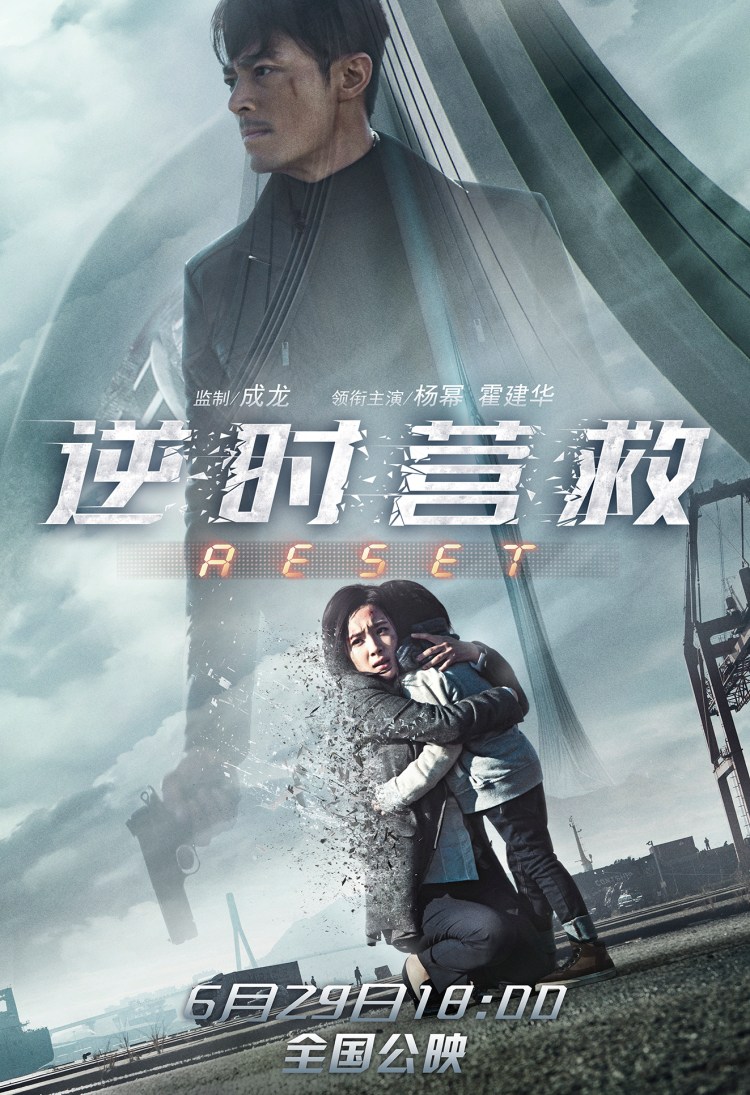
Reset (逆时营救, Chang, 2017)

reset posterTime travel – the solution to all one’s problems. Or is it? Chinese thriller Reset (逆时营救, Nì shí yíngjiù) is helmed by Korean director Chang (AKA Yoon Hong-seung) but it’s also produced by Jackie Chan and is very much in the vein of his recent projects in its non-sensical sci-fi setup and troubling conservative messages. Reset casts a female scientist as its heroine but uses the crisis to explore her ongoing guilt as a single mother with an intense workload who has chosen to dedicate herself to both her work and her son without remarrying. Despite the action packed drama in which Xia Tian plots, shoots, and stabs her way back to her son, the message which is ultimately delivered is that you can’t go back in time and mothers should just give up everything to be with their kids 24/7.

In the near future, the existence of parallel worlds has been confirmed but early research into time travel has been derailed after test subjects transported between universes descended into mindless violence destroying each other and valuable data. Xia Tian (Yang Mi) works for one of the big companies still investigating parallel world theory and has just made a major breakthrough in “projecting” test subjects into the recent past. In order to steal her research for a rival company, Xia Tian’s young son Doudou is kidnapped by mysterious men who give her a limited amount of time to hand over the top secret documents. Xia Tian’s first attempt to rescue her son fails, leading her to make personal use of her findings and travel into the past to change the future.

Reset starts as it means to go on with Xia Tian having a heart to heart with her boss and mentor (King Shih-Chieh) who reminds her that it’s been ages since she broke up with Doudou’s dad and its high time she find someone new. Xia Tian, embarrassed, says she’s dedicating herself entirely to Doudou and doesn’t need anyone else. The bond between mother and son is the focus of the film (though Xia Tian’s clinginess may become an ongoing problem as Doudou grows up) as Xia Tian travels through time to ensure the survival of her little boy no matter how morally compromised she may eventually become.

Use of the time machine apparently has certain side effects, as the first experimenters discovered. The original Xia Tian was a sweet, innocent woman way out of her depth with these fearsome, amoral gangsters but Xia Tian 2 is much more savvy, chloroforming the “nice” version of herself and taking over with the power of hindsight to help her get out of the building before all hell breaks loose. Xia Tian 3, however, has taken things too far, acting without any kind of concession to morality and suddenly becoming some kind of major action star with special forces training for no given reason. There might be a clever point about Xia Tian’s various conflicting roles but Reset doesn’t want to make it so much as have Xia Tian help/hinder herself in a selfish tug of love to save little Doudou who just wants to go home to his mum.

Non-sensical as it is, Reset picks up when it hits its action heavy final third in which Yang Mi, more often seen in sweetly romantic roles, acquits herself well enough as a fiery action star filled with maternal rage. The various layers of the resets generally hang together as the three Xia Tians cross each other’s paths to get Doudou to safety, only to belatedly realise that only one of them can really stay with him forever.

Maternal love is the machine which drives the story forward but it’s also the most problematic element in its partial insistence than Doudou’s fate is somehow Xia Tian’s fault for daring to use her finely tuned brain for the common good rather than just staying home and reading comics with her little boy like a mother should. It’s difficult to escape the conclusion that the lesson is women shouldn’t work, rather than corporations are inherently untrustworthy and that time travel creates problems for everyone (not least editors and scriptwriters) and should generally be avoided. Despite high production values, interesting production design, and an impressive (or is that three impressive) performance(s) from Yang Mi, Reset’s strong action credentials cannot compensate for its unpalatable conservative message and non-sensical science fiction narrative.


Screened at the London East Asia Film Festival 2017.

International trailer (English subtitles)
Angels Wear White (嘉年华, Vivian Qu, 2017)

©22 HOURS FILMS

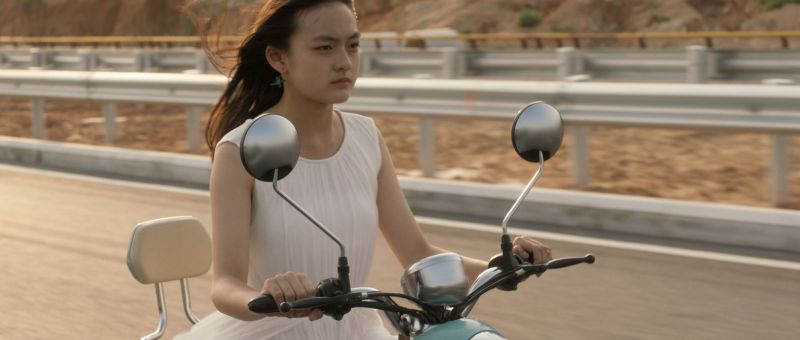
angels wear whiteChinese cinema has been preoccupied with stories of unfairness and systematic corruption for quite some time but they’ve rarely been as difficult to process and horribly universal as Vivian Qu’s Angels Wear White (嘉年华, Jiāniánhuá). A storm of conflicting social attitudes leaves young women open to the most terrible of manipulations while well placed men are infinitely protected by a system of deference and complicity. Women must be pure, angelic and draped in neutral white – a concept so deeply entrenched that it barely needs manipulating to be used as a tool of control.

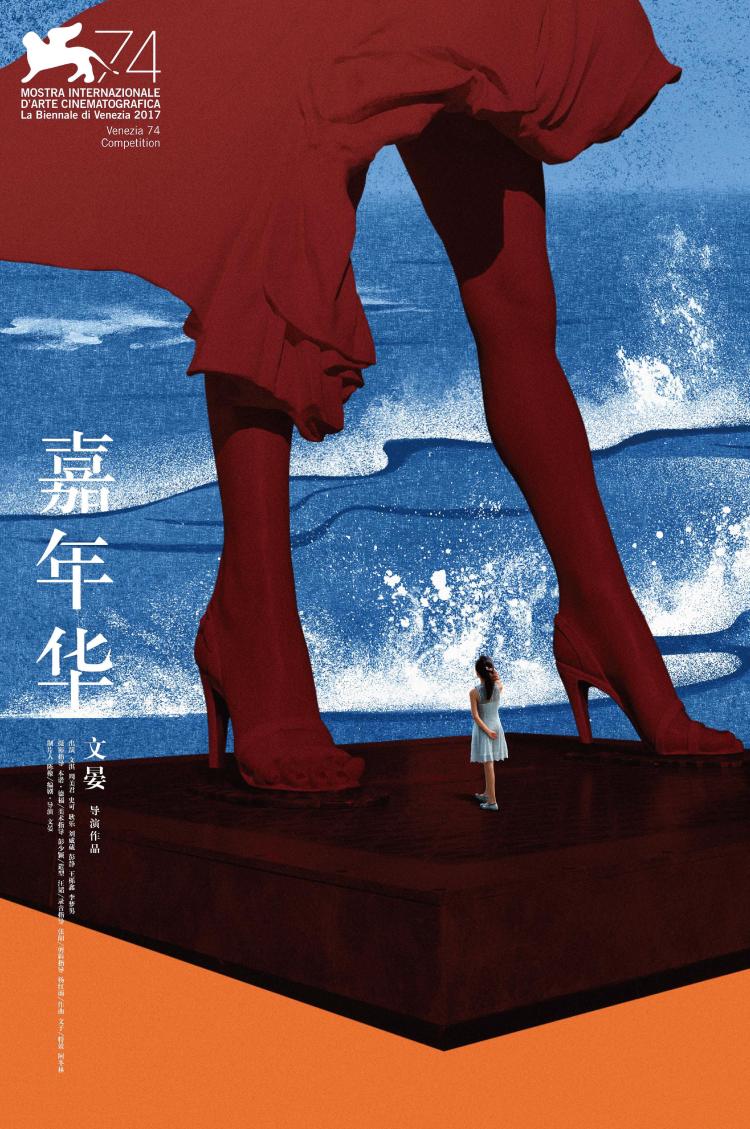
Teenage runaway Mia (Wen Qi) is working illegally at a seaside hotel. Wandering the beach before work, she’s rudely shoved out of the way by two hyperactive little girls who want to take a selfie underneath a colossal statue of Marilyn Monroe in her classic pose from the Seven Year Itch. Meanwhile, several sets of newlyweds are busy taking romantic photos in the picturesque though currently overcast coastal environment. Mia spots the girls again later when she is (illicitly) covering reception for a colleague and they’re brought in by a middle-aged man. Mia finds the man suspicious but seeing as he books two rooms lets it go. She pauses slightly when the still over excited girls order themselves a few beers, but delivers the drinks and leaves the girls to it. Remaining worried she keeps her eyes on the CCTV and eventually spots the man trying to enter the girls’ room but does nothing other than record it on her smartphone.

The two girls, Xiaowen (Zhou Meijou) and Xinxin (Jiang Xinyue), are so young they don’t even quite understand what’s happened to them except for a lingering feeling that they’ve been involved in something bad that will get them into trouble. Xiaowen, on the surface at least the more affected by the incident, has a difficult relationship with her parents which leaves her with no one to confide in and no one to defend her. Xinxin eventually tells her mother what happened and we realise the perpetrator is a police chief and the boss of Xinxin’s father who had made him a godparent as a way of currying favour at work leaving Xinxin’s mother to make the reasonable accusation that he has, in fact, sold his daughter to his boss for the prospect of career advancement. Where Xinxin’s mother is angry with her husband but apparently solicitous for her injured daughter, Xiaowen’s mother projects her own guilt for her neglectful parenting onto hers whom she slaps for apparently “slutty” behaviour, cutting her hair short like a boy’s and taking away her pretty dresses and makeup.

Sitting alone in the waiting room outside, Xinxin asks Xiaowen what a “hymen” is while her mother can be heard wailing loudly from inside the consultation room. The issue becomes less that a predatory man has caused irreparable harm to two innocent young girls, but that their honour has been destroyed along with prospects of future marriage now that they are no longer virgins. The problem is not that the girls are not believed or even that they are ignored. On the contrary, their story seems to be accepted to the point that it must be erased. The police chief himself remains unseen but his underling goes to great lengths to hush the case up, attempting to pay off Xinxin’s parents with the promise of healthy financial support on the condition that they drop the charges to avoid embarrassment to the chief but also, it is implied, to Xinxin who will avoid the social stigma of being the girl involved in the high profile rape case. Eventually reuniting with her father, Xiaowen finds a defender but even his outrage is not enough to see justice done as the full weight of a corrupt system comes together to crush his little girl for simply continuing to tell the truth.

It’s easy to ask why Mia did nothing to prevent such an obviously inappropriate situation but then again she is just a girl herself, not so much older than Xinxin and Xiaowen, and would not have been able to help beyond knocking the door to try and scare the man off. She should not have been manning reception in the first place, and is afraid of getting into trouble because she has no ID papers and is working illegally. Because of way the system works in China, Mia would need to go back to her home town get a genuine ID card which she seems reluctant to do leaving her open to multiple kinds of exploitation as she considers the best way to buy a fake one that will allow her to continue working in more legitimate businesses. Her life has been hard and she has come regard compassion as a weakness.

Mia also has to put up with the worrying advances from her friend and big sister figure Lily’s (Peng Jing) boyfriend, Jian (Wang Yuexin), who openly asks if she’s a virgin because he knows people who will pay good money for that kind of thing. Even Lily who seems more worldly wise is not immune to Jian’s heartlessness, later coming into work with rope burns on her wrists and dark glasses to hide a black eye. Before returning to her home village, Lily visits a clinic for painful surgery to reconstruct her hymen so that she can still get married in overly conservative China.

The statue of Marilyn Monroe seems incongruous enough but speaks to all of those same double standards which continue to disrupt the lives of these young women as she girlishly pushes down the skirt on her pure white dress, awkwardly posed on her matching bright white heels. Marilyn is sexualised innocence at its most uncomfortable. The only real defendant the girls have is a dogged lawyer who treats them with kindness, listening to their story with patience and respect in an attempt to uncover the real truth aside from what anyone may want to hear to think they are supposed to say.

Asked by an almost outsmarted policeman why she can’t find something more productive to do, the lawyer replies that there are simply “too many of these kinds of cases”. “Justice” remains a hollow ideal, an essentially fake construct designed to maintain the position of the powerful rather than protect the weak. Unrelentingly bleak but with the faintest glimmers of hope offered by Mia’s final decision, the female solidarity of the determined lawyer, and the newly rediscovered relationship of Xiaowen and her dad, Angels Wear White is a necessarily difficult and challenging piece but one which arrives at just the right time trailing a series of uncomfortable in its wake.


Screened at BFI London Film Festival 2017.

Clip (Mandarin with English subtitles)

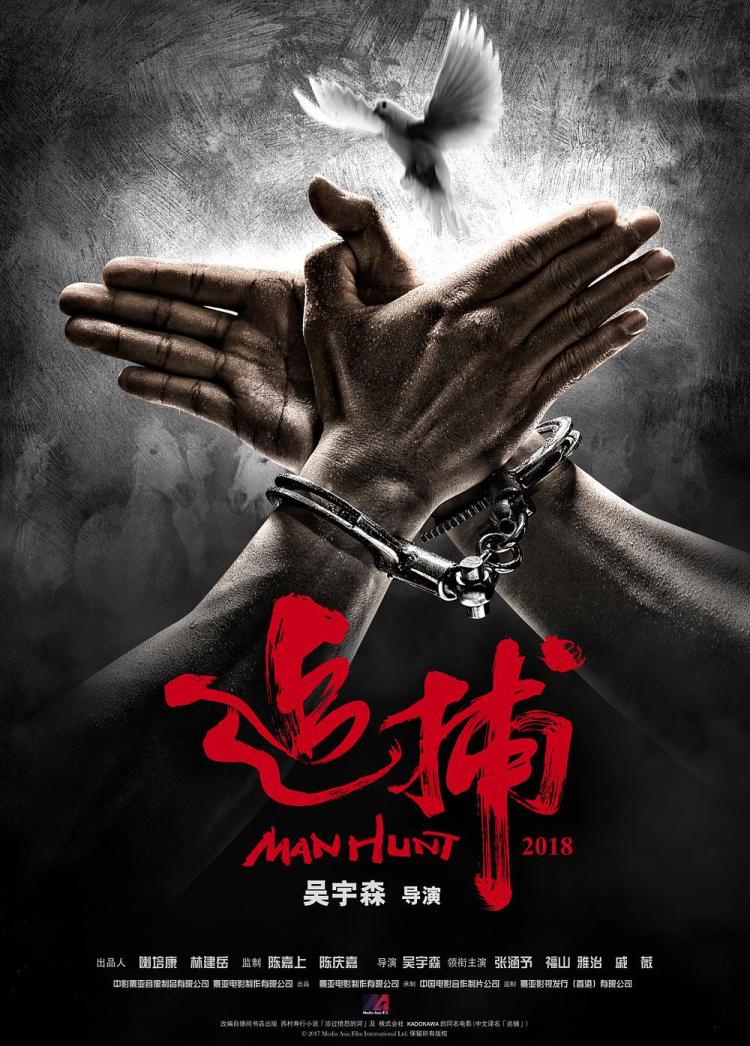
Manhunt (追捕, John Woo, 2017)

Manhunt30 years ago John Woo was one of Hong Kong’s most bankable directors. The father of heroic bloodshed, Woo’s bullet ballet sent shockwaves through action cinema not only in his home country but around the world. Unsurprisingly Hollywood came calling and Woo was one of the first Asian directors to enjoy mainstream US success with ‘90s hits Broken Arrow and Face/Off before his overseas career began to stall and he eventually returned to Hong Kong directing period epics Red Cliff and The Crossing. Manhunt (追捕, Zhuībǔ) is intended as a kind return to source as Woo gets back into the groove of his beautifully choreographed ‘80s action hits but intentionally or otherwise he sails dangerously close to self parody with a mix of Big Pharma conspiracy and wrong man thriller.

Chinese corporate lawyer Du Qiu (Zhang Hanyu) is a trusted employee of a Japanese pharmaceuticals company but is shortly to be transferred overseas, much to CEO Sakai’s (Jun Kunimura) displeasure – Du knows too much about the company’s less than transparent operations. Sakai sets up a honey trap to convince Du to stay but before it can spring Du is accosted by another woman, Mayumi (Qi Wei), who wants to talk to him about a difficult case three years previously in which an employee ended up committing suicide. After talking with Mayumi, Du goes home but the next thing he remembers is waking up in bed next to a dead woman. Du does the right thing and calls the cops, but the cops are working for Big Pharma and soon he finds himself on the run while maverick police chief Yamura (Masaharu Fukuyama) and two female assassins (Ha Ji-won & Angeles Woo) try to track him down.

Manhunt is inspired by the 1976 film starring Ken Takakura which was one of the first non-native movies to open in China following the Cultural Revolution. Woo apparently made the film as a kind of tribute to the actor after he passed away in 2014, but he takes his cues from the source novel by Juko Nishimura rather than the Takakura film and the 2017 Manhunt shares little in common with the 1976 version other than a general plot outline involving a man on the run and unethical practices in the pharmaceuticals trade. Du Qiu is not a stuffy, by the book, prosecutor but a compromised employee of a shady organisation who is oblivious to his own complicity in its extremely unpalatable way of doing business.

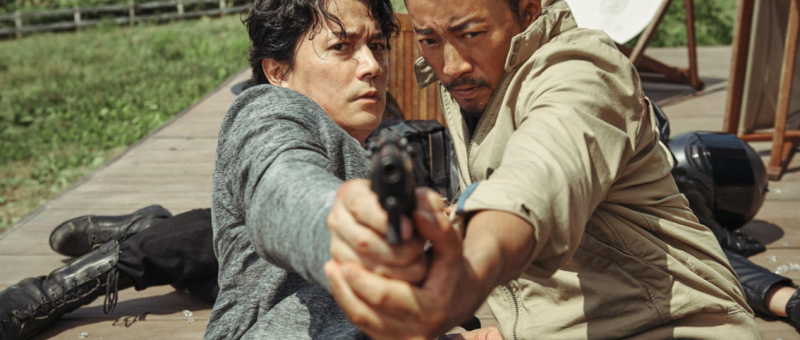
Despite this, Du Qiu is just as lucky as Takakura’s Morioka in that everyone he meets immediately wants to help him. Even sworn enemies with their hearts set on revenge eventually wind up joining team Du as they each descend on the pharmaceuticals research laboratory where the deadly secrets will be revealed. Woo returns to his heroic bloodshed roots in allowing dogged policeman Yamura and the increasingly confused Du to form an odd couple buddy duo which begins with spiky one liners and ends with becoming one as each places his uncuffed hand on the same pistol to take down a few bad guys through the power of togetherness.

Woo’s action credentials remain unchanged as he races from set piece to set piece from the opening surprise massacre to Du’s subway chase escape, jet ski race, and mansion showdown before getting anywhere near the endgame of the research lab. Perfectly choreographed, the sequences bear out Woo’s distinctive sense of humour while also poking fun at his back catalogue through a series of homages including an entire coop full of white doves just waiting for their chance to fly.

Set entirely in Japan, Manhunt shifts between Japanese and Mandarin though it has to be said that the film suffers from its reliance on English which is often poorly delivered and deliberately stylised to ape classic action movie one liners the like of which have been out of fashion for two decades. Woo neatly sends himself up with an opening discussion of “old movies” allowing one of the film’s two female assassins to develop an odd fascination with Du which leads to her eventual awakening from company brainwashing, but he also pays his dues with the theme music to Sato’s 1976 version playing over the first scene of mass bloodshed. Woo may have slipped into self parody with his deliberately over the top theatrics, but he has fun doing it and his gleeful self skewering proves extremely hard to resist.


Screened at the BFI London Film Festival 2017.

International trailer (dialogue free, English captions)

King of Peking (京城之王, Sam Voutas, 2017)

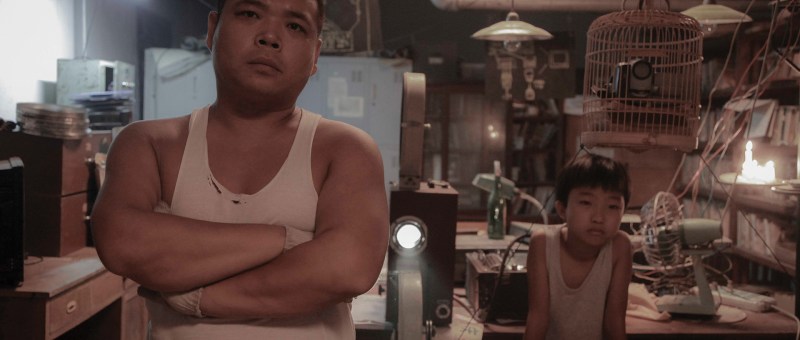
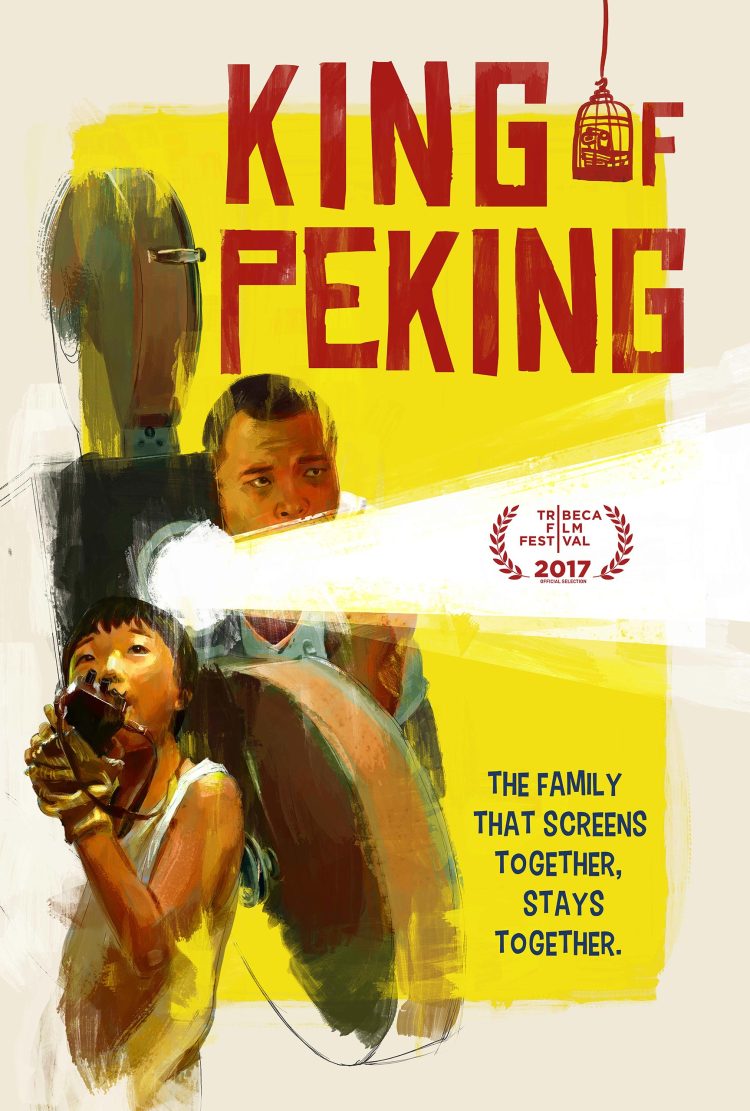
king of peking posterListen up, kids. Things were very different in the ‘90s when the internet didn’t really exist and people still queued round the block to get into giant single screen cinemas. Sam Voutas’ second film, King of Peking (京城之王, Jīngchéng Zhī Wáng), is an homage to these more innocent times taking place in a small corner of Beijing where a divorced father and his son are a charming double act of itinerant projectionists screening “Hollywood movies” for a dollar in the town square. Big Wong and Little Wong see themselves as “movie people” but their days are definitely numbered.

Big Wong (Jun Zhao) owns a Soviet era projector and a few reels of not quite recent but not yet classic movies. While Big Wong sets up a giant sheet and readies the reels, Little Wong runs round town “advertising” the event by shouting as loud as he can. The duo get a fair amount of customers but, as one loudmouth points out, this movie came out ages ago and he already has a copy on video at home – who wants to pay a dollar to watch it on a sheet in the square? This is also a question Wong’s ex-wife wants to know the answer to when she unceremoniously turns up and lays into Wong for “exploiting” their son. Wong’s wife left the boy behind claiming she couldn’t look after him but has since changed her mind. She wants an unfeasible amount of money or Little Wong. Little Wong wants to stay with his dad. Finding the money seemed a difficult prospect to begin with but when the projector catches fire and they have to give everyone their money back it seems all but impossible.

Voutas’ film is a father son drama in which the pair start off as firm friends – nicknaming each other Riggs and Murtaugh just like the Lethal Weapon heroes. Curiously enough, Lethal Weapon 4 is one of the films playing in the on screen cinema with a hand painted Chinese poster which places Rene Russo centre stage with Gibson and Glover on either side. Somewhat surprisingly, Jet Li does not feature. Sadly their father/son relationship is set to deteriorate ahead of schedule as Big Wong comes up with a plan which is intended to pay off his wife and get her to leave him and Little Wong alone. Taking note of the rude customer’s comments, Big Wong gets an idea, a set of DVD recorders, and a camcorder he can stuff into the penguin shaped bin in the cinema to rip off the latest releases, design covers, and sell them on DVD on street corners. Pretty soon, the Wongs are ruling the streets with dad’s innovative business model and son’s ruthless sales patter.

Of course, all of this is very morally dubious. Little Wong doesn’t quite like it, but is won over by his dad’s enthusiasm and, after all, aren’t they doing it because they love movies and want to share them with more people? Well, kind of, but it’s mostly for the money and Big Wong’s scheming soon works against him. Unlike his dad, Little Wong’s great love is for volcanoes, and Big Wong said he’d help him build one but he’s always too busy with the “business”. In becoming successful in his plan, Big Wong has forgotten why he started it in the first place and is too slow to see how his moral laxity is affecting the development of his son’s character.

Voutas avoids a neatly happy ending, going for something more realistic but also heartwarming in its own way as father and son end up understanding each other a little better but remain conscious of the growing distance between them. A tribute to ‘90s Chinese cinema with its oversaturated colour schemes, makeshift production budgets and essential red curtain opening, King of Peking is a warmhearted nostalgia trip filled with strange characters somehow left behind by China’s increasing modernisation such as the very young security guard at the cinema who talks about “work units” being a family and barks at his ushers as if they were a revolutionary cadre about to head off into battle. The security guard, officiously checking tickets, asks one customer for his “purpose of visit” to which he replies “for enjoyment and to forget all my poor life choices”. Big Wong has made a few poor life choices of his own and not all of them can be repaired through the magic of cinema, but as King of Peking proves the movie may soon be over but the memories last a lifetime.


Screened at the BFI London Film Festival 2017.

Original trailer (English subtitles)
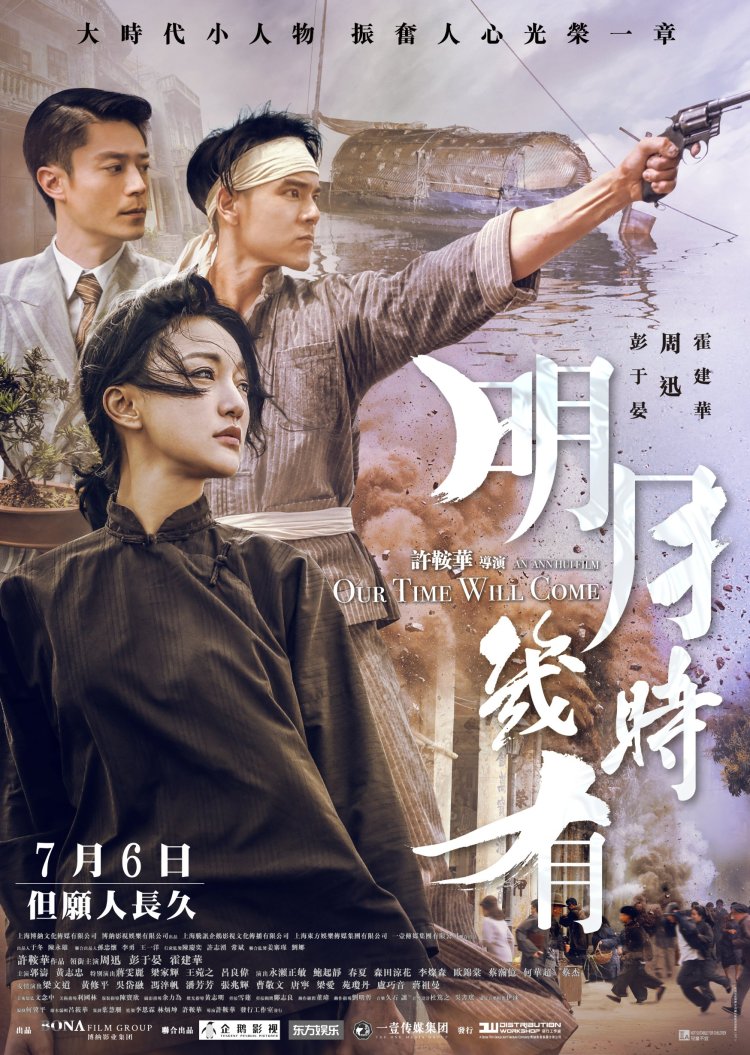
Our Time Will Come (明月幾時有, Ann Hui, 2017)

our time will come posterFor Ann Hui, the personal has always been political, but in the war torn Hong Kong of the mid-1940s, it has never been more true. Our Time Will Come (明月幾時有, Míng Yuè Jǐ Shí Yǒu) was pulled from its opening slot at the Shanghai film festival though it was permitted a screening at a later date. At first glance it might be hard to see what might be objectionable in the story of the resistance movement against the Japanese, but given that this year marks the 20th anniversary of Hong Kong’s handover from British colonial rule to mainland China, there is an obvious subtext. Yet, at heart, Hui’s film is one of resilience and longing in which “see you after the victory” becomes a kind of talisman, both prayer and pleasantry, as the weary warriors prepare for a better future they themselves do not expect to see.

In 1942, school teacher “Miss Fong” Lan (Zhou Xun) lives with her mother (Deanie Ip), a landlady who rents out her upstairs room to none other than Lan’s favourite poet, Mao Dun (Guo Tao). Lan also has a boyfriend, Gam-wing (Wallace Huo), who proposes marriage to her and then announces his intention to leave town. Not really interested in marrying someone who is already leaving her, Lan ends things on a slightly sour note but her refusal is more than just practicality – she wants something more out of life than being an absent man’s wife. Mrs. Fong is an expert in finding out things she isn’t supposed to know (a true landlady skill) and so has figured out that her lodgers are looking to move on. Mao Dun is supposed to make contact with notorious rebel Blackie Lau (Eddie Peng) who will guarantee passage out of Hong Kong for himself and his wife. Unfortunately, he is a little late and a Japanese spy turns up just at the wrong time. Luckily, Lau arrives and solves the problem but a sudden curfew means he can’t complete his mission – which is where Lan comes in. Lau entrusts the group of intellectuals to Lan, instructing her to guide them to a typhoon shelter where another contact will meet them.

This first brush with the business of rebellion provides the kind of excitement Lan has been looking for. Impressed with her handling of the mission, Lau returns and offers Lan a permanent place in his movement as part of a new urban cohort. Her life will be dangerous and difficult, but Lan does not need to think about it for very long. Her mother, ever vigilant, frets and worries, reminding her that this kind of work is “best left to men” but Lan is undeterred. Ironically enough, Lan has never felt more free than when resisting Japanese oppression with its nightly crawls accompanied by noisy drumming looking for the area’s vulnerable young girls. Mrs. Fong blows out the candles and moves away from the windows, but Lan can’t help leaning out for a closer look.

Hui keeps the acts of oppression largely off screen – the late night crawls are heard through the Fongs’ windows with Mrs. Fong’s worried but resigned reaction very much in focus. The schools have been closed and rationing is in full force, but most people are just trying to keep their heads down and survive. The local Japanese commander, Yamaguchi (Masatoshi Nagase), is a figure of conflicted nobility who quotes Japanese poetry and has a rather world weary attitude to his difficult position but when he discovers he’s been betrayed by someone he regarded as a friend, the pain is personal, not political.

Yamaguchi tries and fails to generate an easy camaraderie with his colleague, but the atmosphere among the rebels is noticeably warm. Lan becomes a gifted soldier and strategist but she never loses her humanity – embracing wounded comrades and caring for the children who often carry their messages. When Lan discovers that someone close to her has been captured and is being held by the Japanese she enlists the help of Lau who is willing to do everything he can for her, but coming to the conclusion the mission is impossible Lan’s pain is palpable as she wrestles with the correct strategic decision of leaving her friends behind rather than compromise the entire operation. What exists between Lan and Lau is not exactly a “romance”, the times don’t quite permit it, but a deferred connection between two people with deep respect for each other and a knowledge that their mission is long and their lives short.

Hui bookends the film with a black and white framing sequence in which she also features interviewing survivors of the resistance movement including an elderly version of the young boy, Ben, who is still driving a taxi to get by even at his advanced age. Ben is a symbol of hidden everyday heroes from the pharmacists who treated wounded soldiers, and the old ladies who cooked and provided shelter, to the resistance fighters who risked their lives in more overt ways, who then went back to living ordinary lives “after the victory”. The film’s final images seem to imply that Hong Kong’s time has come, that perhaps the eras of being passed, mute, from one master to another may be nearing an end but the time is not yet at hand, all that remains is to resist.


Screened at the BFI London Film Festival 2017.

International trailer (English subtitles/captions)

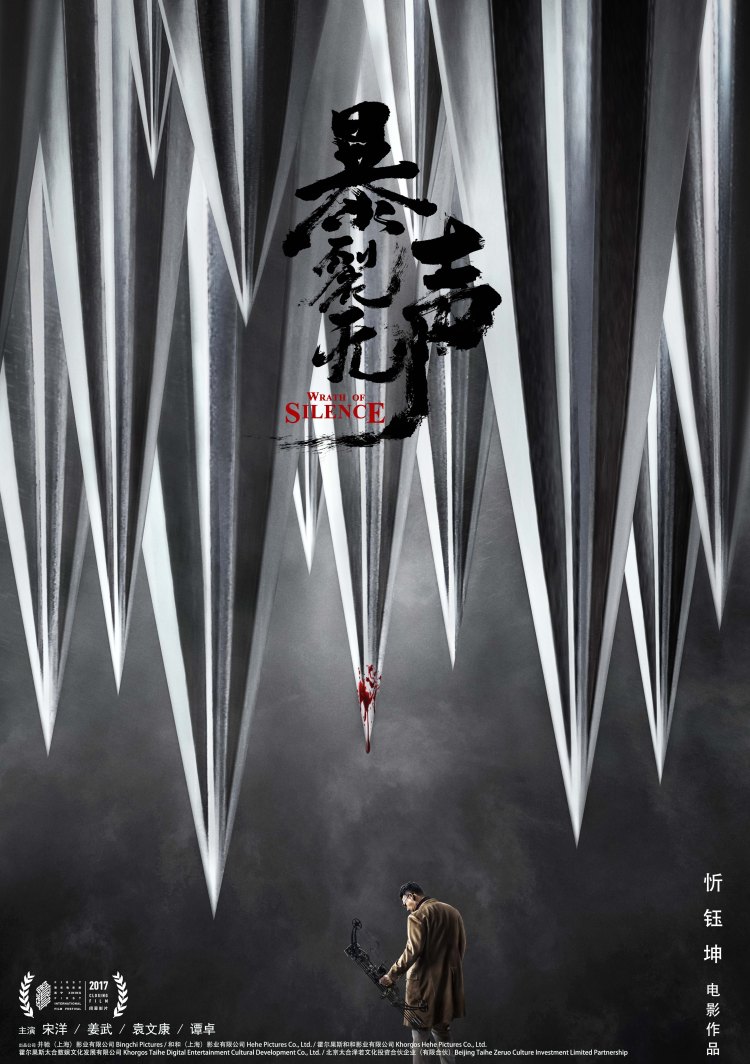
Wrath of Silence (暴裂无声, Xin Yukun, 2017)

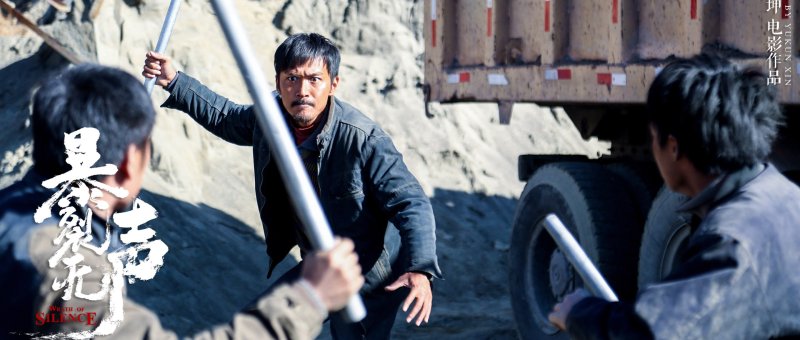
wrath of silence posterNature red in tooth and claw – life in the arid Northlands of modern China is surprisingly bloody in Xin Yukun’s The Coffin in the Mountain followup, Wrath of Silence (暴裂无声, Bào Liè Wúshēng). The film’s Chinese release has, apparently, been indefinitely delayed for unclear reasons but it’s easy to see what might have given the censors occasion for pause in this tale of missing children, corrupt businessmen, and the relentless lusty greed of the new middle classes. A voiceless everyman forced away from his family by a series of unfortunate events, returns to look for his missing son but finds only a malevolent darkness invading the corners of his once peaceful rural mountain town.

In the winter of 2004, a small boy watches his sheep whilst building a small rock tower and drinking from his Ultraman flask. A short while later, his dad, Baomin (Song Yang), is pulled away from a fistfight at the bottom of a coal mine by a phone call from his wife informing him that their son has gone missing. Baomin drops everything and goes home but he’s still persona non grata in the small mountain village after stabbing the local chef in the eye with a lamb bone during a fight over Baomin’s refusal to sign over his land to developers hoping to open a coal mine.

Baomin’s path crosses with that of two other men, gangster-like mining magnate Chang (Jiang Wu) who has recently been “acquitted” of running illegal operations, and Chang’s lawyer, Xu (Yuan Wenkang), a conflicted single parent. Baomin and Xu are at opposite ends of China’s recently born class system – one educated, successful, and inhabiting the new pristine cities, the other literally rendered voiceless by an act of violence, poor, and living an antiquated rural life in a desert wasteland. Chang exists in the no man’s land between them as an example of the new elite – his life is one of Westernised elegance in his smart study and wood panelled drawing room with its deer heads on the walls. Yet it’s not business acumen which underpins his success but thuggery and a thorough disrespect for conventional morality.

There is a double irony in Baomin’s life in that his original objection to the coal mine has sent him straight into one. Owing vast compensation to the chef whose eye he ruined as well as needing money to pay for his sickly wife’s medical treatment, Baomin has little choice but to leave his farm and travel to a distant city where he can earn the money he needs to pay for his various responsibilities. Not only are the coal mines ripping up the landscape, they’re destroying families firstly through forced absences and secondarily through disease born of industrial pollution.

This veniality is all too plain in Chang’s ostentatious display of needless slaughter as he sits at a large dining table entirely covered in plates of raw meat ready to be sizzled in Chang’s favourite hot pots while a finely tuned slicer runs in the background churning out an endless supply of repurposed flesh. Chang’s overwhelming need for consumption is less about hunger than conquest as his hunting hobby proves but the trophies on his walls are as fake as the hairpieces which cover his receding hairline. The force which drives him is not so much need as vanity, fear, and insecurity. Desperate to be hunter and not hunted, he has abandoned all morality and will stop at nothing to ensure his place at the table is secure.

Baomin will stop at nothing until he finds his son. The film’s title, ironically enough, includes a slight pun in its first two characters which are pronounced “Bao” and “Lie” (the name of Baomin’s son) but mean “violence” and “spilt” while the characters of Baomin’s name (保民) mean protect and citizenry. Baomin is a violent man. According to his wife he was always fond of a fight even before rendering himself mute, but it has to be said that violence is, in his voiceless state, his most efficient method of communication. Flashing pictures everywhere he goes, Baomin chases visions of his son, haunted by small boys in Ultraman masks, fighting monsters far more real than the tokusatsu hero’s usual foes.

Fable-like in execution, the final revelations are heavily foreshadowed though dual meanings are plentiful as in a small boy’s innocent assumption of a classic Ultraman pose which looks eerily like something else to those with a guilty conscience, planting the seed of doubt as to whether it really was quite that innocent after all. Xin shoots with Lynchian surrealism as darkness seems to creep idly into the frame and then hover there, threatening something terrible, like the manifestation of willingly unseen truths. The rapid pace of social change has brought with it a loss of morality that endangers the foundation of society itself, sacrificing the young on the altar of greed while the state turns a blind eye to systemic corruption and cowards save their own skins rather than ease the suffering of others. Filled with a quiet rage mediated through melancholy poetry, Wrath of Silence takes a long, hard look into that creeping darkness but finds the darkness looking back with accusing eyes.


Screened at BFI London Film Festival 2017.

Original trailer (dialogue free, no subtitles)


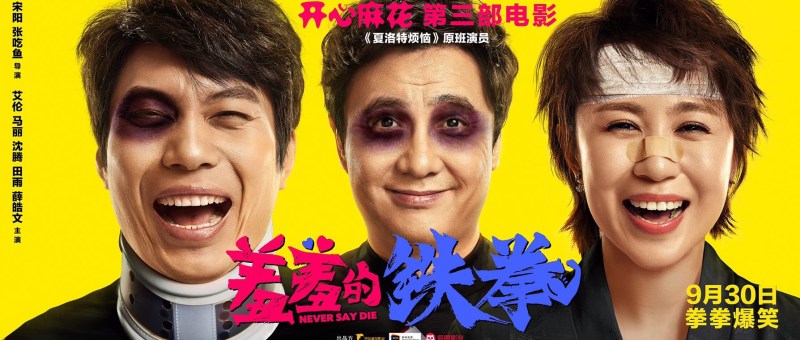
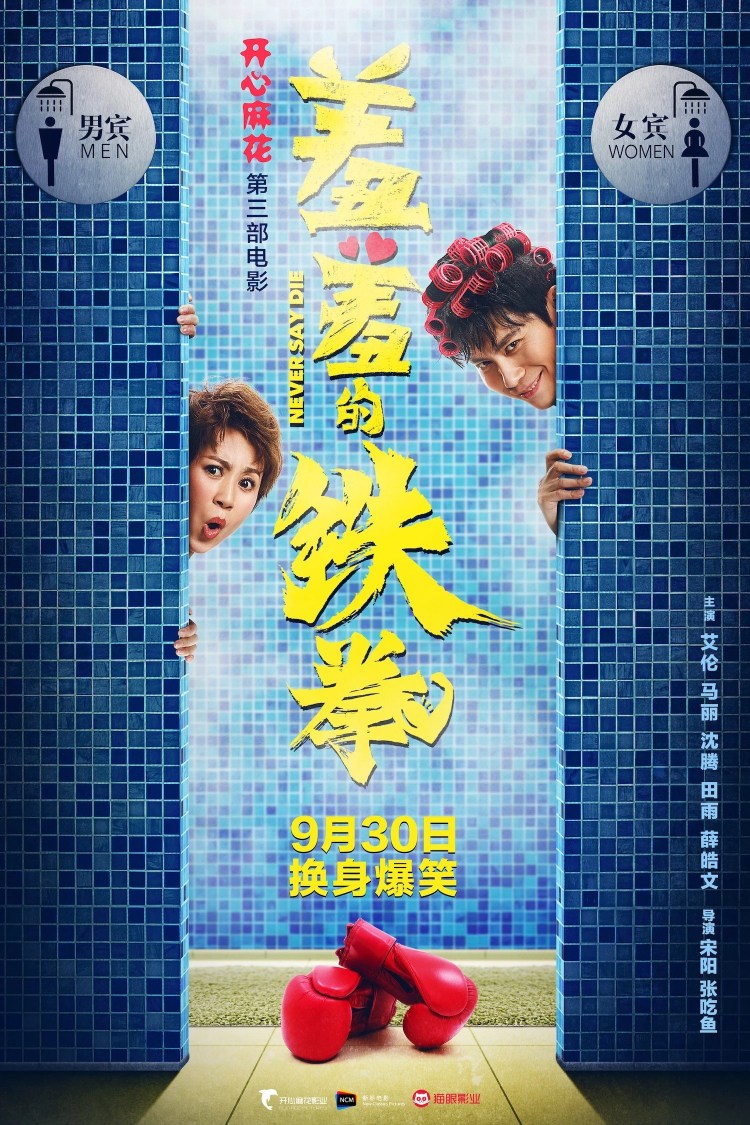
Never Say Die (羞羞的铁拳, Song Yang & Zhang Chiyu, 2017)

Never say die posterBody swapping drama seems to have come back in style of late, though they’ve rarely been as funny as the surprisingly laugh out loud Chinese comedy Never Say Die (羞羞的铁拳, Xiūxiū de Tiěquán). Based on a stage play by the Chinese theatre company Mahua whose last effort Goodbye Mr. Loser did something similar only with time travel, Never Say Die is a story of never giving up, always getting even, and learning to understand yourself through someone else’s eyes.

Edison (Ai Lun) was once an MMA champion, but a scandal three years previously has left him disgraced and reduced to taking dives for his shady boss, Dong (Tian Yu). Edison has a reputation for being good at taking dives because he can make them look so “realistic”, and believes his special talent ought to earn him a few more dollars. Seconds after dramatically hitting the mat, Edison gets a call reminding him he’s late for a weigh-in at a “real” fight. When he gets there he’s confronted by a bulldog reporter, Xiao (Ma Li), who questions him about his history of taking bribes. Reacting angrily, Edison soon realises Xiao’s boyfriend is none other than top MMA fighter and arch-rival Wu Liang (Haowen Xue).

Just to make things more complicated, Xiao is also the daughter of Edison’s manager, Dong, whom she hates and is determined to expose for his corrupt dealings. Edison chases after Xiao when he and Dong discover her recording a very compromising conversation but after ignoring a warning sign the pair end up on a rooftop during a thunderstorm. Edison bumps into Xiao, kissing her by mistake and pushing her into the pool in which they then both get struck by lightning. Waking up in hospital, each of them discovers they’ve come back a little different than they remembered.

This being China with its relatively stringent censorship laws, the body gags are kept to a minimum with Xiao suddenly dropping her reporter’s poise for “manly” roughness and Edison becoming subtly effeminate. Both are horrified by the sudden colonisation of their own bodies and resentful that in order to look after it properly someone they intensely dislike is going to have to be very aware of their most intimate features. This is especially true of Edison who reacts to his new found femininity in the predictable way by fondling his own breasts and then having a fantastic time in a ladies’ only bathhouse (an extended set piece ironically set to YMCA).

The gag is simple enough but actors Ai Lun and Ma Li commit so totally to their new roles that the increasingly absurd situations ring true right up until the trio end up learning Kung Fu from a possibly gay, resentful deputy chief monk (Teng Shen) at a mountain retreat. Veering off from the standard rom-com route, Never Say Die makes a brief sojourn in revenge genre after Xiao finds out some unpleasant facts about Wu Liang (through being Edison) and decides she needs to get her own back by humiliating him in the MMA ring. Edison may have been a champ, but despite his physical training, Xiao is still an elegant female reporter who’s not exactly used to being in the middle of a fight.

Never Say Die does not manage to escape the inherently sexist bias of the gender swap movie, but it does its best to mitigate it. It is problematic, in one sense, that Xiao needs to “man up” to get revenge on her dreadful boyfriend and then is sidelined when it comes time for Edison finish the job for her, but on the other hand she is the more capable and pragmatic of the pair who teaches Edison how to get himself together whilst playing a supporting rather than leading role. Perhaps betraying its comedy stage show routes, the script may appear episodic and meandering but it’s all brought together in grand fashion at the end with nary a gag wasted. The lesson is that eventually you have to get off your high horse and really look at yourself and others whilst resolutely refusing to back down to dishonest bullies if you really want to earn the right to be happy in yourself. Hilarious and emotionally satisfying in equal measure, Never Say Die is an unexpected comic delight which proves surprisingly subversive even in its superficial innocence.


Currently on limited release in UK cinemas courtesy of Chopflix.

Original trailer (Mandarin, no subtitles)

Once Upon a Time (三生三世十里桃花, Zhao Xiaoding & Anthony LaMolinara, 2017)

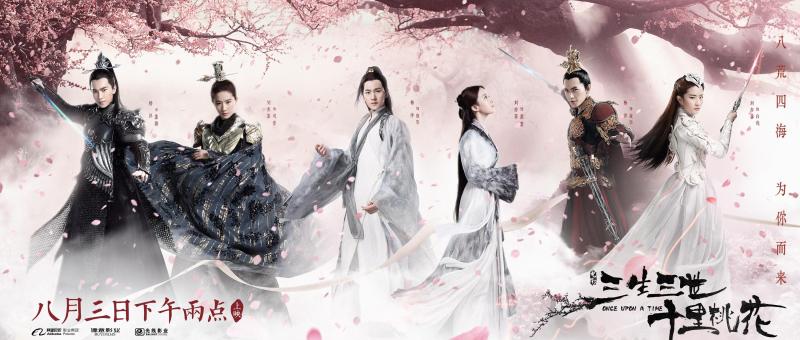
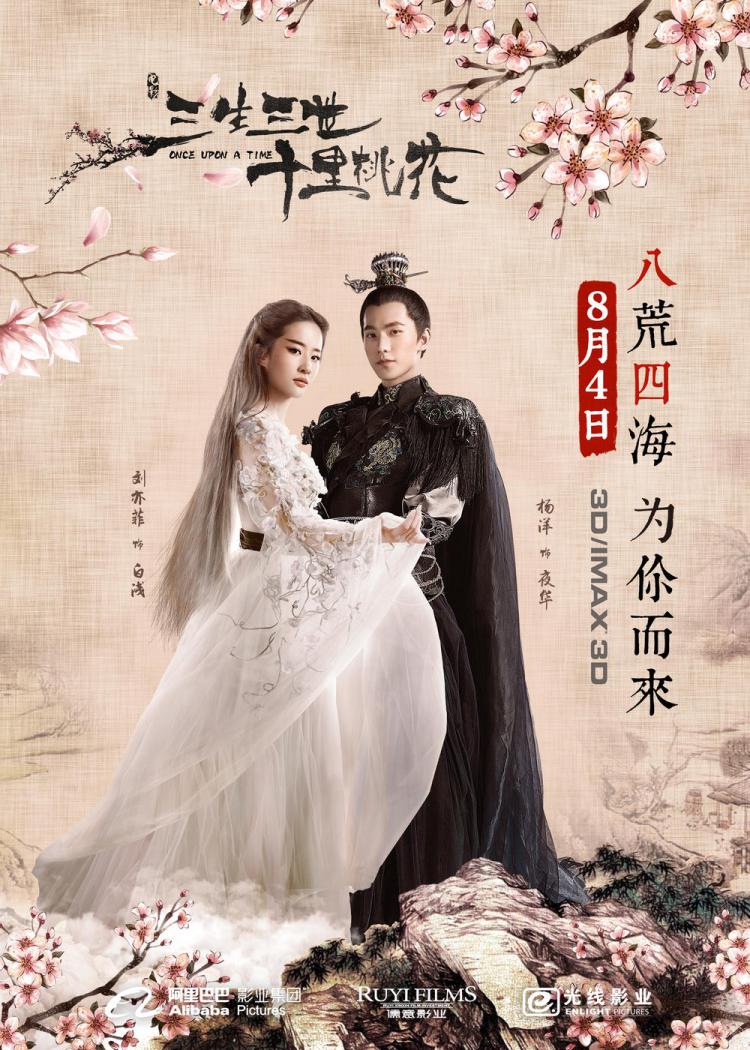
once upon a time posterTang Qi’s popular online novel Three Lives Three Worlds, Ten Miles Peach Blossoms (三生三世十里桃花, Sān Shēng Sānshì Shílǐ Táohuā) has already been adapted into a phenomenally popular TV drama spanning 58 episodes but the big budget, blockbuster adaptation by Zhang Yimou’s regular cinematographer Zhao Xiaoding making his directorial debut in a co-production with Anthony LaMolinara, thinks it can make do with just 110 minutes. Retitled Once Upon a Time in an obvious nod to the film’s attempt to blend classic Western fairytales by way of Disney with traditional Chinese mythology, Zhao’s approach is a (mostly) family friendly one complete with superfluous CGI characters and a kind of essential innocence in its emotional landscape. Yet it also falls into the traps of many a Chinese fantasy blockbuster in its convoluted, confusing narrative, over reliance on CGI visuals, and host of pretty but bland leading players.

A blindfolded woman bids her lover goodbye as she falls through a storm before landing softly in a beautiful orchard covered in peach blossom to be woken by a friend who tells her she had just been asleep. The woman says she remembers nothing but feels as if she’s been inside a dream. He tells her to let it go, in her dream world she lived a very sad life and it’s better not to remember.

As it turns out the woman is the queen of this realm, Bai Qian (Liu Yifei). She spends her days alternating between frolicking with mystical forest creatures like your average Disney princess (only with less singing) and drinking so heavily she passes out. In fact, drinking is pretty much her only hobby and her general demeanour is moodiness born of being sad over something she does not remember. Technically speaking, she’s been engaged to a mysterious prince from an undersea kingdom for quite sometime but has no desire to marry, firstly out of the aforementioned sadness, but also out of a preference for independence, and the fact that the prince is apparently 70,000 years younger than she is and she thinks it’s inappropriate. Nevertheless, she goes (blindfolded due to a problem with her oversensitive eyes) and meets Ye Hua (Yang Yang) and his son Ah Li (Peng Zisu) who immediately recognise her as “Su Su” – the boy’s mother who died 300 years ago.

Though Once Upon a Time is based on a fairly recent novel and draws much of its inspiration from Western fairytales, some familiarity with Chinese mythology will undoubtedly help. Bai Qian is apt to suddenly morph into a white nine tailed fox while her friend Zhe Yan (Luo Jin) is a glowing, fiery phoenix of the battlefield and though the gods possess a number of surprising powers from the ability to spontaneously generate fire or chop vegetables in mid-air, they fight the way any mortal would only with much more destructive effects.

At heart, apt phrase as that is, Once Upon a Time is an epic love story in which two souls wait and search for each other through eons, pushing and probing for recognition all while failing to grasp that which seems to exist between them. The title of the novel is almost a spoiler in itself as it details the passage through three worlds and three lives which has brought Bai Qian and Ye Hua to this particular impasse of awkward, screwball romance. A repeated phrase between the lovers, the Ten Miles of Peach Blossom is a byword for excess – what is the point of ten miles of peach blossoms, when a single petal is enough? Ye Hua affirms he’s found his petal already, though she refuses to come down from her tree. Bai Qian is the obstinate one, pining for a lost love and, perhaps, one she doesn’t remember but there are things Ye Hua has hidden from himself too.

As much about identities in flux eventually settling in love, Once Upon a Time also has its standard fairytale tropes from the “ugly” sisters at the beginning to the wicked step-mother stand in Su Jin (Li Chun) and her machinations to get rid of Su Su/Bai Qian by means of her wicked white tiger. Bai Qian and Ye Hua must come to know all of themselves before recognising their opposing number, seeing straight through the fog of love to its shining core. Despite the depth of its ideas, Once Upon a Time fails to move beyond its fairytale setting, caught between the bright and colorful world of a peach blossom orchard filled with adorable woodland creatures, and the darkness of the woman who lives inside it, slowly killing herself with drink to blot out the inability to remember long buried pain. Intermittently charming, Once Upon a Time is among the better fantasy films emerging from mainland China in recent times but unlike its forgetful lovers never quite manages to recover its heart.


Currently on limited release in UK cinemas.

Original trailer (English subtitles)
Wu Kong (悟空传, Derek Kwok, 2017)

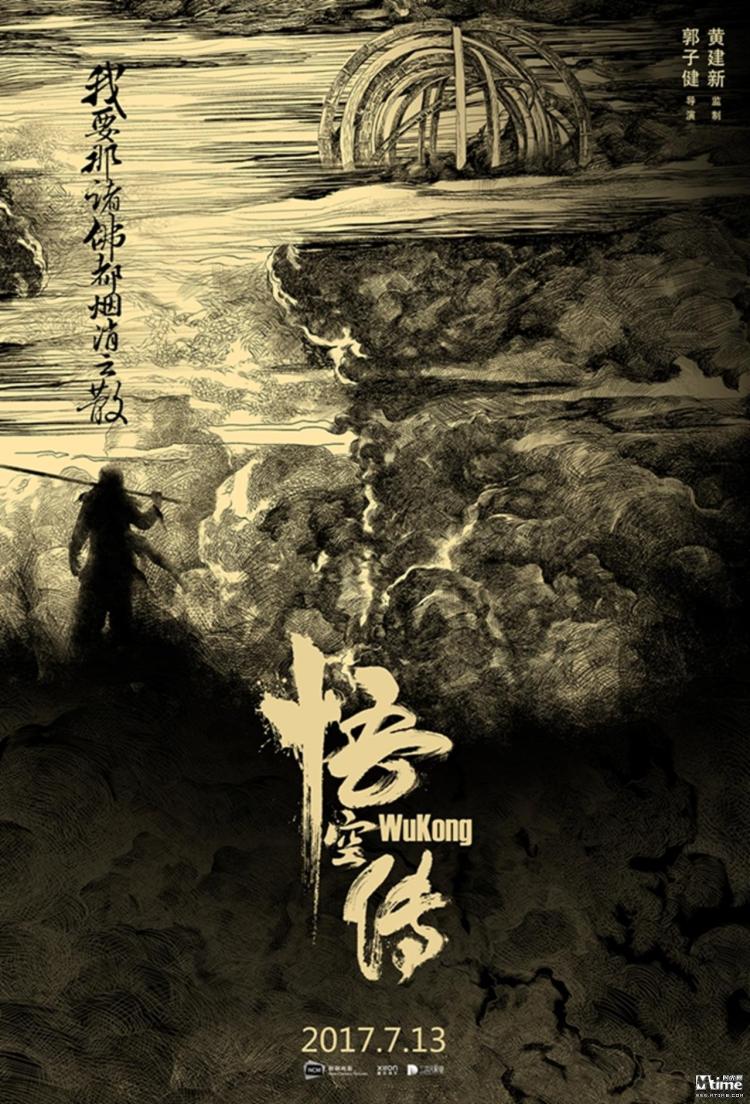
Wu KongAs it stands, contemporary Chinese cinema is veering dangerously close to Monkey King fatigue. Stephen Chow brought his particular sensibilities to the classic Journey to the West before Donnie Yen put on a monkey suit for Cheang Pou-soi, both of which were quickly followed by sequels. Eddie Peng is the latest to pick up the staff for Gallants’ Derek Kwok, though this is a much more youthful incarnation of the iconic hero, acting as a kind of prequel to recent incarnations and as a coming of age tale for the titular “demon” as recounted in the popular online novel Legend of Wukong by Jin Hezai. Told in grand style, Kwok’s Wu Kong (悟空传, Kōng Zhuàn) is a star studded box office extravaganza but embraces both extremes of its family friendly, mainstream blockbuster thrills.

So, Sun Wu Kong (the Monkey King), as you know, was born from a stone atop Mount Huaguo  – a remnant of a giant who attempted to battle the heavens but was defeated. Heaven fears the existence of the mischievous demon and determines to destroy him but he’s saved by a teacher who gives him a human form and the name Sun Wu Kong. Devastated by the destruction of his homeland, Wu Kong (Eddie Peng) vows revenge on the Heavens and travels to voice his concerns in person. Resenting his “destiny” Wu Kong focusses his attentions on destroying the divine astrolabe which ascribes fate to all beings, but little does he know that its guardian, Hua Ji (Faye Yu), wants his heart for herself so that she might rule all of Heaven and Earth.

Kwok opens with a beautifully designed sequence modelled after traditional chinese ink paintings in which he recounts the pre-history and birth of the demon later known as Sun Wu Kong. Unlike some other recent attempts to tackle this famously fantastical world, Wu Kong boasts fabulously high production values as well as much better special effects than most Chinese blockbusters, and it helps that Eddie Peng is not burdened with spending the majority of the movie in prosthetics.

Nevertheless for all the lack of actual plot, there is a lot going on and the brisk pace of the exposition filled opening is hard to follow (but, thankfully, details are unimportant). As in his other adventures, Wu Kong ends up with a collection of friends and enemies including love interest Azi (Ni Ni) – the equally rebellious daughter of Hua Ji who has just returned from 100 years in “re-education” exile and fiercely resents her mother’s cruel and controlling nature. Likewise her half brother, Erlang (Shawn Yue) has also arrived home at just the right/wrong moment and is conflicted in his views towards the Heavens – wanting to be accepted as a true “immortal” but also wanting to protect his little sister, so obviously unhappy with the ruling regime. Two more cohorts appear in the gadget laden Juan Lian (Qiao Shan) – a kind hearted man with a hopeless crush on Azi, and the lovelorn retainer, Tian Peng (Oho Ou), still pining after his childhood sweetheart who was exiled to the mortal world.

Much of the central drama occurs after Wu Kong, Erlang, and Tian Peng destroy “The Bridge of Destiny” and are cast down to the mortal world themselves along with Juan Lian and Azi. Finding themselves in a desperate village which happens to be on the former site of Mount Huaguo, the five start to believe they’ll never be going home and discuss staying to help the villagers defeat the “Cloud Demon” which has been stealing all their water. Interacting with the villagers teachers each of them some vaiuable lessons, but “destiny” is still waiting, and trying to change the fate of these desperate people may have disastrous, unforeseen consequences.

Once again, Wu Kong’s battle lies in the Heavens and may end up costing more than it gains. Kwok’s direction is conventional in one sense, but also manages to add a youthful energy which befits the film’s message. Wu Kong’s rebellion is the same as many a young a man’s – against a pre-ordained fate. As he puts it in the punkish final title cards, he will not be blinded by the sky or bound by the Earth – he will decide his own destiny and will never submit himself to the authority of any god or Earthly power. Attempts at melodrama largely fall flat, as does the unwise decision to shift to fantasy sequences for moments of high emotion, not to mention the inclusion of a sappy pop song to really ram home the theme of tragic romance, but whatever Wu Kong’s failings it succeeds brilliantly in its primary objective as an admittedly vacuous summer blockbuster primed to speak to the hearts of hemmed in teens everywhere.


Currently on UK release at selected cinemas.

Original trailer (Mandarin with English/simplified Chinese subtitles)