Ninja vs Shark (妖獣綺譚 ニンジャVSシャーク, Koichi Sakamoto, 2023)

There’s a lot going on in formerly peaceful village Okitsu. Not only are villagers washing up in bits after being attacked by a mysterious Sea God, but they’re also being abducted by a gang of devil-worshipping bandits. Koichi Sakamoto’s Ninja Vs Sharks (妖獣綺譚 ニンジャVSシャーク, Youjuu Kitan Ninja vs Shark) is exactly what it sounds like only with added zombies and black magic along with a more prosaic darkness in the legacy of domestic violence, entrenched patriarchy, and social prejudice. 

The twin threats are the reason that the village chief decides to employ Kotaro (Koshu Hirano), a drifter with a good reputation as a bodyguard but a bad one as a man. In the last village, he raped the wife of the man that hired him, Tae, on learning that they did not in fact have the money to pay. This fact seems to be forgotten as the film progresses and Kotaro is seen in a much more sympathetic light as someone who has a genuine interest in protecting the village rather than a heartless rapist and mercenary. In any case, on his arrival in Okitsu he walks in the attempted rape of Sayo (Juria Nagano), a woman ostracised by the village for having killed her abusive father after he murdered her mother. Her father was also the Mayor’s brother, which would make him her uncle though he thinks nothing of declaring her “cursed” and offering her up as a sacrifice to bandits and supernatural enemies alike. 

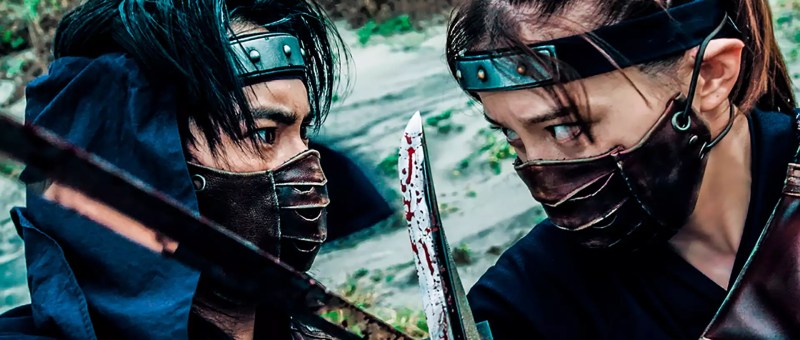
As Kotoaro remarks, some people only feel safe through oppressing others. The pair immediately bond over their shared outsider status and a sense of loss having been instructed by those they could not save that above all else they should live. There is however a minor love triangle in the determination of villager Shinsuke (Shun Nishime), otherwise fairly ineffectual, to protect Sayo from bandits, curses, and the stigmatisation of the village. Nevertheless the trio end up becoming fast friends even as Kotaro’s past comes back to haunt him in the form of roving ninja Kikuma (Kanon Miyahara) who is set on tracking him down as a traitor to their clan. 

Meanwhile, the leader of the devil-worshipping clan has figured out that he can gain eternal youth by eating pearls and vampirising handsome young men after sucking on their chests and licking their faces. Becoming a many-toothed shark-man in the process he has a pact with a giant shark demon which has been slowly killing off the villagers which is counterproductive because he needs them to produce more pearls. Kikuma also has some kind of dark ninja magic which allows her to create zombies, killing and bringing back the woman Kotaro raped as an undead retainer still hoping for vengeance though Kotaro’s dark past seems to be otherwise forgotten in his newfound sense of righteousness. 

It’s obviously a lot, but Sakamoto mostly makes it work as simply a part of this strange feudal world though the real villain is obviously the Mayor who is not sufficiently dealt with and yes, he probably should have closed the beach not to mention looking for a better way to deal with the Sea God if not the bandits. The titular shark does not appear all that much though there are plenty of other fights and action sequences not to mention severed heads and giant blood sprays along with gory dismembered body parts. Less a contest between man and nature, the battle is between the supernatural force of the shark and classic ninja training which Kotaro is forced to re-embrace in his quest to save Sayo having sworn off it because of inherent corruption in the ninja world. In any case, though they might have defeated the shark and struck a partial blow against the devil-worshippers, the trio each find themselves exiled from mainstream society, unable to remain in the village and seeking a life of independence elsewhere. A post-credits sequence hints a sequel suggesting that trouble is, however, likely to follow them as they do their best to survive in Edo-era society where vampire shark-men may actually be the least of their worries.


Ninja vs Shark screened as part of this year’s Camera Japan.

Original trailer (no subtitles)
The Rest of Our Lives (ラストターン 福山健二71歳、二度目の青春, Shinji Kuma, 2023)

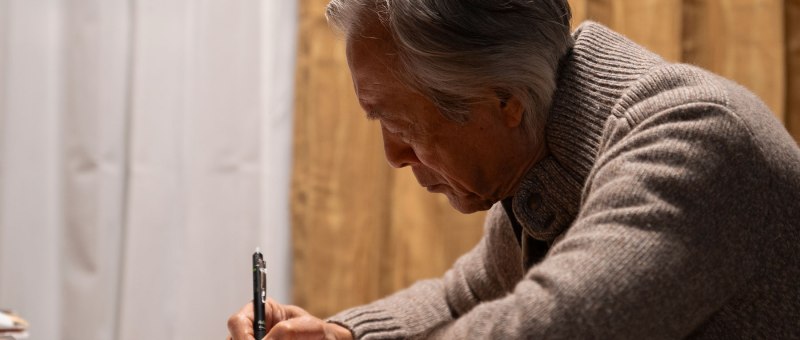
A pair of elderly men struggle to find meaning in their lives in the face of well-meaning infantilism and health anxiety in Shinji Kuma’s warmhearted ageing drama, The Rest of Our Lives (ラストターン 福山健二71歳、二度目の青春,, Last Turn: Fukuyama Kenji 71-sai, Nidome no Seishun). They are not, however, the only ones as even younger people find themselves consumed by existential confusion when reaching a natural turning point and accepting that their lives will have to change. Yet through their various relationships each begins to come to a new accommodation with the present and accept that though their lives may be different than before there are still many things for them to do. 

Kenji lost his wife two years previously having cared for her as she succumbed to Alzheimer’s. These days he likes to take a walk around the neighbourhood and then get on with his usual business though even he begins to realise that he’s become forgetful and is prone to doing strange things like leaving the remote control for the TV in the freezer. His son lives far away but is worried enough about him to install an iPad on the wall so they can call each other any time and he can also check in on him to make sure Kenji hasn’t had a fall or anything like that. But to Kenji it obviously seems like an imposition, his son’s basically spying on him and taking away his privacy along with a little of his independence. Satoru has also been checking out homes and recommends an organisation for elderly people where he can get health advice, stay active, and avoid social isolation. 

Only at the centre he starts to feel insulted, irritated that the staff members talk to them as if there were small children while getting them to do weird exercise regimes that make him feel silly. One elderly gentleman, Hashimoto, eventually storms out exclaiming that they aren’t in kindergarten anymore instantly earning Kenji’s admiration. Even so, as it turns out they are very different men. While Kenji is somewhat reserved and polite, Hashimoto is a chatterbox who makes constant inappropriate comments about women he probably only (just) gets away with because of his age and otherwise loudmouth personality. The friendship between them is slow to develop for this reason, but also because Kenji seems to have forgotten what it’s like to have a friend and accidentally upsets him leading Hashimoto to think that perhaps he is just annoying Kenji and should leave him alone. 

At the swimming pool they’re encouraged to go to, the pair run into Kaori, a former competitive swimmer like them struggling to accept the physical decline of her body along the end of her sporting career. Now working as an instructor she finds teaching an uphill battle partly in her buried resentment but also through a lack of empathy for her students unable to remember what it was like to not be able to swim and impatient with those lagging behind. They are all looking for ways to reorient themselves, not so much because of their age because of the immense changes in their lives along with a sense of loneliness. Kenji lives alone, but even Hashimoto who has moved in with his son confesses that the often feels in the way and once again infantilised seeing as they’ve given him a traditional Japanese room which lacks a locking door. 

Yet the realisation Kenji comes to is that their fear of becoming a burden is misplaced. It’s alright to ask for help when you need it and even better to offer it where you can such as in his thoughtful decision to walk a neighbourhood dog that barks all the time because the elderly lady who owned him passed away and her son’s out all day at work. Shining a light on the lives of the elderly in an increasingly ageing Japan, the film is makes a gentle plea for intergenerational solidarity and a more compassionate society that is responsive to the needs of others and cares for everyone equally. Kenji and Hashimoto marvel that even in their old age they still take pleasure in learning new things while allowing themselves to accept help as a gesture of love while making sure to return the favour wherever they can. 


The Rest of Our Lives screened as part of this year’s Camera Japan.

Sabakan (サバカン SABAKAN, Tomoki Kanazawa, 2022)

A melancholy middle-aged writer looks back to a climactic summer of his youth and the ghost of fractured friendship in Tomoki Kanazawa’s heartwarming nostalgia fest, Sabakan (サバカン SABAKAN). A classic summer adventure movie, the film finds a sense of warmth in childhood memory but also reflects on all that at the time it was impossible to understand along with a sadness in the inevitable end of summer as two boys chase the spectre of dolphins in an otherwise tranquil seaside town.

In the present day, Takaaki (Tsuyoshi Kusanagi) is a struggling author and divorced father already behind on his child support. When he mentions working on another novel, his agent laughs at him that books like that don’t sell while trying to convince him to take a job ghostwriting for an Instagram influencer going viral for her dieting tips. Perhaps because the agent had described his writing as “quick and easy to read”, essentially anonymous and empty, he begins meditating on his childhood self repeatedly praised for his writing by a teacher who is perhaps a little easily moved. 

The summer of 1986 was the beginning of the Bubble era and Takaaki’s memories are indeed filled with a series of cultural touchstones such as the idol Yuki Saito whose poster the young Takaaki sometimes kisses after dancing around singing her hits. All of which is one reason why the poverty of his classmate Kenji (Konosuke Harada) has made him even more of an outcast bullied by the other kids who follow him home and make fun of the rundown house with tarp covering the roof that he lives in with his mother (Shihori Kanjiya) and several siblings. His fisherman father died some years ago and his mother works in the local supermarket doing her best to support five kinds on a part-timer’s salary. Kenji takes a liking to Takaaki because he’s the only kid who didn’t join with the others when they laughed at him, more or less blackmailing him into a summer adventure looking for dolphins in a cove over the mountain. 

Even the younger Takaaki reflects there probably weren’t any dolphins in the first place, Kenji just wanted to go on adventure with him and didn’t otherwise know how to ask. A careless word from his otherwise warm and supportive mother provokes a minor rift in the boys’ relationship that despite himself the younger Takaaki didn’t quite understand causing him to pull away from Kenji in an unwarranted sense of rejection unable to recognise that he is simply awkward and has low self-esteem which caused him to question the reality of their friendship. In any case though they are later separated by unexpected tragedy, their connection becomes a touchstone for each of them reminding them that they are not alone even if no longer together. 

Kanazawa captures an impish sense of fun the boys’ adventure as they find themselves in a tricky situation with a trio of thuggish delinquents and meet an equally melancholy teenage girl at the shore who stares mournfully at a washed up can of Korean soda and explains sadly as she looks out over the sea that she herself has not been there yet. The Yuki Saito poster comes down, signalling the arrival of a coming of age and the putting away of childish things as Takaaki moves into a more concrete adulthood while still floundering in adolescent confusion and the inability to fully understand his new friendship or its growing importance in his life. 

The adult him understands only too well, meditating on his memories and triggered by nostalgia on seeing a can of mackerel and remembering the carefree summer of his youth. The rediscovery of a childhood bond begins to open him up both artistically and in his relationship with the wife and daughter from whom he is separated. Told with humour and warmth, the film is filled with a sense of childhood wonder and the comfort of the everyday largely undimmed by the entrance of tragedy and the essential sadness of summer’s end. Even so it allows its melancholy hero to find a kind of salvation not only in childhood memories of dolphins and canned mackerel but in the enduring quality of a friendship that itself may have become distant.


Sabakan screened as part of this year’s Camera Japan.

Original trailer (no subtitles)

Polan (ポラン, Kota Nakamura, 2022)

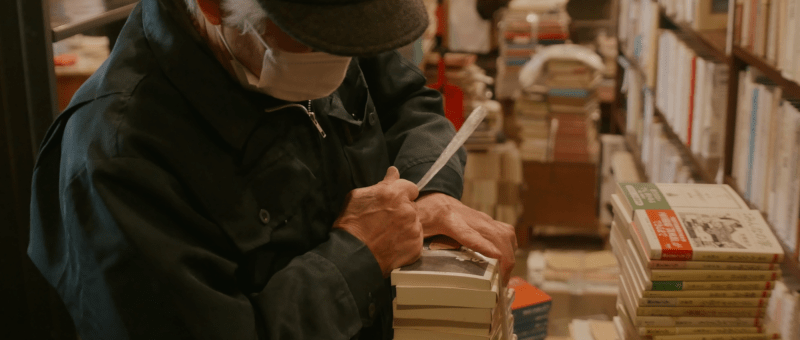
The closure of a second-hand bookshop leaves a gaping hole at the centre of a community in Kota Nakamura’s warmhearted documentary, Polan (ポラン). Driven to close their physical shop because of the ongoing economic effects of the pandemic, an elderly couple contemplate changing times but still hope to save something of paper culture and the organic pleasures of offline browsing from unexpected discoveries to serendipitous friendship and the comfort to be found in having a familiar place you can be certain of returning to. 

As he explains, Kyosuke Ishida found himself disillusioned when most of his fellow student protestors ended up getting regular salaryman jobs. He wanted to prove he was different, so he dropped out and started working as a tutor at cram schools before eventually deciding to open a small second-hand bookshop. The shop was so successful that they later moved to larger premises, but footfall began to fall during the pandemic while online sales remained constant. With his wife Chiseko who runs the bookshop with him already feeling the physical strain of their work and the landlord upping the cost of their lease, the pair eventually decide to close up though Kyosuke has mixed feelings and would have liked to continue a little longer. 

More than the books, what the shop offers is a sense of community. Some customers tearfully remark that they’ve grown up with the store and feel themselves bereft while others share happy memories of browsing the shelves. The store itself is like a place out of time, decorated in a whimsical, antique style from the fretted front window to the antique clock on the wall and old-fashioned dolls sitting on the cases. As they’re fond of pointing out, everyone is welcome at the store and they pride themselves on providing a diverse selection of books rather than just the things they particularly like or know will sell well. Kyosuke devotes whole shelves to each genre and keeps them all well stocked rather than prioritise sure sellers ensuring that rare books are always available. 

As he says, part of what he’s trying to save is paper culture. If you know what you’re looking for, then of course you can find it online right away and have it delivered quickly and cheaply. But perhaps something’s been lost in the drive towards convenience. Kyosuke remembers taking a lengthy train journey as a child during which they had to temporarily disembark in an unfamiliar place but that doesn’t happen with the Shinkansen where you can’t even open a widow or see much of the world around you as you rocket through it. As he sees it, you might have a happier life taking a more difficult path, much as he has opening a bookshop, discovering small things along the way rather than opting for easy convenience. He wants people to experience the thrill of the inconvenience of turning a page, along with “the joy of searching and pleasure of encountering” that can only be found with a physical experience in a real world bookshop. 

Nevertheless as he admits times have changed and we’re entering a new and unknown post-pandemic world. He regrets that the bookshop can’t go too but consoles himself with the knowledge it’ll exist online. There is however continuity as their employee, Minami, decides to open a bookshop of her own taking some of the same sentiments with her in providing another community hub open to a diverse collection of book lovers in pleasant surroundings. Revisiting the location a year later, Nakamura discovers the shop space still vacant. Its bare industrial walls are somehow devoid of life. It’s difficult to believe the bookshop with its whimsical old world charm once existed there. It takes just 20 days to demolish it with the shelving and other furnishings taken by other store owners such as Minami and a distant relative in another town suggesting that the shop itself lives on, moving in a cycle much the books though some of those are unfortunately pulped as last resort. A gentle tribute to a disappeared local institution, the film ponders on what we’re losing in the post-pandemic world along with what our love of convenience may be costing us in a warmth and sensation otherwise unavailable in our rapidly digitising world.


Polan screened as part of this year’s Camera Japan.

Original trailer (no subtitles)
Baian the Assassin, M.D. (Part 1) (仕掛人・藤枝梅安, Shunsaku Kawake, 2023)

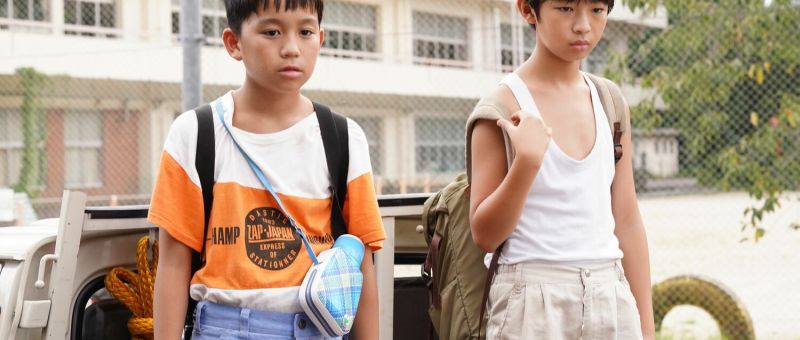
A traumatised assassin takes it upon himself to get rid of a few villains on realising there’s something not quite right with his latest contract in Shunsaku Kawake’s classic jidaigeki homage, Baian the Assassin, MD: (Part 1) (仕掛人・藤枝梅安, Shikakenin Fujieda Baian). The titular hero is the protagonist of a series of novels by Shotaro Ikenami which have spawned several previous adaptations on the big and small screens. Produced in celebration of Ikenami’s centenary the film, one of two, harks back to the golden age of period drama if with a more contemporary sensibility. 

Baian (Etsushi Toyokawa) is ostensibly an acupuncturist though by night he uses his needles to kill rather than to heal. Hired to take out the second wife an inn owner, Omino (Yuki Amami), his suspicions are raised on realising that he had also been the assassin who killed the man’s first wife two years earlier. He blames himself in part for having agreed to assassinate a woman in the first place, and remains conflicted even after accepting the job wondering if Omino is next in the firing line or if she was actually the one who had the other woman killed in order to usurp her place. 

The film makes clear from the outset what a difficult place Edo could be for a woman as Baian carries out an assassination on a boatman who had raped a samurai’s wife and then blackmailed her into further sexual favours only for her to hire an assassin and then kill herself confessing all. Omino had apparently been the stepdaughter of a gang leader who sexually abused her and then died leaving her with no support and nowhere to turn except to sex work. Maybe no one could blame her for taking advantage of a besotted client to escape her terrible circumstances though getting rid of his wife would obviously be a different matter. Omon (Miho Kanno), a maid Baian takes a liking to while investigating, admits something similar that as a widow with a young son realistically speaking there is nowhere else that could she work to support him except on the fringes of the sex trade. Then again, as she says the previous mistress was strict but it was because she cared, whereas Omino is just mean and self-interested. She’s fired all the old staff and brought in pretty young women who are quite obviously being expected to entertain their male customers in more direct ways. 

In any case, Baian soon finds himself drawn into a wider series of plots when his friend Hiko (Ainosuke Kataoka), a skewer maker who assassinates people with poison darts, is tasked with taking out first a lascivious carpenter and then a rogue samurai who has supposedly raped and kidnapped the daughter of his lord which obviously turns out not quite to be the case. Rape and kidnap are depressingly common in Edo-era society where it is largely women who suffer under a patriarchal society with intensely oppressive social codes that demand female purity. In a post-credits sequence, we come to understand that Hiko too is seeking vengeance for the death of a woman who killed herself and her child after being raped by bandits. Meanwhile, Baian reveals that he had a mild hatred of women himself born of pain in having been abandoned by his mother who left with another man and took only his sister with her after his father’s death. He had to overcome that resentment in order to fulfil himself as a doctor treating women’s bodies but struggles when he realises that someone involved in the case is closely linked with his own traumatic past and death may be the only way to save them. 

Both he and Hiko end up breaking the assassin’s code but only in defence of justice, which might sound odd considering the nature of their work. Nevertheless, they each have their scruples and don’t like to think of themselves as having been used or inadvertently killed someone who didn’t really deserve it. As Baian puts it, the greatest villains may really be “well-meaning weak cowards” though perhaps corrupt lords can’t really complain about falling victim to their own tactics. With noticeably polished production values and atmospheric cinematography, Kawake pays tribute to classic jidaigeki and eventually sets his heroes back on the road awaiting the next battle for justice in the distinctly unjust feudal era. 


Baian the Assassin, M.D. (Part 1) screened as part of this year’s Camera Japan.

Original trailer (English subtitles)

Love Will Tear Us Apart (ラヴ・ウィル・テア・アス・アパート, Kenichi Ugana, 2023)

“This film depicts a pure and genuine love between an awkward boy and a girl with a pure heart,” according to a pop idol starring in a film called “garbage love”, but it’s a true enough description of Kenichi Ugana’s genre-crossing slasher romance, Love Will Tear Us Apart (ラヴ・ウィル・テア・アス・アパート). Co-scripted by Hirobumi Watanabe, the film has a deadpan, surreal sensibility but has a lot to say about entrenched patriarchy and a bullying culture. 

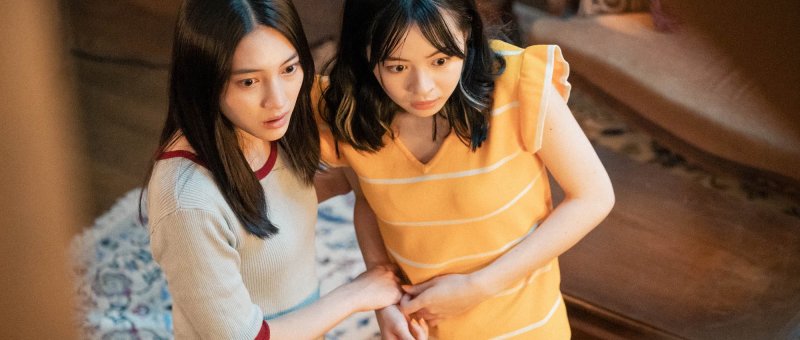
As the film begins, Wakaba is a cheerful little girl who has an all encompassing obsession with a handsome pop idol, but is secretly enduring an oppressive atmosphere of domestic violence in her family home at the hands of her cruel and violent father. In this she might have found a kindred spirit in classmate Koki who is enduring physical abuse at the hands of his mother who openly tells him how much happier she’d be if only he’d never been born. Koki is also being bullied by a pair of mean kids at school and meekly takes it, unable to stand up for himself. When Wakaba steps up and tries to help him, the bullies turn on her too and their teacher (Atsuko Maeda) seemingly does nothing. After the pair bond through a screaming session at a local river, the bullies mysteriously fall out of a window which Koki is then seen ominously staring out of. 

The film jumps on seven years to a teenage Wakaba (Sayu Kubota) who discovers the world is not a safe place for women, repeatedly encountering a series of skeevy guys beginning with her favourite pop band who lure her to a cabin in the woods where they openly talk about getting her drunk to take advantage of her or spiking her drinks. One of the chief victimisers is another woman, Moeka, whose apparent “job” it is to recruit girls for the guys to have fun with. Wakaba’s friend Kanna (Riko) wants to leave, sensing that there’s something not quite right but Wakaba is naive and unable to see the danger. A similar thing happens when she visits Tokyo alone and has a meet cute with a guy who spills coffee on her shirt and offers to buy her a new one, then to show her around, takes her for sushi, declares his love and makes a proposal of marriage. 

As might be expected, many of these men end up dead at the hands of a vicious, chainsaw-wielding serial killer in a white hazmat suit, gas mask, and goggles. You can’t quite blame him for his crimes because everyone he kills is so irrediambly awful while it really does seem that he might be trying to protect Wakaba in some way from the hidden dangers she remains unable to see because of her pure heartedness. While her own father had been cruel and violent, she discovers that Moeka’s, police detective Kamiyama (Mitsuru Fukikoshi), is the opposite but worse in his unsettling obsession with his daughter, whom he believed to “pure and earnest” little knowing that she had been procuring young girls to serve up to the sleazy band members.

In a strange way, the serial killer turns out to be Wakaba’s healthiest relationship even if he’s basically stalking her not to mention murdering people with chainsaws because they threatened her happiness. The film runs through a series of genres from the cute childhood romance that soon turns ominous and the cabin in the woods slasher movie complete with creepy monkey and trainset, to martial arts epic as Wakaba abandons her life to train with a YouTube serial killer catching guru in a tropical resort town but retains its sense of anarchic innocence and internal integrity. As the pop star had implied, it really is a tale of genuine love between an awkward boy and a pure hearted girl in which they gradually realise that they each have a right to be happy and can be so together despite all violence and mayhem around them which includes killing a guy by shoving a grapefruit blender on his head. Strange and absurd the film nevertheless has a heartwarming romantic sensibility along with a desire for a less destructive world defined more by kindness and compassion than bullying and violence. 


Love Will Tear Us Apart screened as part of this year’s Camera Japan.

International trailer (English subtitles)

A Mother’s Touch (桜色の風が咲く, Junpei Matsumoto, 2022)

A young man begins to ponder the meaning of his life while losing both his sight and hearing in Junpei Matsumoto’s heartwarming biopic, A Mother’s Touch (桜色の風が咲く,Sakurairo no Kaze ga Saku). The English title aptly hints at the maternal devotion that kept Satoshi (Taketo Tanaka) part of the world even as he feared becoming isolated from it, though the Japanese “when the pink wind blooms” leans towards the poetic in echoing the ways in which he is able to open himself to a different kind of sensory experience. 

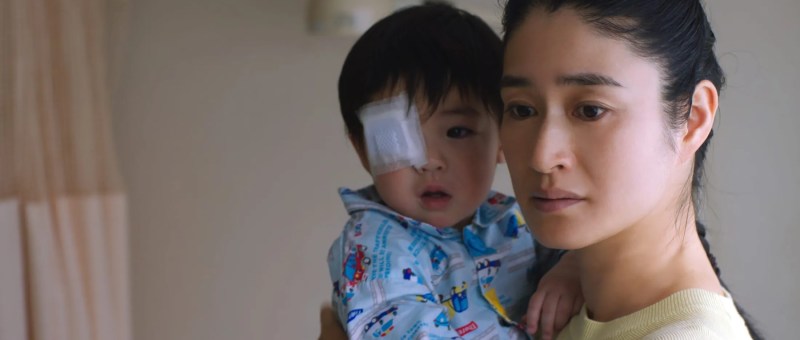
Satoshi Fujisawa would later go on to become the first deaf blind university professor in Japan though the films opens with a toddler Satoshi discovering that he has a rare condition that causes the pressure in his eyeball to increase endangering his vision. Though he undergoes various treatments, he eventually loses the sight in one eye and then the other several years later. While in high school he then discovers that he is also beginning to lose his hearing which, along with braille, had been his primary way of experiencing the world around him. 

Matsumoto’s film does not really go into the various ways in which Satoshi is inconvenienced by a largely ableist society aside from his having to leave home and go to Tokyo to attend a school for the blind. Satoshi does, however, experience bullying as a child particularly from an obnoxious gang of boys who egg him on to remove his glass eye in front of them while otherwise isolated by the constant need to rest his eyes with only rakugo to listen to on the radio. Introduced to braille, he is immediately fascinated remarking that the person who came up with it must have been a genius and explaining that he has not given up on his sight but it doesn’t hurt to learn. 

It’s braille that eventually becomes his lifeline as his mother figures out a way to communicate with him by pressing his fingers as she were typing on a braille keyboard while he replies vocally. Her adhoc solution has apparently gone on to provide an important means communication for other deaf blind people across the world and reminds Satoshi that though he may feel as if he as been marooned in deep space he is not alone and is able to interact with the world around him. While still trying to save his hearing, he had decided to try an alternative treatment method which emphasised heavy exercise and bland food designed to boost the immune system though he discovered that it only robbed him of an additional sensory input and a resultant longing to eat something sweet. Though he is unable to see or hear, he can still taste and smell the world around him welcoming the spring in unexpected ways while embracing his potential and independence.

That said, his major philosophy is that life is full of voids designed for other people to fill in the ways that we can all help each other. The film doesn’t shy away from exploring the strain placed on Satoshi’s family as they try to cope with his medical needs which leave his mother feeling guilty that she is often away from her other two children caring for him at the hospital, and his father lonely and overburdened while trying to balance the demands of his working life with that of taking over the domestic space. In any case, they resolve to get through it as a family doing what they can to support Satoshi without robbing him of the opportunity to lead as independent a life as possible. Satoshi comes to believe that his disabilities may be the price for his purpose, that there must be something he is uniquely supposed to do with his life along with places only he could discover. The film eventually finds him in a space of possibility, recalling happy times with his family as a child but also looking forward towards a new potential for pushing the boundaries and moving beyond the limitations others might have placed on him. 


A Mother’s Touch screened as part of this year’s Camera Japan.

International trailer (English subtitles)

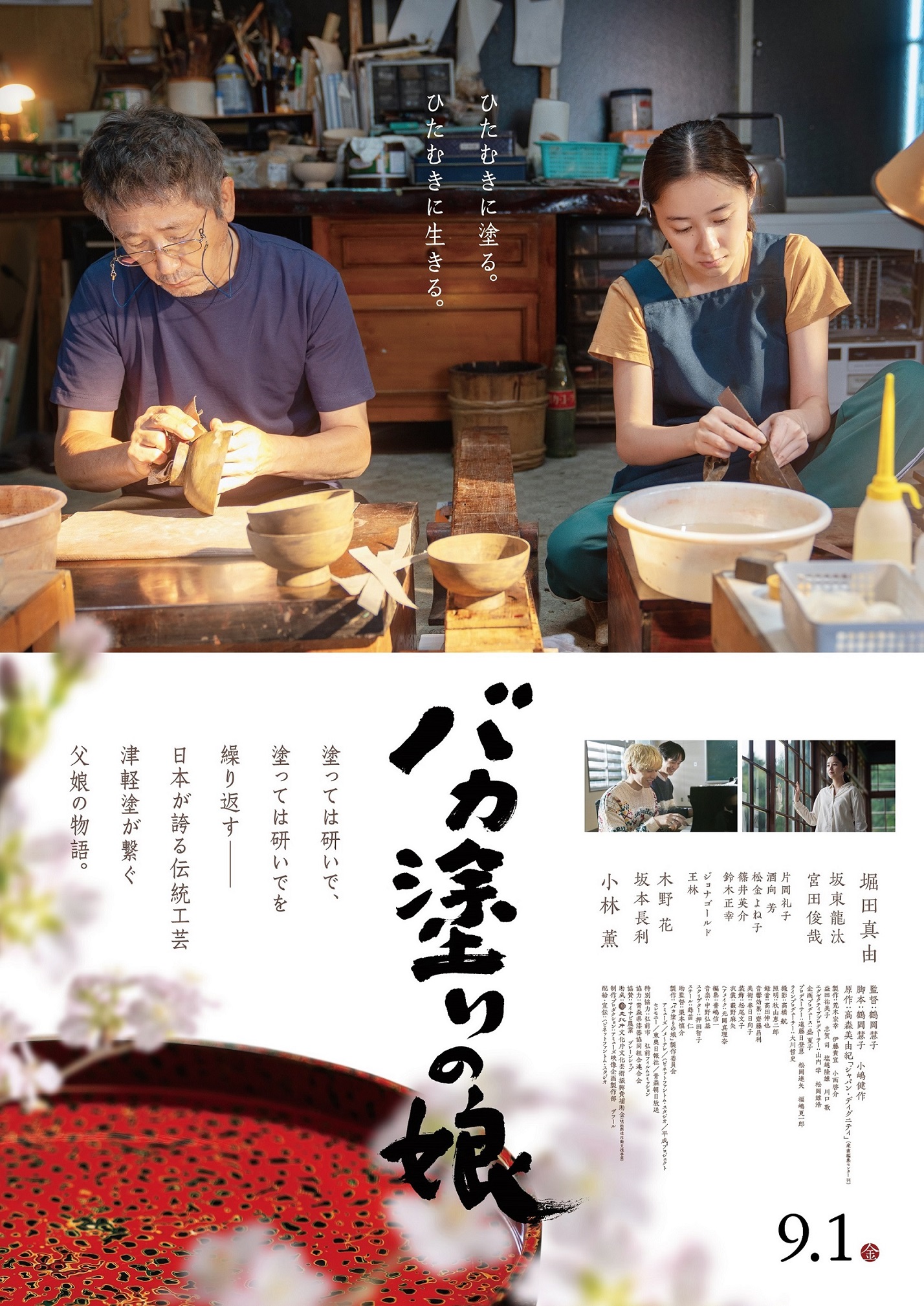
Tsugaru Lacquer Girl (バカ塗りの娘, Keiko Tsuruoka, 2023)

Which traditions should we keep and which should we lose? A young woman finds herself frustrated by outdated gender norms in her desire to take over the family lacquerware business in Keiko Tsuruoka’s gentle rural drama, Tsugaru Lacquer Girl (バカ塗りの娘, Bakanuri no Musume). While her family, save older brother Yu (Ryota Bando) who has already rejected lacquerware, do nothing but run her down and claim she’ll never be a success at anything all she wants to do is devote her life to a traditional craft her father no longer believes has any kind of future. 

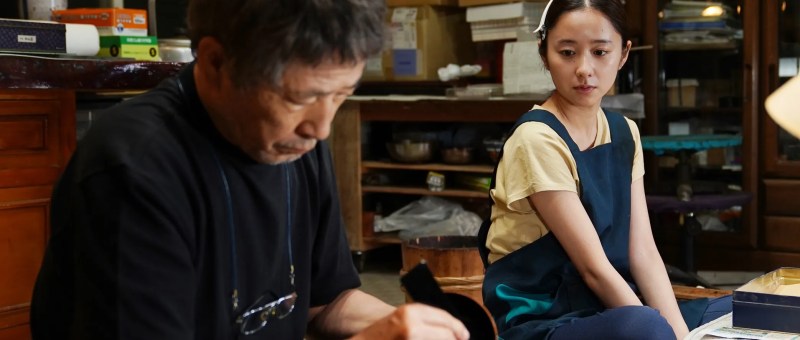
Even so, Seishiro (Kaoru Kobayashi) is dead set on Yu taking over the business to the point that they have become semi-estranged. He calls Miyako (Mayu Hotta) “clumsy” and complains that she has no aptitude for anything unlike Yu who was always good at anything he tried. Miyako too later suggests that she was her brother’s opposite, while he was cheerful and outgoing she is shy and melancholy but then perhaps it’s hard to be cheerful when everyone’s always telling you you’re useless and doing everything wrong. In an interesting parallel, Yu is also trapped by outdated social codes in that he is gay and he and his partner have decided to move to London where they can legally get married and live their life out and proud in a way they feel they cannot do in contemporary Japan. 

Lacking other direction in her life, Miyako has been working a part-time job in a local supermarket which she hates while her father occasionally allows her to help him finish big orders though it’s clear her salary is now their main source of financial support. A local inn keeper who is a good customer of theirs explains to some of his guests that craftsmen rarely construct large pieces such as tables because they are no longer cost effective while fewer young people are willing to take up apprenticeships leaving the traditional art in danger of dying out despite the frequent remarks that everything tastes better out of a lacquerware bowl which is after all in the modern parlance “sustainable” in that it will last for many decades and can easily be repaired if damaged. 

Seishiro doesn’t seem to have a reason for rejecting the idea that Miyako might take over aside from basic sexism in preferring to hand the business over to his first born son. It might be tempting to think that he dissuades her because he thinks there isn’t a future in lacquerware, but if that were the case he could simply retire. Her mother (Reiko Kataoka), who left the family some years ago in part it seems because of her own animosity towards lacquerware and its lack of financial promise, seems to feel much the same comparing Miyako to a more successful cousin who has kids and a high powered job at an international trading firm, telling her that she should be settling down and getting married suggesting that she is simply incapable of becoming a successful lacquerware artist and should at best keep it as a hobby. 

Her mother had also shut down her desire to learn piano as a child by telling her there was no point because she’d never be good at it. Miyako’s decision to prove herself by re-laquering an abandoned piano in her disused school is then an act of rebellion against both parents showing them what she can and will achieve along with the direction she has chosen for her life. Not everyone respects it even if her father begins to come around but really it doesn’t matter because the decision is hers alone whatever anyone else might have said. Far from being insular, the embrace of traditional culture gives Miyako new opportunities and allows her to grow in confidence until she’s finally ready to set off along her own path. Even so, it seems there are some traditions she thinks it would be better to lose, such as her father’s sexism and the homophobia that has forced her brother to emigrate in order to live a happy life just as he is. They call it “fools lacquer” because no one but a fool would go to all this trouble to make a bowl but in many ways that’s the point. Miyako pours all of herself in to the lacquer, piling layer on layer dotted by handfuls of thrown rice that give it its pattern much as she herself is slowly tempered by the world around her.


Tsugaru Lacquer Girl screened as part of this year’s Camera Japan.

Original trailer (English subtitles)

Tea Friends (茶飲友達, Bunji Sotoyama, 2023)

Japan’s rapidly ageing society has provoked an epidemic of loneliness but also perhaps new business opportunities in Bunji Sotoyama’s empathetic social drama Tea Friends (茶飲友達, Chanomi Tomodachi). The phrase may sound innocuous enough, but given some potentially outdated cultural connotations the men who spot the advert cunningly placed in a newspaper to catch the eyes of older readers may have reason to assume that it’s more than just tea and chat on offer. Though as it turns out, it’s not just the old who are lonely as a younger generation in turn often in conflict with their parents also attempt to seek security and comfort in found family.

That said, there’s something a little cult-like about the way that Mana (Rei Okamoto), a former sex worker, talks about her organisation which aims to cure late life loneliness through what others might describe as an elderly sex ring. Employing a collection of older women, she accompanies them to meet new clients where they silently slide viagra over the table. The gentleman caller subscribes to a plan to purchase “tea” and anything that happens inside the hotel room they subsequently go to is just “free love” rather than “prostitution”. Mana sees herself as running a “community safety net” and helping elderly people who might otherwise have become isolated and depressed keep active as part of one big happy family along with the other members of staff who have, like her, become estranged from their parents and relatives. 

For Yoshiki, one of the men who escorts the ladies around, it’s that he views his father as a failure for leaving a well-paid corporate job to open a bakery which subsequently went bankrupt and has led to him living in his car. He thinks that in the end it’s better not to try at all than be left with the humiliation of things not working out. But then for Mana herself it’s more a sense of parental rejection. After a difficult childhood, her now terminally ill mother continues to reject her on the grounds of her history of sex work while she continues to crave the unconditional love of a family. Like a mother hen, she nestles those around her into the Tea Friends organisation which operates out of her own home and strives to create a place where everyone can feel they belong. 

Which is all to say she’s the loneliest one of all, but as someone else later cautions her you can’t cure your own loneliness with the loneliness of others. What she sees as a social enterprise others may see as a deliberate attempt to take advantage of vulnerable people who have admittedly been let down by an indifferent society and are in need of the money even more so than comfort or validation. At the other end of the spectrum, a young woman working at Tea Friends discovers that she is pregnant but her boyfriend immediately rejects her, insisting that he refuses to take responsibility and revealing that he is already married. Chika wants to have her baby, but everyone seems to be telling her that she shouldn’t. The doctors seem to look down on her after realising she isn’t married and the father most likely not in the picture, while an attempt to inquire about benefits at the town hall leads only to judgement as the clerk pithily tells her that they’re there for when you need them but she shouldn’t “depend” on them too much virtually calling her a scrounger and implying she’s been irresponsible in becoming a single mother. 

As another of the older women admits, being used was better than being ignored and at least being part of Tea Friends gave her a sense of purpose and acceptance if only for a time. In any case, Mana’s attempt to find unconditional love from her new “family” largely flounders as even those she’d come to believe herself close to desert her when the threat of legal proceedings enters the picture leaving her to face the music alone while she continues to protect them insisting that they’ve done nothing wrong even if it it was technically against the law. An old man’s devastation on picking up the phone and getting no answer suggests that Mana might have had a point when she said it was a social service seeing as no one else seems keen to tackle the problem of late life loneliness even if she did go about it in a problematic way. As Mana often says, righteousness does not equal happiness and it is often outdated social brainwashing that keeps people unhappy and not least herself as she struggles to find the unconditional love lacking in her life that would enable her to cure her own loneliness even in the prime of her youth.


Tea Friends screened as part of this year’s Camera Japan.

Original trailer (English subtitles)

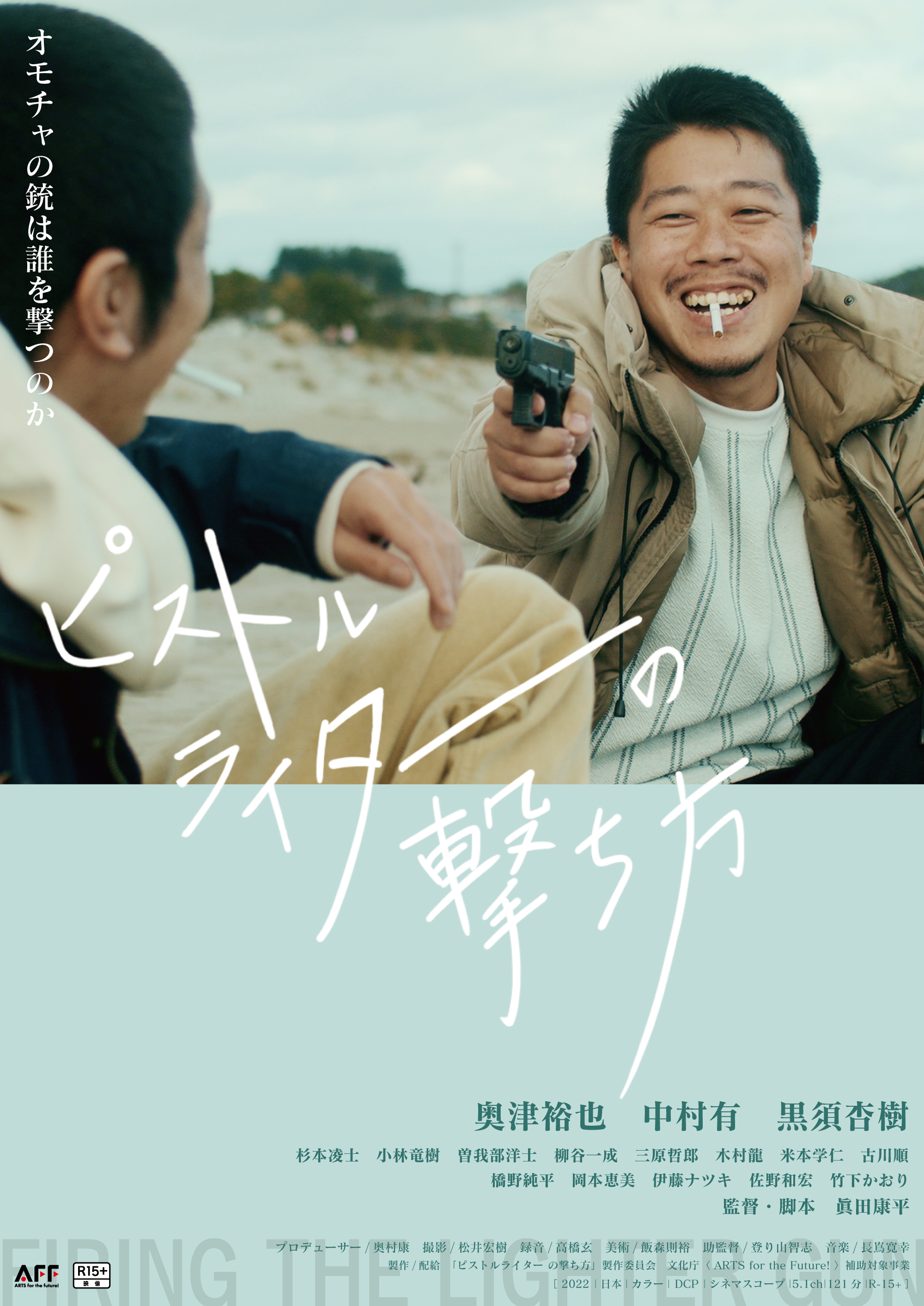
Firing The Lighter Gun (ピストルライター の撃ち方, Kohei Sanada, 2022)

“Whatever got you here, it can’t be any good” a resident of a flophouse reflects on their moribund circumstances suckered to into debt bondage by exploitative yakuza who force them to risk their lives doing clean up in a nuclear exclusion zone. Kohei Sanada’s bleak indie drama Firing the Lighter Gun (ピストルライター の撃ち方, Pistol Lighter no Uchikata) takes place after second nuclear disaster has left even more of the land unsurvivable. The heroes have been quite literally displaced, left without a place to return to or call a home, but are also emotionally alienated unable to envisage an escape for themselves from this otherwise hopeless existence.

Having recently been released from prison, Ryo (Yu Nakamura) remarks that the area has changed since he’s been away but his friend Tatsuya (Yuya Okutsu) counters that he doesn’t really think so. In any case, Tatsuya lives with a huge inferiority complex most evident on his attendance at a school reunion he didn’t want to go to where he sits sullen and dejected among those who’ve moved up in the world not least his ex, Shoko (Emi Okamura), who left him for a guy with a steady government job but still drops by to care for his ageing mother who suffers from dementia and the legacy of domestic abuse. Tatsuya is not a yakuza but his work is yakuza adjacent in that he drives a van full of equally hopeless men recruited for a dodgy operation offering cleanup services in the nuclear exclusion zone. 

Though the jobs are supposed to pay well with a bonus for the hazardous nature of the work, most of it is being skimmed by the yakuza bosses who deduct vast amounts from the men’s pay-packets for “expenses” such as the right to sleep in a communal flophouse where they charge them exorbitant amounts for snacks and drinks which they have to buy because they aren’t allowed to go out. Nor are they allowed to quit the job, trying to run incurs a 50,000 yen fine on top of any debts they’re supposed to be working off. An unexpected addition to Tatsuya’s van one day is Mari (Anju Kurosu), a sex worker, who’s been forced to work for the gang to pay off a debt incurred by an ex who’s since run off. 

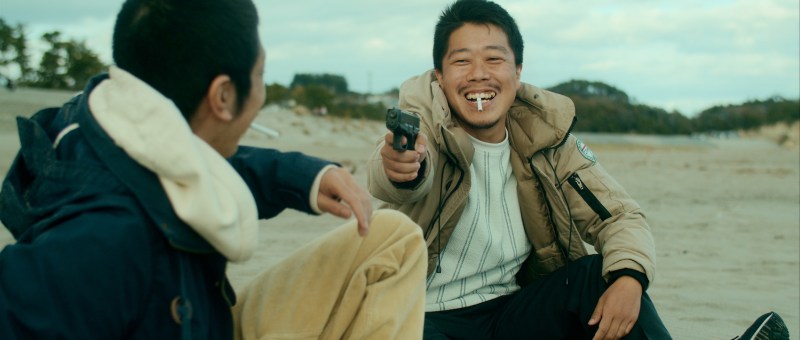
As she later says, it’s a waste of time dreaming about a home, life is easier when you no longer expect one. But despite themselves a gentle bond soon arises among the trio of dispossessed youngsters who each feel trapped by their circumstances but are uncertain if they still have the strength to contemplate escape. Tatsuya’s sense of impotence is embodied by the cigarette lighter he carries around which is shaped like a pistol and realistic enough to cause a yakuza bodyguard a moment of concern but of course of no real use to him. As Ryo puts it, Tatsuya’s problem is that he still cares about those around him and is not heartless enough to treat the flophouse men like the “disposable tools” others regard them to be. He is constantly belittled by grinning boss Takiguchi (Ryoji Sugimoto) who blames him for everything that goes wrong and calls him useless and ineffectual, while the flophouse boss also regards him as soft for refusing to beat one of the men who had tried to escape. 

Ryo meanwhile swings in the opposite direction, giving in to a sense of hopelessness that sees him shift towards yakuza violence but perhaps eventually allows him to bounce back and take a chance on escape even if it maybe short-lived or spent in constant hiding. Tatsuya may feel trapped by responsibility to his mother, but is otherwise psychologically unable to move forward staking all his hopes on the rumour of a new power plant hoping it will ignite the town in the way the construction of the last one did despite knowing its attendant risks. Unlike Ryo, he says there’s no point in running, despite himself still yearning for a home. The flophouse men are no different, the few who escape are soon drawn back to other similar kinds of work because there is no other hope for them. Still, once the final shots have been fired there is a kind of clearing of the air and the light of a new dawn even if few seem to be able to see it. 


Firing The Lighter Gun screened as part of this year’s Camera Japan.

Original trailer (no subtitles)