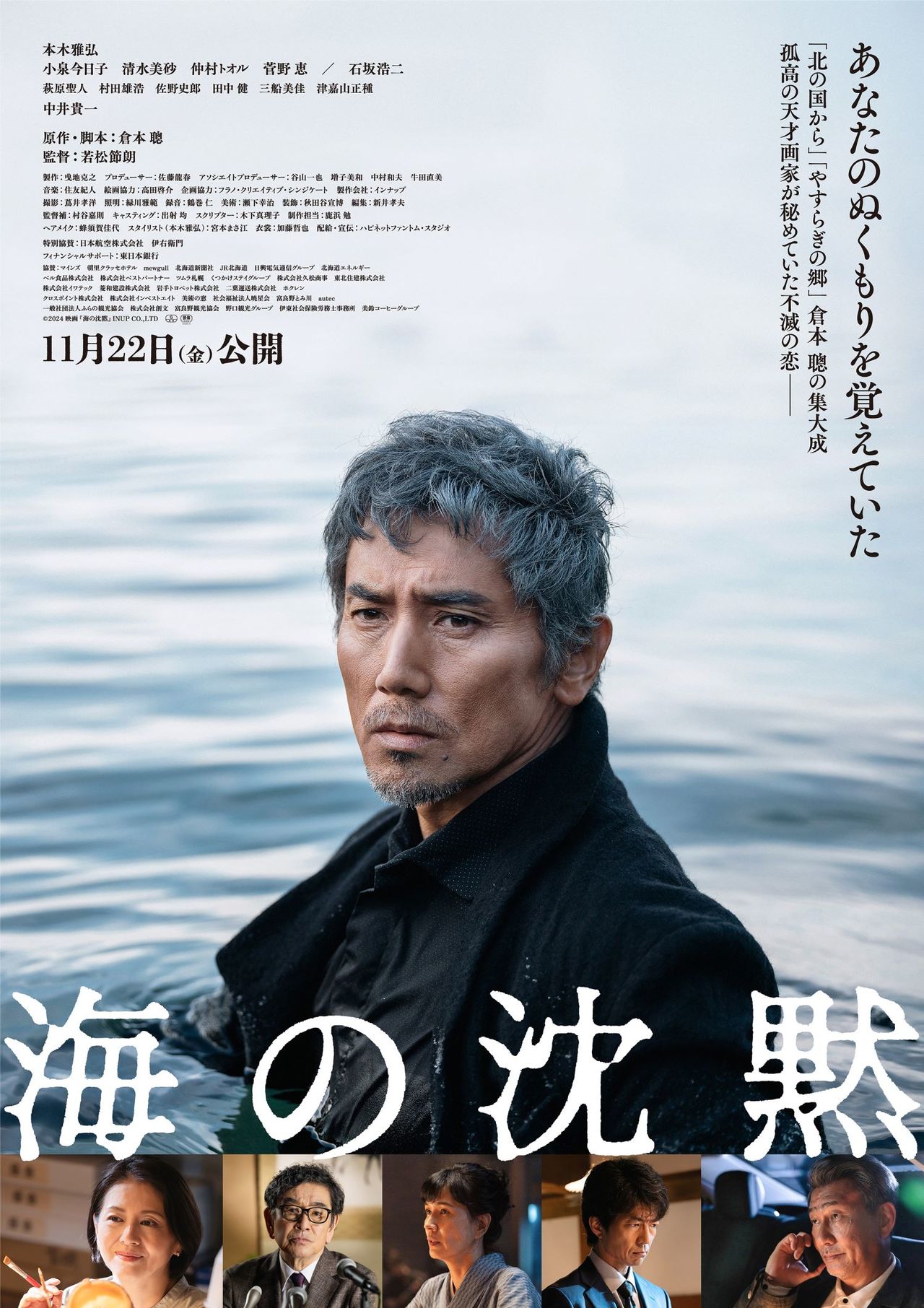
Silence of the Sea (海の沈黙, Setsuro Wakamatsu, 2024)

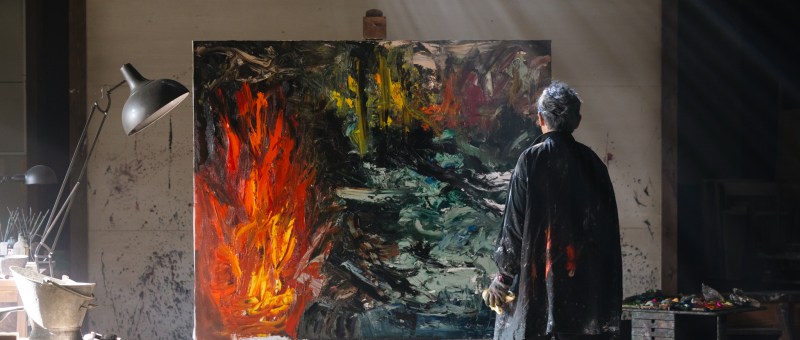
Can there be any greater humiliation than having your work plagiarised and the other person’s being better? Renowned artist Tamura (Koji Ishizaka) feels he has to say something on seeing an old painting at an exhibition honouring his late mentor and realising it’s not the one he painted. He doesn’t think he ever had the ability to paint something with this kind of power even when he was young, and he didn’t even use the materials which appear to have given this version a emotional depth that the original never had.

In some ways, this is Tamura’s past literally coming to the surface to show him that his life has been a series of mistaken choices and whatever success he may have achieved it’s come at the cost of his artistic soul. The first part of Setsuro Wakamatsu’s Silence of the Sea (海の沈黙,, Chinmoku no Umi) ponders why Tamura might be so keen to confess this work isn’t his when he admits that it’s objectively “better”, but even if that might be true, he has to concede it isn’t him and therefore shouldn’t have his name on it. Though he appears to have become greedy and vain, trading on his connections and more of a celebrity artist than someone with real and urgent ideas to express, he is apparently willing to burn all his bridges on the altar of authenticity while simultaneously refusing to divorce his wife, the daughter of his late mentor, despite living with another woman and their child on the other side of the country.

But as someone else says, does it matter whose name is on the painting when it is beautiful in itself? Then again, this beauty is intended both to cover something up and to expose it. In his youth, Tamura apparently threw another artist, Lyuji (Masahiro Motoki), under the bus. 40 years later, Lyuji is a master forger living a life in the shadows tattooing young women with his fevered artistic visions. It’s true enough that he seems to see them only as “canvases” and otherwise rejects personal connection while still carrying a torch for Tamura’s now wife Anna (Kyoko Koizumi). He seems to be stuck in the past, forever meditating on a particular pairing, The Silence of the Sea, which reflected his own moment of trauma when his parents both drowned when he was a child. 

The film seems to pain Tamura and Lyuji as two sides of the same coin. The more Tamura’s star rose, the sicker and more humble Lyuji became as if he were literally bleeding him dry. In the words of his assistant, Lyuji had an imperative to depict beauty, but art seems to deplete him. He literally vomits blood on the canvas while struggling to recreate his lost painting and thereby return to the source of his trauma. The sea for him seems to represent life and death along with life’s beauty and terror, while for Tamura it is perhaps merely picturesque even if for both of them the sun is always setting.

One man has almost painted over the other, stolen a life that might have been meant for him though his talent may lie more in an ability to play the game than in art itself. But at the same time, Lyuji has destroyed himself through his selfishness and single-minded obsession with his art along with the internal traumas it turns out he cannot simply paint over. His life is like the candle that Anna makes in his image, slowly melting away and producing only a single tear from a lonely soul. His eventual conviction is that beautiful things need only exist in our hearts and minds as memory rather than as material things. As he says, measuring art in money is mere foolishness, which paints his career of forgery as an ironic revenge against the art world which values only what’s popular and has become a game for the rich to play to enhance their status little caring for the nature of the art itself. Yet this covering up and later revealing of a truth has led to several deaths, among them a man who lived for art and a woman who yearned for love only to end up a scorned muse of an emotionally distant man. The sea took them all, but for Lyuji at least it may finally have fallen silent in the final perfection of his art.


Silence of the Sea screens as part of this year’s Japan Foundation Touring Film Programme.

Trailer (English subtitles)

Images: © 2024 Eiga Umi no Chinmoku INUP Co.,Ltd
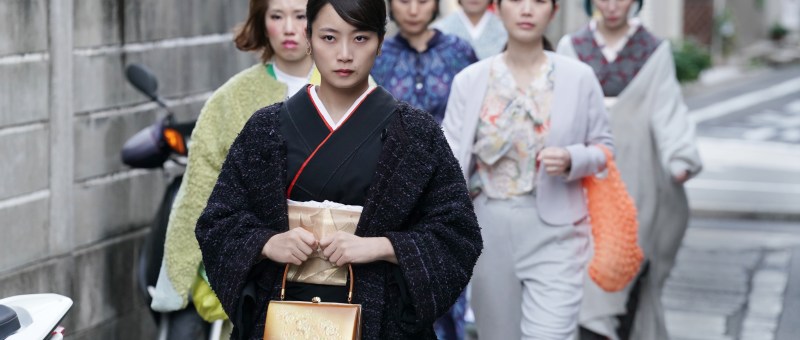
Strangers in Kyoto (ぶぶ漬けどうどす, Masanori Tominaga, 2025)

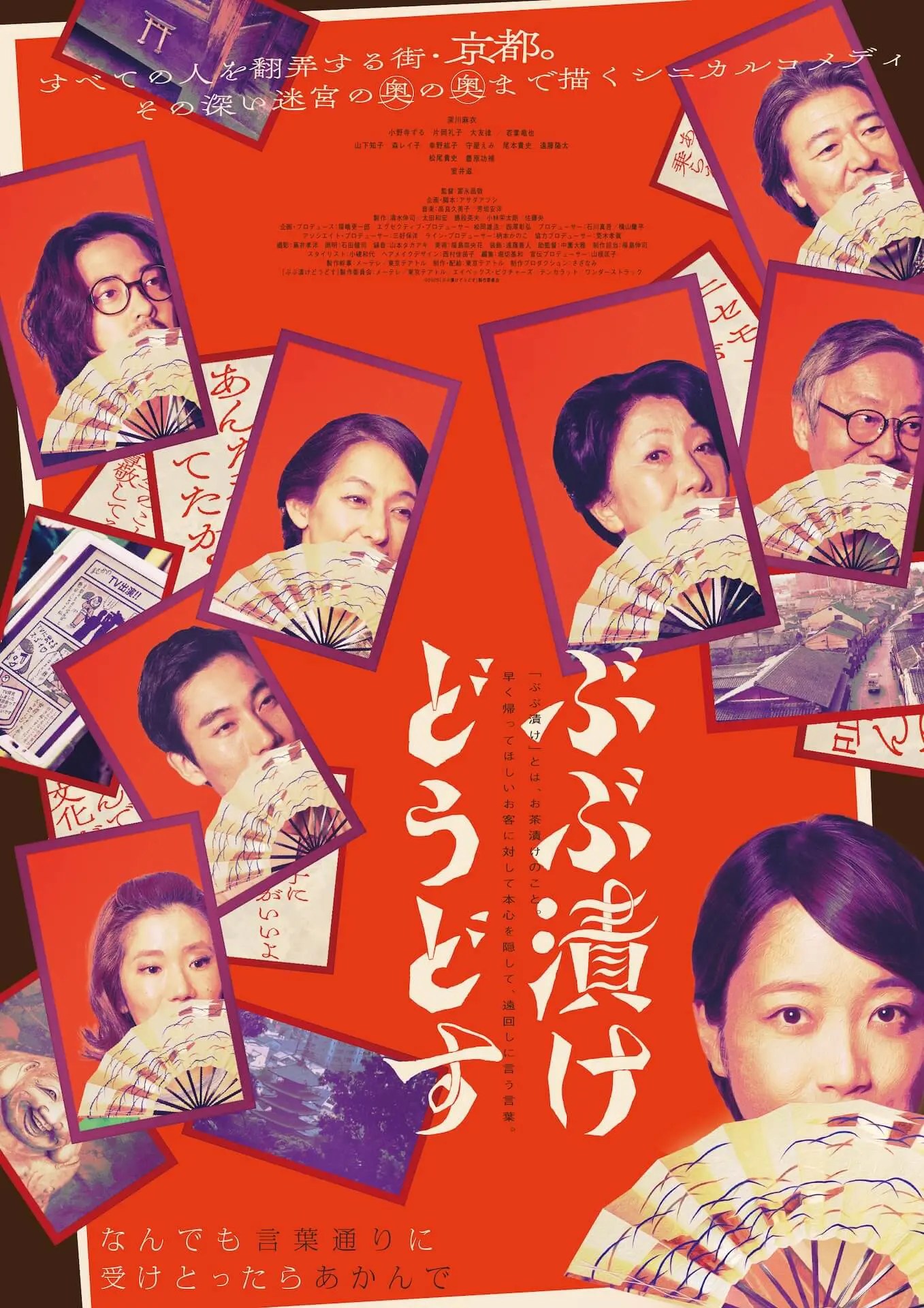
A former capital city, Kyoto is renowned as a historical centre and seat of tradition. But on the other hand, no one wants to live in a museum and while some of these old-fashioned ways of life might seem quaint or comforting, they’re also burdensome and for some an unwelcome imposition. Madoka (Mai Fukagawa), the wife of the 14th heir to a Kyoto fan seller is full of earnest wonder, but she’s also an outsider here and bringing with her own preconceptions and anxieties. 

To begin with, she’s come as a kind of cultural anthropologist directly interviewing local people to gain material for the manga she’s drawing with a friend. When one of the ladies she’s talking to explains that she runs a cafe in a former bathhouse that’s been sensitively adapted so that his traditional space can find new purpose in the modern world, Madoka is visibly disappointed which of course causes offence to her interviewee. Something similar happens when she interviews a woman running a traditional sweet shop who explains that their top-selling items are their halloween specials. They no longer sell anything that would have been on sale when the shop opened a few centuries ago. 

Madoka, who is not from Kyoto, is obsessed with preserving the city’s “true face” and fails to see that these businesses have survived because they’ve been able to adapt to the times when others could not. Repurposing old buildings to house modern businesses is one way of keeping the city alive. Meanwhile, she idolises her mother-in-law’s traditional lifestyle, but is after all experiencing it from the perspective of a guest. It may very well be much nicer to eat rice cooked over an open flame, but she’s not the one who’s got to get up early to stoke the fire or spend hours stirring the pot. She takes her responsibility as the wife of the 14th heir so seriously in part because she doesn’t understand what it entails. Her husband, Mario, meanwhile is keen to remind his mother that he has a life in Tokyo and won’t be returning to take over the shop, at least as long as his father is alive. 

Mario tries to warn Madoka about the complex nature of Kyoto social etiquette, but she fails to understand and makes a series of embarrassing faux pas that gradually destabilise the local equilibrium. In Kyoto, a particular brand of politeness rules in which one’s true feelings are never expressed openly but only through barbed comments that everyone nevertheless understands. So, when someone wants you to know that the party’s over and it’s time you went home, they’ll politely ask if you want any green tea over rice. This level of subtlety is lost on Madoka who comes from a city where size of the community means you have to be explicit.

It never really dawns on her that mother-in-law might have become so fed up with her that it’s easier just to sell the house and end 450 years of tradition than to tell her go home. Then again, it seems like she may be missing some social cues in Tokyo too, while it’s also fairly obvious in any culture that putting her awkward interactions into the manga could end up upsetting those around her. They do, after all, have a point that it’s inappropriate for her to make herself the self-appointed guardian of a place she’s isn’t from and doesn’t live in, disregarding the thoughts and feelings of those who do (not that they really told her what they were). 

Perhaps as she said she’s beginning to understand Kyoto in this regard by fighting back passive aggressively to claim her right to take over the fan shop. She might have a point about the comparatively ugly and utilitarian apartment blocks taking over the city as old buildings are bulldozed to make way for the new, but on the other hand it may not be possible to continue this business as it is and simply bringing in more tourists who’ll just clutter up the place and not buy anything may not be the answer. What the answer is may not be clear, but Madoka at least seems to have found her little niche in the heart of Kyoto, even if it is no longer so polite as to keep its irritation to itself.


Strangers in Kyoto screens as part of this year’s Japan Foundation Touring Film Programme.

Trailer (English subtitles)

Images: ©2025 Strangers in Kyoto Film Partners

The Hotel of my Dream (私にふさわしいホテル, Yukihiko Tsutsumi, 2024)

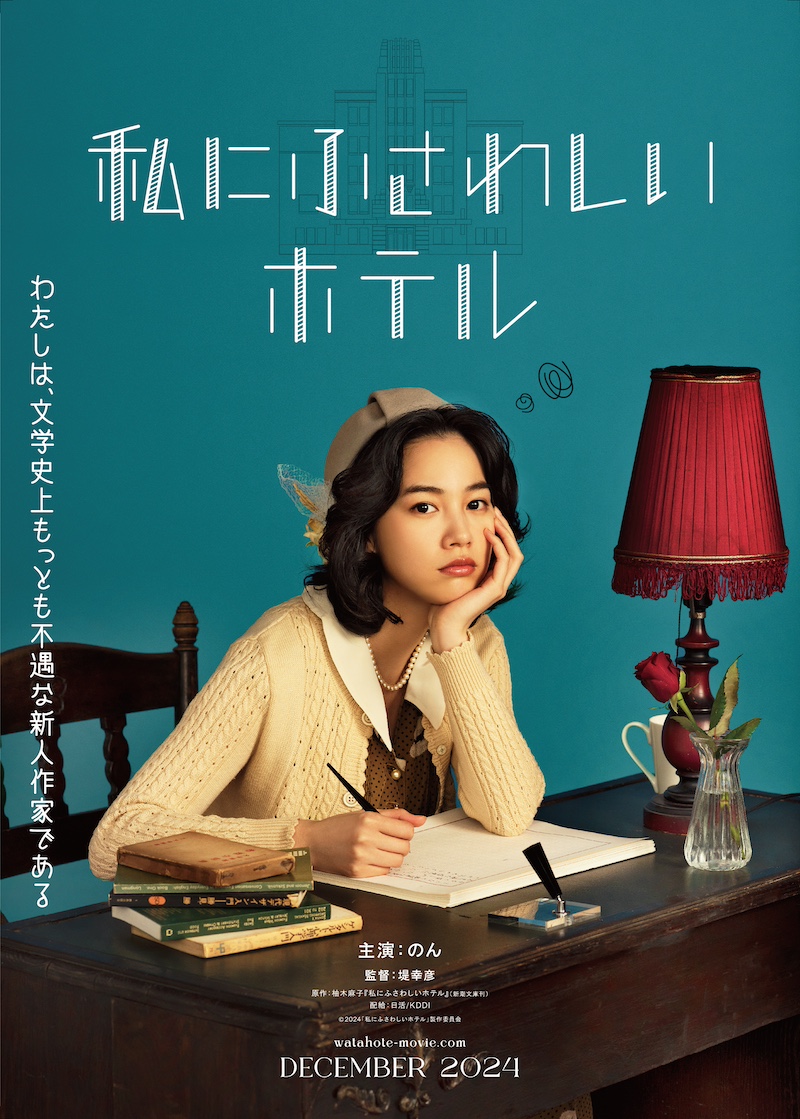
What does a girl have to do to get her book published in this town? Adapted from the novel by Asako Yuzuki, Yukihiko Tsutsumi’s The Hotel of My Dream (私にふさわしいホテル, Watashi ni Fusawashi Hotel) follows its eccentric heroine through a literary feud with an established master in an attempt to defeat a misogynistic, hierarchal and exploitative publishing industry and finally publish a full-length novel. In part a meditation on identity, the trades on its heroine’s charms and the comedic prowess of leading lady Non.

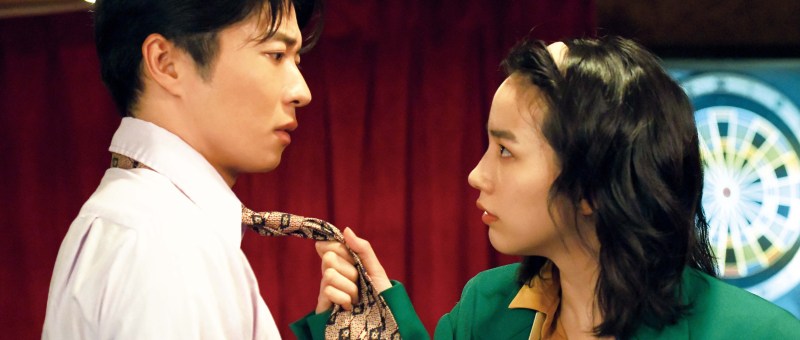
Set in 1984, the film begins and ends at the Hilltop Hotel popular with writers through the ages thanks to its proximity to book town Jinbocho and the offices of big time publishers. Using the pen name Taiju Aida, Kayoko (Non) is an aspiring author who won her publisher’s newcomer prize a few years previously for a short form essay but has been unable to write anything of substance since after being stung by a harsh review from literary master Higashijujo (Kenichi Takito). After learning from her editor Endo (Kei Tanaka) that Higashijujo is in the room upstairs and is on a tight deadline to complete a story for an upcoming anniversary anthology, Kayoko decides to impersonate a hotel maid so he’ll stay up all night and not make it, forcing Endo to use her story instead.

The irony is that Kayoko’s story is popular with readers and she has real talent as a writer that’s being suppressed by the publishing industry at large in the form of her former publisher, Endo, and Higashijujo. Higashijujo is a representative of a particular kind of older writer and is effectively acting as a gatekeeper by suggesting that young women like Kayoko have no place in the literary scene. Even so, he’s captivated by the story she tells him that’s the same as the essay she later has published which cleverly weaves in some of his own personal details. She plays on his vanity and lasciviousness in telling him she’s a big fan and is romantically naive as if dangling herself as bait. Higashijujo realises that Kayoko is Taiju Aida and kicks off a kind of literary feud in which he disrupts her career and she puts on various different personas to upset or embarrass him. 

Nevertheless, his rivalry with her does seem to stimulate his own latent artistic mojo and have him writing manically once again if partly out of resentment, while Kayoko is forced to change her name again before winning a note literary prize as “Junri Arimori” and writing with a completely different style. On realising that they may both be being manipulated by Endo who is setting them against each other in order to stimulate their writing, they team up against him by attempting to disabuse his daughters of the notion that Santa’s not real only they already know. They were just going along with the ruse because that’s a child’s job in much the same as Higashijujo suggests a writer’s is to conjure a pleasant fantasy for the reader and Kayoko creates a series of false personas further her own literary dreams. 

Yet as Kayoko says she’s not given the kind of support that other writers get and even after getting a book published has to go round to stores on her own to encourage them to stock and promote it. She only rises to prominence by charming a bookseller after catching a notorious book thief who didn’t even steal hers because he only takes “popular” books. Kayoko is indeed a total crazy lady, but perhaps you need to be in order to survive in this environment that’s still dominated by men like Higashijujo writing borderline sleazy novels and hanging out with hostesses in upscale Ginza bars. Resented by his daughter, he stays out in hotels for days at a time, leaving his wife alone and neglecting his family. Kayoko has to fight tooth and nail for her place in this space and to prove herself worthy of a room at the Hilltop Hotel while Higashijujo’s ride was must less fraught with difficulty even if it may not have been easy. The final message seems to be, however, that art is created best in opposition and success isn’t always good for an artist as Kayoko finds herself frustrated, feeling as if she hasn’t achieved all of her revenge but has no left to take it against while perhaps still manipulated by Endo who provides a source of authority for her to kick back against as literary queen trying to hang on to her throne.


The Hotel of my Dream screens as part of this year’s Japan Foundation Touring Film Programme.

Trailer (English subtitles)

Images: © 2012 Asako Yuzuki_Shinchosha © 2024 “The Hotel of my Dream” Film Partners