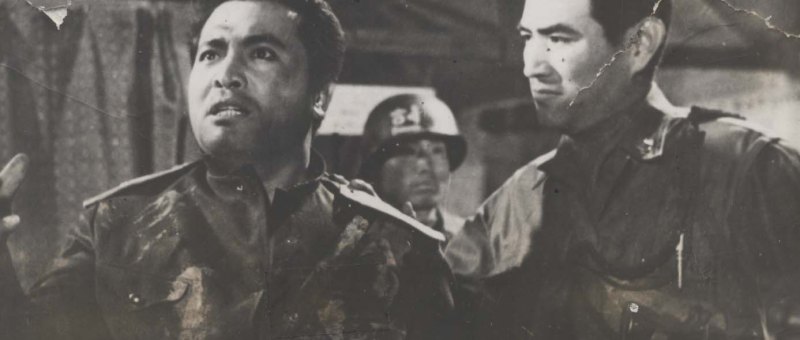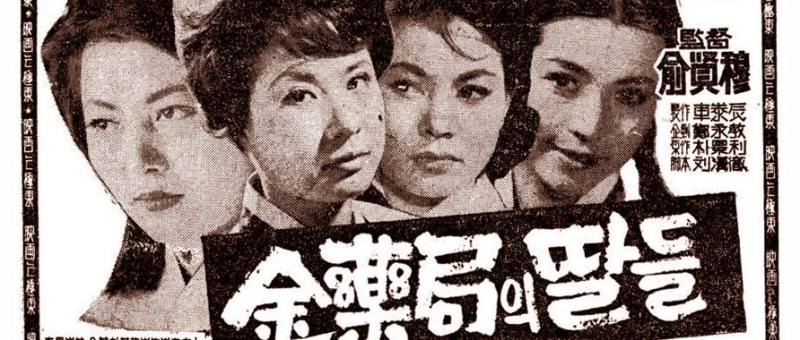
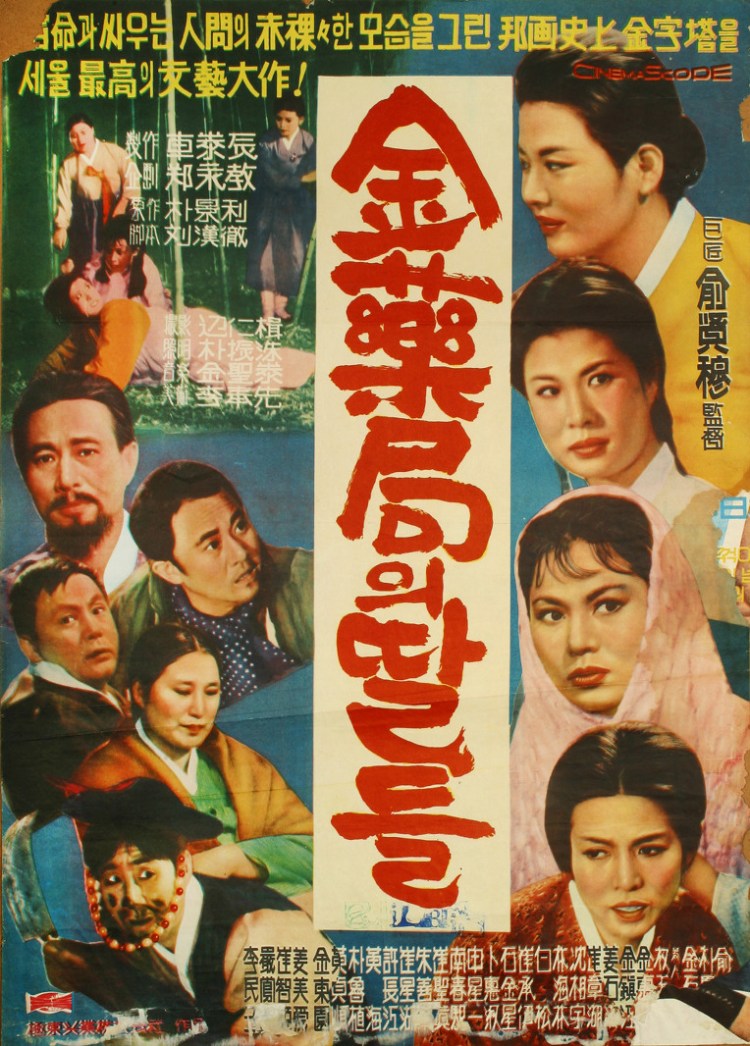
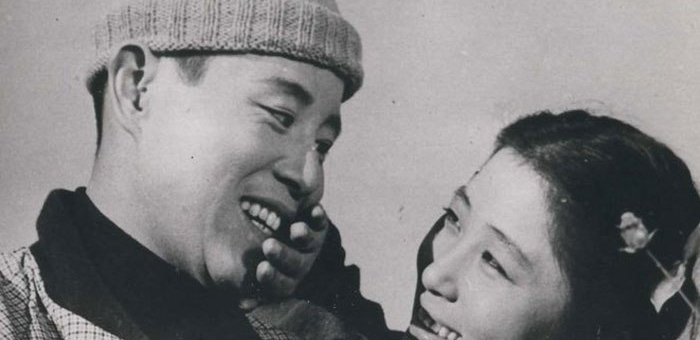
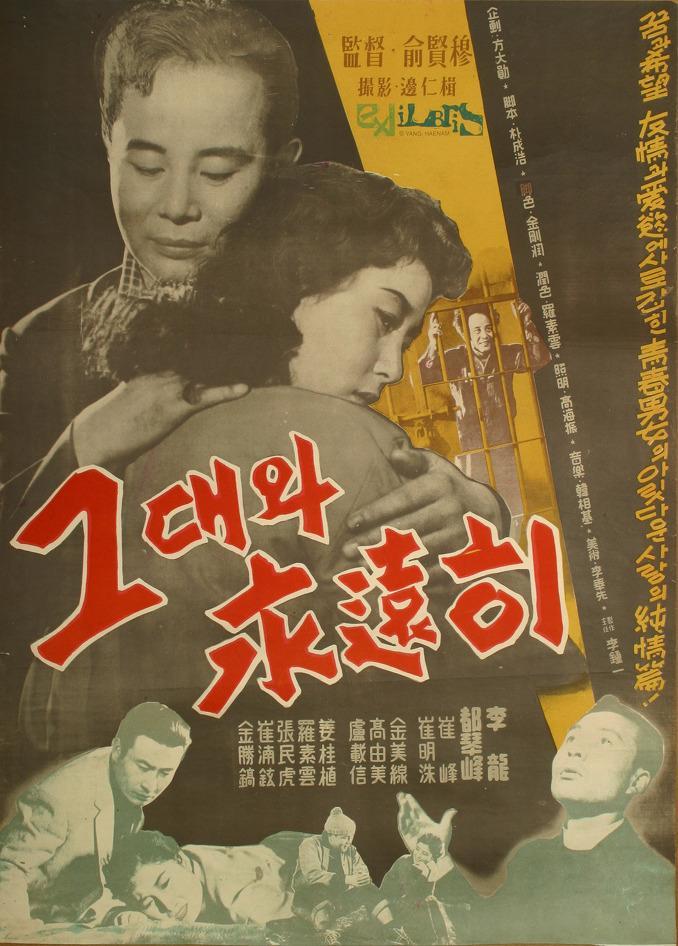
Forever With You (그대와 영원히 / 그대와永遠히, Yu Hyun-mok,1958)

Forever with you posterBest remembered for his 1961 feat of neorealist social drama Aimless Bullet, Yu Hyun-mok was one of the early masters of Korea’s golden age who sought to bring a degree of intellectual rigour and formal experimentation to a medium which often favoured the populist or propagandist. He did, however, have to start somewhere and the earliest surviving film in Yu’s filmography is indeed a melodrama though one perhaps a little to the side of the norm and with an axe to grind as regarding economic equalities and the demands of spiritual morality, even if he is forced to retreat to entrenched social codes in the closing moments.

The camera pans over a city filled with rooftops and eventually lingers on a group of children playing quietly by a wall. Panning over the wall which is exceedingly high, Yu reveals the children to have been playing on the other side of a prison where Gwang-pil (Lee Ryong), an inmate, is about to be released after 10 years inside. All things considered, Gwang-pil does not seem to be a hardened criminal and is optimistic for the future, intending to go straight and hoping to reconnect with the childhood sweetheart he believes is still waiting for him in the outside world though they have not seen each other since Gwang-pil made an ill-advised escape attempt and got his sentence increased a number of years. He recounts all of this to another inmate who is happy for him, broadly, but not quite convinced Gwang-pil is going to make it in the regular world.

Switching to a lengthily flashback, Yu allows Gwang-pil to recount the circumstances which landed him in jail, which also gives the director a chance to engage with his socio-political concerns. 10 years previously, Gwang-pil was a happy young man from an exceptionally poor village who was best friends with Ae-ran (Do Kum-bong). Ae-ran works in a bakery to help support her family, and often walks home with Gwang-pil which is one of the few times they have to be together. A happy day at the beach sees them building sandcastles and dreaming of the life they will one day live with a house and children of their own, only to see all their dreams washed away by a sudden outbreak of rain. In desperate need of money both to support himself and his bedridden mother and to impress Ae-ran, Gwang-pil starts hanging round with delinquents and picking pockets. Though Gwang-pil wants to give back some of the money they stole fearing the woman they took it from is also poor and cannot spare it, he goes along with the delinquents’ plan to rob a nearby US army depot. The others get away but Gwang-pil is arrested and sent to prison.

The first and foremost motivator for Gwang-pil’s descent into criminality is poverty and familial breakdown. His father was a gambler who left his mother flat, while she has become bedridden and is dependent on her teenage son for financial support. With no real jobs available in the town and no prospect of a way out through education, Gwang-pil is seduced by crime despite having no real aptitude for it. The other motivator, if indirectly is Ae-ran or, more specifically, jealous insecurity related to the harmonica playing delinquent Dal-soo (Choi Nam-hyun). Too poor to afford a harmonica of his own, Gwang-pil fears losing Ae-ran to a flashier guy and so he picks pockets to buy her fancy treats little realising all she wants is his time – something he will rob her of by getting himself sent to prison.

The war between Gwang-pil and Dal-soo over possession of Ae-ran will occupy the rest of the film though Ae-ran, like many women in the golden age of Korean cinema, is left with little choice of her own other than to continue suffering. When Gwang-pil gets out of jail it’s one of the other delinquents who meets him – Sang-moon (Choi Myung-soo) has become a priest, in part out of remorse for what happened to Gwang-pil and regret over his criminal past. Sang-moon is determined to help Gwang-pil repair his life but knows finding out what happened to Ae-ran is going to break his heart and send him spiralling into a nihilistic whirlpool of despair. Ae-ran has married Dal-soo who chose the path of crime and still operates a dodgy hostess bar as a front for his gangster activities.

Gwang-pil is just as upset and angry as Sang-moon feared. So much so that he completely misses how miserable Ae-ran is in her marriage and that her daughter, Eun-joo, is nine years old meaning she was conceived before he went to prison. Obsessed with his own pain, anger, and self loathing he fails to see anything other than his ruined hopes and commits himself only to further ruination through drink and the attentions of the manager at Dal-soo’s bar which are not altogether as one might assume them to be.  Only too late does he begin to grasp the real situation but is still too wounded to process it fully. Dal-soo, knowing Ae-ran has never loved him and wondering if her decision to become his wife has been a long form act of revenge, sets a plan in motion to remove his rival from the scene while Gwang-pil also longs for revenge against the man who has stolen everything from him.

Dal-soo and Gwang-pil square off, leaving Ae-ran whose health is so poor and nerves so fragile that she has virtually lived in hospital for the last few years, to suffer alone with only the austere comfort of Sang-moon’s priestly ministrations. Wanting to be “a good wife” she stands by Dal-soo but fears for Gwang-pil, not only for his life but also for his soul lest he fall back into criminality in the shock and hopelessness of her betrayal. Her situation is impossible and the strain of it difficult to bear. She hates her husband and blames herself for the fate of her one true love but has no recourse other than to continue suffering or die. In keeping with the story’s melodrama origins, Ae-ran pays a heavy price for her “weakness”, as does Dal-soo, leaving only the priest and the wronged man behind, strengthened by the need to care for the daughter he never knew he had.

Far from the rigour and furious intent of Aimless Bullet, Forever with You (그대와 영원히 / 그대와永遠히, Geudaewa yeongwonhi) is a much more modest effort even among studio pictures from 1950s. Largely filmed on set with low production values, Forever With You does allow Yu a degree of formal experimentation as he makes frequent use of pans and zooms more commonly seen in the films of 20 years later and occasionally gives in to ostentation as in his expressionist spinning shot of Gwang-pil and a bar girl dancing as he attempts to lose himself in abandon, or an overhead view of a gangster meeting. In the end Gwang-pil comes to himself too late, only realising his foolishness just as he loses everything that mattered to him but Yu changes track, gives him hope again in the prospect of a new beginning, learning to live for others in purehearted sincerity whilst walking away proudly into the harshness of the post-war world.


Available on DVD as part of the Korean Film Archive’s Yu Hyun-mok boxset. Also available to stream via the Korean Film Archive’s official YouTube Channel.
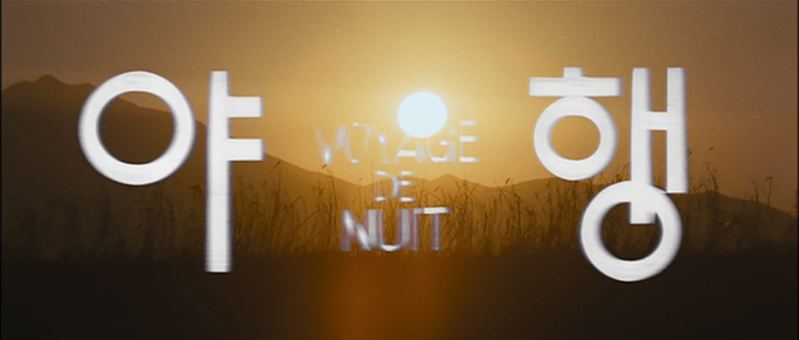
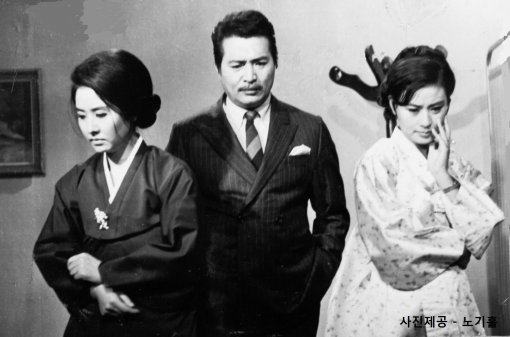
Night Journey (야행 / 夜行, Kim Soo-yong, 1977)

Night Journey posterIncreasing economic prosperity dangles tantalising rewards for the young and ambitious, but for women trapped by outdated social codes the pleasures of success are largely off limits. Director Kim Soo-yong was well known for literary adaptations and Night Journey (야행 / 夜行, Yahaeng) is, like Mist, inspired by a Kim Seung-ok novel but Kim makes a point of shifting the focus, telling the story not just of a jaded bank clerk but also of the effects of living under an authoritarian regime which demands (superficial) conformity, insists on productivity, and slowly destroys the souls of all those caught in its perilous march forwards into the corporate future.

Lee Hyeon-ju (Yoon Jeong-hee) is a woman of a certain age, unmarried, and working as a teller in a bank in Seoul. One of two “old maids” in the office, Hyeon-ju is shocked to find out that her fellow bachelorette from the adjacent desk is about to marry Mr. Choi – the couple had kept their relationship a secret but now that the engagement is public, Miss Oh will be quitting her job the day before the wedding. Alongside the joy such news surely brings, everyone seems to be making a point of being “sensitive” around Hyeon-ju, worried she will be hurt or embarrassed to learn of another woman getting married while she remains single and alone. Hyeon-ju seems more annoyed by the attempts at sympathy than anything else, but accepts her boss’ offer of a few days vacation even if she seems aware it’s mostly to get her out of the way and avoid any potential awkwardness.

Awkwardness is not something that’s going to go away though because Hyeon-ju is leading a double life in which she is actually living with bank clerk Mr. Park (Shin Seong-il) who manages the desk behind her but doesn’t want anyone at work to know about their relationship. Hyeon-ju goes home early to make dinner, but Park plays the after work drinking game, rolling in drunk and collecting the sleeping Hyeon-ju off the couch to deposit on the bed where he climbs on top of her and sates himself before rolling over in a drunken snooze. The relationship between the pair is, effectively, that of a bored middle-aged couple only they do not have the security of a marriage certificate and live in constant uncertainty.

When Hyeon-ju returns home from her brief trip back to the town where she grew up, Park does not say that he missed her, just that things have been very “inconvenient” with her away. “Convenient” is something Hyeon-ju worries defines Park’s feelings towards her, that he regards her as a part of the furniture, as something merely to serve his own desires. A rare evening at home together finds them enjoying a boxing match on TV which later leads to an amorous moment on the floor but just as he did before, Park gives up half way through to go back to the boxing, almost forgetting Hyeon-ju is even there. The other marriage at work prompts Hyeon-ju to wonder if it isn’t time they too made things official, but Park lazily brushes the question off, claiming to find marriage and all that sort of thing very boring. Spying on her partner at work, Hyeon-ju perhaps worries he plans to dump her for a match more advantageous to his career while she remains trapped in her dead-end bank teller job with a marriage her only realistic path to a successful middle age.

Hyeon-ju craves satisfaction – some real connection with Park that makes her feel alive, needed, wanted, and seen as a distinct individual. Returning to her hometown she reverts to her teenage self – putting on her high school uniform and taking her little sister down to the beach to ride her bike just as she had done. It is however not all happy memories – Hyeon-ju was drummed out of town as a hussy, the entire community know and remember her sordid past and if she were to consider an arranged marriage back home she could not expect to marry very well. Nevertheless, a now widowed son of a wealthy family takes an interest but Hyeon-ju is disappointed to realise that despite his bad boy exterior and fancy motorbike, her suitor is a small-town boy after all with a bashful attitude to love and sex which stands in contrast to Heyon-ju’s own passionate, seemingly free nature.

Freedom, however, is something she seems to have little of. We catch her catching sight of a man being handcuffed as she stands atop a busy bridge and we assume she recognises it as a echo of her own oppression but in actuality she fetishes the act of being manacled, almost compelled to place herself in a position of relative powerlessness. Later, on the same bridge, she’s dragged off by a rough man who apparently takes her to a nearby hotel and assaults her while her attempts to resist read more like playing along. Later she goes back to the same bridge, perhaps hoping to see the man again, violent acts of passion seemingly the only ones that wake her from her restlessness.

Fed up with Park, she roams the city streets alone – something respectable women rarely do as she proves when an attempt to enjoy a solo drink arouses the interest of an entire room filled with drunk salarymen in which she is the only female. Drunk men in the street attempt to pick her up and again she seems to enjoy deflecting them, often with little more than a glare though she is mildly surprised when one of them turns out to be the recently married Choi who reveals to her that he is disappointed with married life after discovering Miss Oh was not a virgin during their honeymoon.

The separation of the sexes seems to dictate that men spend the majority of their lives in the deliberately homosocial world of work with its frequent after-hours drinking sessions, while women (excluded) are left with little to occupy their time outside of becoming wives and mothers. Hyeon-ju seems to want something more, but her nighttime catwalk affords her only the mild sensation of pleasure in attracting attention solely so she can exercise the power to reject it.

Yet her attitude to men and sex is perhaps also due to having experienced betrayal and manipulation at a young age. The reason for her expulsion from her hometown was an illicit affair with her middle-aged teacher whose deflowering of her on that same beach on which she rode her bike seems to have occurred with a degree of violence which she continues to crave in all her subsequent couplings. The teacher, with whom she seems to have shared some kind of wedding ritual, was killed in Vietnam, ruining both her reputation and her future prospects through a relationship that was certainly unethical but she alone has payed the price for. He lies in the military cemetery opposite her apartment where she makes awkward, flirtatious eye contact with the soldier on guard each time she walks past.

Hyeon-ju’s hometown ruminations and odyssey through nighttime Seoul only serve to ram home to her how impotent she has been in her dull yet ordinary city life. Seoul may seem like a bustling metropolis of burgeoning modernity but it’s still full of the same tired old ideas where men are men and women are not much of anything. She fantasises about going on a crime spree with a rough looking guy from a cafe but ends up paying for his coffee before becoming the only grownup in an arcade among a group of kids in an attempt to dissolve some of her frustration. Eventually getting what she thought it was she wanted, Hyeon-ju has come too far not realise she doesn’t want it anymore. Literally railroaded into conventionality, she makes the staggering decision to just get off the train altogether, leaving her lover only the cryptic message that the holiday is now over.


Available on DVD as part of the Korean Film Archive’s Kim Soo-yong box set. Also available to stream for free via the Korean Film Archive’s YouTube Channel.

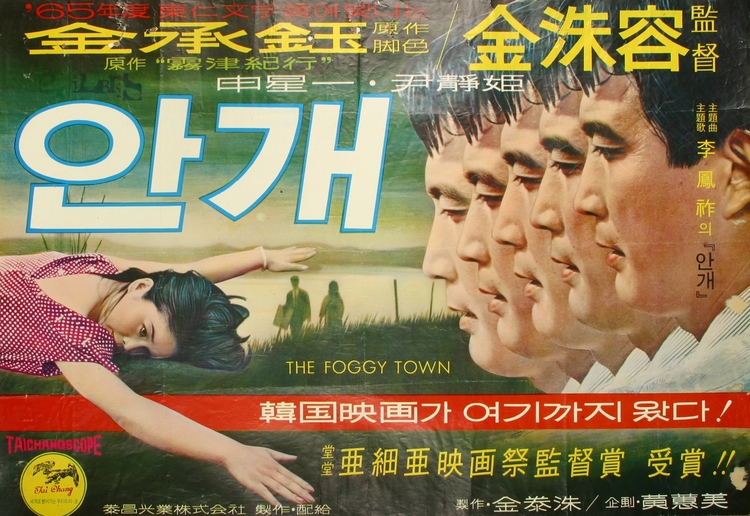
Mist (안개, Kim Soo-yong, 1967)

Mist 1967 posterBy 1967 Korea’s fortunes were beginning to expand. For the young, the future held promise but the nature of that promise was still indistinct. Often considered his masterpiece, 1967’s Mist (안개, Angae, AKA The Foggy Town) was another in the series of literary adaptations for which director Kim Soo-yong had become well known but its avant-garde mise-en-scène and gloomy outlook stand in stark contrast to the heartrending melodramas with which the genre was synonymous. Economic prosperity and superficial success have provoked only emptiness and despair, but a return to source provides little clarity for one harried salaryman lost in the expanding landscape of Korea’s global ambitions.

A poor boy from a remote coastal village, Gi-joon (Shin Seong-il) is now a successful salaryman in the capital where the constant clacking of typewriters, ringing of telephones, and racing of traffic rub at his tired mind. The fact of the matter is Gi-joon is not all that successful – he owes his position to having married the widowed daughter of the CEO. His wife and father-in-law, however, have relatively little faith in his business acumen and so, with the annual shareholders meeting on the horizon, they suggest he get out of the way by paying a visit to his hometown. Gi-joon is not all that happy to be going back, he hated Mujin with its unrelenting fog and general air of existential malaise, but he’s spineless and so he goes, despite himself.

Taking the train, Gi-joon has plenty of time to dwell on his past, literally seeing reflections of his younger self and entering extended flashbacks of memory. Mimicking the stream of consciousness approach of the novel, Gi-joon provides frequent voiceover, introducing his hometown in a less than favourable light as a place which traps its young who yearn to be free of its oppressive boredom. According to the irritated dialogue of two passengers on the bus (which Gi-joon has to take after his lengthy train journey), Mujin is a nothing sort of town where the sea is too shallow for fishing and the fields to narrow for farming, yet the population is large and largely survives on desperation alone, isolated by the oppressive fog that envelops the landscape each and every morning.

Gi-joon characterises the residents of Mujin as petty and materialistic. Having longed to escape, he thought he’d achieved his dreams in Seoul but a trip home forces him to reconsider what it is he’s become. In truth he’s no different from the petty and materialistic villagers he looked down on in their need to look down on each other. Powerlessness has defined his life. As a young man, he resorted to hiding in a cupboard to escape the draft on the orders of his terrified mother and later suffered from weak lungs which made him something of a local laughing stock. Now he’s set for a big promotion in the city but, as his wife reminds him, he wouldn’t even be there if it weren’t for her. Gi-joon’s marriage is one of convenience but it’s clear his wife holds all the cards – a wealthy widow with ambition needs a husband to act as a foil, and a weak willed man like Gi-joon is just the sort to submit himself to her authority in return for the obvious benefits she can offer him. Gi-joon has gained everything he ever dreamed of, but he feels only despair, oppressed by the very system he longed to be a part of.

Back in Mujin his various self delusions are rammed home to him. Trapped once again by the unrelenting fog, he longs to escape from his Seoul life and free himself from the yoke of his marriage and career. Whilst in town he meets up with old friends who introduce him to recent arrival Ha In-sook ( Yoon Jeong-hee) – an opera student turned music teacher who has joined the local school. In-sook is by far the most exciting thing in the extremely boring town, but Gi-joon is worried he’s stepped into the middle of something when he realises his old friend, Park, now a teacher, has a crush on In-sook while another old friend, Cho, now a status obsessed tax inspector, may also have marital designs.

Gi-joon didn’t need to worry about the tax inspector – as it turns out, he thinks he can do better than a mere music teacher and plans to marry up, much like Gi-joon has. Gi-joon bristles slightly at this, as he does to Cho’s lewd story about how he trapped In-sook on an overnight trip and planned to have a fling with her but she managed to get away (much to Gi-joon’s relief). Back home Gi-joon sees reflections of himself everywhere and particularly doesn’t like this alignment of himself with the ugly ambition of men like Cho who only want to lord it over their former friends. More flatteringly he sees his younger self in the depressed, conflicted In-sook who is already going half mad in the stultifying rural town and longs to go back to Seoul. Despite mild qualms about his friends’ feelings, Gi-joon finds himself bonding with the melancholy young woman who again forces him to see himself the way he really is rather than as the idealised personality he’d constructed for himself as a successful Seoul salaryman.

Bonding in their existential loneliness, the two eventually embark on a tender if melancholy affair which, despite their protestations to the contrary, is built on self delusions if not exactly on lies. Gi-joon intends to take In-sook to Seoul, but he won’t, and In-sook knows she won’t leave even if she wants to believe in the possibility of rescue. The world for them is as foggy and indistinct as the mists around the beaches of Mujin. Filled with emptiness and despair, they remain adrift in the post-war society unable to accept the soulless compromises of conventionality but finding no escape from their self imposed prisons.


Available on DVD as part of the Korean Film Archive’s Kim Soo-yong box set. Also available to stream for free via the Korean Film Archive’s YouTube Channel.

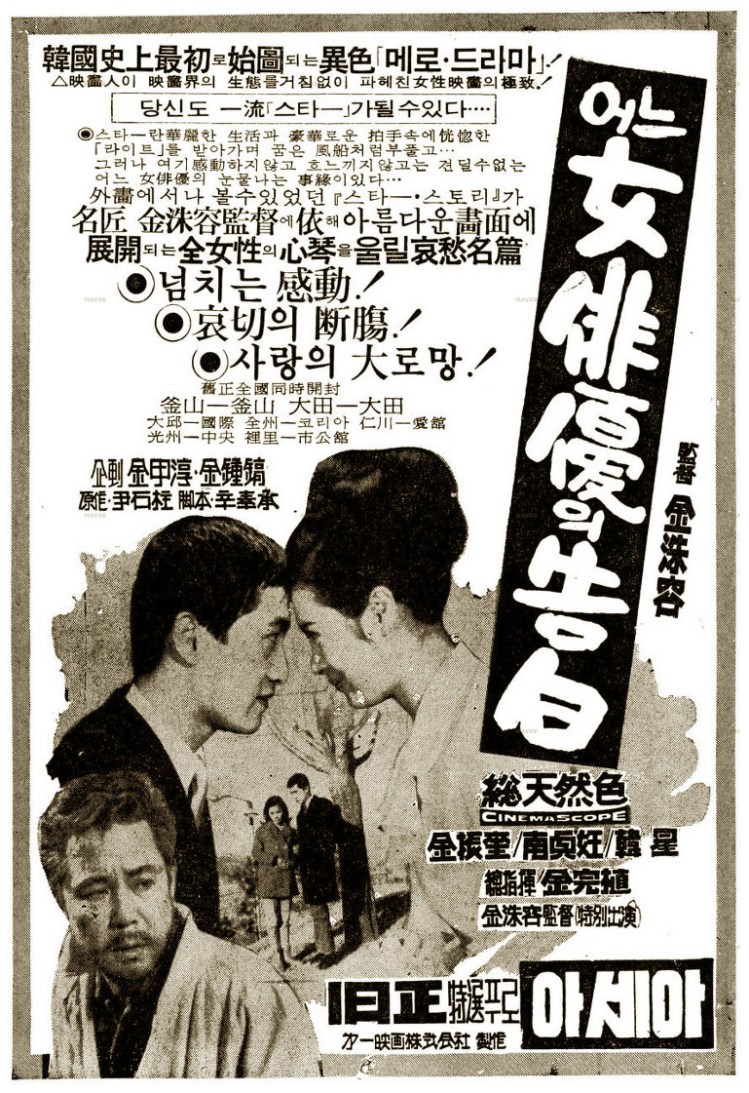
Confession of an Actress (어느 여배우의 고백 / 어느女俳優의告白, Kim Soo-yong, 1967)

Confession of an actress posterKorean filmmaking of the 1960s is sometimes referred to as a “golden age”, but the reality is that films were often churned out at a rapid pace for immediate distribution. Producers got an advance from local distributors, picked a scenario, assigned a suitable director and slotted in big name stars they already had under contract. For this reason production values are often low, but performance standard high despite the fact that many stars are bouncing around from one film to another shooting a scene here and a scene there. Director Kim Soo-yong filmed 10 features in 1967 – including his masterpiece Mist. Confessions of an Actress (어느 여배우의 고백 / 어느女俳優의告白, Eoneu Yeobaeu-ui Gobaek), inspired by a novel by Yun Seok-ju, is the kind of straightforward melodrama that was going out of style – a virtual remake of Chaplin’s Limelight with a little Phantom of the Opera thrown in, but Kim neatly repurposes it as a meta take on the Korean film industry of the day.

Kim Jin-kyu (played by the actor of the same name) was once a famous movie star, but heartbreaking tragedy ruined his career and now he’s a washed up drunk dreaming of the past. Hearing the dreaded “hey mister, didn’t you used to be somebody?”, Jin-kyu wanders into a film shoot and is thrown back to a happier time when he starred in prestige pictures with his regular co-star who was also his lover. Sadly, Miyong died of an illness leaving their last picture unfinished. The studio producers wanted to replace her and complete the movie, but Jin-kyu wouldn’t have it. They sued him for obstruction and his career was ruined. Jin-kyu was told that the child Miyong was carrying had died, but unbeknownst to him, a daughter was born and Miyong asked her friend Hwang Jung-seun to give the baby up for adoption and save it from the stigma of being illegitimate. Running into Jung-Seung at the shoot, Jin-kyu finds out his daughter is alive and determines to turn her into a great star – the only thing he can do for her as her father now that he is in such a sorry state.

Almost all of the characters in the film are named for their actors, though they are obviously not playing themselves in any biographical sense. Nevertheless, there is an intentional reflexivity in Kim’s decision to shift away from his literary source to towards one more immediately cinematic. Much as in Chaplin’s Limelight which does seem to provide a blueprint for the narrative, the arc is one of tragedy and redemption as Jin-kyu attempts to make up for lost time by imparting all his professional knowledge to the daughter he never knew and ensuring her success even at the cost of his own. Ashamed to introduce himself to her as a father given that long years of lonely drinking have reduced him to a broken old man, Jin-kyu gives his advice via letter and avoids seeing Jeong-im, longing to embrace her but afraid he’ll bring shame on her growing fortunes.

When Jin-kyu gets Jeong-im into show business, Kim gets a chance to put the Korean film industry on screen. He starts with a mildly sleazy producer and the established star who’s getting too old for ingenue roles but is desperate to hang on to her leading lady status. Nevertheless, she does have the option, as she points out, of a dignified escape through marriage should her career fail – something that is not an option for her male co-stars. As a young hopeful with no experience and nothing to recommend her beyond a pretty face, Jeong-im’s entry into the world of film is a baptism of fire. Rushed through makeup with its uncomfortable fake eyelashes and into an unfamiliar costume, Jeong-im’s rabbit in the headlights performance does not endear her to the director or more particularly the producer who is looking on from the wings in exasperation quietly calculating how much all of these extra takes are costing in wasted film. Nevertheless, the film is a success and, thanks to Jin-kyu’s careful tutoring, Jeong-im is on track for stardom.

Kim fetishises the camera, the process of filming with its bright artificial lights, tricks and techniques from the ice cold studio shoots to the difficult trips out on location. He makes full use of the relatively rare colour format utilising frequent superimpositions and montages, overlaying the bright neon lights of Seoul with the interior journey of our leading lady as she begins to find her voice. Making a final self cameo, Kim gives in to the inherently melodramatic quality of the underlying narrative but he does so somewhat ironically, rolling his eyes at the need for overly dramatic emotionality while actively embracing it, and lamenting the hardships of filmmaking while churning out his third picture in as many months. Confession of an Actress is not the salacious exposé promised by the title, but it is an illicit look at the decidedly unglamorous side of film production a world away from the bright lights and glossy magazines. 


Available on DVD as part of the Korean Film Archive’s Kim Soo-yong box set. Not currently available to stream online.

The Seashore Village (갯마을, Kim Soo-yong, 1965)

The Seashore village posterKorean cinema of the 1960s was a tightly controlled affair. The authoritarian government of Park Chung-hee had instituted the Motion Picture Law of 1962 which insisted on a studio system with stars under contract and a turnover of at least 15 films a year. The law intended to increase the amount of films produced for mass consumption, giving free reign to the melodrama and thereby accidentally undermining its more censorious aims. Nevertheless, The Seashore Village (갯마을, Gaenma-eul), adapted from a novel by Oh Yeong-su and part of the “literature film” genre for which director Kim Soo-yong would remain famous, goes much further than one would reasonably expect given the conservative nature of Korean filmmaking across the ages. A story of village life with all of its various superstitions and primitive practices, Kim’s film is a daring exploration of female sexuality and the collective power of women away from men.

An opening voice over introduces us to a melancholy fishing village where the life is hard and the people resigned to loss. The boats depart to great fanfare, but just as they are leaving someone remarks that he’s had a bad dream – bad dreams are one of many bad omens for sailors. New wife Hae-sun (Ko Eun-ah) doesn’t wait to watch her husband disappear over the horizon, she takes to the clifftop shrine of the Dragon King and prays for his safe return.

Her prayers are unanswered. A typhoon strikes and Hae-sun’s husband, along with another sailor, is killed. So young a widow, Hae-sun becomes an awkward problem for the villagers. Sang-su (Shin Young-kyun), a shady drifter, begins making subtle overtures which eventually turn into outright harassment and attempted rape. Hae-sun likes the family she married into and wants to stay true to her husband’s memory, but the forces of nature conspire against her.

While Hae-sun is a classically “good” woman who rejects the advances of Sang-su, the other village wives feel rather differently. Everyone except Hae-sun’s widowed mother-in-law (Hwang Jung-seun) knows about Sang-su’s obvious desire for Hae-sun but they see nothing wrong in it. Rather than the conservative atmosphere of the middle-class urban melodrama in which bodies of surrounding middle-aged women act as enforcers of moral discipline, these literal fishwives are of an earthier disposition. Many of them have been widowed with husbands lost at sea – the way they see it, you’d best take your pleasures where you can and there’s nothing wrong with a quick roll in the hay if it eases frustration and aids productivity. They laugh at Hae-sun’s prudery and marvel at her ability to carry on as normal after losing her husband not because of the grief, but because of the lack of intimacy.

It might be 1965 outside of the village, but the old ways still rule here even if they’re on their way out. In the old days, women did not remarry – a serious problem in a small village with few men around to replace those lost at sea. Hence, women have learned to live alone, supporting each other in place of men and often forced to do without them. In a surprising development, Kim flirts with the taboo of lesbianism – something which is addressed half-jokingly by the gossipy widows but eventually gives way to a literal roll in the hay with half the village women looking on in hilarity rather than horror. The women joke about living together but lesbianism does seem to be presented as an imperfect solution to their present problem in the lack of satisfaction available to them due to the absence of men. Far from a taboo, sexual desire is a normal part of life in the village – something ranked alongside eating and sleeping and no more or less embarrassing than any other bodily function. The widows crave men and are unafraid to say so even if some of them are content to make do with each other in resignation to their awkward status as older single women.

Hae-sun is in a slightly better position given that remarriage is apparently no longer so much of a taboo. Unfortunately that presents a problem for her as all she wants to do is stay with her family just as she is. She doesn’t like Sang-su and his increasingly aggressive behaviour towards her is unlikely to change that but nevertheless she eventually finds herself given to him almost against her will. Despite becoming a wife once again, Hae-sun’s beauty continues to curse her by causing problems between men wherever she sets foot. The problems, however, are definitively on the male side – men long to possess her, with violence if necessary, and ruin themselves in their immoral pursuit of a “pure” woman. The village widows rejoice in their earthy pleasures, finding comfort and release in each other but the male impulse, by contrast, is always towards conquest and control, domination rather than mutual support.

Life in the village is hard and often sad, but the women are happy and optimistic. They live the lives that are given to them, and do the best they can with what they have. The very antithesis of the lurch towards modernity, the simple life of the villagers harks back to something purer and more honest without the pretension of urban civility and apparently free from the political concerns of the day. Bold in its outlook, The Seashore Village is a surprisingly progressive effort from the Korea of 1965, subverting its “primitive” setting to present a positive picture of female power and sexuality.


Available on DVD as part of the Korean Film Archive’s Kim Soo-yong box set. Also available to stream for free via the Korean Film Archive’s YouTube Channel.

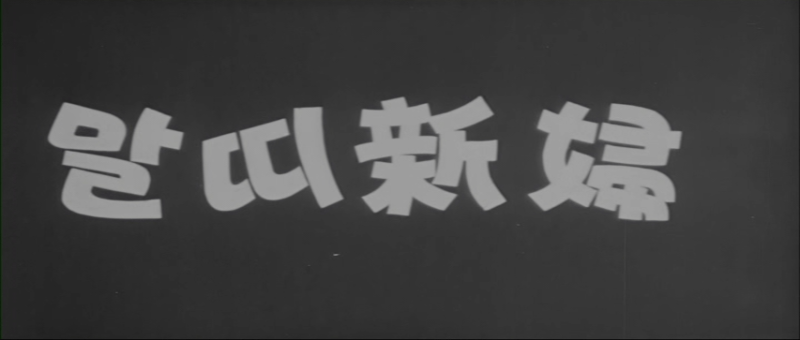
Horse-Year Bride (말띠新婦 / 말띠신부, Kim Ki-duk, 1966)

In the relatively conservative Korean society of 1966 it’s surprising that film like the Horse-Year Bride (말띠新婦 / 말띠신부, Maltti Sinbu) could have been made at all. On the one hand it embraces and subverts common notions of gender by positioning its “horse year women” as somehow deviant from the norm, difficult to deal with and undesirable, but also places them centerstage as individuals making independent choices in their own lives rather than simply trailing along behind their men. Technically the second in a trilogy of films, the first and last being directed by Lee Hyung-pyo, Kim Ki-duk’s Horse Year Bride is a raucous sex comedy, tame by modern standards but transgressive by those of the time. Adopting a mild, if ironic, issue movie stance, Kim also satirises social attitudes to “horse year women” and councils against a trend of aborting babies set to be born in the year of the horse lest they be female and turn into vicious harridans.

The film opens with a wedding in which middle-aged (presumably 35 or 36 year old) Bok-soon (Hwang Jung-seun) marries the extremely miserable looking professor Seok-du (Park Am). The wedding photographer who later turns out to be a horse woman herself and a private eye is surprised to notice that Bok-soon has horse’s hoofs rather than fancy shoes under her wedding dress. A fortune teller (Kim Hee-kap) then introduces us to his matchmaking service and claims the wedding we have just witnessed is a result of his best ever match before introducing us to two more couples – Soo-in (Nam Mi-ri) whose husband Sang-won (Yoon Il-bong) has gone full on domestic to look after her while she’s pregnant, while Mi-hae (Um Aing-ran), also pregnant, fends off the sexual advances of her frustrated husband Keun-ho (Shin Seong-il). The two as yet unmarried horses include the aforementioned private detective, Young-hee (Bang Seong-ja), and a dancer, Suk-ja (Choi Ji-hee), who is engaged but not above making use of her sex appeal for material gain.

Bok-soon, one horse cycle ahead of Soo-in and Mi-hae, laments her long period of matronly virginity and is keen to make up for lost time. Seok-du, however, is not exactly a love machine and is completely worn out by his wife’s appetites, even going so far as to return to the fortune teller and complain that his excellent matchmaking has turned him into an exhausted sex slave. The matchmaker suddenly grabs a picture of Napoleon and has a novel explanation for where the famous general’s hand might be. Anyway, his advice is to practice yoga to increase stamina and keep Bok-soon happy.

Meanwhile, Soo-in and Mi-hae have both lied to their husbands about being pregnant in order to avoid sex so that they don’t conceive a daughter that, like them, will be born in the year of the horse. This particular “White Horse” year is thought to be especially inauspicious and daughters born as White Horses will apparently be total nightmares and have terrible lives. The two relationships send up various culturally accepted norms of martial gender roles as the women both manipulate their husbands to get their own way. Soo-in’s Sang-won is so solicitous about the pregnancy that he’s put Soo-in on virtual bed rest and blossomed into a mother hen clucking around doing the housework but making a total mess of it (because, after all he’s a man, and men aren’t “built” for this sort of thing). Mi-hae’s problem is the opposite in that Keun-ho’s sexual needs are a constant source of frustration to him in which he resorts to pounding a giant mortar in an unsubtle attempt to relieve his pent-up energy. Bok-soon too is subtly manipulating Seok-du by feeding him an “aphrodisiac” and secretly practicing yoga herself to get the most out of her married life.

Unmarried Suk-ja attempts to manipulate men by promising more than she means to give but finds herself in hot water with a grumpy salaryman (Joo Sun-tae) who seems determined to take what he thinks he’s owed. Suk-ja later pays heavily for her rejection but the other women rally to her side to take revenge on the lecherous businessman whom they regard as “human scum” and intend to “re-educate” to treat women better. The vengeful band of women taking revenge on the male sex with each of its various double standards and chauvinistic assumptions derives part of its humour from the relative lack of power available to them but does manage to make a sensible point about the sexist world they inhabit.

Eventually, when the women have given up their power and allowed themselves to become pregnant by their men, even the doctor at the hospital assumes they will want abortions to avoid the threat of White Horse daughters. By this point the women have also resolved that there’s nothing wrong being Horse Women or even White Horse Women, with women excising power (even if in necessarily feminine ways), or with enjoying full relationships with their husbands, but they’re still bound by otherwise typical ideas of female gender roles in the importance of maternity and dream their daughters will be Miss Koreas rather than great scholars or forces for good in the world. The doctor raises an interesting point when he suggests the fear of White Horse Women is an unwelcome foreign import from Japan which both paints it as another symptom of colonial corruption and ignores the fact that the reasons for the ongoing stigma are part of the essential social fabric of Korea. He does, however, find some darkly comic reasons against abortion in citing the economic effects of empty schools and lonely classrooms while also suggesting the women’s daughters may have an easier ride thanks to the lack of competition.

In contrast to his previous films, Kim adopts a youthful, pop-culture infused approach which makes frequent use of domestic and foreign pop music with a lengthy animated title sequence plus extended scenes of music and dance often unconnected to the main drama. Extremely frank in its treatment of modern sexual relations, Horse-Year Bride is an unlikely ‘60s Korean sex comedy filled with silly gags and slapstick humour but proves an extremely effective satire of the complicated social mores of ‘60s Korea.


Available on DVD as part of the Korean Film Archive’s Kim Ki-duk box set. Also available to stream online for free via the Korean Film Archive’s YouTube Channel.

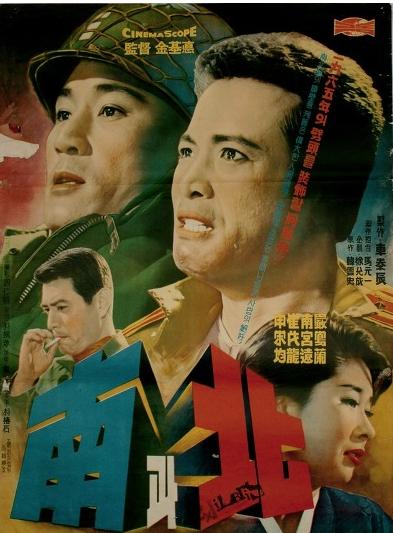
North and South (南과北/남과북, Kim Ki-duk, 1965)

north and south poster

Melodrama has often been an unfairly maligned genre, dismissed as pandering to the sentimental or engaging in frivolous emotion but to do so misses the undercurrent of social questioning that such films often entail. Korea has made the melodrama its own – indeed, though genre is often a more fluid matter in Korea than it is elsewhere it’s difficult to find films of any kind which are completely devoid of melodramatic themes. It’s less of a surprise therefore to find that Korean cinema turns to melodrama to examine one the nation’s most pressing concerns – the relationship between North and South. Kim Ki-duk’s North and South (南과北/남과북, Namgwa Buk) is the story of a woman caught between two men, two nations, and two eras but it’s mediated through the story of a noble North Korean who has battled all in the name of love, left his family, his home, his country only to find that he is too late and the world has already left him behind.

The film begins with capture of a North Korean soldier in November 1952, the middle of the Korean War. Following normal procedure, the soldier, Major Jang Il-gu (Shin Young-kyun) is taken in for questioning but the major matter on his mind is the lady in the photograph he keeps brandishing to everyone he meets. Rather than political disaffection, Il-gu has defected to the South in the name of love – he’s looking for a woman he regarded as his wife, the mother of the son he has never seen. The South Korean officers are less than sympathetic, they’ve been noticing increased activities on the frontiers and they want to know some concrete military details before they even agree to admit Major Jang, but Il-gu won’t talk until they promise to help him look for Eun-ga (Um Aing-ran) – the woman for whom he has betrayed his comrades.

Captain Lee Hae-ro (Choi Moo-ryong), otherwise sympathetic to Il-gu’s plight, runs into a problem when elements of Il-gu’s story start sounding all too familiar. In a coincidence too staggering to believe, Eun-ga is Hae-ro’s wife. Originally reluctant to marry him, Eun-ga had explained that she had a son already and was waiting for the child’s father (to whom she was not “legally” married) from whom she had been separated by the 38th parallel. Lee was patient and persistent, he told Eun-ga that she was free to leave him should her long lost love return (never believing it was possible) and that he was content to look after her until that day came or, should he be so fortunate, for the rest of his life. Now Il-gu has arrived as if to punish him for disrupting this fairytale of doomed romantic love.

Unlike many films of the time, Kim is not interested in demonising the North so much as emphasising the tragedy of Korea’s division. Eun-ga and Il-gu are divided by more than just politics. Eun-ga was the middle-class daughter of a wealthy doctor, Il-gu was the son of one of their servants. Their love was not possible even before the war, but still it blossomed. Growing up together, Il-gu and Eun-ga experienced the quintessentially innocent taste of first love, vowing to stay together even in the face of fierce parental opposition and social convention, but it is the war which eventually seals their fate. Il-gu, not wanting to be conscripted into the Japanese army hides out in a shack where Eun-ga, the only person to know his whereabouts, spends a fateful night with him during which time their child is conceived.

Dreaming only of being re-united with his “wife” and child, Il-gu has been carrying around a picture of Eun-ga and looking for an opportunity to defect ever since the erection of the 38th parallel. Abandoning everything in the name of love, he has left his mother alone in the North and risked his life in hope of seeing Eun-ga once more. Hae-ro, a romantic man himself, is intimidated by Il-gu’s passion. The great, fated love he’d imagined for himself in marrying the nurse who had saved him at his lowest ebb suddenly pales in comparison to Il-gu’s willingness to sacrifice his life in pursuit of a true love dream. Understating Il-gu’s feelings, Hae-ro finds himself in a terrible position, worried that his love will leave him, feeling guilty for pestering her into a marriage she may not have really wanted, and unsure whether he should even tell Il-gu and Eun-ga that he holds the key to their long delayed reunion. Il-gu remains resolute, demanding love or death, but Hae-ro vacillates, drinks himself into solipsistic misery, and indulges his own weaknesses which are only made worse by Il-gu’s continued heroism.

Immediately before the final sequence in which the trio are forced to confront their emotionally difficult situation, Il-gu is threatened with a gun but refuses to give up any information without proof he can meet Eun-ga. Believing all hope to be lost, he asks only to be allowed to go up a mountain to die but is moved by the compassion of intelligence officer Kwon (Namkoong Won) who alone is committed to delivering Eun-ga and eventually gives up his information even though it pains him to betray his own comrades. In an impassioned debate with Kwon, Il-gu gives voice to the film’s overarching message in reminding him “Are we not all brothers”. Kwon, counters that the reason they fight is in service of Il-gu’s quest – it’s precisely so that he can come here, speak freely, and pursue his love unhindered. The “South” is winning, in a sense, but the message of brotherhood and understanding between men is the one which is delivered with the most clarity.

Understanding between men is indeed the theme of Hae-ro and Il-gu’s eventual meeting. Eun-ga’s torment is relegated to background detail as she sobs her heart out in the corner in the unfairness of her impossible situation. Her heart has always belonged to Il-gu and she feels herself to have betrayed him, betrayed love, in marrying an admittedly good and kind man out of reasons of practicality rather than passion. Coming to understand the situation, Il-gu responds with compassion and understanding even in the middle of his own heartbreak. He bitterly regrets his journey and wishes Hae-ro had told him Eun-ga was now his wife rather than allow him to hurt her by suddenly reappearing and breaking her heart all over again. Witnessing Il-gu’s magnanimity, Hae-ro is also moved, offering to step back and allow Il-gu to return to the family he may have lost. Both men recognise the goodness of the other, want nothing more than the best outcome of the situation for Eun-ga and her son, and are committed to moving forward with sensitivity in trying to minimise the emotional pain inflicted on the innocent Eun-ga who continues to suffer through no fault of her own.

The “fault” falls on the 38th parallel which, as Il-gu explains during a painful first meeting with his unknowing son, is “the worst thing ever made by stupid men”. The situation is indeed impossible, there is no easy answer for Eun-ga who will have to choose between past love and a present commitment (or, uncomfortably, have that decision made for her by her respective lovers). Kim dramatises their anguish perfectly through the extraordinary performances of his cast during the drawn out, painful encounter in which they attempt to forge a way forward, but Eun-ga, who stands in for her nation, stands to lose all when this same fierce love and understanding between men may cost her everything in tragic gestures of love and sacrifice.


Available on DVD as part of the Korean Film Archive’s Kim Ki-duk box set. Not currently available to stream online.

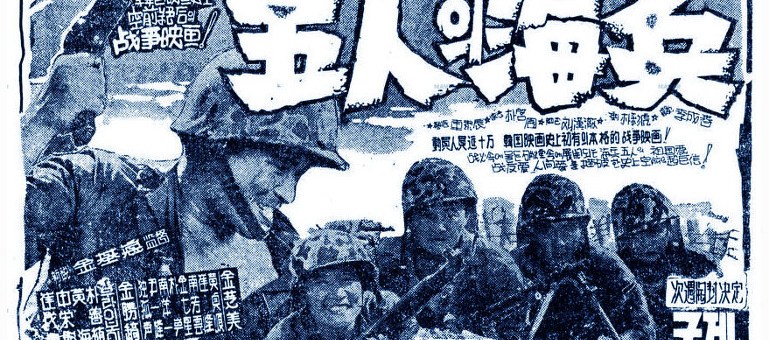
Five Marines (五人의 海兵 / 5인의 해병, Kim Ki-duk, 1961)

Five Marines posterKorean War films have a very particular tone and flavour often absent from those from elsewhere. As sad and despairing as they can be across the world, war films are generally the realm of macho heroism, men bravely holding back tears and charging forth with unrestrained rage in a quest to avenge their fallen comrades. Korean War films, however, like the majority of the nation’s cinematic output, are tinged with melodrama. These men wail, talk about their mothers, and worry for the future while forging intense bonds of homosocial brotherhood and becoming a battlefield family. The debut feature from Kim Ki-duk, Five Marines (五人의 海兵 / 5인의 해병, O in-ui haebyeong) is a prime example of this approach, eschewing combat scenes for behind the lines ensemble drama as ordinary men attempt to come to terms with the extraordinary situation of war.

Stock footage of the battlefield eventually gives way to a small squadron of marines digging trenches and at constant risk of ambush by Chinese forces. The main drama revolves around lieutenant Deok-su (Shin Young-kyun) who is the son of the company commander but there has long been bad feeling between the two men as Deok-su has always felt that his father favoured his brother, Deok-han (Choe Bong), and never really loved him. Meanwhile we’re introduced to another four marines – intellectual Jeong-guk (Choi Moo-ryong), Ju-han (Flyboy / Gwak Gyu-seok) – a father of five from Seoul, farm boy Yeong-seon (Park Nou-sik), and mother’s boy with anger issues Hun-gu (Hwang Hae). Following the death of two comrades, the squad of five is sent on a daring missing into enemy territory to blow up an arms depot through which they aim to make the sacrifice their friends have made in some way meaningful.

Made just eight years after the end of the Korean War and apparently commissioned by the Marine Corps in the wake of the May 16 military coup which initiated the dictatorship of Park Chung-hee, Five Marines takes a very different approach to that seen in other contemporary war films such as Lee Man-hee’s The Marines Who Never Returned. Though in no way particularly jingoistic or warmongering, it would be difficult to describe Five Marines as an “anti-war” movie, not least because it avoids depicting scenes of combat until the final mission in which, as expected, some or all of the heroes will fall valiantly defending their fellow Koreans as well as their friends.

Jeong-guk, the college educated enlisted man, originally considers himself to be taking part in the pantomime of war, going along with the ridiculous sham of soldiering, but when a fellow soldier – a young boy who spends his time rewriting a poetic confession of love he doesn’t quite have the nerve to send to the girl he left behind, falls in front of him, Jeong-guk suddenly wants to join the fight for real. The idea of militaristic patriotism is then subtly reinforced if not quite sold with patriotic fervour. The necessity of the sacrifice is never questioned and the idea of doing one’s duty remains paramount even if it is also clear that the war has taken these men out of their familial environments leaving their women at home alone and, perhaps, defenceless.

Kim explores the peacetime lives of each of the men through flashback with the consequence that we get to know and care for them as people rather than as combatants. We rejoice with Jeong-guk when he hears he’s going to be a father, share Ju-han’s amused frustration when his wife includes all their bills in his mail, and worry with Hun-gu when his usual letters have not arrived. During their down time, the men discuss women but with more tenderness than expected – save for Yeong-seon’s rather lewd (and apparently fabricated) story of his wedding night for which he is rightly taken to task by his stern company Sergeant. Rather than focussing on the negatives of military service, Kim emphases the warmth and friendship among the men who forge deeper and stronger connections precisely because of the ever present threat of death.

When the final mission rolls around, Kim allows the action to take centre stage as the five man squad plots and executes a daring raid which does not quite go to plan and eventually erupts into a more conventional fire fight. Marrying the demands for macho battle scenes with the emotional quality of melodrama, Kim allows the men to sort out their emotional difficulties, shedding both blood and tears in equal measure. More emotional drama than action packed celebration of the glory of war, Five Marines may not quite be what the Marine Corps had in mind but perhaps serves their purpose anyway in reinforcing the positive ideas of camaraderie and patriotism whilst telling the stories of ordinary men and extraordinary heroism.


Available on DVD as part of the Korean Film Archive’s Kim Ki-duk box set. Also available to stream online for free via the Korean Film Archive’s YouTube Channel.

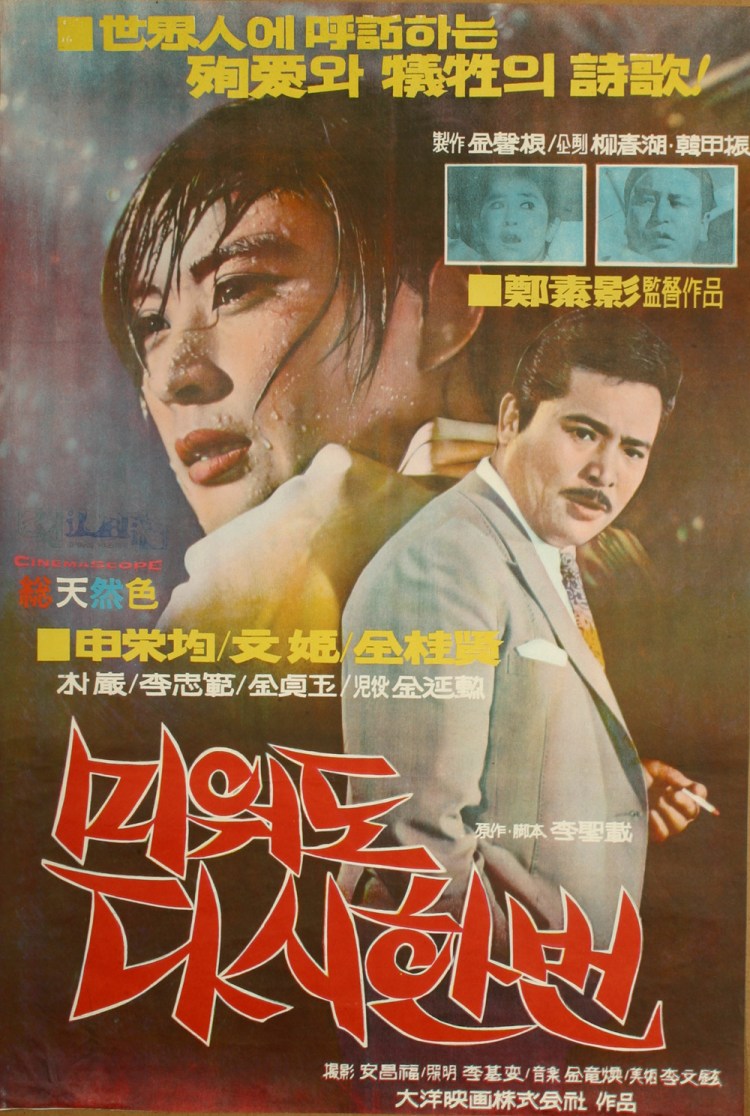
Love Me Once Again (미워도 다시 한번, Jung So-young, 1968)

love me once again posterBy the late 1960s, Korean society was caught in a moment of intense social change. Though under the oppressive authoritarian regime of Park Chung-hee, the strict censorship regulations of the early 1970s had not yet taken effect and the 1962 Motion Picture Law which encouraged a shift towards commercial cinema intended for mass entertainment created a fertile ground for melodrama which itself enabled subtle commentary on modern society. The first in what would become a long running series with two sequels and a number of remakes stretching into the 1980s, Love Me Once Again (미워도 다시 한번, Miweodo Dasi Han Beon) is a prime example. A box office hit and pop culture phenomenon, Love Me Once Again is a somewhat unusual entry the melodrama canon in its broadly sympathetic treatment of adultery and attitude towards children born out of wedlock.

The film begins in the present as family patriarch Shin-ho (Shin Young-kyun) enjoys a pleasant family Sunday fishing with his son and picnicking with his wife (Jeon Gye-hyeon) and daughter but the scene is quickly interrupted by a servant who comes to fetch Shin-ho to greet an urgent visitor to the house. The visitor turns out to be an old friend of Shin-ho’s who has a distressing message for him – Hye-young (Moon Hee), a young woman with whom he had an affair eight years previously, is back in town and would like to meet.

Flashing back eight years, Hye-young is a young kindergarten teacher living in the lodging house where Shin-ho is staying while working away from home. The pair become friends and everyone seems to assume they are a couple, though Shin-ho insists Hye-young is just a friend. Nevertheless, he eventually begins an affair with her leading Hye-young to turn down a marriage arranged by her parents. Though Shin-ho discourages her to do this, Hye-young has no idea he is already married with two children and believes he will marry her at some point in the future. Shin-ho plans to tell Hye-young about his wife but can’t bring himself to do it, allowing her to find out in the worst possible way when his wife arrives with both kids in tow. Realising she’s been duped and feeling in the way, Hye-young takes off without warning leaving only a letter wishing Shin-ho well and letting him know that she is pregnant with his child and intends to raise it alone.

Hye-young is certainly a very “modern” forward thinking woman though she is also morally upright, only embarking on a relationship with Shin-ho because she believes he is the man she will spend her life with. Her family had arranged a marriage for her and express their frustration with Hye-young for not returning home immediately in a letter which also makes plain that they will suffer embarrassment if she refuses the marriage altogether – which she does. When she returns home pregnant with Shin-ho’s child, her brother (who seems to be the head of the family), throws her out. Hye-young’s mother seems more sympathetic, but is powerless to help. Hye-young will have to manage on her own without the assistance of friends or family.

Eight years on she has a lovely little boy, Young-shin (Kim Jung-hoon), whom she has raised alone in hardship but not unhappiness. Encouraged by her brother and seeing how Young-shin looks on enviously at other little boys playing with their fathers on the beach, Hye-young begins to wonder if it might not be better to have Shin-ho raise Young-shin alongside his other two children in a middle-class family home. As Shin-ho’s son he would have a life of material comfort, a paternal input, and be free of the stigma of being the illegitimate child of an unmarried single mother.

Though the situation is difficult, it is handled with calm and maturity on all sides, not least from Shin-ho’s wife who takes a while to think hard on the situation and then agrees to look after Young-shin but only as a full adoption. She asks that Hye-young refrain from writing to or seeing her son, leaving him entirely in the family’s care. Hye-young has made her decision and agrees that may be for the best, even declining the offer of written updates from Shin-ho’s best friend. Once Young-shin has become a part of Shin-ho’s family, his wife truly does her best to make him feel at home as the third of her children, treating him kindly and taking the older two to task for teasing their “baby brother”. The children however are not quite so accepting with Shin-ho’s eldest son particularly hostile, bullying little Young-shin mercilessly even though he has done nothing to provoke his anger other than try to be friends with him. Getting a new little brother is perhaps particularly hard for the children who now have to share everything with a virtual stranger, but despite the efforts of Shin-ho’s wife, she just can’t seem to make them accept him.

Shin-ho, feeling awkward and guilty, is not quite as committed as his wife is to making the new family work. He tries to treat Young-shin as his son, but never quite connects with or makes him feel at home. The major problem is that the family all insist Young-shin must forget about Hye-young and commit fully to his new family as they are committing to him but that’s a lot to ask for an eight year old boy who quite fairly misses his mother and does not understand why he is not allowed to see her. A crisis occurs when Shin-ho angrily confiscates a locket Hye-young had given Young-shin containing her photo as a memento, sending him off on a long journey trying to find a way back to his mother. Being only eight, Young-shin has no idea how to go about finding her bar knowing the name of the town where he used to live. Roaming around the city all alone calling his mother’s name, Young-shin stays out all night. Shin-ho and his wife are sick with worry, searching for him in the pouring rain, but when he finally returns drenched and miserable, Shin-ho treats him only with anger and not with tenderness.

Meanwhile, Hye-young is struggling to come to terms with her decision to “abandon” her son, having bad dreams that Young-shin is being mistreated or is miserable, missing her as much as she misses him. Obeying the family’s request to stay away, Hye-young cannot resist coming to visit and observing from far away, hoping to catch a glimpse of her son and find out if he is well and happy. Unfortunately she turns up just as he’s gone out looking for her and spots him cowering outside Shin-ho’s house, drenched in the rain. Afraid to go near him she urges him to go inside, calling out from the shadows only to be spotted by Shin-ho as she makes her escape.

Rather than wallow in misery, Jung does not refuse the inherent melodrama of the situation but addresses it realistically and with a degree of maturity and patience most real life situations can only aspire to. Hye-young believes that Shin-ho hates herself and her son and will never be able to accept them as members of his family, but even so he does appear to have developed at attachment to Young-shin and hopes that he can maintain contact with him even if it remains clear Young-shin cannot remain in their home. Shin-ho’s wife too makes a point of not blaming Young-shin for her husband’s mistake and displays compassion for Hye-young who meant her no harm and has incurred only suffering as a result of her involvement with Shin-ho. Where most melodramas would punish Hye-young for her transgressions, Jung is kinder to her, never condemning her for her “immoral” behaviour in sleeping with Shin-ho before marriage and making it clear that her decision to live independently as a single woman and raise Young-shin alone is not only valid but correct and to be supported. A controversial attitude for the Korea of 1968 but one which declares itself on the side of modernity rather than adherence to traditions which more often than not create more problems than they solve.


Available to stream for free via the Korean Film Archive’s YouTube Channel.

The Last Witness (최후의 증인, Lee Doo-yong, 1980)

Last Witness Restoration posterThe Last Witness (최후의 증인, Choehuui jeungin), a pregnant title if there ever was one, begins with a melancholy voice over by way of a warning. It tells us that the path we are about to embark on will be a dark one but strikes a more optimistic note in affirming that 1980 was the year old evils were cleared away and, the narrator hopes, such darkness will have been left behind in the approaching new decade. Sadly this will not come to pass. The Last Witness is adapted from a novel by Kim Seong-jong which was published in 1974 but Lee Doo-yong filmed his adaptation in 1979 during the brief surge of hope for a brighter future following the assassination of dictator Park Chung-hee which ended with the military coup staged by general Chun Doo-hwan placing the country under martial law. A detective is assigned a case, but his investigation takes him on a long, soul searching journey into the recent past in which he finds countless crimes, betrayals, and proofs of human cruelty which ultimately destroy his ability to believe in the better, brighter future which has been promised yet denied.

Oh (Hah Myung-joong), a recently widowed, strung out police detective is handed a case by his sympathetic boss which seems to have been buried. A brewery owner, Young Dalsoo (Lee Dae-keun), has been murdered whilst fishing at a river and there appear to be few clues save that the woman he was living with was apparently not his legal wife. Oh’s preliminary enquiries all point back to an incident 20 years previously when Young was the youth leader in the village and supposedly helped to capture/kill a squad of rebel communist guerrilla fighters who had been hiding on Mt. Jirisan. 

Lee structures the tale to mimic Oh’s investigation; we follow him as he follows leads, jumping back to the 1950s and then forward again the world of 1980. The war becomes a corrupting and dividing line but Lee is bold in his tenet that the wounds did not heal after the truce. The villainy and greed continued, women were used and abused, men were cheated and betrayed. Justice no longer existed and the system continued to be bent to the will of the powerful rather than used for the defence of the weak.

It’s no surprise that Lee had such trouble with the censors. The version of the film restored by the Korean Film Archive runs 154 minutes (the first cut apparently ran 158) but for its original release the mandated cuts took it down to 120, leaving an already complex narrative near incomprehensible. Aside from the scenes of rape and violence, the censors took issue with the depiction of judicial corruption and particularly with its manipulation to facilitate sexual coercion of a defenceless young woman.

The woman at the centre of the storm is Son Jihye (Jeong Yun-hui) – the daughter of a wealthy man who nevertheless became a commander of a communist guerrilla unit during the war. When General Son went into the mountains he took his daughter with him, but realising he was on the losing side, and resenting orders he believed would result in nothing more than martyrdom, Son lost faith in “communism” and was murdered by his own men in an act of mutiny. Before he died he entrusted a treasure map marking the spot he buried his ancestral wealth to a fellow officer with the instruction to look after his daughter and make sure she gets her inheritance. The soldier failed to keep his promise. Jihye is raped and then gang raped, rescued by a sweet and simple man, Bau (Choi Bool-am), whom she later marries, and then forced to become the mistress of an official who also raped her. Jihye and Bau are the innocents chewed up by the system, good people pushed into a corner by the politics of others and then let down by a society so riddled with corruption that it can no longer command any degree of faith from its continually oppressed people.

The Korea of 1980 is being attacked through the legacy of 1950 but whether in concession to the censors or no, the communists do not come off well either. Son, described as an eccentric, is clearly a misguided madman who has betrayed his class on a superficial level, saving his own wealth for a rainy day, but he is allowed a semi-noble death in finally renouncing communism as a cruel, ambitious underlying has him brutally executed by bloody, violent bayonets while his daughter watches from behind a nearby bush. Once Son is dead the madness sets in as the guerrillas hide out beneath a primary school, listening to small children sing happy songs while they tie up and rape a terrified teenage girl having abandoned all concessions to morality and their supposedly noble cause.

If the communists were bad what came later was worse. Interviewing a witness, Oh is keenly aware that the man is telling him only a part of the truth, leaving out a painful detail but leaving in just enough for a skilled investigator to understand. It is this act of selective silence that Oh has come to challenge, exposing the whole sordid story of his nation across two decades of war, trauma, economic recovery and political oppression. Oh cannot resist meting out a little justice of his own in reciting the man’s hidden truth back to him, forcing him to confront the ugliness of his of youth and the guilt that he has long been repressing. Unable to prosecute him for his crimes, Oh hopes that the man will be punished “emotionally” by his words but his actions have far more severe consequences than he ever could have anticipated.

What Oh finds when he solves the crime is a long history of rape, secrecy, betrayal, selfishness, and the misappropriation of law by the powerful to oppress the powerless. It all goes back to the mountain and the war, a young woman robbed and violated, her protector imprisoned, and a legacy of pain which will come back to haunt those responsible but bring only ruin and anguish to its original victims. The question of the “last witness” remains unsolved – will these be the last witnesses to an era of fear and impotence now that the bright future is on its way, or is Oh the last witness, deciding to take his terrible knowledge with him to a better place? Then again the film itself stands as a testament to its times, butchered by censors but carrying forth its own hidden truths only to deliver them 30 years later than expected. Lee’s powerful murder mystery is an investigation into the death of a nation about to be reborn which makes its grim yet inevitable conclusion all the more painful in its brutal negation of a long buried hope.


Screening as part of the London Korean Film Festival 2017 at Regent Street Cinema on November 4th, 2pm.

The Last Witness is also available on all regions dual format DVD & blu-ray courtesy of the Korean Film Archive. In addition to English subtitles on the main feature, the blu-ray disc also includes subtitles for the commentary track by Park Chan-wook and film critic Kim Young-jin, while The DVD includes subtitles for the commentary track by Kim and Lee Doo-yong as well as an additional commentary by director of Kilimanjaro/The Shameless Oh Seung-uk and journalist Ju Sung-chul.

The accompanying booklet is fully bilingual and includes essays by Kim Young-jin, Ju Sungchul (Editor of Korean film magazine Cine 21), and Inuhiko Yomota (film critic – the booklet also includes the original, untranslated essay in Japanese), as well as a note on the restoration from the KOFA conservation centre.

(Not currently available on the Korean Film Archive’s YouTube Channel)

Original trailer (Restored, English subtitles)