Gyeong-ah’s Daughter (경아의 딸, Kim Jung-eun, 2022)

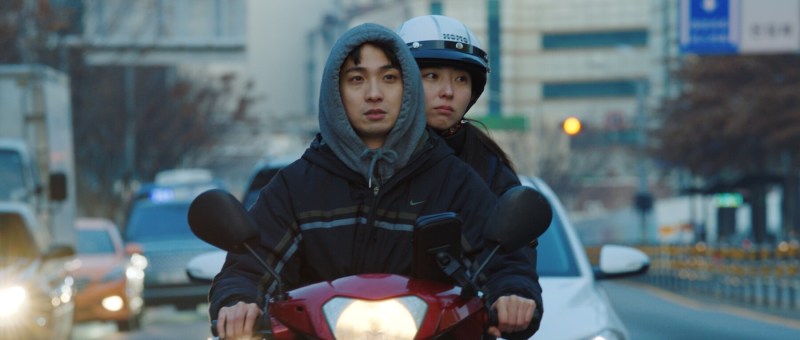
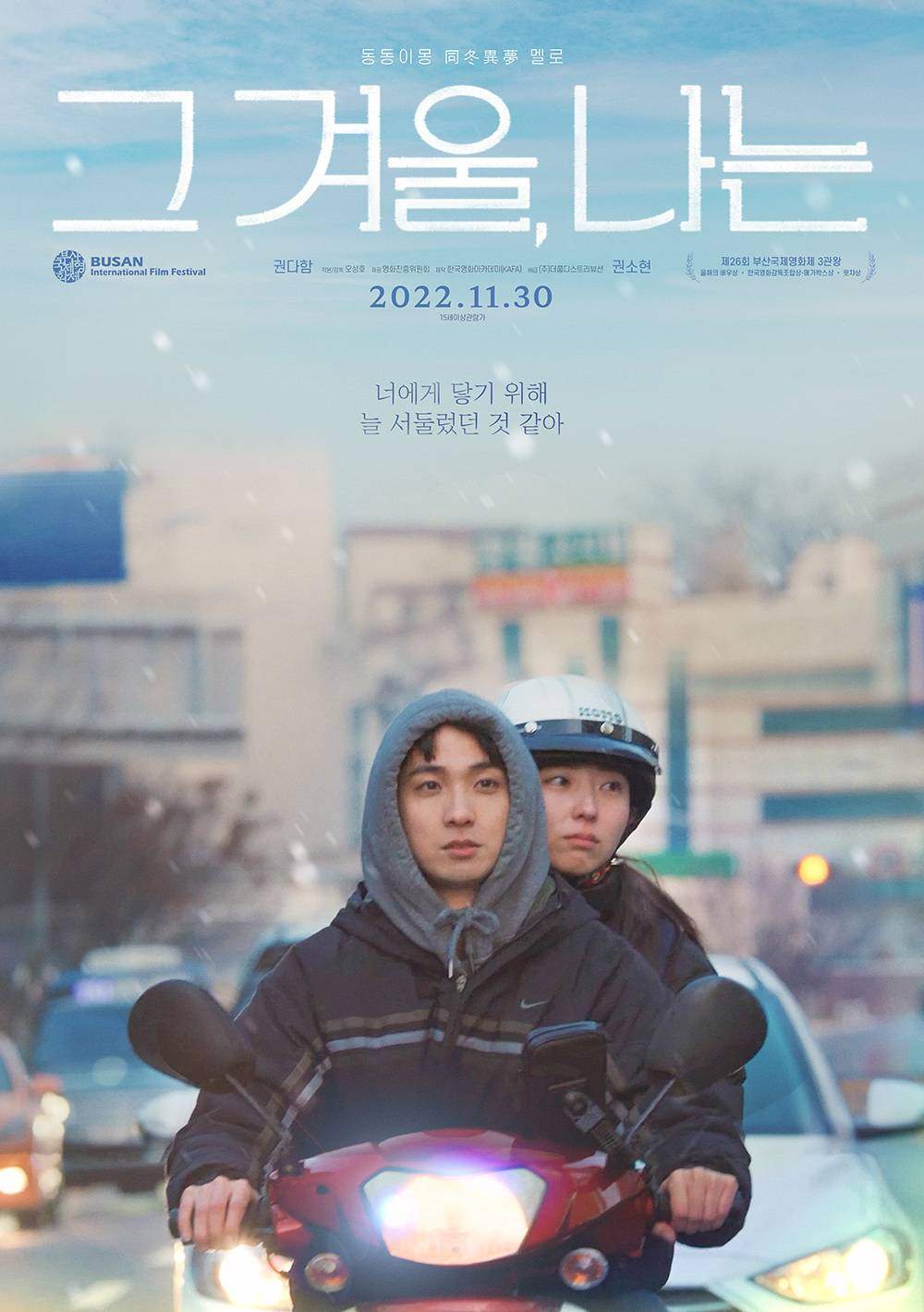
“It’s not your fault. And it’s not mine either.” a young woman declares, finally freeing herself of internalised shame while trying to live under the oppressively patriarchal social codes of contemporary Korea in Kim Jung-eun’s quietly enraged drama, Gyeong-ah’s Daughter (경아의 딸, Gyeongaheui Ddal). As the title implies, the film is as much about parents and children and the various ways the older generation unwittingly fail the younger in mistakingly clinging to the conservative ideas that defined their own youth but bring nothing but misery to all as it is about the pervasive misogyny of the modern society. 

Pushed to the edge, Yeon-su (Ha Yoon-Kyung) exclaims that she cannot bear being Gyeong-ah’s (Kim Jung-Young) daughter sick of her overly possessive, controlling parenting along with her initial failure to support her during one of the most miserable moments of her life. As the film opens, Gyeong-ah facetimes her daughter and the pair chat cheerfully for a while even though Gyeong-ah criticises Yeon-su’s new haircut as she shows her around her new apartment showing off the cheerful lights she’s stringed above her bed. But then, the conversation takes a turn for the strange with Gyeong-ah suddenly insisting that Yeon-su prove she is alone, taking the phone to the bathroom to show her there’s no one hiding in there and then even out in the hall in the event that she knew her mother might ask. We can well understand why Yeon-su, who is a grown woman about to start her first job as a high school teacher, might prefer to keep her mother at arm’s length unwilling to take the trouble of sharing her private life with her.  

It’s this sense of distance that informs Gyeong-ah’s reaction when she suddenly receives a strange video from an unknown number and realises that it is a sex tape featuring her daughter. First of all she feels betrayed that Gyeong-ah lied to her when she repeatedly, and invasively, asked if she had a boyfriend while otherwise badgering her about not being married. But then she also feels ashamed, horrified, to see her daughter engage in behaviour that she views as somehow sordid. When Gyeong-ah confronts Yeon-su she blames her, disgusted that her adult daughter was sexually active in the first place but doubly so that she allowed herself to be filmed while doing it. 

The fact that Yeon-su knew her boyfriend, Sang-hyun (Kim Woo-Kyum), was filming and did not stop him is brought up repeatedly as if this is all her fault for being so stupid or perhaps perverse to have agreed to it. As we discover, Yeon-su broke up with Sang-hyun because he was possessive and controlling a fact he proved by continuing to harass her with relentless text messages and phone calls to which she did not respond. Eventually he turns up at her place of work with flowers and does not take well to Yeon-su’s attempt to explain that his actions are not “romantic” but have actively frightened her. As she gets into a taxi to leave, he further threatens her by giving the cab driver her address reminding her that he knows where she lives while making it clear to him that she’s his woman. “What a reliable boyfriend” the driver quips, chuckling that he probably suspects he might kidnap her. Yeon-su wisely decides to go to her mother’s instead, only to get another earful about the dangers of staying out too late alone. 

Sang-hyun’s decision to send the sex tape to all of Yeon-su’s close contacts including Gyeong-ah is another attempt to exercise control over her life as act of revenge in being scorned. A sense of patriarchal entitlement seems to surround her. When a (negative) pregnancy test is found at the school, the principal mutters about conducting some kind of witch hunt on the look out for teenage lovers adding that “girls today are shameless” as if the boy bears no responsibility or else is simply led astray by a “bad” girl who should be taught a lesson in feminine purity. Later in a cafe, Gyeong-ah hears a man remark that he’s “popular with women at work”, when he makes a move they can’t resist him. Unable to cope with rejection, Sang-hyun destroys Yeon-su’s life yet faces no consequences of his own. She can no longer bear to be looked at, distancing herself from her friends and taking a leave of absence from her job barely leaving a tiny one-room apartment and forced to pay exorbitant sums to a data security company to try and erase the video from the internet knowing it will never really be “over” because someone could always just reupload it. 

On going to the police she’s again asked if she consented to the video being filmed and told that in practice no one really gets convicted for these crimes because they just say their phone was stolen or that they were hacked. Even Yeon-su’s lawyer later pressures her to settle out of court while she’s further harassed by Sang-hyun’s otherwise well-meaning mother who is forced to realise that she’s raised such a fragile boy. Gyeong-ah in turn is forced to reckon with her maternal failures, that though Yeon-su had supported her through her abusive marriage she was not there when she needed her and in fact tried to reinforce the same oppressive social codes that caused her nothing but misery all through her life. When the report of a woman who had killed her husband after long years abuse being sentenced to a lengthy prison term plays on the television in a cafe, even Gyeong-ah’s best friend exclaims that a woman should stick with her husband no matter what unable to understand what might have motivated the woman’s actions. 

Yet Gyeong-ah continues to ask her daughter why she’s not married, forcing her into this selfsame cycle of abuse and control. The old man that Gyeong-ah looks after has several sons, yet they’ve hired a middle-aged woman to look after him while his daughter, a successful lawyer, looks in occasionally and beats herself up that she’s somehow failing in her duty of care. She explains that she didn’t want to get married, but might have liked to have children, eventually sympathising with Gyeong-ah’s dilemma and offering some free life and legal advice to an increasingly depressed Yeon-su, though Gyeong-ah had perhaps judged her implying that she was wrong to choose a career over becoming a wife and mother. Gyeong-ah is beginning to realise the mistake in her complicity, but as Yeon-su says it’s not her fault and nothing good will come of it until each of them learns to stop blaming themselves so they can move on with their lives. When Gyeong-ah finally removes the family portrait from her wall and leaves it out for the bin men, just as Yeon-su had tried to do with the remnants of her relationship with Sang-hyun, it’s as if she’s freeing herself from the outdated patriarchal social codes that convinced her she had no right to resist or claim her own agency over her life. Yeon-su has perhaps taught her a valuable lesson while rediscovering her self-confidence and fighting back against the sheer entitlement of the fragile men that thought it was their right to ruin her life by shaming her into submission. 


Gyeong-ah’s Daughter screened as part of this year’s San Diego Asian Film Festival.

International trailer (English subtitles)

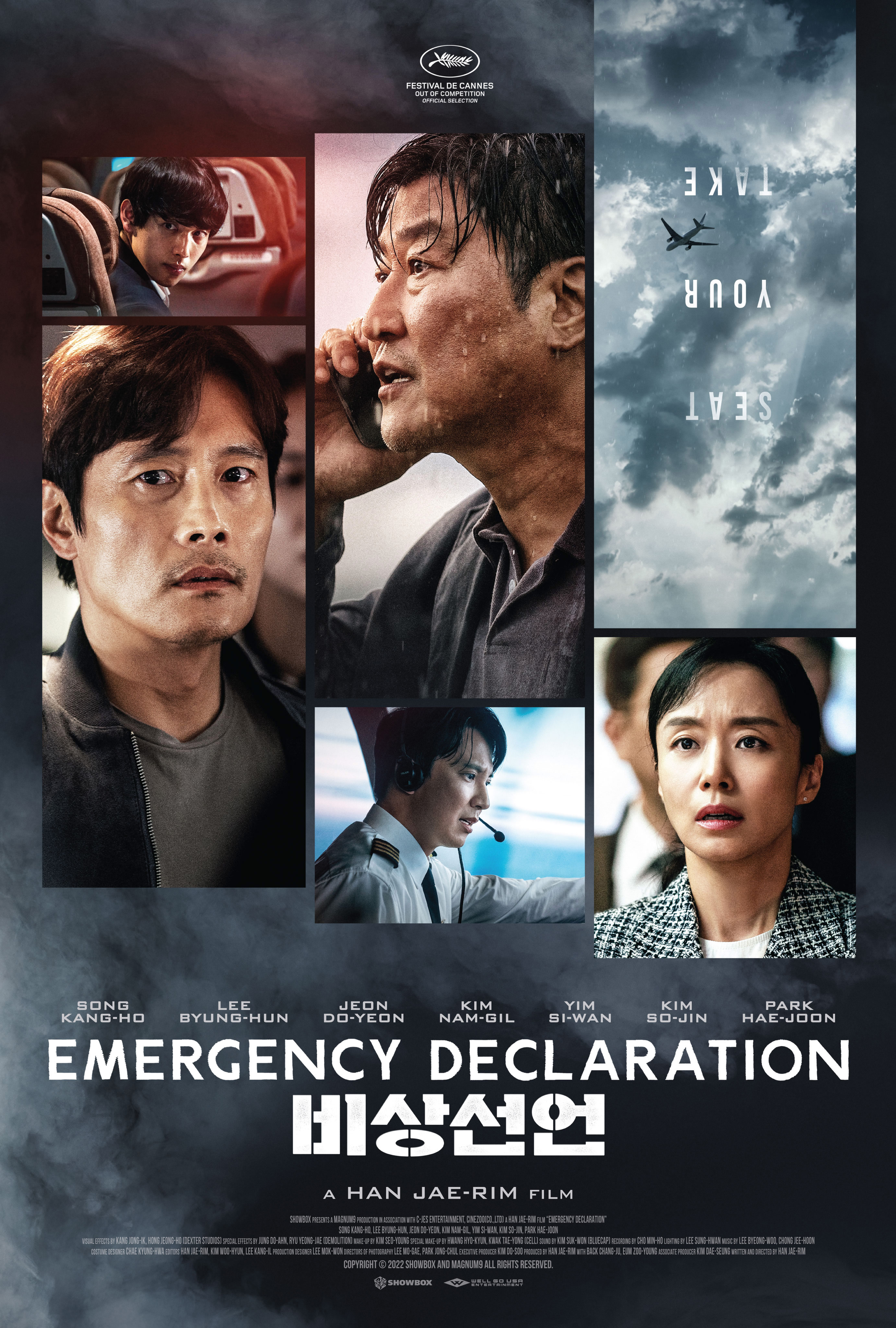
Emergency Declaration (비상선언, Han Jae-rim, 2021)

“Disasters are arbitrary” admits a pundit commenting on a potential air disaster, “people became victims for being in a certain place at a certain time”. “We were caught in a disaster that none of us wanted” the pilot later echoes while explaining that they have chosen to exercise what little control is left to them in making their own decision as to how they intend to deal with the hand that fate has dealt them. Han Jae-rim’s Emergency Declaration (비상선언, Bisang Seoneon) harks back to classic disaster pictures of the 1970s such as genre archetype Airport but also meditates on Korea’s place in the contemporary global order along with the rights and wrongs of exercising one’s own judgement when it goes against all practical advice. 

The disaster in this case begins with a mad scientist, Ryu (Im Si-wan), who decides to kill as many people as possible along with himself by releasing a deadly virus he tweaked to make even more lethal aboard a commercial airliner. Later it’s suggested that Ryu had some kind of breakdown after the death of his mother, also a microbiologist, who had a domineering influence on his life which does seem to play into an uncomfortable trope of blaming the mother for everything that goes wrong with a child though Ryu’s resentment is in part towards the pharmaceuticals company he claims fired him unfairly. As in many recent Korean films, a strong undercurrent of anti-Americanism runs throughout, the international pharmaceuticals company with an American CEO refusing to assist the Korean police’s inquires not wishing to admit that they illegally procured a deadly virus from the Middle East and then allowed Ryu to get hold of it illicitly. This also of course means that they are slow to grant access to a potential antidote/vaccine despite carrying both. Meanwhile, the plane is later turned back from Honolulu and prohibited from landing anywhere on US territory because of the uncertainty surrounding the infected on board. 

The plane in effect becomes a kind of plague ship that takes on additional significance during an era of pandemic. Having been rejected by the US, the plane tries to land in Japan but is also refused permission and later threatened by the Japanese Self Defence Forces who even open fire on it and threaten to shoot the plane down if it does not leave Japanese airspace. The official response is more nuanced than it had been with the Americans, a politician expressing his regret and sympathy with the people of Korea but also emphasising that their responsibility is towards the people of Japan and that as they cannot be sure the treatment will work on Ryu’s mutated variant, they cannot allow the plane to land. As the opening titles explain, an Emergency Declaration is a sacred aviation rule that means no one should be refusing them help, yet they do begging the question of what it really means if in the end the authorities can just choose to ignore it. 

But then again, it seems that not even Korea is fully onboard with accepting the plane back onto Korean soil. With news quickly spreading via social media, mass protests erupt from those who brand it a “biochemical missile” and would rather it be shot down than risk contaminating the wider population while counterprotests insist that there are many Korean people onboard and it’s only right that they be allowed to return home and be cared for by the authorities. The authorities are however torn, unwilling to admit they’re considering simply allowing 150 people to die for the greater good leaving only the Transport Minister (Jeon Do-yeon) to exercise her own judgement in arguing for the plane landing with quarantine procedures in place. 

Former pilot Jae-hyuk (Lee Byung-hun), a passenger on the flight with his little girl who suffers from eczema, is later tasked with exercising his own judgement in deciding whether to land the plane at a closer airport he feels is safer or try to hold out until the destination recommended by the authorities despite dwindling fuel supplies. The plane disaster is Jae-hyuk’s redemption arc allowing him to overcome past trauma in having made a similar decision before which led to the deaths of two cabin crew thanks to the selfishness of passengers who blocked exits trying to retrieve their luggage before escaping. One thing that wasn’t so much of an issue in the ’70s is that passengers are now able to receive information in real time via their phones thanks to onboard wireless, meaning that they learn all about the virus, the cure, and that the cure might not work independently giving rise to even more chaos and confusion and presenting a serious threat to traditional disaster management techniques. Nevertheless, they too eventually exercise their own judgement in coming to the conclusion that perhaps it is better if they choose not to land rather than risk infecting their friends and family.

The passengers on the plane do not blame those on the ground accepting that they are simply afraid. “You can’t just save yourselves” a particularly paranoid passenger is fond of saying completely oblivious to the fact that’s what he’s been trying to do with a pointless insistence in segregating the infected aboard a plane that exclusively uses recycled air only to completely reverse his thinking on hearing the plane may make an emergency landing in which case the rear of the plane, where the infected are, is safer. It is in the end a radical act of self-sacrifice by a policeman on the ground (Song Kang-ho) that paves the way to a happier solution for all but could just as easily have turned out differently. Disasters are arbitrary after all, at least as long as you aren’t the one causing them. Counterintuitively, the message may be that your government might not help you and others certainly won’t, but if you’re making your own emergency declaration you have the right to exercise your own judgement in the knowledge that either way you’ll have to answer for your decision.  


Emergency Declaration is released in the US on Digital, Blu-ray, and DVD on Nov. 29 courtesy of Well Go USA.

Clip (English subtitles)

A Lonely Island in the Distant Sea (절해고도, Kim Mi-young, 2021)

A dejected artist finds himself reconsidering his life’s choices when his teenage daughter drops out of education to become a Buddhist nun and he falls in love with a forthright professor in Kim Mi-young’s contemplative drama, A Lonely Island in the Distant Sea (절해고도, Jeolhaegodo). Though the title could easily enough refer to the hero himself, it echoes the sense of impossible longing symbolised by an island he could see but did not travel to though there was no real reason preventing him save his own feelings. In any case, the island and the day on which he saw it have become lodged in his memory as a nostalgic image of irresolvable desire. 

Now in early middle-age, Yun-cheol (Park Jong-hwan) is an unsuccessful sculptor who feels he has failed to live up to the promise of his youth and mainly earns his keep through commercial work such as crafting replicas of the solar system for a local museum. Divorced from his workaholic wife, he’s called in by his daughter Gina’s (Lee Yeon) school when they object to some admittedly disturbing artwork she had drawn on a series of roller blinds without permission. Yun-cheol is less concerned with the fact the paintings suggest that Gina is experiencing some kind of mental anguish than the school’s reaction to them, her teacher admitting that they took the blinds out and burned them. His anger is directed towards their wilful destruction of a work of art because it seemed to them more akin to vandalism or destruction of their property. Describing Gina as “mean”, they imply that they will ask her to leave suggesting that she would benefit from a different environment. In many ways that’s how Gina feels too, eventually revealing that she has decided to leave education altogether and later giving up her art to practice Buddhism. 

It’s the idea of abandoning her obvious talent that Yun-cheol struggles to understand. As a young man, he’d also considered becoming a monk or even a Catholic priest as, as he describes it, “safe paths for lost souls” if he failed to realise his ambitions of becoming an artist. Discovering that his daughter had had the same dilemma, even if she took a different path, shakes his sense of self in realising that his internal conflict was not unique. While trying to understand Gina’s desire to renounce the world, he begins to fall in love with a free spirited professor and cancer survivor but Ji-young (Kang Kyung-heon) is not prepared to wait around for him to sort himself out on his own and is quickly tired of his tendency to retreat into isolation rather than face his problems. Having learned only half a lesson, he later moves into Gina’s retreat where he is eventually asked to leave by the head nun bluntly who tells him that he is not suited for the monastic life. 

It may be that Yun-cheol exists outside of regular society because of his unusual upbringing in a mountain shack with his similarly isolated father, yet he struggles with himself and his relationship to art while seemingly unable to build lasting relationships with people as if they too were islands in a distant sea he could only gaze at from afar. He tells his daughter he would never abandon her in the way his mother had him but in a sense he might have done so in having lost the will to live amid his intense loneliness and lack of artistic fulfilment. Nevertheless, his growth comes in a kind of acceptance in acknowledging Gina’s choice to become a nun along with Ji-young’s declining heath and desire for isolation. 

When he had first met her, Yun-cheol had responded to Ji-young’s lecture about a would-be-revolutionary who did not go through with his cause by asking her why he would seek to implode the world in which he lived though this is the same thing Yun-cheol eventually does in his own mini-revolution choosing new paths in middle age whether in fear and regret or in search of possibility. A mystical meeting with a maternal wild boar helps to give him clarity though it seems he is forever destined to be a lonely island looking out at a distant sea filled with an unanswerable longing.


A Lonely Island in the Distant Sea screened as part of this year’s London Korean Film Festival.

Original trailer (no subtitles)

Hot Blooded (뜨거운 피, Cheon Myeong-kwan, 2022)

A dejected gangster decides to take the chance on a different kind of life but is soon pulled back into internecine underworld conflict where humanity is weakness and the only prize is a lonely hegemony in Cheon Myeong-kwan’s ‘90s-set thriller, Hot Blooded (뜨거운 피, Ddeugeoun Pi). As much about fathers and sons as it is about uneasy brotherhood, Choi’s adaptation of the novel by Kim Un-su harks back to the classic gangster picture in which the hero proves too noble for his surroundings and finds a single act of compassion provoking nothing more than chaos and misery. 

In the small enclave of Kuam, Busan, Hee-su (Jung Woo) is a petty foot soldier on the cusp of turning 40 who is becoming tired of this way of life. Loyal to his boss, Son (Kim Kap-soo), Hee-su is also aware that times are changing and the boss’ tried and tested approach may no longer meet them. When a vicious gangster, Yong-kang (Choi Moo-sung), returns from exile abroad after fleeing to escape a murder charge, gangland equilibrium is suddenly unbalanced not least by his shift into drug dealing that eventually places him at odds with Hee-su’s gang. After defusing a potential turf war, Hee-su decides he wants out and takes up with booze smuggler Yang-dong in the electric slot machine trade hoping to make enough money to open a small hotel on a nearby island with his longterm girlfriend and her adult son Ami (Lee Hong-nae) who has just been released from prison after falling in with a thuggish gang. 

As he eventually realises, Hee-su has merely ended up as a pawn stuck between Son and Nam, the head of a rival outfit trying to muscle in on their territory. His first problem is that his childhood friend, Chul-jin (Ji Seung-hyun), is a liaison for Nam’s gang. Son explains that only by taking out someone like Chul-jin can they start a negotiation with Nam to nix a gang war before it escalates, but Hee-su cannot bring himself to kill his friend while sufficiently unbalanced by his suggestion that he’s being played by Son as to doubt the old man’s advice. We’re given constant reminders that Chul-jin is a father of young children, while Hee-su has no children of his own but is a surrogate father figure to Ami. Effectively brothers, the two men met as orphans at a government facility and it’s clear that Hee-su sees Son as a man to whom he owes a fatherly debt while Chul-jin may not have any loyalty to anyone besides himself even as he claims that all he wants is to live peacefully with his children just as all Hee-su wants is to open his hotel and live with In-sook (Yoon Ji-hye) and Ami in a less violent environment. 

Hee-su’s decision to leave is a kind a of betrayal in itself, born of a desire to break free of the restrictive codes of gangsterdom and be his own man charting his own future but little realising that his life is still ruled by the laws of the underworld. Later someone asks him what it is he wanted to protect. All he can say is that there was something once, but he’s forgotten what it was. In leaving his gangster family he unwittingly destroys his dreams of forging his own, robbed of the more peaceful life he dreamed of by the chaos and violence of the underworld. The irony is that everyone describes Kuam as a “shithole”, a moribund small-town where even the casino hotel craze which is the centre of the gangster economy may be on its way out. Hee-su can’t really understand why they’re having a turf war over a place no one wants, only to realise it’s just a smokescreen to disguise what it is that’s really worth having and why. 

A late existential speech makes plain Hee-su’s predicament in Yang-kang’s logic that men like him fall to the depths of hell or become kings of all they survey. Yet for Hee-su it’s all much the same, rendered lonely by everything he’s lost while achieving the success craved by so many that is the opposite of what he wanted. It turns out Son may have had a point, the reason he survived so long was his ability to keep calm and play the long game. Hot-headed revenge is a luxury a gangster can’t afford as Hee-su finds out to his cost. “Fathers are all powerless” Chul-jin tries to tell him, though there’s something left of the old Hee-su in his final act of letting a man who betrayed him go because he’s the last in the boss’ bloodline potentially sealing his own fate in some far off act of vengeance. Very much a classic gangster drama in which a noble foot soldier finds himself torn by conflicting loyalties, Hot Blooded proceeds with a weary fatalism leaving its hero a coldblooded ghost which might be a fitting end for a man who once tried to make his fortune selling fake hot peppers.


Hot Blooded screened as part of this year’s London Korean Film Festival.

Original trailer (English subtitles)

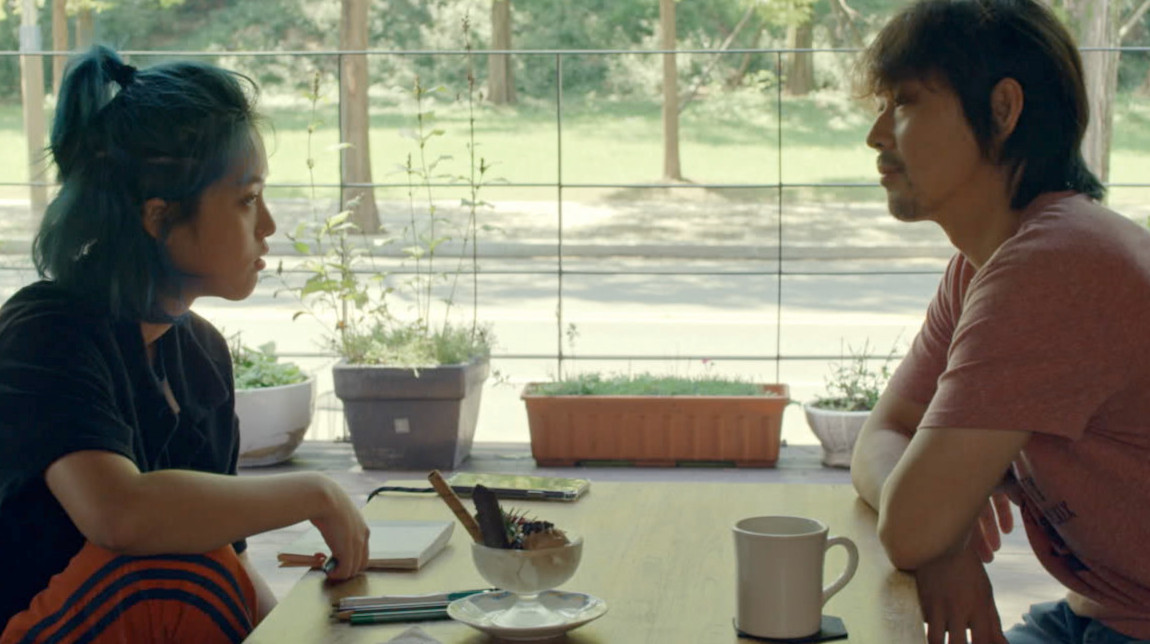
Walk Up (탑, Hong Sang-soo, 2022)

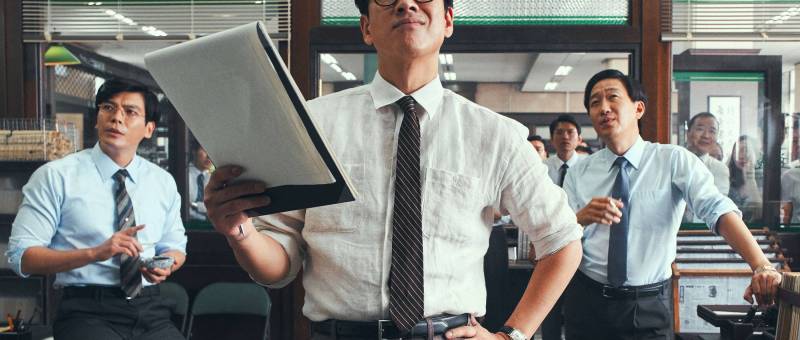
“Really all of us are like that. We’re different when we go out” an older woman tries to console, ”you want to believe that the person you see at home is the real him”. The second remark may come out more cuttingly than she means it, unsubtly suggesting that really you never know anyone and the intimacy you might believe exists within a family is just a performance. The director at the centre of Hong Sang-soo’s Walk Up (탑, tab) is indeed several different people with several different women across multiple floors of a small building owned by an old friend, Mrs Kim (Lee Hye-young), with whom he repeatedly checks in across the space of several years. 

Distance does seem to define Byungsoo’s (Kwon Hae-hyo) existence. When he turns up at Mrs Kim’s the first time, it’s with his daughter, Jung-soo (Park Mi-so), whom he later reveals he had not seen for five years. Jung-soo is there trying to make a connection, hoping Mrs Kim will take her on as an apprentice interior designer having experienced a moment of crisis on leaving art school and discovering that “art has nothing to do with money”. That’s also a problem that repeatedly plagues Byungsoo. During their conversation he’s called away to a meeting with a film producer, and later reveals that a project has fallen through after the funding was pulled at the last minute. Byungsoo embarks on a small rant about the commercialisation of the film industry in which artistic decisions are overruled by investors and no one really cares anymore about whether the film is any good only if it’s going to make money. 

Jungsoo had described her father as “feminine” and “domesticated” during her early childhood before her parents’ divorce, explaining that he seemed to change after his film career took off. Where once he’d been content to spend time a home, suddenly he was out all the time partying with actresses. Jungsoo seems to regard this personality shift as a kind of betrayal, hurt by Mrs Kim’s suggestion that Byungsoo may have been repressing himself at home and the “real” Byungsoo was the one who liked to go out on the town. Then again, people can be many things at once and perhaps there’s no one “real” Byungsoo so much as there’s the Byungsoo of the moment. Sunhee (Song Seon-mi), another failed painter who now runs a restaurant on the second floor, panders to his wounded ego repeatedly telling him how much she likes his films, though mostly for the things they’re not, and that she hopes that he will go on making films for many years to come. 

But it’s obvious that Byungsoo is deeply insecure, eventually drifting into an affair with Sunhee and living with her in the second floor apartment having taken a break from filmmaking due to ill health. He bristles when she tells him she’s going to visit a friend who slighted him on a previous occasion and tries to guilt her into not going, repeatedly texting her while she’s out to a degree that seems uncomfortably possessive and controlling. Yet he eventually ends up hugging his pillow and admitting to himself that perhaps he’s no good at relationships and deep down gets along better on his own. Even so, he later ends up with a third woman, an estate agent, who brings him wild ginseng to help with his health worries while he moves up to the studenty top floor flat which while barely big enough to turn around in comes with a spacious roofgarden. By this point his relationship with Mrs Kim, who basically begged him to move in when he first visited with Jungsoo, has clearly become strained, she perhaps also a little hurt in appearing to have carried a torch for him while hinting at feeling trapped in an unsatisfying marriage as the building itself continues on a course of disrepair. 

Mrs Kim too appears to have differing personas as she shuffles between the floors of the building she owns while each of the episodes replays with only slight differences and subject to the consequences of the last. Failed artists moving to Jeju to start again becomes a repeated theme, though it’s as if Byungsoo is resisting the pattern, talking of buying a dog with Sunhee when they relocate but then putting it off for another three years while they save money. By the time he’s made it to the top floor it’s like he’s hit rock bottom, raving about a vision from God telling him to move to Jeju and make 12 films while still ostensibly on an extended break from filmmaking. Shooting once again in a crisp black and white, Hong finally brings us back to where we came in leading us to wonder how much of what we’ve just seen really happened and how much was just a kind of thought experiment created by a bored and insecure director feeling maudlin and trying to figure himself out while his career collapses around his ears. Maybe you have to go up so you can come back down, but it doesn’t seem to leave you any less lonely as the melancholy Byungsoo discovers smoking a solitary cigarette looking up at the house from outside as if trying to decide where exactly he belongs. 


Walk Up screens at Ultrastar Mission Valley on Nov. 9 as part of this year’s San Diego Asian Film Festival.

Trailer

The Novelist’s Film (소설가의 영화, Hong Sang-soo, 2022)

Once again in a meta mood, Hong Sang-soo’s The Novelist’s Film (소설가의 영화, Soseolgaui Yeonghwa) seems to be peopled by those who’ve already given up. The heroine’s friend has given up her writing career to run a small-town bookshop while she herself is struggling with writer’s block, her friend’s assistant has given up acting to learn sign language, and a movie star she later meets has apparently retired because she doesn’t feel the desire to act anymore. In similar fashion a director declares that some have perceived a shift in his career that leads him to concede that he just doesn’t feel the sense of “compulsion” that used to drive him and his work may have become freer and more authentic as a result. 

As usual, Hong may partly be taking about himself, about his relationship to filmmaking and to his muse Kim Min-hee who is herself given a meta moment when berated by the director, Park (Kwon Hae-hyo), who tells her that her decision to retire is a “waste” of her talent only to be shouted at by blocked novelist Junhee (Lee Hye-young) who is hoping to make a film in order to rejuvenate her creative mojo. Junhee tells Park in no uncertain terms that Kilsoo is not a child and if this is the choice she’s made he ought to respect it, circling back to the offensiveness of the word “waste” and its various implications. The situation is so awkward that it leads Park’s wife to leave it all together, but it’s true enough that after this outburst Junhee seems to find a more comfortable relationship with Kilsoo than with any of her old acquaintances as they bond in mutual admiration and shared creative endeavour. 

It’s with a sense of tension that the film opens, Junhee venturing into the bookshop run by an old friend (Seo Young-hwa) only overhear a heated argument between her friend and a younger assistant, Hyunwoo. As so often with Hong the nature of the relationship is unclear, the argument intimate in quality not really the kind one has with an employee or casual acquaintance and so awkward that Junhee decides to wait outside until it’s over. In any case, Junhee’s manner even with the friend she’s deliberately tracked down and come to see is somewhat accusatory and passive aggressive as if hurt by her friend’s decision to abruptly drop out of contact apparently having given up writing and intending to cut herself off from her city life in its entirety.

Her encounter with the director is similar in that she seems clearly annoyed with him, firstly pretending not to recognise his wife then accusing of them of deliberately hiding from her at a popular tourist attraction. Picking up on the vibes, he asks her if she’s still upset with him over a project to adapt one of her novels that fell through. She says she isn’t but is obviously annoyed about something while his wife elaborates on his creative process and the ways she thinks he and it have changed. Then again the wife is also a little strange, introducing herself to Kilsoo, whom they’ve randomly bumped into in a park, as someone who lives with director Park rather than as his wife answering Kilsoo’s question of how long she’s lived with him with a very matter of fact 30 years. Junhee is similarly vague about the extent of her relationship with an ageing poet and former drinking buddy (Gi Ju-bong) with whom she had herself lost touch or perhaps partially ghosted when his interest turned romantic. We hear brief snippets about Kilsoo’s personal life, an allusion to scandal and drinking problem but never see her offscreen husband, only his filmmaker nephew (Ha Seong-guk). 

Yet the the serendipitous connection between Kilsoo and Junhee allows each of them to reignite their creative spark while generating an unexpected friendship. The film novelist envisions is scripted but intended to capture something of Kilsoo as she is while ostensibly playing a character, exposing the reality of the vague relationships by cutting through artifice to the truth. In another series of meta comments, the poet reminds her she needs a hook to draw the audience in but she simply tells him she’ll figure that bit out later because the story is in its way irrelevant. “He writes what he lives” she later says of him, a little dismissively. In any case, the film she makes takes on another meta quality, Hong himself perhaps behind a camera as Kim Min-hee and another woman gather flowers eventually ending with a mutual declaration of love and a sudden burst of colour in what has been a static and monochrome affair which hints at the sense of freedom and comfort Hong like the director may have found in new artistic connection. 


The Novelist’s Film screens at Ultrastar Mission Valley on Nov. 4/7 as part of this year’s San Diego Asian Film Festival.

US release trailer (English subtitles)

Hunt (헌트, Lee Jung-jae, 2022)

“How long can you fight violence with violence?” one accidental ally asks another towards the conclusion of actor and star Lee Jung-jae’s 80s-set directorial debut, Hunt (헌트). As the title implies, this is a story of two men stalking each other but also each ironic representatives of an ideological divide both seeking a better future while torn between violent overthrow and peaceful revolution in the dying days of a Cold War in what could be termed its ground zero. 

As the film opens, the South Korean president, a stand-in for an unnamed Chun Doo-hwan, faces mass protest from local Korean-American democracy activists on return to his hotel while on a diplomatic visit to Washington. His security team is itself somewhat compromised in that it is a joint operation between foreign and domestic intelligence teams neither of which have must trust in the other. When it’s discovered that a plot is underway to assassinate the president, foreign intelligence chief Park (Lee Jung-jae) is taken hostage but insists on capturing the suspect only for domestic chief Kim (Jung Woo-sung) to abruptly shoot him, leading Park to wonder if Kim did it to keep him quiet rather than simply to neutralise an immediate threat. Assuming North Korea is most likely behind the plot, each begins to suspect the other is a mysterious double agent known as Donglim. 

What soon becomes apparent is that the two men, the domestic and the foreign, are being pitted against each other by the questionable authority that is the Chun regime. Recently promoted from the military, Kim had in fact instigated Park’s torture in the immediate aftermath of the assassination of the previous president, also a military dictator, Park Chung-hee. Both men appear to be conflicted in their association with an authoritarian government in the wake of widespread state violence including the brutal suppression of the Gwangju Uprising in May 1980. Nevertheless, both are party to acts of torture many of them enacted on teenage democracy activists they routinely smear as communists. 

In short, no one could really blame anyone who wanted to overthrow this brutal regime but as oppressive as it is, it’s also backed by the Americans who would rather keep Chun in power than risk the students’ wishes that the American military pull out of Korea coming to fruition lest it lead to a similar situation in Okinawa, which had only returned to Japanese sovereignty a decade earlier, undermining their ongoing foreign policy goals in Asia. If there is one clear villain, aside from Chun, it’s the shady the international order that is content to watch authoritarian leaders enact violence on their people when it supports their own interests. Nevertheless, it’s also true that Park and Kim’s personal vendetta sparks major diplomatic incidents in two sovereign nations which in any other case would seem primed to turn this cold war hot.

What emerges is a cat and mouse game in which each attempts to unmask the other while on increasingly unstable ground unable even to rely on support from their superiors who in any case answer directly to Chun. It seems there are several factions who would like to unseat him even if they do not necessarily object to authoritarian rule only to persistent state violence against citizens who are more often than not mere children. The differences between Park and Kim are ideological in more ways than one, torn between the belief that only violence can free them from violence and the desire to seek a better solution but each agreeing that assassination is the only viable path to deposing Chun and ushering in a better future despite the failure of the assassination of the previous president to do the same . 

Anchored by strong performances from veteran actors Lee Jung-jae and Jung Woo-sung, the film also features a host of cameos from some of the nation’s top stars including Hwang Jung-min as a manic North Korean airforce defector and Lee Sung-min in a small but pivotal role as a Korean-Japanese asset. With notably high production values and truly astonishing action sequences, Lee excels in capturing the paranoid atmosphere of the conspiracy thriller and an almost unbearable tension between its twin protagonists who will later discover that they are quite literally on the same bus even if they have very different destinations in mind. 


Hunt screened as the opening night gala of this year’s London East Asian Film Festival and arrives in UK cinemas/digital on 4th November courtesy of Altitude Films.

UK release trailer (English subtitles)

The Roundup (범죄도시 2, Lee Sang-yong, 2022)

Force of justice Ma Seok-do returns five years after The Outlaws to right more wrongs in jet-setting action comedy, The Roundup (범죄도시 2, Beomjoidosi 2). By this stage in his career, actor Ma Dong-seok has succeeded in creating a persona for himself as a loveable bruiser whose violence is just a way of being and always in service of a greater good. These are qualities very much in play as Seok-do (Ma Dong-seok) finds himself defending the interests of Korean citizens abroad against crooks the cops failed to catch at home.

Seok-do is however in the dog house for being accused of using excessive force in the papers after neutralising a hostage incident in a convenience store. To keep him off the front pages, the higher ups decide to send him on a mini mission abroad bringing home a Korean fugitive who has apparently turned himself in to the Vietnamese authorities. Given that this is quite an odd thing to do and the criminal’s explanation that he was suddenly overcome with guilt and wanted to repay his debt to society doesn’t ring true, Seok-do smells a rat. As he discovers, it all points back to the kidnapping and murder of a rich man’s son by vicious gangster Hae-sang (Son Seok-koo) who preys on unsuspecting tourists. Rather than get the police involved, the boy’s father has decided to hire a bunch of mercenaries to take revenge further destabilising the local underworld in Ho Chi Min City. 

It has to be said that there is something a little uncomfortable in the quasi-nationalist posturing of the film’s central premise. Korea has effectively been exporting crime by allowing dangerous criminals to flee abroad where the law can’t touch them. Korean crooks then make trouble for Korean tourists even if not quite to the extent of Hae-sang, all of which ignores the effects on the local Vietnamese population in concentrating on Korean on Korean crime. At the end of the film it’s even suggested that Korean police officers might be dispatched to other areas of Asia to look after Korean tourists which shows a certain lack of respect for national sovereignties while more or less letting the same police officers off the hook for failing to catch criminals in Korea or address the issues which led to them entering lives of crime. A maverick cop, Seok-do does rather throw his weight around in a foreign country, caring little for protocol and threatening to spark a diplomatic incident every few seconds. 

Then again he is just particularly keen on shutting down Hae-sang and exposing him for his heinous acts, cleaning up a mess that has ended up spilling over abroad. Ironically enough, the bereaved father, Choi (Nam Moon-cheol), maybe a powerful CEO but he made his money loansharking and is pretty much a petty gangster himself so of course he wants personal vengeance once again uncomfortably hiring mercenaries from China. Meanwhile, Seok-do ends up enlisting the help of a formerly undocumented migrant when Choi ends up getting kidnapped himself by a cornered Hae-sang.

In any case, Seok-do more than holds his own against the bloodthirsty villains in a series of well choreographed action sequences culminating in a one-on-one showdown on a bus. Much of Ma’s appeal lies in his effortless ability to take down bad guys which he does a plenty, even dispatching one via escalator to his waiting teammates below. Even so, he knows not to take himself too seriously and is keen to cede screen time to the ensemble allowing a gentle camaraderie to appear among his squad members despite their separation while Seok-do and the Captain are in Vietnam trying to have a covert holiday and the rest of the team are left behind to do regular admin work in the office. Though it may present some rather uncomfortable ideas in a kind of Korean exceptionalism that implies a degree of superiority over and disregard towards other Asian nations, the film is nevertheless a charming retro action comedy and perfect showcase for the charismatic star as his no-nonsense policeman makes a point of slapping down bad guys and fighting international crime while generally living his best life hanging out with similarly justice-orientated buddies. 


The Roundup screens in Amsterdam on 27th October & 4th November as part of this year’s Imagine Fantastic Film Festival.

International trailer (English subtitles)

Decision to Leave (헤어질 결심, Park Chan-wook, 2022)

“I went through hell for you but without you my life would be empty” a fugitive murderer asks an insomniac detective to tell the woman he loves, making his own Decision to Leave (헤어질 결심, Heojil kyolshim) which will in fact be one of many in Park Chan-wook’s achingly romantic noir. Tinged with fatalism, the pursuit of love is also one of death and leads inevitably to a kind of haunting from which there is no real escape though you wouldn’t really want one anyway. 

In any case, the detective Park Hae-joon’s (Park Hae-il) sense of reality is already fracturing under the strain of his incurable insomnia. As he tells his partner, it’s not that he can’t sleep because of his obsessive stakeouts, it’s that he goes on stakeouts because he cannot sleep. Unfortunately for him, there have been relatively few murders lately. He wonders if it’s because of the nice weather, as if homicidal rage were being held in check by the gentle art of picnicking which it has to be said has a strange logic to it. Living apart from his wife who is a nuclear engineer in provincial Ipo, Hae-joon prides himself on being a good policeman and is preoccupied by his failure to catch two suspects currently on the run for a vicious murder. When he’s called to the scene of a dead body lying below a cliff, most are ready to rule it a tragic accident or perhaps a suicide but Hae-joon isn’t so sure especially given the unusual behaviour of the man’s much younger widow, Seo-rae (Tang Wei), who appears almost indifferent to her husband’s death and giggles to herself during an interrogation a habit she later claims is born of nervousness and a lack of confidence in her ability to speak Korean having migrated from China. 

Seo-rae’s Korean is perhaps a little better than she makes out, but still we see her repeating lines from romantic dramas on television, lines she later repeats to Hae-joon, while he wonders if her taste for historical romance has lent her Korean its archaic quality. They are each in a way out of time, she remarking that he strikes her as “dignified” to a degree she didn’t expect in a “modern” man while he ironically tells her that he was drawn to her because like him she liked to look at things directly. Yet there’s nothing at all direct about the mysterious Seo-rae whom he suspects of murdering her husband, and though there might be something unspoken directly understood between them their attempts at communication are always frustrated. Not only is there an ever shifting language barrier, but a mediation through text message and voice note or else through the act of being observed at a distance. As they grow closer, Hae-joon allows Seo-rae to listen to his surveillance tapes recorded as he voyeuristically watched her apartment from the rooftop opposite. She immediately deletes them but later does something similar herself, and is finally undone by her inability to delete a potentially incriminating recording because it has come to mean too much to her. 

The pair are in a sense perfectly matched. Hae-joon’s melancholy wife finally exclaims that he needs murder and violence in order to be happy, while Seo-rae admits that she ends up with terrible men like husband because it would take something extreme such as a murder for a good man like Hae-joon to take notice of her. As the couple dance around each other, Park colours their non-romance with shades of the gothic in the repeated motif of the crow feathers each of them find as they work their way towards the apotheosis of their love. As they say every love story is a ghost story and what is love if not an unsolvable mystery? Hae-joon’s sense of reality is forever in flux, Park playfully dressing Hae-joon’s new team and his old team in similar outfits as he segues between fantasy, reality, and memory while trying to parse out an objective truth. Hae-joon’s tragedy may be that he discovers more than he ought to know but not enough to solve the mystery, destined to be haunted by his unresolved cases and the elusive silhouette of lost love lingering silently in the mists of memory. 


Decision to Leave screened as part of this year’s BFI London Film Festival and is now on general release in US & UK cinemas courtesy of MUBI.

International trailer (English subtitles)

Angae (Mist) by Jung Hoon-hee (1967) which is also the title song for Kim Soo-yong’s 1967 film of the same name.

I am More (모어, Lee Il-ha, 2021)

I am More (모어, More) is as much a mission statement as it is a simple piece of biographical information in Lee Il-ha’s musical documentary following transgender drag artist More. Born in Korea but based in Japan since 2000, Lee’s previous documentaries focused on the position of Zainichi Koreans but with I am More he explores the position of minorities within Korea itself while providing a platform for More to express herself fluently through music and performance art. 

More describes herself as having a love hate relationship with drag which she has been performing for over 20 years in the bars and clubs of Itaewon. She relates that she still has a gun in her heart and that going to perform is like going on duty while throwing shade on the Western customers at her bar and their $1 tips. Even so, drag was a liberating experience for her on arriving in the city in which attitudes towards gender norms were much stricter than they had been in the small town where she grew up even if they had not exactly been much warmer there. Embarking on her studies at Seoul University of the Arts, a fellow student punched her in the face and told her to lose her feminity while when forced to do military service she was briefly placed in a mental hospital. 

More’s warmhearted and completely accepting mother claims that there was no bullying during More’s childhood and that nobody thought much of her atypical gender presentation, but More also reveals that she once tried to take her own life during high school but survived and in fact went straight to an exam to avoid getting in trouble for missing classes. Her teacher also recalls another student whom he describes as “effeminate” and apologises for the way they were treated by their classmates while More seems to have developed a friendship with one of the bullies who tormented her but also showed her kindness. He reflects on the various ways their perspective was “limited” by their small-town upbringing remembering how small he felt on going to the city and realising he was no longer at the top of the social hierarchy. 

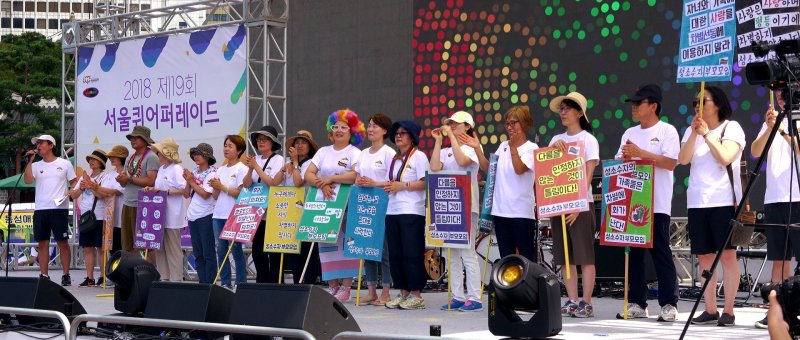
The situation may be very different than it was during More’s childhood, but the LGBTQ+ community still faces prejudice and discrimination from religious groups who are seen protesting pride events and harassing attendees while a patriotic song from the era of dictatorship singing of “our Korea” ironically plays in the background. More is in a longterm relationship with a Russian man, Zhenya, whose immigration status is precarious as he is stuck on a job seeker’s visa. Same sex marriage is not recognised in Korea meaning that he is unable to apply as a spouse and is in the midst of trying to gain Korean citizenship. Meanwhile despite having a PhD in chemistry he is currently unemployed and losing himself in the comparatively tranquil world of Pokémon Go where he says the monsters are kinder than people. Though they have been together a long time, some of it on and off as Zhenya later implies, Lee follows More as she introduces Zhenya to her parents who welcome him with open arms and make sure to invite him to all the major celebrations as More’s partner seeing as he obviously has no other family in Korea to spend them with. 

Meanwhile, Lee spends much of the documentary focussing on More’s rehearsals for a show in New York celebrating the 50th anniversary of Stonewall during which she develops a friendship with Hedwig and the Angry Inch star John Cameron Mitchell who later travels to Korea and remarks on how difficult it can be to be yourself in a conformist society where individuality can sometimes be read as selfishness. Hedwig in a sense brings things full circle with a reference back to More’s own Wig in a Box moment discovering drag in Itaewon while Lee is careful to give her her own space to express herself as she lip syncs to iconic pop songs and performs poetry and performance art in elaborate outfits at Seoul landmarks as if beckoning towards a new and more inclusive culture. A vibrant portrait of a queer artist who is absolutely herself I am More more than lives up to its name in its electric advocation for a world of love and joy. 


I am More screened as part of this year’s New York Asian Film Festival. It will also be screening in London on 13th November as part of this year’s London Korean Film Festival.

Festival trailer (dialogue free)

Though the film’s subtitles refer to More as “he”, she has confirmed with festival organisers that she prefers feminine pronouns.

Images: ⓒ2021 EXPOSED FILM, All Rights Reserved