The Sea Knows (玄海灘은 알고 있다 / 현해탄은 알고 있다, Kim Ki-young, 1961)

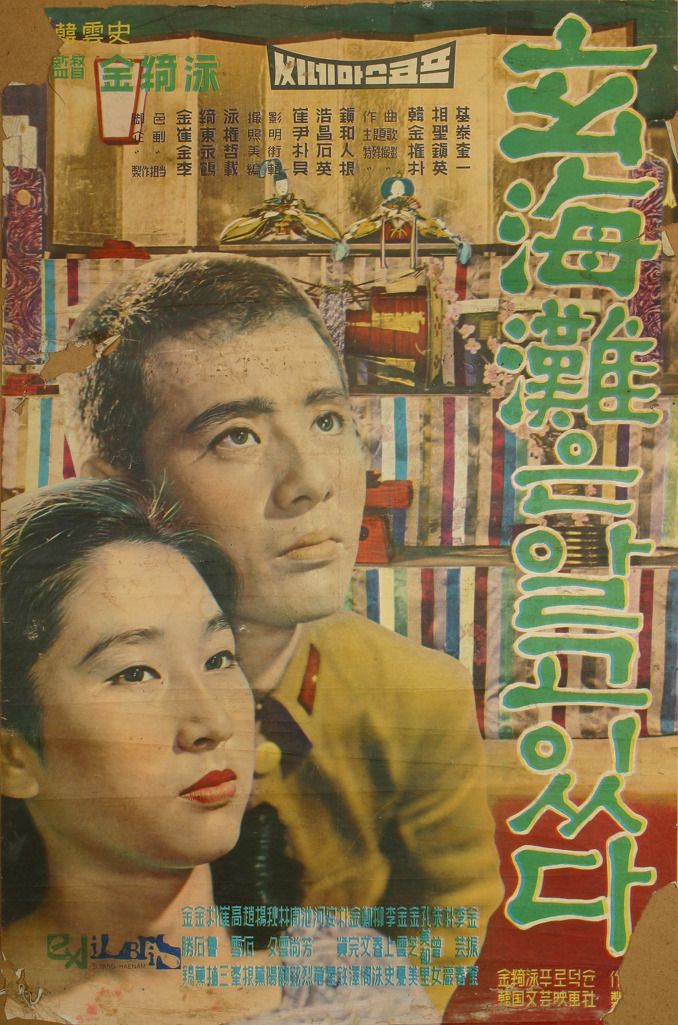
The Sea Knows posterThe Korea of 1961 was a land in flux. The corrupt regime of Rhee Syngman had been brought to its knees following mass protests regarding the rigged 1960 elections but hopes for a new democracy were cut short when military General Park Chung-hee staged a coup, later declaring himself president for life and continuing his authoritarian rule until he was assassinated by one of his own subordinates. Kim Ki-young’s The Sea Knows (玄海灘은 알고 있다 / 현해탄은 알고 있다, Hyeonhaetaneun Algoitta) arrived perhaps at just the right time, ducking under the radar before the Motion Picture Law of 1962 would forever change the industry and if not prevent at least frustrate any attempt to discuss the controversial themes at the heart of Kim’s drama. The Sea Knows is, like much of Kim’s work, a tale of power and desire only this time on a wider scale as he examines the complicated relationship between Korea and Japan as mediated through romantic melodrama.

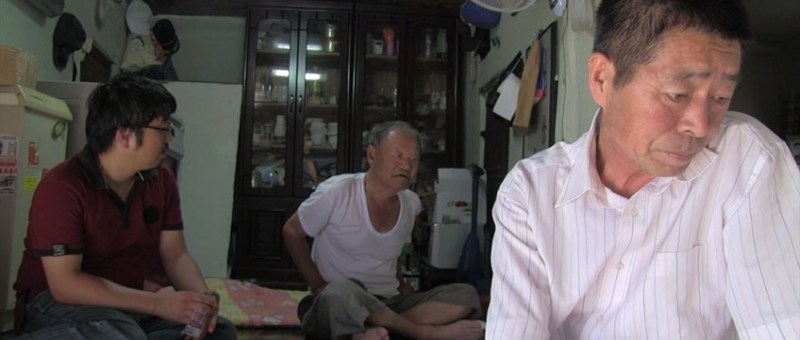
We open in 1944. Korean student Aro-un (Kim Wun-ha) has been conscripted into the Japanese army following an incident in which he embarrassed a high-ranking official (something which has made him a local hero at home). Despite the fact that Korea has been inducted into the Japanese empire and Koreans are now sons of the emperor too, the regular Japanese troops are not exactly grateful for service of their brethren from across the sea. Koreans are a pain, they decry. They’re always going on about justice and fairness. They won’t just shut up and take their lumps like regular Japanese soldiers. The “50 year tradition” of the Japanese army is to break the will of new recruits through violence, strip them of their individuality, and reduce them to a finely tuned hive mind.

Needless to say, Aro-un is not eager to comply. There’s a strong strain of homoeroticism in the strangely camp banter between the higher-ups. At the first inspection the commanding officer takes a good look at Aro-un, decides he resembles a “cute puppy” and recommends he come to his room to get some “biscuits”. Meanwhile a particularly sadistic NCO, Mori (Lee Ye-chun), pinches the chest of Aro-run’s judo champion friend Inoue (Lee Sang-sa) and decides he’ll not be an easy target – unlike the short and wiry Aro-un who is too righteous to know what’s good for him. Mori, an insecure and under qualified NCO, makes use of men like Aro-un to entrench his own position through the “50 year tradition” of military discipline. The humiliations mount until Aro-un is forced to lick Mori’s excrement encrusted boots in punishment for having failed to polish them to his satisfaction.

Yet, unlike in the majority of Korean films dealing with war and occupation, the Japanese are not universally bad – there are many just like Aro-un who are uncomfortable with the militarist line and are doing what they can to resist, albeit often passively. Aro-un’s university friend, Nakamura (Kim Jin-kyu), is just such a man, turning down the possibilities of promotion to avoid endorsing the regime while acknowledging that there is little more he can do to free himself from it. It’s through Nakamura that Aro-un meets his own source of salvation in the unlikely figure of a young Japanese woman – Nakamura’s sister Hideko (Gong Midori). Hideko originally betrays the common prejudice against Koreans in claiming that the perpetrators of a nearby robbery were most likely Korean seeing as Koreans can’t get jobs and therefore have no other options than to steal, though in retrospect perhaps her assertions were a more logical comment on poverty and entrenched oppression than they were on racial stereotyping.

Hideko is, as Aro-un later points out, a very unusual Japanese woman. A free spirit, she finds herself drawn to Aro-un and is committed to pursuing a course of true feeling over that laid down by the codes of her society, choosing his sensitivity over the brutalisation of her militarist nation. War, Aro-un muses philosophically, is about the manipulation of the present. Love is about the foundation of a future. Yet there is also something dark and imbalanced even in their otherwise pure romance as each finds themselves becoming a symbol of suffering and violence. Aro-un is drawn to Hideko’s unexpected warmth as she sheds tears for his suffering on hearing of his various degradations, seeing no difference in the tears of a Japanese woman and those of his Korean mother who each felt his pain as their own, but Hideko’s insistence on hearing of his latest humiliations almost takes on a sadistic quality as the pair become bound by suffering as much as by innocent connection.

Kim’s central tenet is a bold one for the increasingly volatile world of 1961, making a case for borderless connection over nationalistic chest thumping and championing the resilience of the human spirit as well as the enduring power of love as a counter to the horrors of war. War is, in another of Aro-un’s philosophical musings, just something that happens to you and makes enemies of those who might have been friends. Making extensive use of stock footage and model shots, Kim plunges Aro-un into a fiery hell from which only love and will can save him. An unexpectedly nuanced but no less harrowing tale of wartime brutalisation and spiritual resistance, The Sea Knows is an impassioned plea for humanity in an inhumane age in which there are no heroes and no villains, only victims and resistors caught in a vast web of power and madness.


The Sea Knows was screened as part of the Korean Cultural Centre’s Korean Film Nights 2018: Rebels with a Cause series. You can also watch it online for free courtesy of the Korean Film Archive’s YouTube channel. The existing print is, however, incomplete and badly damaged – four sequences in which there is picture but no sound or sound but no picture are missing / unsubtitled in the online version but are present in the restoration.
Claire’s Camera (La caméra de Claire / 클레어의 카메라, Hong Sang-soo, 2017)

Claire's Camera poster“I want talk about someone. About a man of 25, at the most. He is a beautiful man who wants to die before being marked by death. You loved him. More than that.” Hong Sang-soo channels Éric Rohmer through the aptly named Claire’s Camera (La caméra de Claire / 클레어의 카메라), but does so through the unexpected prism of Marguerite Duras whose poem is recited in French at the request of a sleazy Korean film director (Jung Jin-young) making a clumsy attempt to pick up the titular Claire (Isabelle Huppert) through an otherwise beautiful act of cross cultural interaction. The poem, like Claire’s polaroids, exists in an uncanny space – someone wants to tell us about a man we once loved as if we never knew him who wants to die before he is changed by death. Like Duras’ landmark exploration of the shock waves of imploding romance, Hong offers us life in fragments as Claire’s polaroids attempt to rewrite a half remembered history in order to make sense of a disordered present.

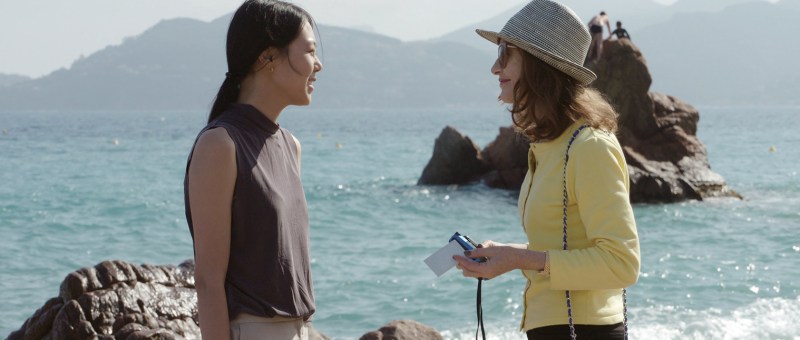
Film sales assist Man-hee (Kim Min-hee) is abruptly fired by her boss, Yang-hye (Chang Mi-hee), right in the middle of the Cannes film festival. Yang-hye offers no real reason why Man-hee has to go save that her perception of her has changed. She no longer feels that Man-hee is an “honest” person and as a person who values “honesty” she no longer feels comfortable working with her. Rather than lick her wounds back in Seoul, Man-hee decides to enjoy the rest of her time in Cannes as a kind of holiday which is how she ends up meeting Claire – an older French woman who is visiting the city for the very first time and has brought along her Polaroid camera to properly record the event.

Claire seems to pop-up here, there, and everywhere, dressed in an old-fashioned detective’s outfit of a stylish trench coat and trilby, snapping away like she’s gathering evidence about an international conspiracy. Striking up an awkward conversation with melancholy womanising film director So eventually brings her into the orbit of the three Koreans who are, we later realise, involved in an embarrassing workplace love triangle. Yet each time Claire appears, her photos don’t make sense – she has a photo of Man-hee wearing her trench coat that we never see her take while her other pictures seem generally out-of-order with the timeline as it has been presented to us.

The only way to change things, Claire intones, is to look at everything again very slowly. Ironically enough she offers the opportunity to do just that by means of instant photography, snapping a still frame of a painful memory in order to ruminate and reconsider. She claims she takes photographs as a means of being in the moment – after all, once you take the photo the subject is no longer the same. The act of being photographed has perhaps changed them, but more than that time has passed and we’re all seconds older now than we were before if perhaps no wiser. Yet looking at the photograph, literally looking at yourself from an external perspective, prompts a reevaluation of the past and perhaps changes the course of the present.

There is also, of course, a meta dimension to all this – as he had in The Day After and On the Beach at Night Alone, Hong muses on his own romantic difficulties in casting his real life love Kim Min-hee as a character with a near identical name while also ensuring that So is even more of a Hong stand-in than his usual leads. Man-hee has been unfairly dismissed because of an indiscretion with the drunken director who has had her fired, by his current girlfriend, out of a sense of embarrassment. Both Yang-hye and So are “shocked” by Claire’s photograph which frames her in a sultry pose wearing (they claim) much more makeup than usual, while So, spotting her at a party, goes into a semi-paternal rage about Man-hee’s (not really all that short) denim hot pants and generally “immodest” appearance. Berating her for a supposed lack of self-confidence, accusing her of “selling herself” and trying to catch the attention of men, So “directs” her to be more authentic. Which is quite something seeing as he is currently dressed in a borrowed tux in order to conform to social expectations.

Authenticity, or more directly “honesty”, becomes a running theme from Yang-hye’s instance that Man-hee is “dishonest” to a young filmmaker’s insistence that it’s hard to make an “honest” film. Claire, at least, seems to be embarking on a process of “honest” art even if nothing she says or does quite adds up. Light and bright and breezy, Claire’s Camera is Hong in Rohmer mode, wistful yet resigned and perhaps even hopeful. There’s a reason everyone seems to be so “reasonable” even in the most unreasonable of situations, other people’s feelings are not something that can be debated and are best accepted even if understood only retrospectively. Claire and her camera seem perfectly aware of that, silently observing in preparation for presenting evidence in a self inquisition, but doing so with kindness even in the knowledge that sometimes it’s easier not to look.


Claire’s Camera was screened as part of a teaser series for the upcoming London Korean Film Festival. The next screening in the series will be Gonjiam: Haunted Asylum at Picturehouse Central on 30th August.

International trailer (English subtitles)

The Vanished (사라진 밤, Lee Chang-hee, 2018) [Fantasia 2018]

The Vanished posterThe past refuses to die in The Vanished (사라진 밤, Sarajin Bam) – Lee Chang-hee’s remake of the 2012 Spanish thriller, The Body. Ghosts, of one sort or another, torment both of our male leads – a dogged policeman and increasingly unhinged husband, as they try to solve the mystery of a disappearing corpse whilst each battling a degree of latent resentment towards various forces of social oppression. A tale of conflicting bids for vengeance, The Vanished pits an emasculated trophy husband against a controlling career woman wife while the forces of order look on in disapproval but then all is not quite as it seems and perhaps this is not the story we first assumed it to be.

The horror-inflected tale begins in a morgue on a rainy night as a disinterested security guard becomes unexpectedly spooked by his surroundings. Discovering one of the trays open and a body missing, the guard panics and feels himself stalked by something undead before being clubbed on the back of the head and knocked out. Maverick cop with a traumatic past Woo Joong-sik (Kim Sang-Kyung) arrives on the scene and discovers the missing cadaver belonged to prominent businesswoman Yoon Seol-hee (Kim Hee-Ae). The cause of death is thought to have been a heart attack brought on by her workaholic lifestyle but Joong-sik isn’t so sure. He hauls in the “trophy husband” – improbably good-looking university professor and sometime employee of Seol-hee’s pharmaceuticals company, Jin-han (Kim Kang-Woo). Jin-han has come straight from the flat of his pregnant mistress and is understandably on edge as every move he makes only further incriminates him in the “death” of his wife.

Increasingly unhinged, Jin-han is certain that Seol-hee is not really dead and has embarked on an elaborate plan of revenge for his affair with a student, Hye-jin (Han Ji-An). Lee wastes no time in confirming that Jin-han had at least intended to do away with his wife. Jin-han was apparently no longer interested in her money and would have wanted a divorce but believed his wife to be a ruthless woman who would never willingly let him go. Using an experimental anaesthesia drug, he hoped to get rid of her undetected but now fears that she has somehow woken up and wants her revenge. What Jin-han wanted, he claims, was his freedom – Seol-hee, an older career woman, bought him with trinkets, belittles his work, and refuses him all agency. He was tired of playing the toy boy and wanted his life back and so he chose to reassert his manhood through murder.

Of course, all is not quite as it seems. Through Joon-sik’s investigations, Jin-han comes to believe that perhaps Seol-hee planned the whole thing – anticipating that he would try to use the drug against her and engineering a situation in which she would fake her own death just to get back at him. Whether a ghost or not, Seol-hee haunts him, threatens his happy future with the sweet and innocent Hye-jin who calls him professor and respects him as a learned man, and seems set to achieve her goal if only by driving Jin-han out of his mind with worry and confusion.

Meanwhile, Joon-sik is battling another series of oppressive presences in the form a grudge against “the wealthy” possibly relating to a mysterious traumatic incident from his past, and a boss who wants him to find the missing body as quickly as possible and then forget the whole thing given the fact that Seol-hee and Jin-han had been a “celebrity couple” which makes all of this quite embarrassing for everyone. The two men end up engaged in a cat and mouse game as Jin-han becomes convinced that he’s the real victim in all this and is at the centre of an elaborate conspiracy leaving his pregnant girlfriend alone and vulnerable, while Joon-sik continues to push him towards confessing that he took the body and hid it possibly in some kind of fugue state.

“The body” is perhaps a better title as the concept itself comes in for constant reappraisal and we gradually understand that not everyone is talking about the same thing, leaving aside the complete erasure of Seol-hee as a woman with a name who may have been murdered by a vengeful husband (as unpleasant as she is later shown to be) in favour of viewing her simply as a nameless corpse or grudge bearing ghost. Twists pile on twists and history rewrites itself, but the buried past will someday be unearthed and justice served, if with a side order of irony.


The Vanished was screened as part of Fantasia International Film Festival 2018.

Original trailer (Korean subtitles only)

Bungee Jumping of Their Own (번지점프를 하다, Kim Dae-seung, 2001)

Bungee Jumping on theie own posterLove is a continuous stream, according to the debut film of Kim Dae-seung, Bungee Jumping of Their Own (번지점프를 하다, Bungee Jump Hada). The title may sound whimsical, but it’s less the physical act of fall and rebound we’re talking about here than a spiritual bounce, souls which spring from one body to another and eventually find their way home. Kim presents eternity as one great confluence and love as an enduring bond which survives not only death and time but transcends existence itself. Love is a spiritual cause, but, as the rather muddy philosophy goes on to suggest, perhaps not so free of social mores as it would like to believe itself to be.

In 1983 university student In-woo (Lee Byung-hun) meets the love of his life, Tae-hee (Lee Eun-ju), as she steals a place under his umbrella during a violent rainstorm. Shy and introverted, In-woo waits at the bus stop where Tae-hee abruptly left him hoping to see her again, finally encountering her by chance on his university campus. Despite his diffidence, the pair eventually become a couple and are very happy together but In-woo will shortly have to leave for his military service. He asks Tae-hee to meet him at the station, waiting once again only to be left alone on the platform as the trains fly by.

Flashforward 17 years to the start of a new millennium and In-woo is now a slick, confident man entering middle-age, married to someone else and with a small daughter of his own. He teaches high school and is the kind of inspirational teacher many dream of being, well-respected by his students for his patience and faith as he remains committed to stand up for them no matter what. In-woo might have thought he’d put the memory of Tae-hee to the back of his mind to go on living, but a strange young man, Hyun-bin (Yeo Hyeon-soo), begins to reawaken in him the buried memory of his first love. Seeing echoes of Tae-hee in the young male student, In-woo finds himself facing several different kinds of social and internal pressures to which he had previously given little thought.

Arriving in 2001, Bungee Jumping of Their Own is (sadly) one of the first “mainstream” films to touch on the theme of homosexuality, only the film itself is quite determined to negate any kind of homosexual reading into its central love affair – it is, after all, not “Hyun-bin” that In-woo is falling in love with, but the reincarnated soul of Tae-hee, which is to say a “female” soul and not a male one. Though Kim’s metaphor of existence as a great river through which love endures across time and societies ought to make gender and the physical body an irrelevance, same-sex love is relegated to an inappropriate absurdity. In a playful conversation about reincarnation in which In-woo and Tae-hee pledge their love to one another, In-woo jokingly asks what would happen if he were too were reincarnated as a girl, to which Tae-hee replies that they’d just have to wait for the next reincarnation. Despite the endurance of their love, it is apparently not viable outside of a traditional male/female pairing and any other iteration is tragedy to which the only solution is suicide and the hope for a quick reincarnation to find each other again in more socially appropriate forms.

Nevertheless, Kim does also do his best to criticise a still conservative society’s prejudice against homosexuality though this too has its problematic elements in unwittingly conflating two issues which ideally speaking are better not conflated. In-woo is a teacher falling in love with a boy who is not only a minor but also his student – a situation clearly inappropriate in any and all circumstances. However, the while the crusty old dinosaurs in the staffroom lament the new liberal society and fear being branded sex pests for leering at the girls, claiming it’s their own fault for “looking like that”, In-woo comes in for an especial level of vitriol targeted not at a pervy teacher but simply at a “gay” man while Hyun-bin is gradually ostracised by his friends simply for being the object of his affection and therefore tarred with the gay brush.

Meanwhile, the conflicted In-woo goes to see a doctor to correct his “sickness” only to be told that his responses indicate a “normal” heterosexual man with that caveat that he should also regard his interest in men as a “normal” part of life. Desperate to not to acknowledge his same-sex desire, In-woo becomes violent towards his wife in an effort to reinforce his masculinity, unwilling to discuss with her the real reasons their marriage has always been hollow – not his possible bisexuality, but that he has only ever loved Tae-hee and will only ever love Tae-hee in whichever form she appears.

In-woo makes a point of teaching his students that “different” does not mean “wrong” but it’s apparently not a lesson he’s able to internalise. Kim plays with dualities, idealises imperfect symmetries, and shows us that things which might seem “different” from one perspective are in essence the same, yet he walks back his message of acceptance to emphasise the importance of conforming to social norms rather than allowing the love between Tae-hee and In-woo to exist in the physical world in any other iteration than male/female. Nevertheless, Kim’s true intention of painting love as a continuous stream made possible by cosmic serendipity is a romantic notion difficult to resist and even if his reasoning proves occasionally hollow he has perhaps opened a door towards a greater understanding.


Bungee Jumping on Their Own was screened as part of the Rebels With a Cause series at the Korean Cultural Centre London.

Original trailer (no subtitles)

I Have a Date with Spring (나와 봄날의 약속, Baek Seung-bin, 2018) [Fantasia 2018]

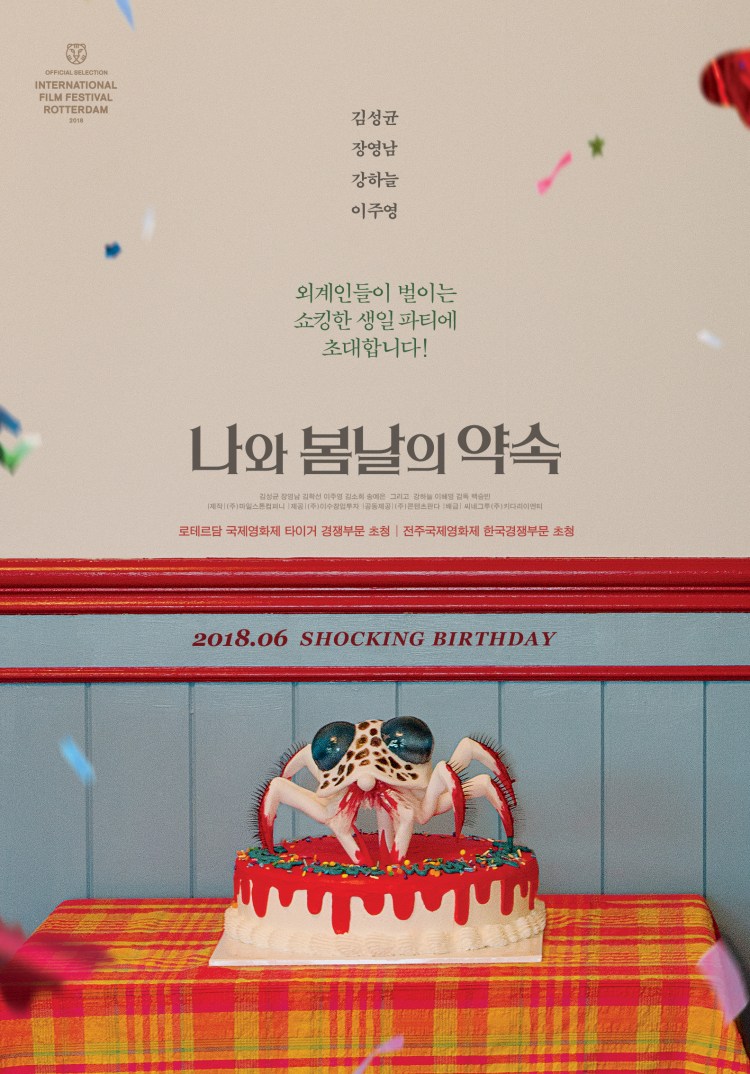
I have a date with springIf the world was going to end tomorrow, which of your many anxieties would you most like to ease before you go? I Have a Date with Spring ( 나와 봄날의 약속, Nawa Bomnalui Yaksok) is, as its name suggests, a hopeful tale despite its apocalyptic pretence as its lonely film director hero learns to accept the looming presence of death in order to move beyond his creative block. He may need aliens and the promise of knowledge from beyond our world to do it, but in contemplating the many ways in which modern life is unsatisfactory, he can perhaps begin to envisage a world in which it might not be so bad to live.

Depressed director Lee Gwi-dong (Kang Ha-Neul) hasn’t made a film in 10 years. The last decade has seen him struggling with the same script, an apocalyptic tale of the end of the world in which three unhappy individuals are visited by omniscient aliens to help them celebrate their birthdays which happen to fall on the day before the Earth will be destroyed. Sitting in a forest on his own birthday, reminding us that he came here to work and not to die, Gwi-dong is shocked to receive a visitation from four mysterious campers, one of whom claims to be a fan of his earlier work.

The picture Gwi-dong (and by extension Baek Seung-bin) paints of modern Korean society is one marked by extreme loneliness and existential isolation. The death obsessed director is currently sporting a large cast on his arm apparently a result of an act of self harm committed in frustration regarding his own sense of disconnection and personal failure. The three “heroes” of his tales within a tale are all also shy, lonely, and increasingly withdrawn, no longer interested in finding escape from their personal imprisonment. A dreamy high school girl longs for the destruction of the world while a middle-aged professor laments his missed opportunities for romance and a harried housewife feels both guilt and regret in remembering she was once the leader of a militant feminist movement back in college.

Each of them is, like Gwi-dong, “celebrating” a birthday but due to their specific personal circumstances they are each celebrating alone as those close to them are either absent or have entirely forgotten. The aliens, not revealing the imminent destruction of the planet, promise each of them something special in return for trust and time but the gifts they deliver are perhaps not altogether welcome despite their original appearance. The lonely high school girl bonds with the middle-aged alien over a shared sense of childish glee in monsters and adventure, relieved simply to hear the word “friend” but still unsure whether she should trust him and follow his instructions. Meanwhile the housewife, ignored at home by her noisy child and indifferent husband, is glad to be recognised once again and have the power of her youth literally returned to her in the form of a gun but remains unsure if she should use it. The professor, on the other hand, is corrupted by his original encounter but grateful for his “mother’s” gift and commits himself to living fully and finding love despite the potential risks.

As the mysterious older lady at the campsite tells Gwi-dong, we’re all doomed anyway so we might as well go nicely, beautifully – if we can. Through each of his various stories, Gwi-dong learns to see the presence of death, the end of all things, as not such a bad thing after all. It will come, bidden not, and so there seems little point in worrying about it now. Suddenly his creative world expands. No longer thinking only of death he conjures hundreds of other universes each filled with their own stories, certain that one day “spring will come”. Oddly optimistic for a film about the end of the world, I Have a Date with Spring makes the case for reaching out in a sometimes cold world even if it risks being devoured by strange space crabs or suddenly developing painful boils (tiny bubbles of love?) all over your body. You have to go sometime, so you might just as well sit back and see what happens. The Earth is a beautiful place, enjoy it while it lasts.


I Have a Date With Spring was screened as part of Fantasia International Film Festival 2018.

International trailer (English captions/subtitles)

Korean Film Nights 2018: Rebels With a Cause

barefooted Youth posterFollowing on from the Novels on Screen season, the Korean Cultural Centre London is back with another series of free film screenings this time themed around those who have dared to defy the social norms of their times.

19th July – Bungee Jumping of Their Own

1024full-bungee-jumping-of-their-own-posterLee Byung-hun stars as a conflicted high school teacher who begins to see echoes of a woman he loved and lost years ago in a male student.

26th July – The Sea Knows

EWBtY1xr1lnEpnQOKim Ki-young recasts the folly of war as a romantic melodrama in which a Korean conscript to the Japanese army receives harsh treatment from his sadistic superior but later falls in love with a Japanese woman.

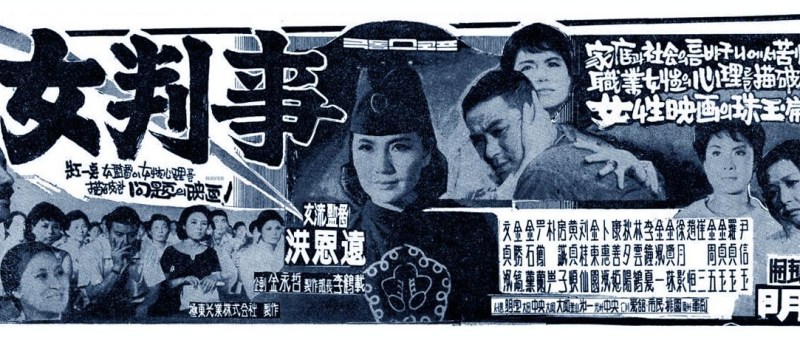
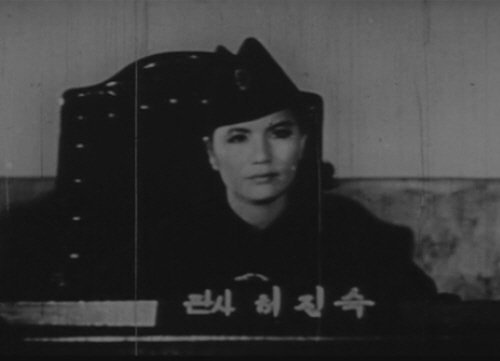
2nd August – A Woman Judge

71d8383407a3d1bec2d8eed51ce3a6eeMoon Jeong-suk stars as a determined young woman hellbent on becoming a judge in defiance of social convention which views marriage and motherhood as the only paths to female success. Encouraged by her father but forced to dodge her mother’s constant attempts to marry her off, she pursues her dream in spite of intense disapproval.

9th August – The Barefooted Young

barefooted Youth stillKim Ki-duk (the old one!) draws inspiration from Ko Nakahira’s Dorodarake no Junjo for a tragic tale of love across the class divide as poor boy Du-su (Shin Seong-il) and Ambassador’s daughter Johanna (Um Aeng-ran) meet by chance and fall in love. Faced with the impossibility of their “pure” love in an “impure world” the pair find themselves an impasse, unable to reconcile their true feelings with the demands of the society in which they live. Review.

16th August – Mandala 

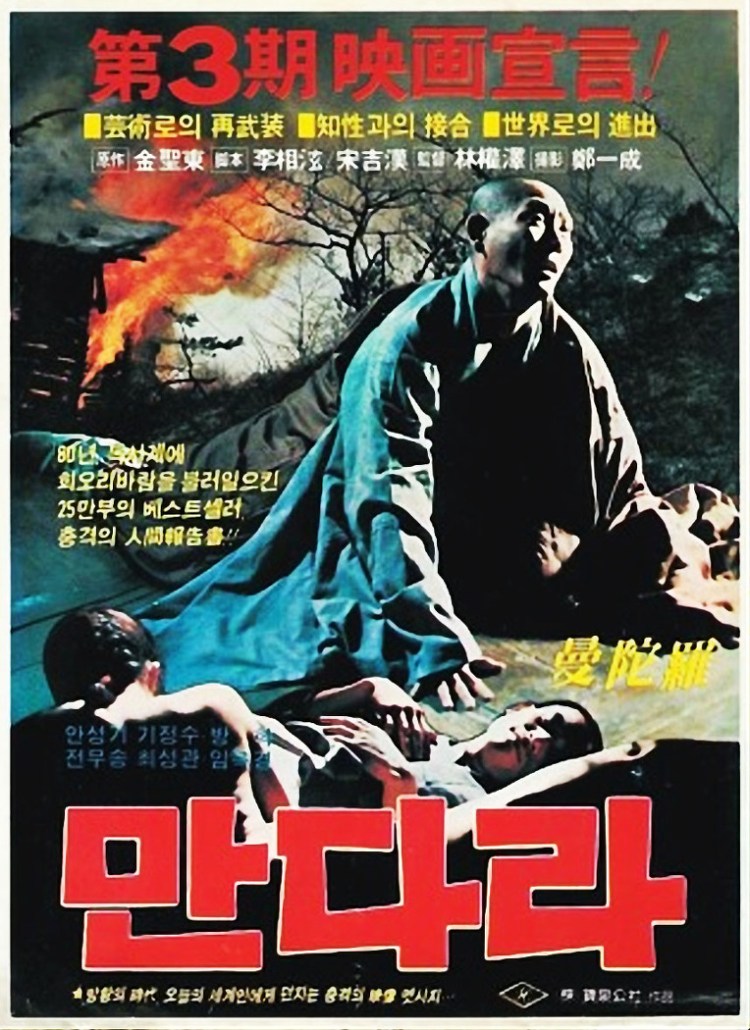
Mandala posterIm Kwon-taek’s “artistic breakthrough” stars Ahn Sung-ki as a young man who has abandoned his girlfriend and university studies to become a Buddhist monk but later meets an older man who indulges all of life’s Earthly pleasures such as wine and women.

23rd August – Black Republic

Black Republic still 1Park Kwang-su revisits the democratisation movement in its immediate aftermath as a student who hides from the authorities in a small mining village finds himself at odds with his environment while haunted by the possibility that his longed for revolution will not come to pass.

The Rebels With a Cause season runs throughout July and August. All screenings are free but must be booked in advance and take place at the Korean Cultural Centre in central London. Reservations are currently open for all the films via the links above. You can keep up to date with all the latest screening news via the Korean Cultural Centre and London Korean Film Festival websites and be sure to follow the festival on TwitterFacebookFlickrInstagram and YouTube channels for the most up to date information.

Tickets are also currently on sale for the latest teaser screening for London Korean Film Festival – Claire’s Camera, at Regent Street Cinema on 23rd July, 7pm. The next teaser in the series has not yet been announced but will take place on 30th August.

After My Death (죄 많은 소녀, Kim Ui-seok, 2017)

After my death posterKorea has one of the highest suicide rates in the world as the pressure cooker society conspires to railroad those who find themselves in someway excluded from its rigourously conformist demands toward inescapable despair. With the phenomenon so common, has it become true that society itself has become inured to its effects, seeking not to ease suffering but to control damage? For the clutch of schoolgirls at the centre of Kim Ui-seok’s After My Death (죄 많은 소녀, Choe Manheun Sonyeo), suicide has taken on its own allure as an escape from the demands they feel themselves unable to meet but there are few looking to guide them away from the abyss rather than to negate their own responsibility for failing to do so.

A high school student, Kyung-min, is missing. Her backpack and shoes have been found near a local bridge and it is feared that she may have committed suicide though there is no note or additional evidence to suggest that she has taken her own life nor have they found a body. With speculation rife, all eyes are on another student, Young-hee (Jeon Yeo-Bin), apparently one of the last people to have seen Kyung-min alive. Though Young-hee and Kyung-min had been good friends in the past, they were no longer close and had apparently run into each other by chance along with another friend of Young-hee’s, Han-sol. Han-sol’s testimony differs from Young-hee’s in that she says Kyung-min seemed “gloomy” and that the evening had taken an intense turn after she suddenly declared her love for Young-hee only for Young-hee to tell her to prove her devotion by dying.

Things get worse for Young-hee when the police track Kyung-min’s movements via CCTV and find footage from a nearby tunnel which appears to show a gentle kiss between the two girls. Hounded, Young-hee finds herself a target of persistent harassment by her school mates who insist that she is in someway cursed and “infects” people with “bad thoughts” while Kyung-min’s mother (Seo Young-hwa) has also started semi-stalking her hoping to find out “the truth” about what happened to Kyung-min.

The other girls, testifying to Kyung-min’s character, reinforce the view that she was “gloomy”, a loner who didn’t fit in. She didn’t like K-pop, didn’t socialise much, and was into depressing things. When suspicions rise regarding her possible suicide, the school is quick to leap to conclusions – that like many in South Korea she had become over anxious about college applications, but as her grades were good and Kyung-min was a diligent student this explanation seems unlikely which works out well for the school. Kyung-min’s teacher quickly goes into damage limitation mode, confirming that she had been withdrawn, struggled to communicate with her classmates, and was probably very lonely though he lays most of the blame on melancholy ‘90s shoegaze which he assumes must have somehow tipped her over the edge. What all of this means is that it’s not his fault, and he feels he has justification for “failing” in his duties of pastoral care towards a student whom by his own admission he suspected of being in distress.

During Young-hee’s questioning, she repeatedly tells the police officer in charge that she too is suicidal and that she told Kyung-min about her own plan to jump off a bridge because she thought it might help. Young-hee is quite clearly depressed even before all of these very difficult events but finds no one willing to listen to her distress, only making herself a magnet for further hostility from just about everyone with even her teacher berating her for stealing Kyung-min’s thunder in insisting that she stole her idea of jumping off the bridge rather than trying to commit suicide through an overdose of sleeping pills which, Young-hee claims, was her intention before she discouraged her lest she end up still alive but brain damaged.

The lingering doubt is to which “me” is the owner of “death” in the title, or to whom the Korean title of “unrighteous girl” might apply. The motives for Kyung-min’s (presumed) death may be beside the point as a policeman investigating the case suggests – perhaps she didn’t want “understanding” so much as oblivion. What we’re left with is a rather poignant love triangle and the suggestion that Young-hee’s intense depression is a result of repressed same sex attraction which opens another series of questions about which acts are “unrighteous” – suicide or love, with the unfortunate implication that perhaps one cannot but lead to the other. In any case, the problem is that all these kids want to die and the adults no longer want to stop them, only to avoid any potential responsibility for what the children in their care may or may not try to do. Melancholy and drenched in despair, After My Death has nothing but sympathy for its lonely teens but finds no possible escape from the crushing vice of a blame fuelled conformist society.


After My Death was screened as part of the New York Asian Film Festival 2018.

Original trailer (English subtitles)

Interview with director Kim Ui-seok from the 2017 Busan International Film Festival (English subtitles)

What a Man Wants (바람 바람 바람, Lee Byeong-heon, 2018)

What a man Wants posterMarriage, eh? Bit of a rollercoaster. Lee Byeong-heon’s sex farce What a Man Wants (바람 바람 바람, Baram Baram Baram) takes two ordinary couples and exposes the various hypocrisies which underpin their existences as they battle boredom and excitement in turn before finally figuring out exactly which relationship(s) they would ideally like to be in full time. The sexual politics are distinctly old fashioned, as is the male fantasy wish fulfilment at the film’s centre, but Lee chooses wryness over cynicism in asking if a little infidelity here and there might actually strengthen an otherwise shaky connection.

Seok-guen (Lee Sung-min) used to design rollercoasters all over the world, but now he drives a taxi on Jeju and gets his kicks “picking up” fares. That’s not to say he doesn’t love his wife, the patient Dam-deok (Jang Young-Nam), but he enjoys the thrill of the chase and favours instant gratification over the patient pleasures of married life. Seok-guen is often aided and abetted in his assignations by his straight laced brother-in-law, Bong-soo (Shin Ha-kyun), who is married to Seuk-guen’s forthright sister, Mi-young (Song Ji-hyo). Bong-soo doesn’t really approve of Seok-guen’s carrying on and doesn’t see the appeal of extra-marital affairs, but realises he has little choice other than to help Seok-guen out or risk his family life imploding. The couples live next-door to one another and are extremely close.

The trouble starts when Seok-guen tries to pick up the alluring Jenny (Lee El) at a pool bar. Bong-soo, not normally smitten, is seemingly hit by a lightening bolt and finds himself suddenly fantasising about another woman. Seok-guen had long been urging Bong-soo to have an affair (which is odd seeing as Bong-soo is married to his little sister), but he probably hadn’t envisaged him stealing Jenny out from under him. Flattered when Jenny starts paying him attention, Bong-soo succumbs only to make a rookie mistake of going home with her panties in his jacket pocket. Bong-soo takes revenge for years of being an alibi and blames the whole thing on Seok-guen who is mock thrown out by Dam-deok though she only really means to teach him a lesson rather than get rid of him for good.

The problem with Jenny is she’s not really real. She’s an embodiment of a male fantasy that might as well have been conjured up by the otherwise dull Bong-soo. With her sexy outfits, self consciously cute way of speaking, and frankly unbelievable interest in a boring failed restaurateur you really have to wonder if she’s not some kind of spy or a master criminal lining up a mark (except that neither Seok-guen or Bong-soo have any money). Sadly, no. She’s just the archetypal sexpot ripped straight from a ‘70s farce with little more to her character than sauciness with a side order of harlotry, despite the valiant efforts of actress Lee El who attempts to imbue her later emotional scenes with depth and sincerity to make up for her underwritten role. Jenny repeatedly claims to know what men “want” and then gives it to them, like some sort of temptress from a folktale, never allowed to express what it is she might “want” but only ever hanging around to be “won” by one of the two guys.

Bong-soo and Seok-guen undergo a role reversal when an unexpected tragedy forces Seok-gun to reassess his philandering ways while Bong-soo becomes a practiced adulterer. The marriage of Mi-young and Bong-soo is already on shaky ground – their sex life is all but dead and they’ve been having trouble conceiving. Mi-young is addicted to social media while Bong-soo spends his spare time building LEGO models, and in addition to being marital partners they also co-own an “Italian” restaurant which Bong-soo has long wanted to turn into a Chinese one (he trained as a Chinese chef) but Mi-young continually ignores his dream despite the fact that the restaurant is permanently empty and about to go bankrupt. Partly mid-life crisis, Bong-soo’s affair is motivated by a need to reassert his “manhood” while Jenny flatters him, strokes his ego, and does all the “wifely” things the “bossy” Mi-young refuses to do.

Yet just as Seok-guen said they would, Bong-soo’s fortunes improve thanks his to philandering – he becomes a better chef, the business takes off, and Mi-young (paradoxically) seems to develop more faith him as well as additional respect for his increasing “manliness”. Both men, through their interactions with the almost non-existent Jenny, are then forced to consider what, or who, it is they really want though Lee’s message seems to be that there are “secrets” in every marriage and perhaps it’s better not to ask too many questions if you want to maintain a happy married life. Cynical, though gleefully so, What a Man Wants is a salty affair but one which ultimately places its faith in “love” to find its way home despite the messiness of the journey.


What a Man Wants was screened as part of the New York Asian Film Festival 2018.

International trailer (English subtitles)

I Can Speak (아이 캔 스피크, Kim Hyun-seok, 2017)

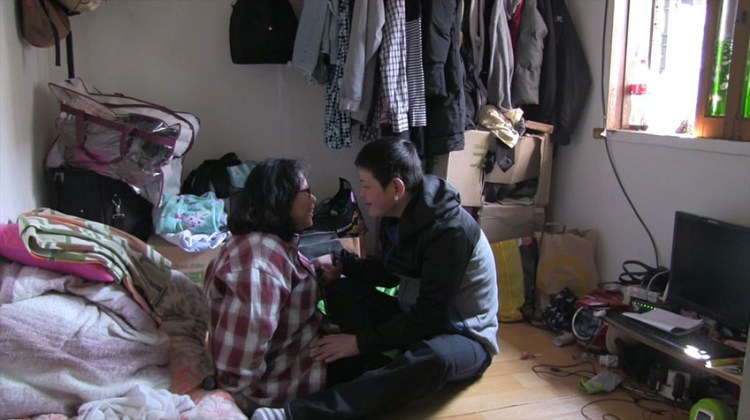
I Can Speak posterGenre in Korean cinema has always been a more fluid affair than it might be elsewhere, but careering from zany generational comedy to affecting historical drama is perhaps a bold choice. I Can Speak (아이 캔 스피크) is, in many ways, the story of an old woman’s personal revolution as she finds herself repurposing her “Goblin Granny” credentials to pursue justice for a great evil she spent a lifetime hiding from, but it’s also an unabashedly political attack on a legacy of unresolved national trauma. Nevertheless, despite its slightly awkward straddling of cheeky comedy and heartrending melodrama, I Can Speak does at least manage to lay bare a series of entrenched social problems affecting all areas of modern Korean society while also making a fairly uncontroversial (at home at least) political point.

Park Min-jae (Lee Je-hoon) has just transferred to the local council offices in a rundown area of Seoul. Seeing as he’s new and very by the book, he doesn’t know that everyone in the office is terrified of “Goblin Granny” (Na Moon-hee)  – an old woman who turns up every single day with a list of complaints and things around the neighbourhood that could do with being fixed. Min-jae, unaware of Goblin Granny’s fortitude, attempts to deal with her complaints in a bureaucratic manner. He is no match for Ok-boon’s bloodymindedness, but his straightforward approach eventually earns her respect.

Ok-boon is the sort of old woman familiar to many municipal offices in that she is essentially lonely and comes in to complain about things just to make her presence felt. She does have a few friends, however – one being the lady who runs the local convenience store, and the other a woman of around her own age who can speak fluent English. Ok-boon decides she ought to learn English too and enrols in an expensive cram school but is abruptly kicked out of the class which is almost entirely filled with youngsters because of her old lady ways. On the way out, however, she runs into Min-jae who was there to check that his extremely high TOEIC scores were still valid. Ok-boon manages to talk Min-jae into giving her English lessons in return for decreasing the burden on the municipal offices by making fewer complaints.

I Can Speak begins firmly in the realms of bureaucratic comedy as the council workers find themselves cowering in front of Goblin Granny while simultaneously enjoying their cushy jobs for life which require almost no effort in their daily activities. Some in the community assume Ok-boon is a horrible old busybody who likes making trouble and pulling other people up on their various social failings but her community patrols come from a good place. The woman who runs a small stall in the market assumes Ok-boon reported her to the police for selling alcohol to a minor but that’s not the sort of thing that Ok-boon would think worth reporting, which is why she doesn’t think much of breaking city regulations to enjoy a drink outside her friend’s shop. Everything she reports is because she genuinely worries someone may get hurt and her main area of concern is with the strange goings on around the market which is earmarked for “regeneration”. Her concerns are not unfounded as she discovers when she overhears some of the council workers talking about taking backhanders to push the redevelopment through while making use of “external labour” in the form of shady gangsters tasked with clearing the area so the ordinary people who live in the old fashioned neighbourhood will consent to quietly move away. Perhaps because no one ever stood up for her, or because she’s sick of being pushed around, Ok-boon is not going to go quietly nor is she going to allow any of her friends to be taken away without a fight.

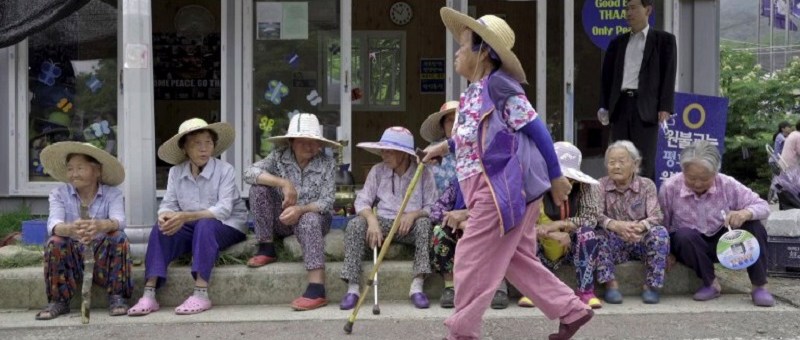
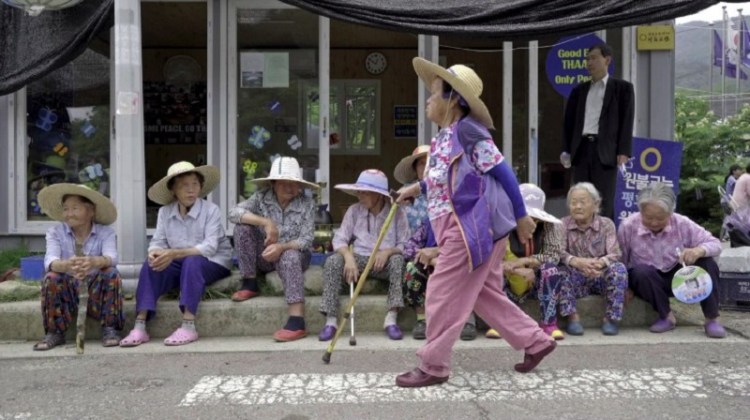
Ok-boon is perhaps attempting to fight something else, something she has been afraid to revisit for most of her life. The fact is that Ok-boon was one of many Korean women forcibly abducted by the Japanese army at the end of the Second World War and subjected to heinous, inhuman treatment as sex slave in one of the many “comfort woman stations” which existed throughout Japanese occupied territory. After the war, she was disowned by her family who saw only shame in her suffering and insisted she tell no one what had happened in fear of damaging her family’s reputation. One of the reasons Ok-boon wants to learn English is to be able to talk to her little brother again who she has not seen since they were children and has apparently forgotten how to speak Korean after spending a lifetime in the US.

English does however give her back something that she’d lost in the form of a familial relationship with the otherwise closed off Min-jae who is also raising a teenage brother (Sung Yoo-bin) following the death of their parents. It is true enough that it is sometimes easier to talk about painful things in a second language – something Min-jae demonstrates when he shifts into English to talk about his mother’s death. Abandoning Korean allows Ok-boon to begin dismantling the internalised shaming which has kept her a prisoner all these years, too afraid to talk about what happened in the war in case she be rejected all over again. Her worst fears seem to have come true when her old friends learn about her past, but what they feel for her is empathy rather than shame, hurt that Ok-boon was never able to confide in them and unsure what it is they should say to her now.

Ok-boon learns that she “can speak” – not only English but that she has the right to talk about all the things that happened to her and the long-lasting effect they have had on her life, that she has nothing to be ashamed of and has a responsibility to ensure nothing like this ever happens again. English becomes a bridge not only between her past and future, but across cultures and eras as she finds herself bonding with a Dutch woman giving a testimony much similar to her own and receiving the same kind of ignorant, offensive questions from the American law makers as well as cruel taunts from a very undiplomatic Japanese delegation. Undoubtedly, the final sequence is a very pointed, almost propagandistic attack on persistent Japanese intransigence but then its central tenet is hard to argue with. Tonally uneven, and perhaps guilty of exploiting such a sensitive issue for what is otherwise a standard old lady regains her mojo comedy, I Can Speak is an affecting, if strange affair, which nevertheless makes a virtue of learning to find the strength to stand up for others even if it causes personal pain.


I Can Speak screens at the New York Asian Film Festival on 12th July, 6.30pm.

Original trailer (English subtitles/captions)

Microhabitat (소공녀, Jeon Go-woon, 2017)

Microhabitat posterIs there a “right” or, by implication, “wrong” way to live your life? The heroine of Jeon Go-woon’s debut feature Microhabitat (소공녀, Sogongnyeo) is determined to live by her own rules, but her unconventional approach to life in competitive Korean society is not treated with the same kind of universal acceptance with which she treats each and every person she meets on her meandering path towards fulfilment. Life is conspiring to take away even the smallest pleasures which make existence bearable, but small pleasures are sometimes all life is about and perhaps the only thing really worth fighting for.

At 31 years old, Miso (Esom) lives what might outwardly be thought of as a miserable existence. Working as a cleaner she exists hand to mouth and is able to afford only a tiny, unheated, one room apartment in a run down part of the city. Her life is tightly budgeted and whatever else anyone might say about the way she lives, Miso is not irresponsible and refuses to get into debt. It is therefore a huge problem when a New Year price hike threatens to push her beloved cigarettes out of her reach. If that weren’t worrying enough, her landlord is also jacking up the rent. Staring intently at her accounts book, Miso contemplates a life without cigarettes and whiskey and then takes a look around her before deciding to strike through the line marked “rent”. Packing her most essential belongings into a couple of suitcases, she decides to make herself temporarily homeless and reliant on the kindness of former friends now virtual strangers whom she hopes will be minded to repay past kindnesses by putting her up for a while.

Miso’s plight is symptomatic of many in her generation who feel they’ve lost out in Korea’s relentlessly competitive, conformist, and conservative society, but her fate also bears out something of a persistent social stigma directed at those without means or family. Unlike the friends she decides to track down, Miso never graduated university – she lost her parents young and then ran out of money, but then she isn’t particularly bitter about something she was powerless to control. Miso’s small pleasures are also ones generally marked off limits to “nice” young women who generally do not smoke or drink and the old fashioned austerity mentality sees nothing good in a “self indulgent” need to enjoy life by “wasting” money on “frivolous” things if you claim not to be able to find the money to pay your rent. Some would say Miso has her priorities all wrong and has messed up her life by getting trapped in the world of casual labour and still being single at such an advanced age, conveniently ignoring the fact that much of the social order functions solely to keep women like her in their place so the higher ups can prosper.

Miso, however, would probably listen patiently to their concerns before calmly brushing them off. She is happy – to an extent, at least, with her minimalist life. She doesn’t need a fancy apartment or a swanky car, she only wants her cigarettes, her whisky, and her boyfriend Hansol (Ahn Jae-Hong) – an aspiring manhwa artist who feels broadly the same but is starting to get frustrated with his own precarious economic circumstances and present inability to offer the degree of economic support which would mean the pair could move in together. The first friend she tracks down, Mun-young (Kang Jin-a), has become a workaholic salary woman who self administers saline drips at work to increase her productivity and declines to put Miso up on the grounds having someone around when she’s not there makes her uncomfortable. Each of her old bandmates has opted for the conventional life but it has not served them well – keyboardist Hyun-jung (Kim Gook-hee) is unhappily married and trapped in a home of oppressive silence, Dae-yong (Lee Sung-wook) is a brokenhearted wreck whose wife has left him after less than eight months of marriage, vocalist Roki (Choi Deok-moon) has a strange relationship with his parents, and former guitarist Jung-mi (Kim Jae-hwa) has thrown herself headlong into stepford wife territory going quietly mad through boredom and insecurity in the palatial apartment that belongs to her husband’s family.

For various reasons, Miso understands that she can’t stay with her friends very long though she tries to help each of them as best she can while she’s around. She cleans their apartments, cooks them nutritious meals, keeps them company and listens to their problems though few of them take the trouble to really ask her why it is she is in the position she is in or how they might be able to help beyond providing temporary shelter. Surprised by one of her wealthy clients who is unexpectedly at home during cleaning time and seems to be distressed, Miso does her best to comfort her, making it clear that she does not disapprove of her client’s lifestyle and thinks she has nothing in particular to be ashamed of. The client, vowing to leave her present occupation behind, feels quietly terrible that her decision inevitably means Miso will lose her job but Miso genuinely means it when she says she’s happy for her client and hopes she will be able to attain her dreams.

Forced to leave the memory of each of her friends behind, Miso’s world seems to shrink until even her beloved whisky now seems like it will be out of her reach. Jeon Go-woon is unafraid to lay bare Miso’s bleak prospects, though she depicts them in an often humorous light as Miso goes apartment hunting in the darkest and dingiest part of Seoul, striding up endless flights of stairs to rooms with increasingly tiny windows before landing at the only realistic possibility in a filthy attic space with no electricity. Still, Miso remains undaunted. She is free, beholden to no one, and retains her kind heart even as she becomes a cypher to us, lost under the grey skies of an indifferent city until she alone becomes the tiny light on its ever expanding horizons.


Microhabitat screens as part of New York Asian Film Festival 2018 on 10th July, 6.30pm.

Original trailer (no subtitles)