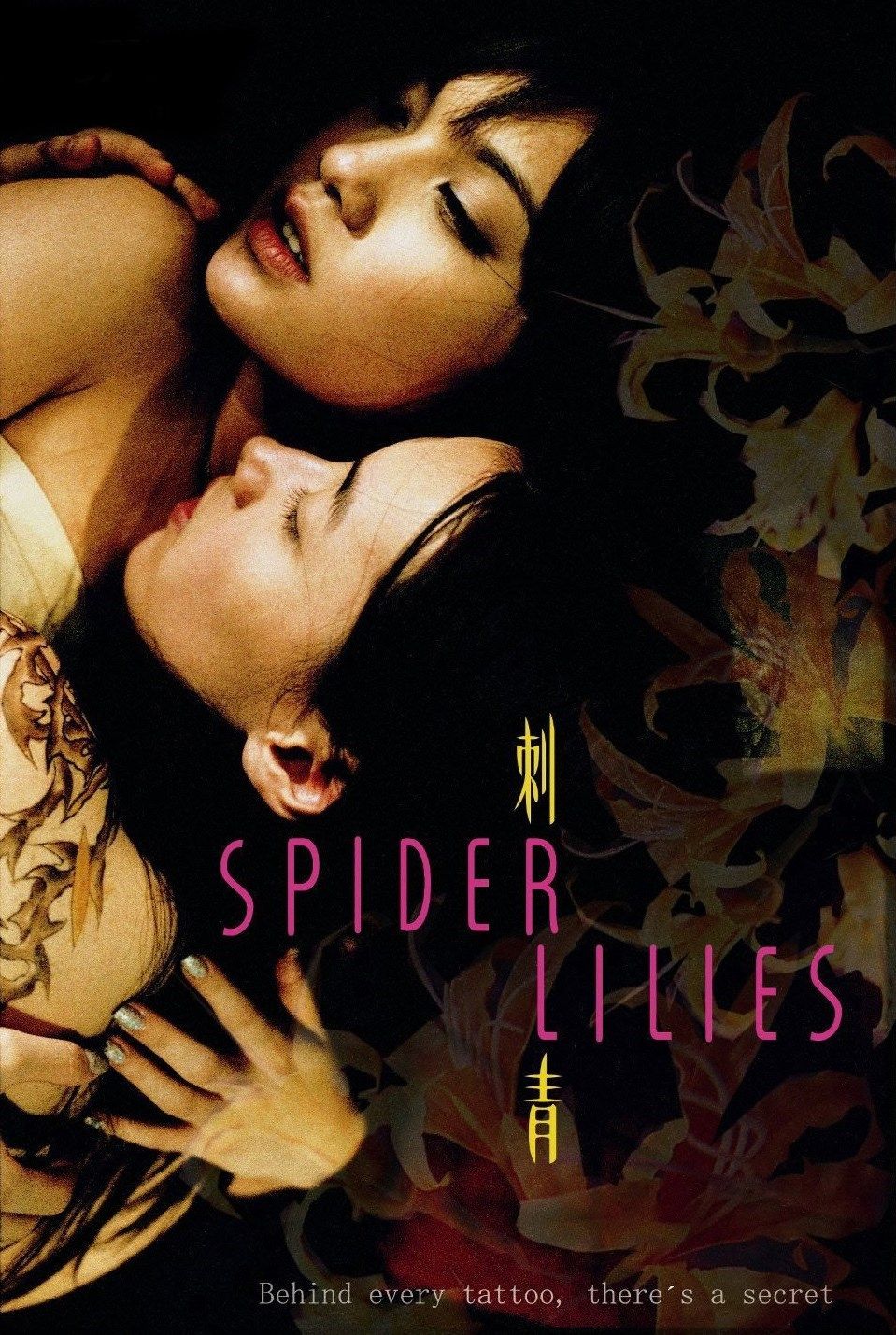
Spider Lilies (刺青, Zero Chou, 2007)

“I have no choice but to live in a virtual world” according to the lovelorn heroine of Zero Chou’s ethereal reflection on love and the legacy of trauma, Spider Lilies (刺青, Cìqīng). Two women connected by childhood tragedy struggle to overcome their respective anxieties in order to progress towards romantic fulfilment, eventually freeing themselves only by destroying the image of that which traps them. 

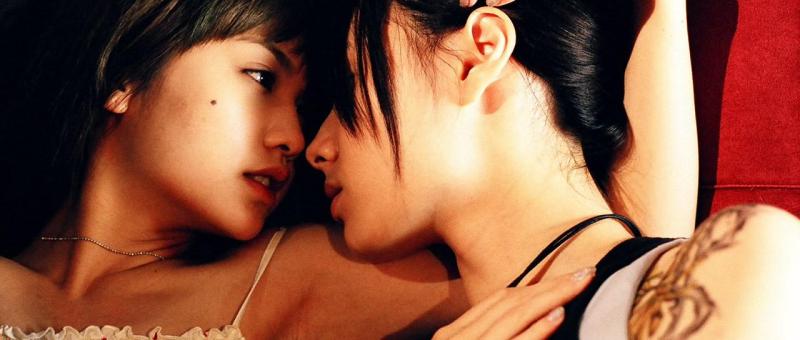
In the present day, Jade (Rainie Yang) is an unsuccessful camgirl with a habit of shutting down her clients on a whim which doesn’t play well with her boss. In an effort to spice up her live show, she decides to get a raunchy tattoo only to realise that the tattooist, Takeko (Isabella Leong), is in fact her long lost first love, a neighbour she took a fancy to at the tender age of nine. For her part, Takeko appears not to remember Jade but cannot deny the presence of her unusual spider lily tattoo, a version of which hangs prominently on her wall. Hoping to maintain contact, Jade decides to get the spider lily tattoo herself but Takeko is reluctant, explaining that the spider lily is a flower that leads only to hell. 

According to Takeko’s master, there is a secret behind every tattoo and the responsibility of the tattooist is to figure out what it is but never reveal it. Thus Takeko crafts bespoke tattoo designs for each of her clients designed to heal whatever wound the tattoo is intended to cover up, such as the ghost head and flaming blades she tattoos on a would-be gangster who secretly desires them in order to feel a strength he does not really have. Her tattoo, however, is intended as a bridge to the past, a literal way of assuming her late father’s legacy in order to maintain connection with her younger brother (Kris Shen) who has learning difficulties and memory loss unable to remember anything past the traumatic death of their father in an earthquake which occurred while she was busy with her own first love, a girl from school. Feeding into her internalised shame, the tattoo is also is a means of masking the guilt that has seen her forswear romance in a mistaken sense of atonement as if her sole transgression really did cause the earth to shake and destroy the foundations of her home. 

Then again, every time Takeko seems to get close to another woman something awful seems to happen. Jade, meanwhile, affected and not by the same earthquake is burdened by the legacy of abandonment and the fear of being forgotten. Living with her grandmother who now has dementia the anxiety of being unremembered has become acute even aside from the absence of the mother who left her behind and the father last seen in jail. “Childhood memories are unreliable” she’s repeatedly told, firstly by Takeko trying to refuse their connection, and secondly by a mysterious online presence she misidentifies as her lost love but is actually a melancholy policeman with a stammer charged with bringing down her illicit camgirl ring. The policeman judgementally instructs her to stop degrading herself, having taken a liking to her because he says he can tell that she seems lonely. 

A kind of illusionary world of its own, Jade’s camgirl existence is an attempt at frustrated connection, necessarily one sided given that her fans are not visible to her and communicate mainly in text. It’s easy for her to project the image of Takeko onto the figure of the mystery messenger because they are both in a sense illusionary, figments of her own creation arising from her “unreliable” memories. Jade wants the tattoo to preserve the memory of love as a bulwark against its corruption, at once a connection to Takeko and a link to the past, but the tattoo she eventually gets is of another flower echoing the melancholy folksong she is often heard singing in which the lovelorn protagonist begs not to be forgotten. 

“I am a phantom in your dream and you too live in mine” Jade’s mystery messenger types, hinting at the ethereality of romance and fantasy of love. Caught somewhere between dream and memory the women struggle to free themselves from the legacy of past trauma and internalised shame, but eventually begin to find their way towards the centre in making peace with the past in a sprit of self-acceptance and mutual forward motion.


Spider Lilies streams in the UK 26th April to 2nd May courtesy of Queer East

Original trailer (English subtitles)

The End of the Track (跑道終點, Mou Tun-Fei, 1970)

“It’s too dark in there, I can’t see the end” the hero of Mou Tun-fei’s The End of the Track (跑道終點, Pǎodào Zhōngdiǎn) complains though in the end he’ll find himself venturing into the darkness all alone. Like many of his contemporaries, Mou had come to Taiwan from the Mainland as a child during the Chinese Civil War but eventually made only two features on the island spending the bulk of his career working in exploitation cinema for Shaw Brothers in Hong Kong. The second of his two Taiwanese movies neither of which were ever given a mainstream release, The End of the Track continues in the broadly Neo-realist vein of I Didn’t Dare to Tell You while venturing towards the expressionistic in its innovative use of rhythmic editing and sound design to mimic the hero’s sense of confusion and anxiety in an oppressively authoritarian society. 

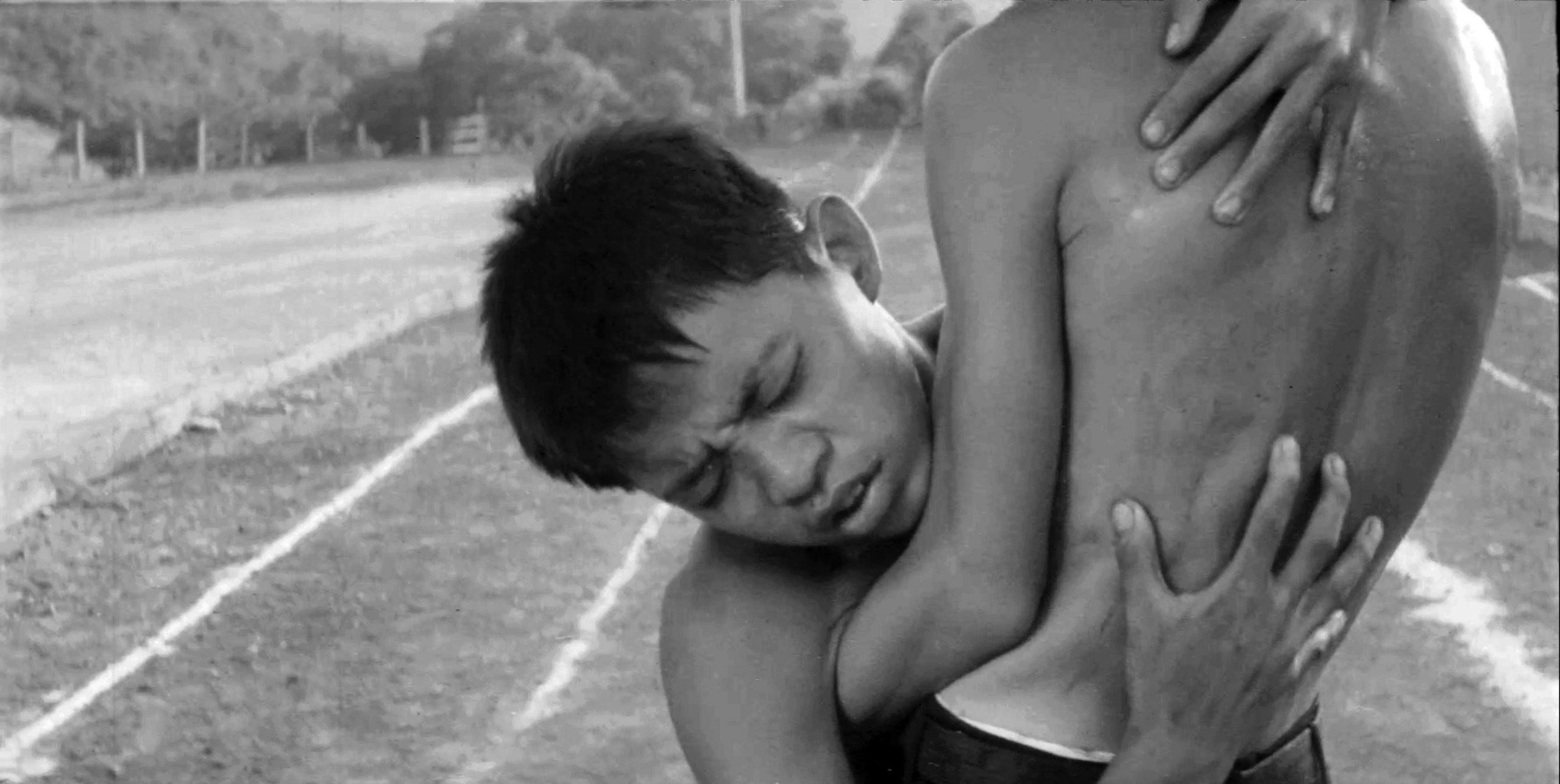
A middle-class boy, Hsiao-Tung (Chen Da-Wei) is best friends with Yung-Sheng (Tsai Tu-Chuen) whose parents operate a small noodle cart. Despite the class disparity between them, the boys are inseparable spending their time skinny-dipping at local beaches, play fighting, or exploring a disused mine they regard as their place joking about the possibilities of hidden gold. Tragedy strikes however when Hsiao-Tung gets bad vibes about venturing into the mine and suggests they head back to school to engage in a mutual “race”, he with his abacus and Yung-Sheng on the track. Shortly after Hsiao-Tung brings up the fact another boy has called them “queer” which they both laugh off with an intention to beat him up they later think better of because of his pimples, Yung-Sheng begins to tire but thanks to Hsiao-Tung’s encouragement continues to run until finally collapsing in his arms and thereafter passing away. 

The homoerotic undertones of the intense friendship between the two boys have been posited as a possible reason the film was not passed for release, and there is certainly something in the fact that Yung-Sheng dies seconds after the word “queer” is uttered though the underlying subtext seems to be bound up more with their class disparity than with the repression of their latent sexual desire. Academically gifted and from a middle-class family, Hsiao-Tung seems primed for conventional success in a rapidly developing economy while Yung-Sheng whose potential lies in his physicality will most likely be left behind. Hsiao-Tung’s attempt to push him beyond his limit eventually leads to his death in his inability to outrun the restrictions placed on him by his society. The two boys have been on different tracks all along, their paths set to diverge even as they fight desperately to maintain their friendship.

In the depths of his guilt feeling that he hastened Yung-Sheng towards his death in failing to recognise his distress, Hsiao-Tung attempts to atone by helping out at his parents’ noodle stand hoping to make his dream of opening a physical store a reality. Yet while his efforts eventually earn him acceptance from the Lees, the conclusion he comes to is that he cannot take his friend’s place or exchange his life for Yung-Sheng’s. He cannot change “track” to become a noodle stall owner’s son, but neither can he reconcile himself to the petty conservatism that defines the lives of his respectable middle-class parents, angrily throwing back at them the instructions given to children in order to become “model citizens” that they should work hard and mind their own business as his father berates him for his bad grades encouraging him to prioritise himself before others so that he might be of more use to society in the future. Hsiao-Tung finds himself bitterly remarking that Yung-Sheng’s death was then his own fault, reacting to the selfish individualism of an authoritarian society which tells him that his intense grief for his friend is wrong and that care and compassion for others is an inappropriate waste of potential. 

Continuing to visit his friend’s grave, Hsiao-Tung remains lost recalling the many conversations they had in which they were torn in their relationships with their parents feeling as if they ought to obey but also that there were times they desired their own freedom. “Everything is so changeable” he complains, “what’s right and wrong in this world all depends on the time, place and people.” He tells us that he doesn’t want to figure it out anyway, but claims to know now what’s going on coming to an understanding of himself as he re-contemplates the cave less afraid to face the darkness of adulthood as he ventures forth all alone in search of an ending.  


The End of the Track streamed as part of Electric Shadows.

I Didn’t Dare to Tell You (不敢跟你講, Mou Tun-Fei, 1969)

Born on the Mainland in 1941, Mou Tun-Fei was one of many making the move to Taiwan with his family following the Chinese Civil War in 1949. In fact, he made only two films in Taiwan, neither of which were ever released, and spent the bulk of his career in Hong Kong working for Shaw Brothers where he became associated with a brand of extreme exploitation cinema before finally returning to the Mainland, later working on the notorious co-production Men Behind the Sun. 

His debut, however, I Didn’t Dare to Tell You (不敢跟你講, Bù Gǎn Gēn Nǐ Jiǎng), is a gritty social drama inspired by the neorealist movement and the French New Wave even throwing in a few nods to The 400 Blows. No single reason is offered as to why it ultimately went unreleased, it was apparently not because Mou was unhappy with the film, though its mildly subversively digs at contemporary authoritarianism and perhaps problematically left-wing take on structural inequalities may have made it unpalatable to the censors even if its unexpectedly rosy coda feels like a concession made for their benefit. 

The hero, Da-Yuan (Hsu Jian-Sheng), is a lonely little boy tormented by playground bullies and raised by an often absent single-father (Chen Kuo-Chun) who has despite himself pledged his son as an apprentice in settlement for his gambling debts. Da-Yuan, however, wants to stay in education after middle school and is wary of an older man, Uncle Chen, who often drops by the house inspecting his teeth as if he were a horse at market. Consumed by guilt, Da-Yuan’s father eventually decides to honour his son’s wishes and send him to the public high school telling Uncle Chen that the deal is off. Uncle Chen, however, is less than sympathetic insisting that Da-Yuan’s father pay back the money he owes within the month. Spying on his father Da-Yuan overhears their conversation and begins to feel guilty himself, wondering if he should give up on staying at school but later deciding to look for work to help his father pay off the debt entering an arrangement with another boy who had to drop out of education to work in a print house, pulling his shifts while his friend does Da-Yuan’s homework to prepare for entering the high school the next year as his older brother had promised him he could. 

The subject of child labour seems to have been the controversial element that may have upset the censor’s board, suggesting a series of economic and social problems at the heart of a developing society as kids like Da-Yuan find themselves exploited while at the mercy of an irresponsible parent, in this case his father’s gambling which sees him berated by their no-nonsense landlady who makes no secret of her disapproval of his parenting style. Da-Yuan’s father, meanwhile, desperately tries to make amends by thrusting himself into overwork in low pay, exploitative conditions which have left him exhausted and in poor health as his constant coughing hints. Discovering that Da-Yuan has been neglecting his studies to work, he is crushed and betrayed, feeling as if all his sacrifices have been for nothing throwing his son out never knowing that he did it only in an attempt to ease his burden. The truth is eventually only revealed by Da-Yuan’s staunchly loyal friends who eventually “dare” to tell in the interests of justice. 

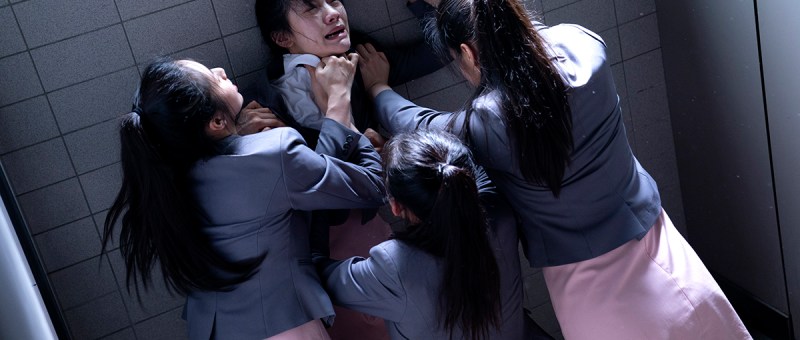
Meanwhile, a parallel conflict is going on in the heart of Da-Yuan’s school teacher (Grace Gua Ah-leh) who first appears as an austere figure with her hair in a tight bun wearing thick-framed glasses and dressed in a severe suit. Outside of school she finds herself at odds with her beatnik artist fiancé who complains that she’s travelled too far to the dark side and that her newfound conservatism is turning the kids into identical mindless drones devoid of life or creativity. She meanwhile, intensely resents his beard and shaggy hair complaining that he wasn’t “like this” when they first met two years previously, but once he smashes her unfashionable glasses which were merely an affectation designed to add to her sense of authority, her outlook does indeed begin to change. Letting her hair down and dressing in a more comfortable fashion she begins to bond with the kids and develops a sympathy for Da-Yuan investigating why it is he’s always falling asleep in class now determined to help rather than punish. 

In the end, authoritarianism loses out, the teacher’s earlier assertion that pupils need to be obedient members of society replaced by a more compassionate desire to nurture their individual talents and personal happiness. Nevertheless, the coda occurring after a poignant freeze-frame a little after the boy utters the film’s title to his chastened father, seems improbably optimistic, subtly re-enforcing the power of the state in its parade of pristine public high schools as if to say the system works in direct contrast to everything we’ve just seen implying that the dissatisfying reality of boys like Da-Yuan can be fixed by a simple act of truth sharing and an acceptance of mutual responsibility. Shot with unflinching though never preachy naturalism, Mou’s steely drama is otherwise resolute in its anti-authoritarianism condemning both the deadening effects of a rigid educational system and an unforgiving society that actively frustrates the hopes and dreams of ordinary kids like Da-Yuan and his friends. 


I Didn’t Dare to Tell You streamed as part of Electric Shadows.

Born to be Human (生而為人, Lily Ni, 2021)

Taiwan is often regarded as among the more liberal of Asian nations, but it is certainly not free of outdated ideas of gender and sexuality as Lily Ni’s powerful sci-fi-inflected drama Born to Be Human (生而為人, Shēng ér Wèirén) makes clear. Like the similarly themed Metamorphosis from the Philippines which also made much of butterfly imagery, Born to Be Human finds a teenager’s ordinary existence upended by the sudden discovery that they are intersex along with the realisation that they have almost no agency over their medical decisions, but is ultimately more concerned with undermining the fallacy of the gender binary along with the sometimes duplicitous actions of the medical profession than with exploring the intersex identity. 

Unpopular at school 14-year-old Shi-nan (Lily Lee) is a regular teenage boy who secretly buys porn mags from the old man on the corner and enjoys playing online video games. Still embarrassed about his body, he is deeply worried on noticing blood in his urine after experiencing painful stomach cramps and half-convinces himself he has bladder cancer while too anxious to tell his parents or seek medical help. When his parents eventually find out they take him straight to the hospital but are fobbed off by an overworked doctor who diagnoses him with a urinary tract infection caused by an infected foreskin, something which they assume can be fixed by circumcision. Returning to school after some time off to recover, however, the problem recurs with Shi-nan collapsing during a sports lesson his shorts stained with blood. A more comprehensive medical exam reveals that Shi-nan is in fact intersex and has a functioning womb directly connected to external male genitalia. 

This unfortunately brings Shi-nan into the orbit of Dr. Lee (Yin Jau-Der), apparently a specialist in urology with an improbably futuristic office, who immediately latches on to Shi-nan’s case as a means of advancing his own career. He recommends to Shi-nan’s parents that they “correct” his physical body according to his chromosomal makeup, explaining that he may be at increased risk of cancer maintaining both sets of sex characteristics. On discovering the analysis has come back female, Shi-nan’s father’s first question is how he can carry on the family name if his son is now a daughter while his mother and the doctor fixate on Shi-nan’s viable womb and the all important ability to procreate. Feeling he will not understand, the parents decide not to share his medical diagnosis with Shi-nan even while he continues to believe that he is dying from bladder cancer, telling him only that he will undergo circumcision signing the consent forms for his gender confirmation surgery without ever consulting him. 

Already 14 years old and having lived all his life as a boy, this forced gender transition provokes a secondary sense of dysphoria as Shi-nan becomes Shi-lan and moves to the capital to attend an elite school presumably offered some kind of financial incentive from Dr. Lee who continues to monitor her progress. Removed from her previous environment, Shi-lan is plunged into hyper femininity as if the entirety of her previous personality had been erased. On her birthday she is given a pink cake with frills and a selection of dolls, while her bedroom is similarly pink and frilly, apparently part of Dr. Lee’s treatment programme to acclimatise Shi-lan to her new identity. Even her mother laments that she’s behind on her feminine education, unable to cook or do chores which she fears will interfere with her ability to get married. Shi-lan says she doesn’t intend to marry, but her refusal is met only with confusion as if a woman’s entire purpose lies in marriage and childbirth. Of course, the secondary issue is that Shi-lan is sexually attracted to women, upset and embarrassed to receive a love letter from a boy at school while pining for her sympathetic deskmate who later becomes her first friend. 

Meanwhile, she is forced to adopt a female personality more or less against her will, later explaining an old photo of herself as one of a younger brother who has unfortunately passed away but will remain always in her heart. Having been bullied at her last school, Shi-lan fears discovery but is subject to a secondary prejudice after a nosy girl goes through her bag and finds a bottle of pills she identifies as being for the treatment of depression later getting her parents to complain to the school that they shouldn’t be forced to share a class with a “mental patient”. 

In fact, Shi-lan has been lied to again, the pills aren’t for depression and she is in fact being tricked to take them against her will as part of her forced transition. She describes herself as a “monster”, neither male nor female, and is acutely compelled to feel that those are her only two options. Her new friend, Tian Qi (Bonnie Liang Ru-Xuan), takes her to a Taiwanese opera performance starring her mother in which a female scholar poses as a man in order to get her education only to fall for a classmate making it clear that an idea of gender fluidity has cultural currency yet Shi-lan has been denied the right to define her own identity, told that what she is is wrong or incomplete, and ultimately reduced to a subject for experimentation by an unethical doctor. Confronting him to be told he has turned her into a “normal person”, she later insists that she can ruin his work just as he has ruined her life, walking through a market witnessing flesh being butchered and fish gutted, before buying a bouquet of sunflowers echoing those on the doctor’s jigsaw puzzle. Whatever her intentions, Shi-lan perhaps comes into herself even if with a dark purpose in mind, actively claiming an identity that is defiantly her own in rebellion against a conservative society that refuses to accept her for all that she is.


Born to be Human screened as part of the 2021 Osaka Asian Film Festival

Original trailer (dialogue free)

Wrath of Desire (愛・殺, Zero Chou, 2021)

“Desire is the only truth. The body never lies” according to the prison missives penned by the heroine of Zero Chou’s latest meditation on sex, death, guilt, and repression, Wrath of Desire (愛・殺, Ài・Shā). As the title perhaps implies, Chou frames her epic tale in the extremes of Greek tragedy, opening with an ethereal desert scene and cryptic Butoh dance that equates desire with death as the victim later laments “it was I myself who pointed the knife at my heart”. 

The dreamlike opening gives way to a prophetic scene of violence as an androgynous young woman fends off an attack from a “burglar” who is later discovered to be part of a conspiracy sent to steal evidence that could be used against her father, a political candidate anxious that her existence as his love child not affect his chances of election. Visibly shaking from her traumatic encounter, Phoenix Du (Peace Yang) is comforted by the sympathetic female prosecutor in charge of her case, Jade Liu (Weng Chia-Wei), who finds herself somehow captivated by the intense tattoo artist. Witnessing her capacity for violence after they are attacked by more of the mayor’s thugs when she perhaps inappropriately offers her a ride home from the courthouse, Jade takes Phoenix back to her flat to tend to her wounds only to find herself overcome by desire when Phoenix playfully kisses her as if to test her naive hypocrisy. The two women share a single night of intense passion, but Jade is a pastor’s daughter and failure to resist her “blasphemous” desires leaves her only with shame and fear. In retaliation she has Phoenix sentenced to three years in prison hoping to forget her, while Phoenix spends her time inside writing 372 extremely intense love letters insistent that the body doesn’t lie and convinced that Jade has in fact imprisoned herself in her wilful repression. 

God is always between them, a cross hanging from the rear mirror in Jade’s car as they make their high speed getaway while it’s the Lord’s name that Jade cries out during their night of passion but out of guilt more than ecstasy as Phoenix urges her to let herself go, aware it seems that she continues to struggle against herself. While Phoenix is inside, Jade finds herself drawn to an androgynous young man, Meng Ye (Hsu Yu-Ting), who is accused of stabbing a cousin (Huang Shang-Ho) who had become his legal guardian and thereafter molested him. Referring to her as “sister’ Meng Ye reminds Jade of the younger brother who took his own life after being rejected by their religious family because of his homosexuality, something which undoubtedly contributes to her ongoing inability to accept her same sex desires describing her feelings for Phoenix as lust rather than love, something dirty and sinful to be rejected. After becoming aware of her inner conflict, Meng Ye suggests a platonic marriage to create a “family free from desire”, offering Jade the “stable family” she’s been looking for while he gains “social acceptance”. Yet on Phoenix’s release it’s Meng Ye who determines on bringing her into their life as a “friend” only to find himself consumed by jealousy while questioning the nature of desire. 

Chou intercuts the non-linear action with a series of black and white intertitles featuring Phoenix’s charred letters along with noirish, Rashomon-esque testimony from a handcuffed Jade and Meng Ye along with a third woman, Chrys (Chen Yu-Chun), who had apparently fallen for Phoenix in prison only to remain frustrated by her lack of interest in anyone outside of Jade. “Sex without love is as empty as violence without hate” Phoenix writes in one of her letters, repeating that the body does not lie and Jade is only harming herself in her continued denial. Phoenix is indeed correct, though 372 letters is rather excessive as is her stalkerish insistence in the face of Jade’s refusal. Nevertheless the ménage à trois eventually turns dark as Meng Ye determines to exorcise his resentment by making Phoenix betray herself in unmasking the hypocritical repression of her own desires. Meng Ye claims he’s a “pet” to his cousin and brother to Jade, what he wants from Phoenix is a love she might not choose to give him, but is also bound for a dark and nihilistic destination.

Though the mayoral conspiracy angle is an outlandish detail strangely forgotten in the ongoing narrative, all three are in a sense wounded orphans betrayed by parental failure and left adrift without firm anchor in a hostile society each looking for safe harbour whether in the certainty of bodily desire, its rejection, or subversion. Apparently the “first” in a six film series each set in different Asian cities (though the “second” The Substitute set in Beijing and filmed in 2017 is currently streaming via Gagaoolala, as is the reported third We Are Gamily set in Chengdu now streaming as a five-part webseries while the feature edit is also streaming via Amazon Prime US), Chou’s latest more than lives up to its name as the trio find themselves consumed by the fire of desire while unable to extricate themselves from a complex spiral of shame and repression.


Wrath of Desire screened as part of the 2021 Osaka Asian Film Festival

Original trailer (English subtitles)

No. 76 Horror Bookstore: Tin of Fear (76号恐怖書店之恐懼罐頭, David Chuang & Hung Tzu-peng, 2020)

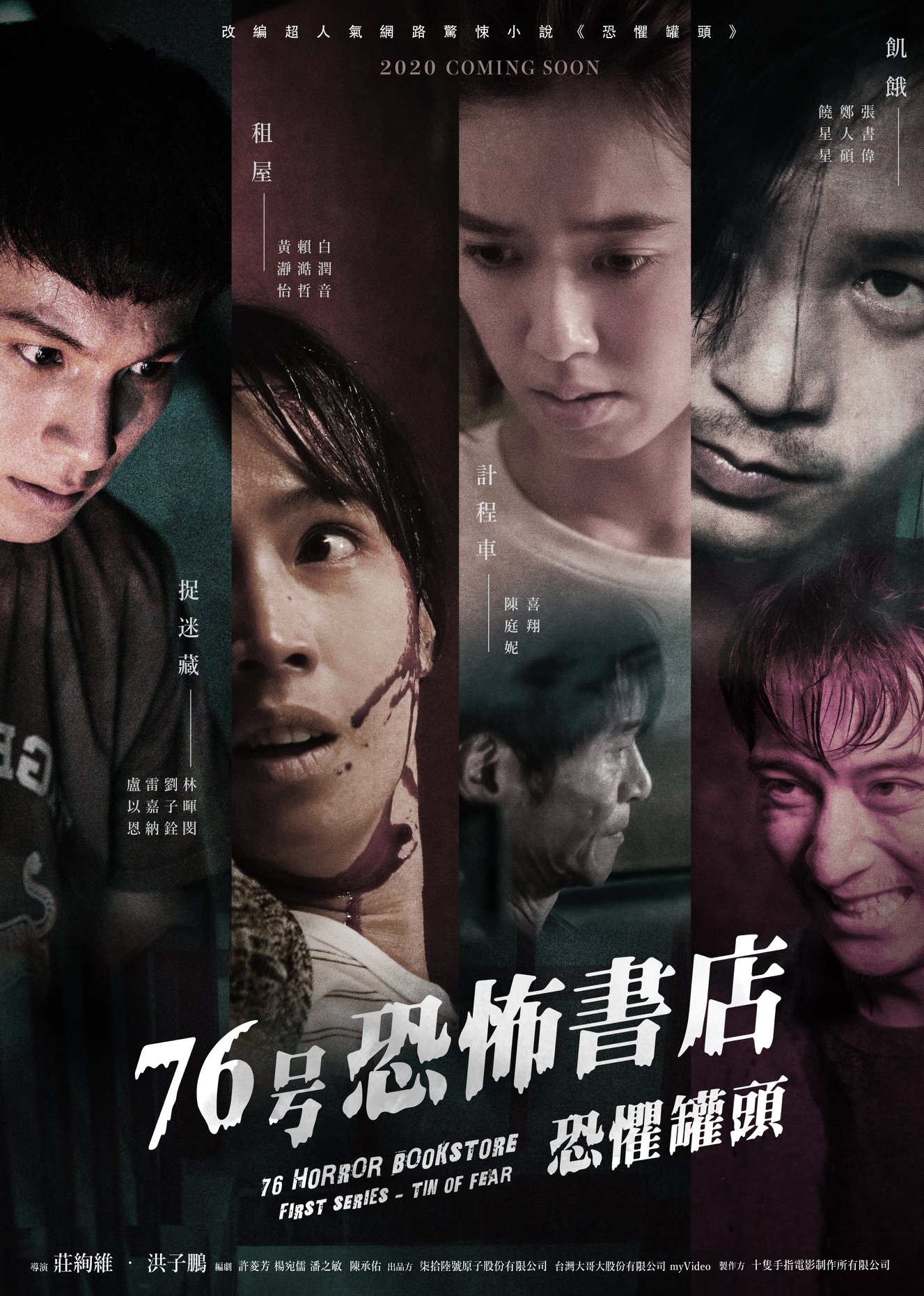
The first in a potential franchise, David Chuang & Hung Tzu-peng’s chilling anthology 76 Horror Bookstore: Tin of Fear (76号恐怖書店之恐懼罐頭, 76-Hào Kǒngbù Shūdiàn zhī Kǒngjù Guàntou) adapts four short stories from the online novel series of the same name. Somewhat interconnected and featuring some of the same cast, the four episodes each present a different kind of horror but all featuring a rather grisly spin from the secrets contained in the grim apartment building of the first instalment to the heartbreaking familial drama of the last as a collection of contemporary lost souls attempt to make sense of life, death, and that which exists somewhere in between. 

Titled “Rent”, the first chapter sees single mother Miss Ho (Esther Huang) leave her young son behind to travel to Taipei hoping to earn money through sex work in order to buy a house in which they can live together. Unfortunately, however, her city existence is even grimmer than expected, inhabiting a rundown apartment block overseen by an extremely creepy landlord (Lai Hao-Zhe) who informs her that the previous tenant, whose belongings are still in the room, abruptly disappeared without trace. “When your son grows up, he’ll be able to protect you” the landlord adds in rather sexist fashion finally getting round to fixing the lock on her door while singing unsettling nursery rhymes about slow rats getting eaten alive. Gradually Miss Ho becomes aware that the building is home to a dark secret connected with the sad fate of one particular family who apparently attempted to resist the urban renewal programme but ironically finds that her own victory lies in a sense with complicity. 

Meanwhile, in Hunger a convict (Joe Chang Shu-Wei) wakes up on the outside after a traumatic episode only to discover that in this version of reality food has been declared illegal. The clerk at a convenience store (Troy Liu Tzu-Chuan) reacts to his polite request for sustenance with shear horror as if he’d just asked him where he might be able to find the weapons grade plutonium or high grade explosives. A strangely dressed man hanging round outside explains that there’s no more food for another 76 days, but he can supply him with some tins for a small fee. Gesturing at the sign inside the store which is currently counting down to a ghost festival might have clued the man in on where he might be if only he had his thinking cap on, but sure enough he finds himself trapped in a purgatorial hellscape and eventually faced with an ironic confrontation as he resolutely fails to take the opportunity to overcome his baser instincts. 

Shifting into teen supernatural romance, Hide and Seek takes a less grisly though no less cruel turn as a bunch of kids head out on an adventure to celebrate the 18th birthday of Xiaoqi (Eric Lin Hui-Ming). Best friend Shaohua (Troy Liu Tzu-Chuan) has organised a camping trip to a supposedly haunted former dormitory yet the conflict here is of a more ordinary kind in that both the boys had unwittingly intended to declare their love to the same girl. Nevertheless, as the haunted house adventure proceeds Xiaoqi begins to to wonder who is haunting who, unwittingly forced into a delayed confession of his repressed emotion. 

Something similar befalls Hsin-chieh (Annie Ting-ni), the 30-something heroine of final instalment Taxi who has recently discovered she is pregnant and is subsequently consumed with maternal anxiety that reflects the loss of each of her parents in very different circumstances along with a possible sacrifice of independence and individual identity. Nagged by the aunt who raised her and seemingly cajoled by her perfectly pleasant, vaguely supportive boyfriend Ah-Shu (Wang Wei), Hsin-chieh leans towards an abortion, ending the relationship and getting a flat of her own but soon finds herself haunted by a creepy little girl and a host of other strange goings on until finally forced to face the legacy of abandonment in order to make peace with the traumatic past, ending a painful cycle of guilt and retribution in a bloody confluence of death and rebirth. Filled with surreal and nightmarish imagery, Taxi is at heart all about forgiveness and moving forward, a fitting end these four gloomy tales of supernatural harassment and guilty consciences finding at least a ray of hope in new life unburdened by fear or shame.


No. 76 Horror Bookstore: Tin of Fear streams in the US March 27 – 31 as part of the 12th season of Asian Pop-Up Cinema.

Original trailer (English / Traditional Chinese subtitles)

Chen Uen (千年一問, Wang Wan-Jo, 2020)

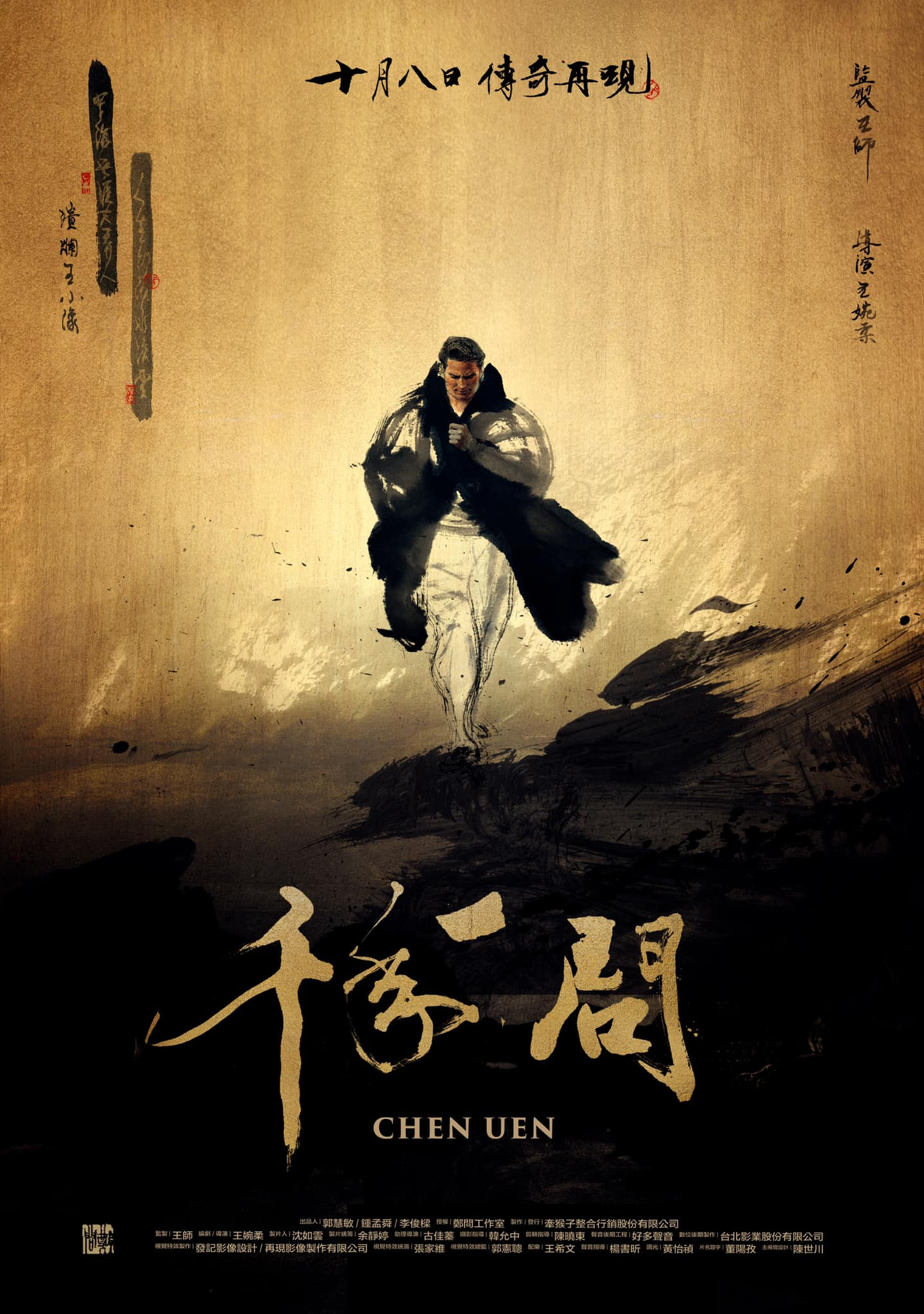
Born in Daxi in 1958, Chen Uen became one of Taiwan’s premiere comic book artists eventually publishing in Japan and Hong Kong and later travelling to the Mainland to work in the growing online gaming industry. Sadly after a tumultuous career spanning over 30 years, Chen passed away of a heart attack at the young age of 58 in 2017. Though he had perhaps not always been appreciated to the degree he would have liked in his home country, the artist did receive a posthumous exhibition at the National Palace Museum the summer following his death, apparently the first comic artist ever to have received such an honour. 

Exploring both his life and career, Wang Wan-jo’s engrossing documentary (千年一問, Qiānnián Yī Wèn) paints an enigmatic picture of the complicated artist, bringing his work to life with a series of animatics along with poignant shots of an animated Chen walking the city streets and eventually arriving at his own exhibition. Through interviewing his various collaborators, the image of him which eventually arises is of a man who was at once singleminded, driven by artistic conviction and certain in his skills, and that of a sometimes insecure talent privately hurt by his public failures and resentful that his home nation often failed to embrace his work. 

Like many of his generation, Chen was profoundly influenced by wuxia serials and carried that love into his art, becoming one of the first artists to move away from the then dominant Japanese manga aesthetics drawing inspiration from traditional Chinese ink painting including the use of a brush rather than the pen. In his later, increasingly avant-garde work we see him experimenting further with materials using toothbrushes and sand, scorching the paper with fire or marbling ink in water to achieve his desired effect. As mangaka Tetsuya Chiba (Ashita no Joe) points out, manga panels are constructed with narrative progression in mind yet Chen treated each of his panels as a standalone image with a strongly cinematic vision. This tendency towards directness in his stripped back storytelling leads Chiba and others to offer the slight criticism that to some readers Chen’s comics may have lacked dramatic richness as a consequence. Nevertheless, he soon found himself wooed by Bubble-era Japan, invited by publishing powerhouse Kodansha to collaborate on a series of wuxia-themed projects beginning with The Heroes of Eastern Zhou.

The Japan move would be the first of many, allowing Chen to escape the sense disillusionment he felt in Taiwan while honing his skills as a contractor for a major publishing house willing as his editor testifies to work on whatever they suggested including the ubiquitous cute girls then popular in the Japanese manga market. Unfortunately, however, he does not seem to have settled very comfortably in Tokyo while his wife recounts her difficulties trying to navigate raising their two children while unable to speak the language. The family soon returned to Taiwan, and Chen would make his subsequent moves alone leaving his family behind to work in comics in Hong Kong before moving on to Beijing where he began working on concept art for the then nascent world of online gaming beginning with a franchise inspired by Romance of the Three Kingdoms.  

In an excerpt from a TV interview, Chen describes his comic work as a dream that miraculously came true adding that had he been interested in material comfort he probably would have stuck to jacket art for video games which might have proved more lucrative. His decision to do just that later in his career might then seem like a minor defeat even as it feeds into comments from some of his assistants that he liked to stay ahead of technological change and was keen to experiment with new tools even teaching himself photoshop intuitively while the program lacked Chinese-language support. His colleagues describe him as mercurial, an unhappy person probably lonely away so long from his family yet also fiercely caring and protective of his staff. For Chen, heroes were less fearsome warriors than those who were “unwavering, rational, and polite”, qualities which ironically mirror his own personality though others also call him stubborn, a perfectionist who always did what was right rather than settling for the easy option. A poignant memorial to the under appreciated pioneer of Taiwanese comic art, Wang’s documentary does not set out to solve mystery of Chen but revels in his contradictions while celebrating the glorious complexity of his bold and colourful career. 


Chen Uen streams in the US until March 28 as part of the 12th season of Asian Pop-Up Cinema.

Original trailer (English subtitles)
The Silent Forest (無聲, Ko Chen-Nien, 2020)


There can be no justice in silence, but when those in a position to help refuse to listen what can be done? Inspired by true events, Ko Chen-Nien’s The Silent Forest (無聲, Wúshēng) takes aim at cycles of abuse and systems of oppression in society at large through a thorough investigation of the culture of silence at a school for deaf children in which endemic bullying spreads like a virus emanating from a single trauma inflicted by a negligent authority. Yet this kind of violence cannot be fought with violence and there must be empathy too for the bully or the chain will never end as Ko’s ambivalent conclusion makes clear. 

The film opens with a boy on the run, finally chasing down an old man and tackling him to the ground pummelling him until the police turn up and separate them. The policemen are frustrated. This is apparently the first time they’ve ever come into contact with a deaf person and have no idea how to communicate with him. Chang Cheng (Troy Liu Tzu-Chuan) tries to protest their injustice, but they continue to treat him as aggressor rather than victim even as he explains in writing that the old man had stolen his wallet (the old man claims he “found” it and was planning to hand it in). Finally a teacher from his new school, Mr. Wang (Liu Kuan-ting), turns up and interprets but it quickly becomes clear that he too is in a sense complicit, reporting that Cheng is sorry for what he did and grateful to the officers. In his view at least, the boy has his wallet back and there’s no harm done so why make a fuss? Just let it go and everyone goes home.

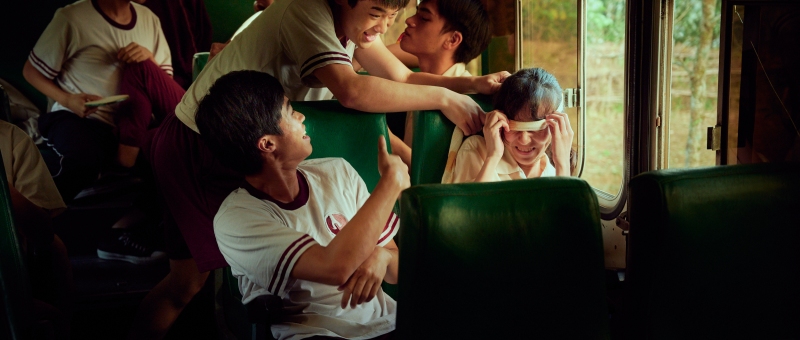
It’s this conflict between “silence” and justice that continues to prey upon Cheng’s mind after he starts at the school and becomes aware of the widespread culture of bullying witnessing a girl he likes being sexually abused by a gang of boys at the back of the school bus while the teacher sitting at the front does nothing. He tries to convince the girl, Beibei (Buffy Chen Yan-Fei), to tell one of the other teachers but she refuses, not wanting to “betray” her “friends”, insisting they were “just playing around”. Her reluctance however mainly stems from an intense fear of being sent away, that she might have to leave the school which is the only place she feels accepted. Both she and Cheng feel intensely othered in the hearing world, wary of being blamed for things that weren’t their fault as if their very existence were bothersome or “abnormal”. Even if it means putting up with extreme degradation, she would prefer it to the loneliness she felt before she found the school.

Yet the sense of social isolation is only one of the various oppressions to be found at the institution which ironically cultivates a culture of silence as regards the ongoing abuse as a means of preserving its reputation and therefore the “greater good” in providing the “safe space” from the social stigma the children face in the hearing world. Beibei points out that she was screaming, yet nobody could hear her. At first she tried to tell a teacher, but the teacher blamed it on her and implicitly on her disability insisting that the boys were “good kids” who were “just playing around” and didn’t understand she didn’t like it because she failed to communicate that she was uncomfortable. If they knew she was suffering they’d have stopped, the teacher insists before coldly walking away. Mr. Wang feels quite differently and wants to help but discovers that the culture of silence extends much deeper than he thought and the problem most likely cannot be solved through a few simple countermeasures but requires whole-scale systemic reform.

In fact, very little is done by the authorities leaving Chang Cheng with a hero complex believing that he has to be strong to beat the bad guys and save Beibei, but his righteous desire still leads him back towards complicity in order to protect her. The arch antagonist, Xiao Guang (Kim Hyun-Bin), bullies as a defence mechanism insisting that no one would dare bully him, manipulating others to do his bidding through the same mentality that one can either be a bully or a victim. Yet Xiao Guang is also a victim himself, a wounded damaged boy let down by a culture ruled by shame and unable to defend himself by any other means though apparently uniquely vulnerable to one particular aggressor. Only by addressing the root of his trauma can the cycle be brought to an end, but the concurrent cycles which he set in motion will in turn require their own resolution. A painful allegory, The Silent Forest boldly makes the case for speaking out but also admits that it doesn’t matter how loud you shout if no one is listening and without the desire for empathy and communication in all its forms the cycles will grow and repeat until the end of time.


The Silent Forest streams in Illinois until March 21 as part of the 12th season of Asian Pop-Up Cinema.

Original trailer (English subtitles)

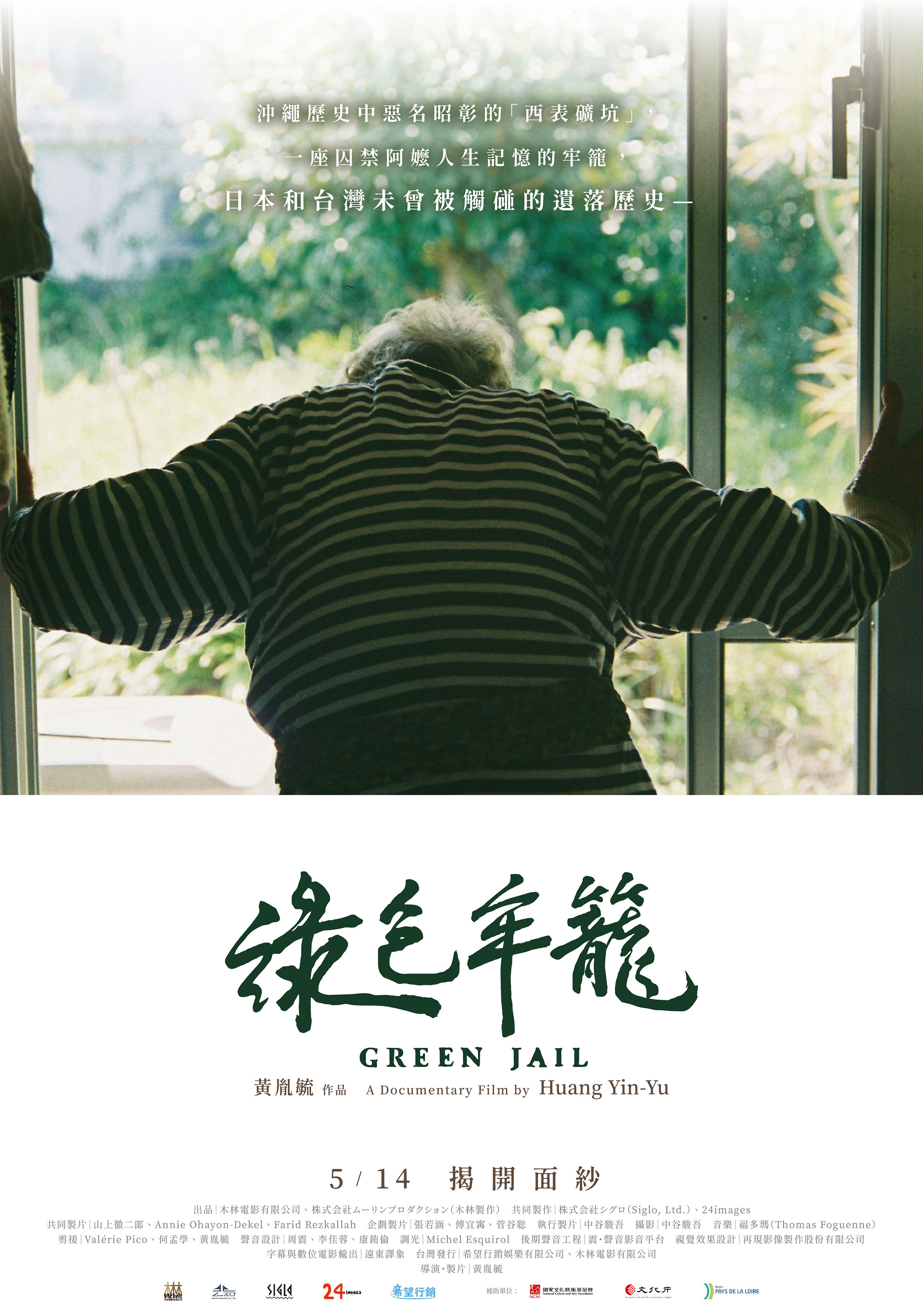
Green Jail (綠色牢籠, Huang Yin-Yu, 2021)

The legacy of Japanese imperialism continues to haunt a small Okinawan island once home to a sprawling network of coal mines but now mostly to ghosts of its troubled past at least according to Huang Yin-Yu’s beautifully lensed, elegiac documentary Green Jail (綠色牢籠, Lǜsè Láolóng). So named for its thick forests of mangrove trees, the island’s Iriomote Coal Mine ceased production in 1960 but from the late 19th century to the fall of the Japanese Empire at the end of the war, lured workers from not only from the Japanese mainland but from Korea, China, and Taiwan with false promises of tropical climes and plentiful fruits failing to disclose the harsh and exploitative working conditions they would later prove unable to escape. 

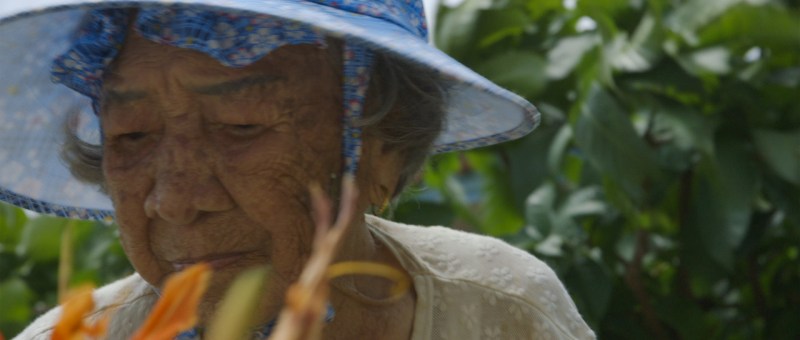
Possibly the last witness to these times, grandma Yoshiko Hashima (her name naturalised from the original Yang) travelled to the island with her adopted father, Yang Tien-fu who worked for the mines and was responsible for recruiting other workers, at the age of 10 leaving briefly after the war but soon returning. The last of the Taiwanese settlers, she recalls little regarding the running of the mines save witnessing frequent beatings by Japanese soldiers but does recall the discrimination she faced as a foreign worker from the local community who by far made up the smallest percentage of those employed at the mines finding herself with few friends as locals often even declined to eat their food or accept their hospitality. 

Yet in a strange way history perhaps repeats itself. Now elderly and alone, her children all having left the island returning only infrequently, she rents out her spare room for extra money to an American traveller, who, like her, came to Japan as a teenager. Though Luis tells us that he hadn’t intended to stay long on the island but likes being able to help Yoshiko who is elderly and alone, she tells us that she regrets her decision to rent to him which she claims she made in the belief he had a wife. She describes him as “‘messy”, claims he has lice, and that his slovenliness has attracted an influx of ants while the pet dog that he keeps on a leash outside disturbs her with its constant whining. Later we see him again having returned to Kansai revealing that he felt that people disliked him and found it difficult to fit in, but that his time in Okinawa has perhaps brought him clarity in the further direction of his life. 

Luis was at least able to leave the island at a time of his own choosing, but as the ghostly voice of Yoshiko’s late father reminds us those who worked in the mines were not so lucky. He tells us that he once slept on a pile of bones and the remains of workers who attempted to flee but ended up starving to death in the jungle were a frequent sight in local caves. Exploited and manipulated, workers were often hopped up on morphine, for which they had to pay, in order to up their productivity but also to make them dependent on their employment to avoid withdrawal aware that they would be unable to obtain a such substances in their home country. They also found themselves borrowing on their wages, especially if they contracted malaria and were unable to work, leaving them essentially indentured and therefore unable to leave without satisfying their debts. Yoshiko tells us that few wanted to come to “Dead Man’s Island” yet Tien-fu declares himself uncertain why some miners remained unhappy with the arrangement eventually needing to organise a specialised police force to enforce discipline complaining that workers who were in debt and therefore earning almost nothing often shirked and only worked when the police were around. 

Travelling around the otherwise idyllic landscape with its verdant green forests and peaceful rivers, Huang finds occasional ghosts of the departed miners hovering on the horizon dressed only in their white fundoshi underwear, slipping into brief scenes of reconstruction set amid the now ruined structures of the industrial mining complex. The last survivor, Yoshiko hangs on alone yet perhaps not quite reflecting on the implications of her father’s role in the development of the mines or particularly of their legacy. Her own life has evidently been hard, adopted as an infant and then married to her “brother” only to see her children desert her left behind alone in the Green Jail a guardian of a dark history few wish to remember. Juxtaposing the island’s traumatic past with the beauty of its verdant scenery Huang’s elegantly composed documentary poses some serious questions about the imperial legacy but always mindful of its wandering ghosts. 


Green Jail screened as part of the 2021 Osaka Asian Film Festival.

Original trailer (Japanese subtitles only)

The festival will also be screening Huang Yin-Yu’s accompanying short film Green Grass, Pale Fire: an elliptical, ethereal dramatisation of three men’s attempt to escape the mines only to find themselves trapped by the beautiful yet maddening landscape.

Images: (c) Moolin Films, Ltd./ Moolin Production, Co., Ltd.

Ohong Village (蚵豐村, Lim Lung-yin, 2019)

Familial legacy and frustrated dreams conspire against father and son in Lim Lung-yin’s striking 16mm debut, Ohong Village (蚵豐村) . Set in a small oyster farming community on the southern shore of Taiwan, Lim’s anti-urban panorama is an ambivalent contemplation of small-town existence as its trio of frustrated male protagonists find themselves caught in an existential riptide torn between a nostalgia for a simpler life and the lure of the new and the modern far away in the cities. 

30-year-old Sheng (Lin Yui-Hsu) left the village seven years previously and has rarely visited during his time away but has now come home for his sister’s wedding where he boasts of his vast success, his claims of earning millions daily ringing somewhat hollow. As it seems, things have not gone entirely well in Taipei and Sheng most likely is not intending to return. His old friend Kun (Chen Hsin-Tai) who stayed in the village, similarly boasting of the vast sums he too earns as a top oyster shucker, has a business proposition for him, hoping to capitalise on the recent tourism craze by renovating the raft his father left him and turning it into a tourist boat selling the oyster farmer experience to people from the cities. Meanwhile, the oyster business seems to be on its last legs, Sheng’s embittered father Ming (King Jie-wen) unceremoniously dumped by a business contact who flatly tells him that his oysters are no longer plump enough and he’ll be going across town to source his catch in future. 

Ming’s sense of hopeless disappointment is additionally acute because, as we’re told, his father was a big man on the island whose catch extended far and wide. Grandma (Wu Mei-he) laments that in the old days the community were happy working together on the salt flats but now the fields are flooded and those who were wealthy left the village never to return. Angry with himself for his perceived failure to live up to his father’s legacy, Ming is also resentful of his son whom he sent to the city to make a better life for himself only to see him return with nothing other than disappointment and a sense of internalised inadequacy. Frustrated by his hollow self aggrandising he snaps at Sheng to cut the “bullshit”, but otherwise pushes him away, discouraging his friendship with Kun who he sees as everything he wanted Sheng not to be, and pouring scorn on the boys’ newfound dream of tourist boat entrepreneurship. 

For his part, Sheng begins to reconnect with his grandfather’s legacy perhaps literally given direction by the old compass he finds among his possessions which leads him to a distant shore on which sits a giant and mysterious statue. Wearing a T-shirt emblazoned with the word “faith”, Sheng had been otherwise sceptical of traditional thinking, snapping at Ming for talking to a tree in communicating with his late father and unconvinced by Kun’s divinatory claims asking who it is who’s making his decisions him or God. Nevertheless, a drunken voyage through the neon-lit streets provokes in him visions of the upcoming festival, while he too later finds himself taking refuge in ritual and risking all to protect a lonely tree from an oncoming storm. 

Kun asks his friend why he didn’t ask him to come when he left, and Sheng gives him the unconvincing excuse that Kun is a man who loves his freedom and wouldn’t have taken well to the city where there are rules which must be followed. Kun agrees that there’s freedom in the village, but he doesn’t know what to do with it. While Sheng begins to find his direction, accepting his legacy and his place, Kun travels in the other direction doing something stupid and chasing the dreams Sheng has now abandoned though there’s no real way to know if his own claims of vast riches are yet more “bullshit” or an ironic boon that mirrors Sheng’s progress towards inner peace. 

Shot on grainy 16mm and scored with a mix of traditional folk instrumentation, synths, and retro pop, Ohong Village is imbued with a sense of melancholy nostalgia for a way of life that has in a sense already disappeared but also with frustration and youthful ennui as the two young men search for hope and possibility while Ming is left only with lonely middle-aged disappointment and an ambivalent desire for his son both to go and to stay. Reimagining the village as a space of both purgatorial ruination and possible salvation, Lim’s etherial drama finds little other than despair and emptiness in its flooded vistas but offers perhaps also a strange sense of melancholy warmth if only in the intensity of its longing. 


Ohong Village streamed as part of the 14th Five Flavours Film Festival.

Original trailer (English subtitles)