Sunshine Women’s Choir (陽光女子合唱團, Gavin Lin, 2025)

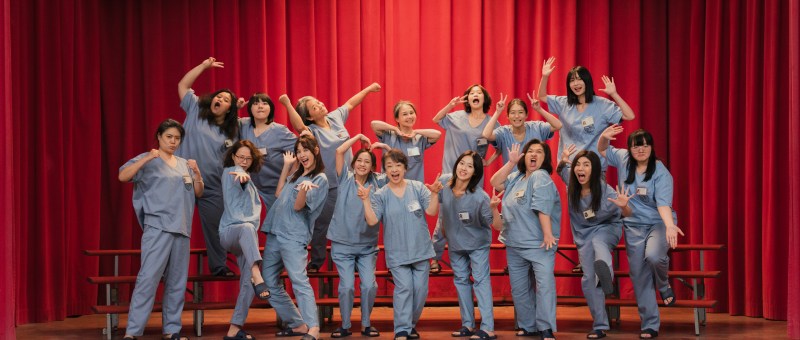
The healing power of music allows a collection of women to transcend their incarceration in Gavin Lin’s tear-jerking prison drama, Sunshine Women’s Choir (陽光女子合唱團). Inspired by Kang Dae-kyu’s 2010 Korean film Harmony, Lin shifts the focus to female solidarity while highlighting how each of these women has been victimised under a patriarchal society. Participating in the choir becomes the sunshine in their lives, giving them a sense of connection and purpose that reunites them with the people they once were before the traumatic events that brought them to prison.

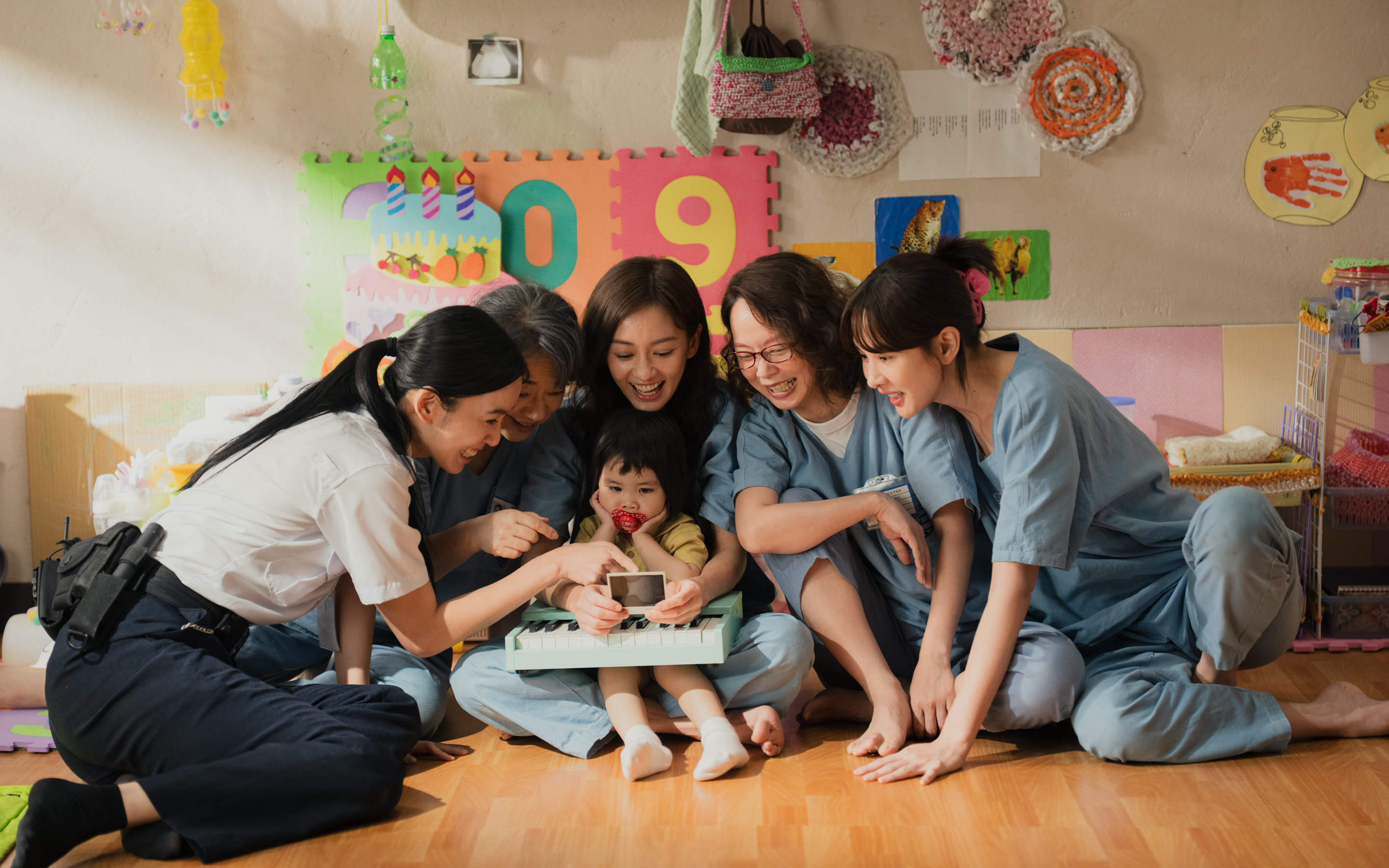
Hui-zhen (Ivy Chen Yi-han) gave birth to her baby Yu-shin after being convicted of murdering her abusive husband who had become violent and paranoid after being declared bankrupt during the 2008 financial crash. He did not want the baby, and began beating Hui-zhen in order to engineer a miscarriage. Hui-zhen, however, held out and was able to carry Yu-shin to term, which is what has earned her the admiration of prison guard You-wen who implies she was pressured into an abortion she didn’t want. Allowed to keep her daughter for the first three years, Hui-zhen is raising Yu-shin with the help of her doting cellmates who’ve become an extended family invested in Yu-shin’s future.

That might in some ways seem a little rosy, and prison life is presented as almost cosy as if Hui-zhen were engaging in a protracted series of sleepovers were it not for the occasional bouts of violence that, at one point, get her sent to solitary. Nevertheless, there is a sense that the women maybe better off in here, safe from male violence and interference and allowed a different kind of “freedom” even while imprisoned and subjected to the rigid routines of the prison. Even so, Chief Fang (Miao Ke-li), the head of the women’s prison, is not keen on Hui-zhen keeping Yu-shin whose presence requires adjustments to her carefully controlled order. She continually advises Hui-zhen to have her adopted early because this is no environment to raise a small child. 

Hui-zhen is faced with a choice when she discovers that Yu-shin has an eye condition that could lead to visual impairment that can’t be properly treated in the prison. Resolving that she may have to give her daughter up, Hui-zhen suggests starting the choir on noticing that she likes music and wanting to give her something to remember after they’ve parted. Being in the choir also helps the other women make peace with their past traumas while giving them a  sense of solidarity, not only that they were not alone in the suffering they experienced on the outside, but that they can encourage and support each other now no matter who they may have been before.

But this sense of solidarity also extends beyond the prison walls when it’s revelead that Yu-shin has been adopted by a same-sex couple. Yu-shin’s adoptive mother sympathises with Hui-zhen and accepts her place in Yu-shin’s life even while agreeing to Hui-zhen’s request never to tell her that her mother was a murderer. Similarly, Hui-zhen’s former cellmates watch over Yu-shin from the shadows after their releases, continuing their roles as secret aunties to ensure she grows up happy and healthy, never encountering the kind of suffering that led them to be incarerated.

Then again, the ironic nature of Hui-zhen’s fate suggests that she’s being punished a second time for the same crime which began at least as self-defence, and was ultimately committed to save the life of herself and her child even if it fits a legal definition of murder. The older woman she shares a cell with similarly pays for a crime she’s spent a lifetime atoning for that was motivated by her cheating husband’s rejection of their son who had learning difficulties. Just as Hui-zhen’s husband had blamed and beat her, Granny’s (Judy Ongg) husband becomes cruel due to the perceived would to his masculinity and social standing as the father of a child he sees as imperfect, while their daughter is more or less forgotten about. That she is ultimately unable reconcile with her mother until it’s too late seems like another cruel irony. Nevertheless, the song the choir sings insists that they were never once forgotten, and this final affirmation of selfless maternal love is in the end, the force that heals all wounds allowing the women to move from the traumatic past and into new lives of sunshine and happiness.


Sunshine Women’s Choir opens in UK cinemas on 17th April courtesy of Central City Media.

Trailer (English subtitles)

Wrath of Desire (愛・殺, Zero Chou, 2021)

“Desire is the only truth. The body never lies” according to the prison missives penned by the heroine of Zero Chou’s latest meditation on sex, death, guilt, and repression, Wrath of Desire (愛・殺, Ài・Shā). As the title perhaps implies, Chou frames her epic tale in the extremes of Greek tragedy, opening with an ethereal desert scene and cryptic Butoh dance that equates desire with death as the victim later laments “it was I myself who pointed the knife at my heart”. 

The dreamlike opening gives way to a prophetic scene of violence as an androgynous young woman fends off an attack from a “burglar” who is later discovered to be part of a conspiracy sent to steal evidence that could be used against her father, a political candidate anxious that her existence as his love child not affect his chances of election. Visibly shaking from her traumatic encounter, Phoenix Du (Peace Yang) is comforted by the sympathetic female prosecutor in charge of her case, Jade Liu (Weng Chia-Wei), who finds herself somehow captivated by the intense tattoo artist. Witnessing her capacity for violence after they are attacked by more of the mayor’s thugs when she perhaps inappropriately offers her a ride home from the courthouse, Jade takes Phoenix back to her flat to tend to her wounds only to find herself overcome by desire when Phoenix playfully kisses her as if to test her naive hypocrisy. The two women share a single night of intense passion, but Jade is a pastor’s daughter and failure to resist her “blasphemous” desires leaves her only with shame and fear. In retaliation she has Phoenix sentenced to three years in prison hoping to forget her, while Phoenix spends her time inside writing 372 extremely intense love letters insistent that the body doesn’t lie and convinced that Jade has in fact imprisoned herself in her wilful repression. 

God is always between them, a cross hanging from the rear mirror in Jade’s car as they make their high speed getaway while it’s the Lord’s name that Jade cries out during their night of passion but out of guilt more than ecstasy as Phoenix urges her to let herself go, aware it seems that she continues to struggle against herself. While Phoenix is inside, Jade finds herself drawn to an androgynous young man, Meng Ye (Hsu Yu-Ting), who is accused of stabbing a cousin (Huang Shang-Ho) who had become his legal guardian and thereafter molested him. Referring to her as “sister’ Meng Ye reminds Jade of the younger brother who took his own life after being rejected by their religious family because of his homosexuality, something which undoubtedly contributes to her ongoing inability to accept her same sex desires describing her feelings for Phoenix as lust rather than love, something dirty and sinful to be rejected. After becoming aware of her inner conflict, Meng Ye suggests a platonic marriage to create a “family free from desire”, offering Jade the “stable family” she’s been looking for while he gains “social acceptance”. Yet on Phoenix’s release it’s Meng Ye who determines on bringing her into their life as a “friend” only to find himself consumed by jealousy while questioning the nature of desire. 

Chou intercuts the non-linear action with a series of black and white intertitles featuring Phoenix’s charred letters along with noirish, Rashomon-esque testimony from a handcuffed Jade and Meng Ye along with a third woman, Chrys (Chen Yu-Chun), who had apparently fallen for Phoenix in prison only to remain frustrated by her lack of interest in anyone outside of Jade. “Sex without love is as empty as violence without hate” Phoenix writes in one of her letters, repeating that the body does not lie and Jade is only harming herself in her continued denial. Phoenix is indeed correct, though 372 letters is rather excessive as is her stalkerish insistence in the face of Jade’s refusal. Nevertheless the ménage à trois eventually turns dark as Meng Ye determines to exorcise his resentment by making Phoenix betray herself in unmasking the hypocritical repression of her own desires. Meng Ye claims he’s a “pet” to his cousin and brother to Jade, what he wants from Phoenix is a love she might not choose to give him, but is also bound for a dark and nihilistic destination.

Though the mayoral conspiracy angle is an outlandish detail strangely forgotten in the ongoing narrative, all three are in a sense wounded orphans betrayed by parental failure and left adrift without firm anchor in a hostile society each looking for safe harbour whether in the certainty of bodily desire, its rejection, or subversion. Apparently the “first” in a six film series each set in different Asian cities (though the “second” The Substitute set in Beijing and filmed in 2017 is currently streaming via Gagaoolala, as is the reported third We Are Gamily set in Chengdu now streaming as a five-part webseries while the feature edit is also streaming via Amazon Prime US), Chou’s latest more than lives up to its name as the trio find themselves consumed by the fire of desire while unable to extricate themselves from a complex spiral of shame and repression.


Wrath of Desire screened as part of the 2021 Osaka Asian Film Festival

Original trailer (English subtitles)